Re-Engagement Email Campaigns for Festive Season One-Time Buyers


A re-engagement email campaign for festive one-time buyers is a short, segmented sequence sent to customers who bought during the sale and then went quiet. It works best when you split buyers by why they purchased, lead with value before discounts, measure clicks and purchases instead of opens, and retire people who never respond. That last step protects the list you will need for next season.
In this article17 sections
The stakes are practical, not theoretical. Google’s sender guidelines ask senders to keep reported spam rates below 0.10% and avoid ever reaching 0.30%, and mailing a large, cold post-festive list is a fast way to drift towards that line. At the same time, Apple’s Mail Privacy Protection preloads tracking pixels, so open metrics become unreliable. This guide shows how to win customers back without damaging deliverability or trusting the wrong numbers.
What Is a Re-Engagement Email Campaign for Festive Buyers?#
A re-engagement email campaign is a planned series of emails aimed at subscribers or customers who have stopped engaging. For festive buyers, it targets people who made one purchase during a sale and have not returned. The aim is to bring back those worth keeping, and to identify those who will not respond so you can stop mailing them.
This differs from a general win-back effort because festive one-time buyers are a mixed group. Some bought a gift, some chased a discount, and some discovered a brand they would happily buy from again. One message cannot suit all three.
How Do You Segment One-Time Festive Buyers?#
Segment by the reason for purchase, using data you already have. Each group needs a different message, and the right segmentation often matters more than the copy.
| Segment | How to identify | Lead with |
| Gift buyers | Gift wrap, different shipping name, gifting category | Occasion reminders and gift guides |
| Deal-driven buyers | Large discount used, bought only sale items | A clear, limited incentive |
| Full-price buyers | Little or no discount used | Product value, new arrivals, content |
| High-value first orders | Order value well above your average | Personal, service-led outreach |
| Problem orders | Returns, complaints, delivery issues | Suppress from promotions; send service follow-up |
Before building any segment, suppress customers who are still in your post-purchase flow, anyone who has unsubscribed, and people with open support issues. For methods, see Search Savvy’s guides on email list segmentation and RFM and behavioural segmentation.
When Should You Start the Win-Back Email Sequence?#
Start when a customer is overdue by your own standards, not after an arbitrary number of days. Look at customers who have bought twice and measure the typical gap between their first and second orders. A reasonable starting point is to trigger the sequence once a one-time buyer passes that typical gap, then test earlier and later.
Two festive-specific points apply:
- Let the post-purchase flow finish first. Delivery updates and review requests come before any win-back message.
- Gift buyers may not be overdue at all. Their next natural purchase is the next gifting occasion, so an occasion reminder often works better than a “we miss you” email. Search Savvy’s guide to post-festive email retention covers the weeks after the sale.
What Does a Win-Back Email Sequence Look Like?#
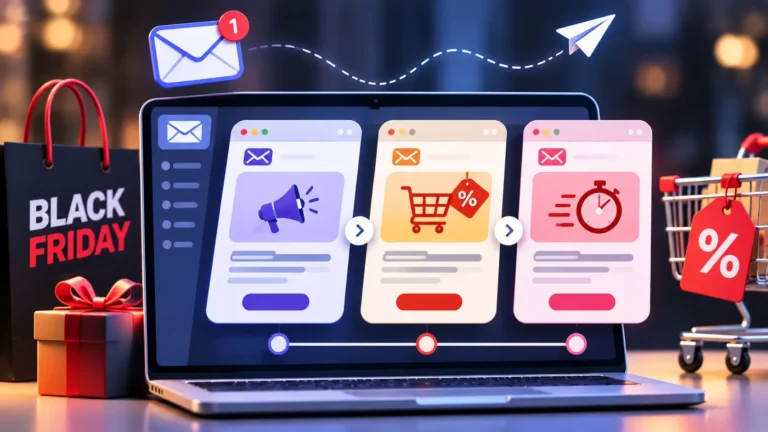
Use three emails over a few weeks, each with a different job. Treat the spacing as a starting point to test.
- The value check-in. No discount. Offer something useful tied to what they bought: care tips, styling ideas, or products that complement the order.
- The reason to return. Add proof, such as reviews of items they viewed or bought, and a clear next step. A soft incentive is optional here.
- The decision email. Make it a final, honest message: stay on the list, change preferences, or unsubscribe. A small incentive may fit if margins allow.
Anyone who clicks or buys leaves the sequence immediately. Anyone who ignores all three moves towards your sunset process.
Incentive vs Value: Which Re-Engagement Approach Works Better?#
Neither wins universally, and the right answer depends on the segment and your margins. A value-first email respects margin and suits customers who paid full price. An incentive suits price-sensitive customers but can teach them to wait for discounts.
| Approach | Strengths | Risks |
| Value-led | Protects margin; builds trust | Slower response from deal-driven buyers |
| Incentive-led | Clear reason to act now | Margin cost; may train discount-waiting |
| Hybrid | Value first, incentive last | Needs a longer sequence |
Do the arithmetic before offering a discount. As an illustration, a 15% discount on a ₹2,000 order gives up ₹300 of margin, and that cost applies to every redemption, including from customers who would have bought anyway. Test it with a holdout group, a random slice of the segment that receives no incentive, so you can see the true lift.
What Are Good Re-Engagement Subject Lines?#
Effective re-engagement subject lines are specific, honest and relevant to what the person bought. Avoid guilt, fake urgency and anything that pretends to be a transaction.
| Approach | Example |
| Utility | How to care for your festive purchase |
| Personal | New arrivals that pair with your last order |
| Curiosity | Still thinking about it? Here is what others chose |
| Occasion | Planning ahead for the next gifting season? |
| Honest | Do you still want to hear from us? |
A/B test subject lines on clicks or revenue, not opens, because Apple preloading distorts opens. Mailchimp notes that click activity is still reported for contacts using Apple Mail. For wording help, see our guide to writing email subject lines people open.
What Is a Sunset Policy for Inactive Subscribers?#
A sunset policy is a written rule for when you stop emailing people who no longer engage. It protects deliverability, keeps your metrics honest and saves sending costs. Contacts who ignore the full win-back sequence are suppressed from regular campaigns instead of mailed forever.
To build one:
- Define inactivity by clicks, purchases or site visits, not opens. Open-based rules can keep disengaged Apple Mail users on the list.
- Set a window that fits your purchase cycle. A once-a-year gifting category needs a longer window than a consumable.
- Send a final “should we keep you?” email before suppressing.
- Suppress, do not delete, so you can honour the opt-out and avoid re-importing the contact by mistake.
- Review the policy annually.
Deliverability is the main reason to bother. Google’s sender guidance also requires one-click unsubscribe for marketing mail from senders sending more than 5,000 messages a day to Gmail. For the technical side, see our guide to email deliverability and sender reputation.
If you operate in India, note that the substantive provisions of the Digital Personal Data Protection regime are scheduled to come into force on 14 May 2027. Keep clear records of consent and honour opt-outs now. This is general information, not legal advice.
How Do You Measure a Re-Engagement Campaign?#
Measure outcomes that cannot be faked by image preloading, and compare against a control group.
| Metric | Why it matters |
| Reactivation rate | Share who click or buy within a set window |
| Revenue per recipient | Shows whether incentives pay for themselves |
| Unsubscribe rate | Signals fatigue or poor targeting; see how to reduce unsubscribes without sending less |
| Spam complaint rate | Check Gmail’s rate in Postmaster Tools against the 0.10% guideline |
| Holdout comparison | Separates campaign lift from customers who would return anyway |
Report open rate only as a rough signal, if at all.
What Mistakes Should You Avoid?#
- Sending one message to every festive buyer
- Mailing before the post-purchase flow is complete
- Defaulting to a discount for everyone
- Judging success by open rate
- Keeping non-responders on the list indefinitely
- Using guilt or fake urgency in subject lines
- Skipping a holdout group
Bottom Line#
Treat festive one-time buyers as separate groups, wait until they are genuinely overdue, lead with value, and use incentives where margin allows and testing supports it. Define inactivity by clicks and purchases, and sunset those who do not respond. Search Savvy’s guides on email retention and segmentation cover the supporting steps, and your next festive list will thank you for the cleanup.
FAQ#
How many emails should a win-back sequence have?#
Three is a sensible starting point: a value check-in, a reason to return and a final decision email. Test the number and spacing for your audience.
Should I offer a discount in every re-engagement email?#
No. Lead with value for full-price and gift buyers, and reserve incentives for price-sensitive segments or the final email.
How long should I wait before calling a subscriber inactive?#
It depends on your purchase cycle. A category bought once a year needs a longer window than one bought monthly.
Are open rates useful for sunset policies?#
Not on their own. Apple Mail Privacy Protection preloads tracking pixels, so use clicks, purchases or site visits to define inactivity.
What happens if I keep emailing inactive contacts?#
Complaints and low engagement can raise your spam rate, and Google asks senders to keep that below 0.10% and avoid reaching 0.30%.
Can I re-engage customers who unsubscribed?#
No. Honour unsubscribes and never re-add those contacts to marketing lists without fresh, documented consent.