Behavioural Segmentation at Scale: RFM Modelling and Predictive Send-Time Optimisation
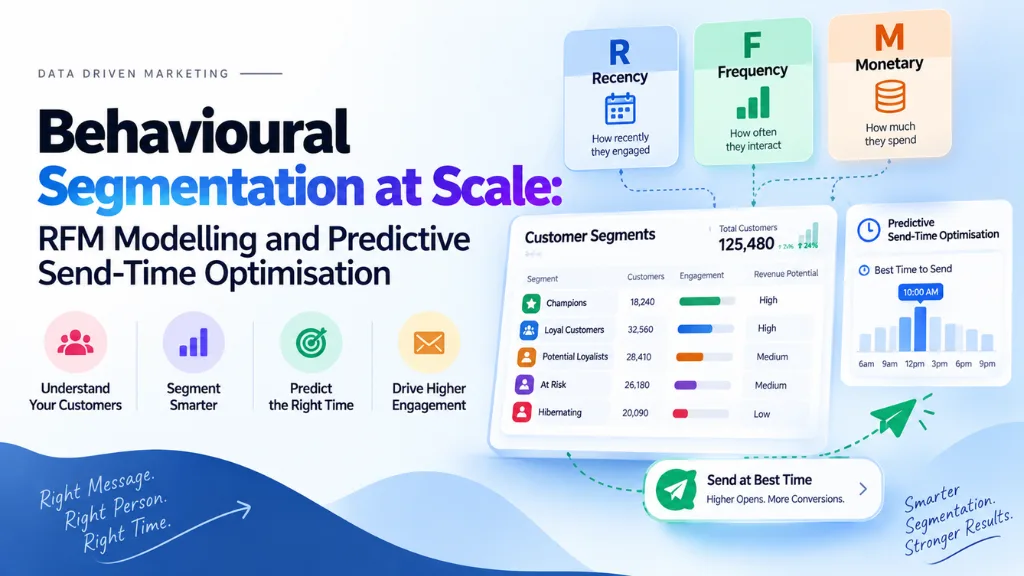

Grouping customers by age or location tells you almost nothing about who’s actually about to buy again. Grouping them by what they’ve actually done – when they last purchased, how often, and how much they’ve spent – tells you considerably more, which is exactly why behavioural segmentation built on RFM modelling has remained a foundational marketing technique for decades, even as machine learning has extended what’s possible on top of it. Layered with predictive send-time optimisation, this combination is now one of the highest-leverage systems available to a marketing team working at scale.
In this article10 sections
This guide covers RFM modelling as the accessible foundation, where it genuinely breaks down at scale, how machine learning extends rather than replaces it, and how predictive send-time optimisation fits into the same system to determine not just who to target, but exactly when.
What Is Behavioural Segmentation?#
Behavioural segmentation groups customers according to what they’ve actually done – purchase history, engagement patterns, browsing behaviour, support interactions – rather than static demographic or firmographic attributes like age, location, or job title. The distinction matters practically: two customers of the same age and location can behave in completely different ways, while two customers who’ve never met and share nothing demographically can behave almost identically, and it’s the behavioural pattern that predicts what happens next far more reliably than the demographic profile does.
RFM Modelling: The Foundation#
RFM segmentation scores each customer on three variables pulled directly from transaction data: Recency (how long since their last purchase), Frequency (how many times they’ve purchased), and Monetary value (how much they’ve spent in total). Each customer typically receives a score, often on a simple scale, for each dimension, and combining the three produces a segment – a “5-5-5” customer who bought recently, buys often, and spends a lot looks very different from a “1-1-1” customer who purchased once, long ago, for a small amount.
RFM’s enduring value comes from its accessibility. Because it’s built entirely from data almost every business already has in an orders table, it doesn’t require data science expertise to build, and – just as importantly – anyone on a marketing team can look at an RFM segment and immediately understand why a specific customer landed in it. That interpretability matters more than it might seem: a segmentation system nobody on the team trusts or understands doesn’t get acted on, no matter how sophisticated its underlying logic.
Where RFM Breaks Down at Scale#
RFM’s simplicity is also its limitation. It’s fundamentally backward-looking – built entirely from what a customer has already done, with no mechanism for anticipating what they’re likely to do next. It treats behaviour as relatively fixed, when in reality customer behaviour shifts continuously, sometimes gradually and sometimes abruptly, in ways a static three-variable score can’t capture. And it has a cold start problem: a customer who signed up five minutes ago has no purchase history at all, meaning RFM simply has nothing to score them on.
These aren’t reasons to abandon RFM – they’re reasons to extend it. The genuinely useful question at scale isn’t whether to move past RFM entirely, but whether machine learning can build meaningfully on top of the foundation it already provides.
Extending RFM with Machine Learning: Predictive Segmentation#
Predictive segmentation scores customers by what they’re likely to do next, rather than only what they’ve already done – identifying a high-value moment before it shows up in historical purchase data, rather than reacting to it afterward. This shift from reactive to anticipatory targeting is the core practical advantage machine learning adds to the RFM foundation.
Three broad model families handle this extension, each suited to a different kind of question:
- Clustering algorithms (such as K-Means or DBSCAN) group customers by shared behavioural patterns with no predefined labels, useful for discovering segments a team hadn’t already hypothesised.
- Classification models answer yes/no questions about a specific customer – “is this customer at high risk of churning?” – trained on historical examples of customers who did and didn’t take that action.
- Predictive scoring models rank customers by likelihood of a specific future action, such as making a purchase within the next fourteen days, producing a continuous score rather than a binary label.
Where RFM works from three variables, machine learning-based segmentation typically ingests considerably more – commonly somewhere between 50 and 200 behavioural features per customer, spanning page views, email opens, cart additions, support interactions, and session-level engagement data. In production, models built on gradient-boosted decision trees (implementations like XGBoost, LightGBM, and CatBoost are common) tend to outperform deep learning approaches for this kind of structured, tabular customer data, since it lacks the spatial or sequential patterns neural networks are specifically built to exploit.
One illustrative example worth noting, with the appropriate caveat that it’s a single case rather than a universal benchmark: a nonprofit direct-mail targeting comparison found customers selected using RFM criteria alone responded at under 1%, customers selected using machine learning alone responded at nearly 4%, and customers selected by both methods agreeing responded at nearly 8% – with a similar pattern in return on investment across the three groups. The detail worth generalising from this isn’t the specific percentages, which won’t transfer directly to another business or context, but the pattern: the strongest-performing segment was where machine learning and human-interpretable RFM logic agreed, not where either replaced the other entirely.
Predictive Send-Time Optimisation: What It Actually Does#
Predictive send-time optimisation calculates an individual open-probability window for each subscriber based on their own historical engagement behaviour, then sends each message at that person’s personal optimal time rather than a single fixed batch time applied to an entire list. Someone who reliably opens email at 7 AM and someone who reliably opens it at 9 PM receive the same message at genuinely different times, rather than both getting it at whatever hour a campaign happened to be scheduled.
This is reported to be one of the more consistently reliable lifts available from AI-driven email marketing – send-time optimisation alone is commonly cited as improving open rates by roughly 20 to 30% compared to fixed-time batch sending, a figure repeated across multiple independent 2026 industry sources. Combined with predictive segmentation (determining who should receive a given message) and generative AI for the message content itself, this produces what several 2026 sources describe as a “dual-engine” approach – predictive AI handling timing and targeting, generative AI handling the actual copy – reported to outperform either capability used in isolation.
RFM vs. ML-Enhanced Segmentation vs. Predictive Send-Time at a Glance#
| System | What It Determines | Data Required | Key Limitation |
| RFM modelling | Which broad value/engagement tier a customer belongs to | Transaction history only (recency, frequency, spend) | Backward-looking; cold start for new customers; treats behaviour as static |
| ML-enhanced segmentation | Who is likely to convert, churn, or need retention effort next | 50–200+ behavioural features across many touchpoints | Requires clean, unified data; still has a cold-start gap for genuinely new customers |
| Predictive send-time optimisation | When to message each individual customer | Historical engagement timing data per subscriber | Needs enough send history per person to model reliably; less useful for brand-new subscribers |
Building a Behavioural Segmentation System at Scale#
- Start with a clean RFM foundation built directly from transaction data – recency, frequency, and monetary value – as an accessible, interpretable baseline every stakeholder can understand and trust.
- Layer in behavioural event data beyond transactions: page views, email engagement, cart activity, support interactions, and other available touchpoints, expanding the feature set available for more sophisticated modelling.
- Match the model type to the actual business question. Use clustering to discover segments you haven’t already hypothesised, classification for specific yes/no risk questions like churn, and predictive scoring when the goal is ranking customers by likelihood of a particular action.
- Handle the cold-start problem explicitly, rather than letting new customers fall through the cracks of a system built entirely on historical behaviour. A simple rule-based fallback segment for customers without enough history yet keeps them from being invisible to the system until sufficient data accumulates.
- Layer predictive send-time optimisation on top of the resulting segments, so that both who receives a message and when they receive it are individually optimised rather than fixed at the campaign level.
- Retrain models on a regular, disciplined cadence – weekly at minimum is a commonly cited baseline – since customer behaviour patterns shift continuously, and a model trained on stale data degrades in ways that aren’t always immediately obvious in aggregate performance metrics.
- Monitor for drift and validate continuously, treating model performance as an ongoing operational responsibility rather than a one-time deployment task.
Common Pitfalls at Scale#
- Treating AI-driven segmentation as a black box that replaces RFM’s interpretability entirely. Losing the ability to explain why a customer sits in a given segment costs stakeholder trust and can stall adoption, even when the underlying model is genuinely more accurate.
- Ignoring the cold-start problem. A model with no fallback for brand-new customers effectively excludes them from targeted treatment until they’ve accumulated enough history – a meaningful gap for any business acquiring new customers regularly.
- Retraining too infrequently. Customer behaviour shifts continuously; a model retrained quarterly or less often is working from an increasingly outdated picture of what customers are actually doing.
- Using the wrong model type for the underlying question. Applying a predictive scoring model where a straightforward classification question (“is this customer at risk?”) would suffice adds unnecessary complexity without improving the actual decision being made.
- Relying entirely on vendor-reported lift statistics without independent testing. Figures like the commonly cited 20–30% open rate lift from send-time optimisation or industry-wide revenue benchmarks are directional evidence, not a guarantee any specific implementation will see the same result – genuine testing rigor and continuous model monitoring are what separate programs that extract real value from those that don’t.
- Building predictive complexity before the RFM foundation is clean. A predictive model trained on incomplete or poorly unified underlying data inherits every gap and blind spot already present in that data, regardless of how sophisticated the modelling technique layered on top happens to be.
Frequently Asked Questions#
Is RFM modelling still relevant now that machine learning-based segmentation exists? Yes. RFM remains the accessible, interpretable foundation that most other behavioural segmentation techniques build on top of, and its simplicity is precisely what makes it usable by teams without dedicated data science resources. The practical question for most businesses isn’t whether to abandon RFM, but how to extend it with additional behavioural signals and predictive modelling.
What’s the difference between behavioural segmentation and predictive segmentation? Behavioural segmentation, including RFM, groups customers based on what they’ve already done. Predictive segmentation scores customers based on what they’re statistically likely to do next, using machine learning models trained on historical behavioural patterns – allowing a business to act before a customer’s likely next action shows up in past data.
How much does predictive send-time optimisation actually improve email performance? Multiple 2026 industry sources cite improvements in the range of 20 to 30% in open rates compared to fixed-time batch sending, though actual results vary by audience and implementation, and this figure should be treated as a directional benchmark rather than a guaranteed outcome for any specific program.
What is the cold-start problem in behavioural segmentation? It refers to the difficulty of segmenting or scoring a customer who has little or no historical behavioural data yet, such as someone who just signed up. Since most predictive models depend on historical patterns, new customers need an explicit fallback approach – often a simpler, rule-based segment – until enough data accumulates to include them in more sophisticated modelling.
How often should behavioural segmentation models be retrained? Weekly is a commonly cited minimum baseline in 2026 industry practice, reflecting how quickly customer behaviour patterns can shift. Retraining less frequently risks the model working from an increasingly outdated picture of actual customer behaviour.
Do I need a data science team to implement behavioural segmentation? Not necessarily for RFM modelling itself, which is accessible enough to implement using transaction data alone. More sophisticated machine learning-based segmentation and predictive send-time optimisation increasingly come built into mainstream marketing platforms, though genuine testing rigor and ongoing model monitoring still benefit from some level of analytical oversight regardless of platform.
The Bottom Line#
Behavioural segmentation at scale works best as a layered system rather than a single technique: RFM modelling provides an accessible, interpretable foundation nearly every stakeholder can understand, machine learning extends it with predictive scoring and a far richer feature set once that foundation is clean, and predictive send-time optimisation determines not just who to target but exactly when to reach them individually. None of these layers replaces the others – the strongest results consistently come from combining them, with disciplined retraining and genuine testing rather than trusting vendor-reported benchmarks alone. Search Savvy’s performance marketing services build segmentation and targeting strategy around exactly this layered approach, and the email marketing glossary and marketing automation glossary are useful references for the terminology covered throughout this guide.