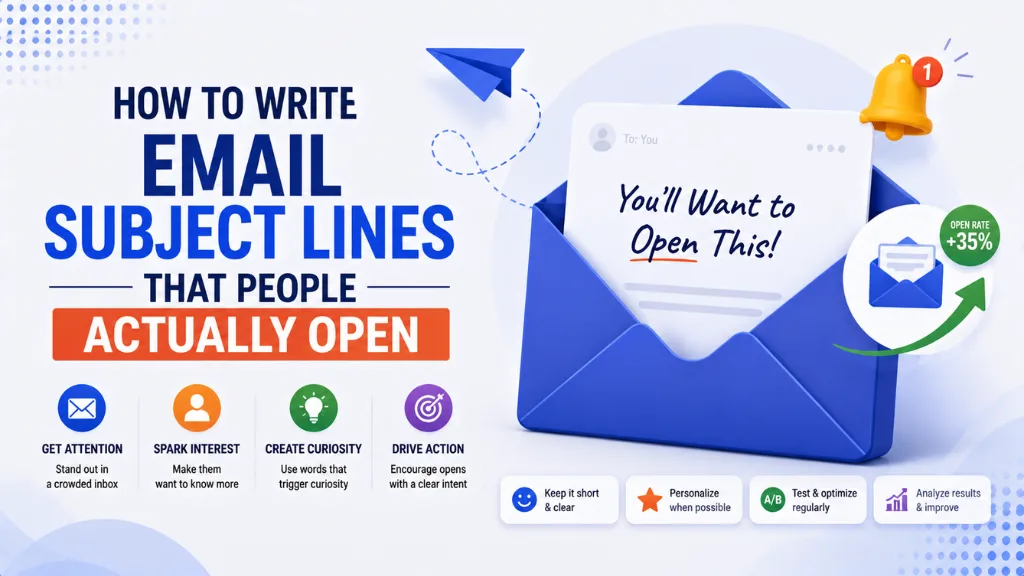
How to Write Email Subject Lines That People Actually Open

Here is the part of email marketing that decides everything before a single word of body copy gets read: the subject line.
In this article14 sections
Writing email subject lines well is the single highest-leverage skill in email marketing, and the data from 2026 makes this unusually clear. The subject line accounts for up to 47% of the decision to open an email – ahead of sender name, send time, and every element of the email itself. A perfect email with a weak subject line is an email nobody opens.
Writing email subject lines badly does more than miss an open. A staggering 70% of recipients report marking emails as spam based solely on the subject line – without even reading the content. A poor subject line does not just reduce opens; it actively damages your sender reputation, which can permanently suppress future campaigns across your entire list.
Writing email subject lines correctly, on the other hand, compounds returns across everything else. AI-generated and optimised subject lines outperform human-written alternatives by 26%, and that advantage grows when combined with smart personalisation and send-time testing.
At Search Savvy, subject line optimisation is one of the first things we review in any email marketing audit, because improving a subject line costs nothing and can meaningfully shift open rates within a single campaign. This guide covers exactly how to do it.
Why Do Email Subject Lines Matter So Much in 2026?#
Writing email subject lines matters more in 2026 because the inbox has become significantly more competitive. The average person receives 121 emails per day, and the decision to open or delete happens within seconds – sometimes based on a glance at just the first few words visible on a mobile screen.
Writing email subject lines has also become more measurable than ever. By late 2026, 61% of enterprise email programmes use AI for at least one element of campaign creation, with subject line generation and testing among the most widely adopted AI use cases. Brands combining AI subject line optimisation with send-time personalisation see the largest gains, but the foundational principles – clarity, specificity, and relevance – remain unchanged.
People Also Ask: What is the average email open rate in 2026? Short Answer: A good average email open rate in 2026 ranges from 28% to 35% for marketing emails, though benchmarks vary significantly by industry, email type, and list quality. Note that Apple’s Mail Privacy Protection inflates open rates for Apple Mail users, so CTOR (click-to-open rate) is increasingly used alongside open rate as a more reliable engagement signal.
How Does a Great Email Subject Line Work Psychologically?#
Writing email subject lines that convert relies on a small set of psychological triggers that have remained consistent across years of testing – even as platforms, audiences, and spam filters have evolved.
Writing email subject lines that consistently outperform comes down to triggering one of four responses in the reader’s mind before they even decide to open: curiosity, relevance, urgency, or clear stated value. The strongest subject lines typically combine two of these triggers rather than relying on just one.
- Curiosity – creates an information gap the reader wants to close (“The email mistake hurting your open rates”)
- Relevance – signals the email is specifically for this person right now (“Your September report is ready”)
- Urgency – motivates immediate action rather than deferral (“Last 6 hours: your discount expires tonight”)
- Stated value – communicates the benefit upfront without making them guess (“5 subject line templates with 40%+ open rates”)
Writing email subject lines with curiosity alone risks feeling clickbait-like if the body copy does not deliver. Stated value alone can feel transactional. The strongest performers balance what the reader gets with enough intrigue to make opening feel worth the effort.
People Also Ask: What psychological triggers make people open emails? Short Answer: The four main psychological triggers that drive email opens are curiosity (creating an information gap), relevance (signalling the email is specifically about something the reader cares about right now), urgency (time pressure that discourages deferral), and stated value (making the benefit of opening clear upfront). The highest-performing subject lines typically combine two of these rather than relying on one alone.
How Long Should an Email Subject Line Be?#
Writing email subject lines at the right length is more important in 2026 than it was even two years ago, since mobile accounted for 55% or more of global email opens in 2025, and mobile inboxes typically truncate subject lines after 30 to 50 characters.
Writing email subject lines between 30 and 50 characters is the consistently recommended range across every major email platform’s benchmark data for 2026. The 40 to 50 character rule is now considered mandatory for mobile performance, since subject lines outside this range get truncated and lose their intended impact.
Writing email subject lines with the most important words first is the practical implication of this. If the compelling part of your subject line is in the second half of a 70-character string, mobile readers will never see it. Front-load the hook.
| Subject Line Length | Recommendation |
| Under 30 characters | Works well for known senders; can feel too vague for cold audiences |
| 30–50 characters | The 2026 sweet spot for mobile and desktop combined |
| 51–70 characters | Acceptable on desktop but risks truncation on mobile |
| 70+ characters | Avoid – the critical part is likely cut off on mobile |
What Subject Line Formulas Work Best in 2026?#
Writing email subject lines from proven frameworks produces more consistent results than writing from scratch every campaign. These formulas work across industries, list types, and email platforms because they are built around the psychological triggers that drive opens.
Formula 1: The Numbered Benefit#
Writing email subject lines with a specific number in them outperforms vague alternatives significantly. Subject lines containing numbers generate 113% higher open rates than those without, since numbers communicate specificity and digestibility at a glance.
Examples:
- “5 subject line mistakes killing your open rates”
- “3 email templates that convert in under 90 seconds”
- “How we grew our list 40% in one month”
Formula 2: The Question#
Writing email subject lines as direct questions works particularly well when the question is one the target reader is already asking themselves. A question that reflects a real concern the reader has feels personal rather than broadcast.
Examples:
- “Why is your email open rate dropping?”
- “Are you making this subject line mistake?”
- “Ready to triple your email ROI this quarter?”
Formula 3: The Personalised Hook#
Writing email subject lines with personalisation beyond just a first name consistently outperforms generic alternatives. Emails with a personalised subject line are opened 26% more often than generic ones, according to Campaign Monitor’s 2026 Personalisation Report. The strongest personalisation references recent behaviour, location, or specific context – not just a name token.
Examples:
- “[Name], your October content calendar is ready”
- “Based on what you read last week…”
- “Still thinking about [product they browsed]?”
Formula 4: The Curiosity Gap#
Writing email subject lines that leave a deliberate information gap motivates opens as a natural information-seeking response. The key is to tease something genuinely interesting without being misleading – the body copy must deliver on the curiosity the subject line creates.
Examples:
- “The email metric most marketers ignore”
- “We tested 400 subject lines. Here’s what won.”
- “One change that doubled our click rate”
Formula 5: Urgency and Scarcity#
Writing email subject lines with genuine time pressure or limited availability creates urgency that overcomes the tendency to defer. The word “genuine” matters here – manufactured urgency that proves false erodes subscriber trust permanently.
Examples:
- “48 hours left: your exclusive early access”
- “Only 12 spots remaining – close tonight”
- “Your discount expires at midnight”
People Also Ask: Do emojis in subject lines improve open rates in 2026? Short Answer: Emojis in subject lines increase open rates by up to 56% in B2C contexts, but decrease them by 4% in B2B, according to GetResponse’s 2026 Emoji Study. Emojis work when they reinforce the subject line’s message rather than replacing words – one relevant emoji beats a string of decorative ones every time.
What Should You Avoid When Writing Email Subject Lines?#
Writing email subject lines requires knowing what to avoid just as much as what to include. Several common patterns actively damage deliverability by triggering spam filters before the email even reaches an inbox.
- All-caps words – “LAST CHANCE” or “FREE OFFER” reliably trigger spam filters on Gmail and Outlook
- Excessive punctuation – “!!!” or “???” at the end of subject lines are classic spam signals
- Spam trigger phrases – “Act now,” “Click here,” “100% free,” “No obligation” are flagged by most modern filters
- Misleading subject lines – subject lines that promise something the email does not deliver destroy trust and dramatically increase unsubscribes and spam complaints
- Vague non-subject-lines – “Update from us” or “A quick note” give the reader no reason to open and perform consistently at the bottom of any benchmark
Writing email subject lines that are misleading is worth calling out separately. In many markets, deliberately deceptive subject lines also violate email marketing regulations including CAN-SPAM and India’s IT (Intermediary Guidelines) Rules, making this not just a deliverability risk but a legal one.
People Also Ask: What words should you avoid in email subject lines in 2026? Short Answer: Avoid all-caps, excessive punctuation (!!!, ???), and phrases like “Act now,” “100% free,” “Click here,” “Buy now,” and “No obligation,” since these reliably trigger spam filters on major inbox providers. Also avoid misleading subject lines that do not match the email content, which drives unsubscribes and can violate email marketing regulations.
How Should You Test and Optimise Email Subject Lines?#
Writing email subject lines is a practice that improves fastest through systematic A/B testing rather than intuition alone. Most email platforms – including Mailchimp, Kit, and MailerLite – include native A/B testing that allows you to send two subject line variations to a subset of your list and automatically deliver the winner to the remainder.
Writing email subject lines for A/B tests works best when you change only one variable at a time. Testing a shorter subject line against a longer one alongside a tone change and a different emoji makes it impossible to know which element drove the result. One change per test produces clear, actionable data.
At Search Savvy, we recommend running A/B tests on every campaign of more than 1,000 subscribers, using a 20% split (10% to each variant) and a four-hour decision window before the winner goes to the full remaining list. A follow-up resend with a new subject line to non-openers can add up to 30% more opens per campaign – one of the highest-ROI email tactics available without any additional content creation.
How Should Indian Brands Approach Writing Email Subject Lines?#
Writing email subject lines for Indian audiences benefits from a few market-specific considerations. India’s email open behaviour skews heavily mobile – well above the global average – making the 30 to 50 character length rule even more important than in desktop-dominant markets.
Writing email subject lines that reference India-specific context – festival timing like Diwali or Holi, INR-denominated offers, or localised examples – consistently outperforms generic English subject lines for Indian subscriber bases. A subject line like “Your Diwali SEO checklist is ready” outperforms “Your seasonal checklist is ready” for the same underlying email because it signals immediate personal relevance.
Conclusion: The Subject Line Is the Campaign#
Writing email subject lines well is not a finishing detail applied after the real work is done – it is the campaign’s first and most consequential decision. The subject line accounts for nearly half of the decision to open, making it the highest-ROI single element in any email marketing programme.
Search Savvy treats subject line optimisation as a core skill in every email strategy we build – not because it is glamorous, but because no body copy, offer, or design improvement can compensate for an email that never gets opened in the first place.
FAQ: Writing Email Subject Lines – Your Questions Answered#
Q1: What is the ideal length for an email subject line in 2026? Between 30 and 50 characters is the consistently recommended range for 2026, driven by mobile’s dominance of email opens. Subject lines beyond 50 characters risk being truncated on mobile screens, cutting off the most compelling part of the message before readers can process it.
Q2: Does personalising email subject lines actually improve open rates? Yes significantly. Emails with personalised subject lines are opened 26% more often than generic alternatives, according to Campaign Monitor’s 2026 Personalisation Report. The strongest personalisation goes beyond first-name tokens to reference recent behaviour, purchase history, or specific subscriber context.
Q3: Can I use AI to write email subject lines? Yes, and the data supports it. AI-generated subject lines outperform human-written ones by an average of 26%, with the advantage compounding when combined with send-time optimisation. Use AI tools to generate multiple variants, then A/B test the top candidates rather than publishing AI output without testing.
Q4: How many subject line variations should I test at once? Test two variations per campaign, changing only one element at a time – length, tone, emoji presence, or a specific trigger word. Testing multiple variables simultaneously makes it impossible to identify which change drove the result, undermining the learning value of the test.
Q5: How do I know if my subject line is triggering spam filters? Most email platforms include a spam score checker before sending. Additionally, monitor your deliverability metrics – a sharp drop in open rates without a content change often signals spam filtering. Avoid all-caps, excessive punctuation, and known trigger phrases as baseline precautions before sending.
Q6: Should I resend emails with a new subject line to non-openers? Yes. Resending to non-openers with a different subject line 48 to 72 hours after the original send can add up to 30% more opens per campaign. Change only the subject line, keep the body copy identical, and exclude anyone who already opened the first send to avoid duplicate emails to engaged subscribers.
Not sure whether your current email subject lines are the reason your open rates have plateaued? Visit Search Savvy for an email marketing audit that analyses your subject line patterns, open rate trends, and the specific changes most likely to move your numbers.