Post-Festive-Sale Email Strategy: Retention Over Discounts

The festive sale ends, the orders ship, and most brands do the same thing next: send another discount. It feels safe, but it quietly teaches new buyers to wait for the next offer. A post-festive email retention strategy does the opposite. It uses the weeks after the sale to help customers succeed with what they bought, earn a second order on value rather than price, and separate real repeat buyers from one-time bargain hunters.
In this article20 sections
The economics favor this. Harvard Business Review notes that, depending on the study and industry, acquiring a new customer costs anywhere from five to 25 times more than retaining an existing one. The same article cites older Bain research linking a 5% retention gain to 25% to 95% higher profits. Those figures are broad and not specific to email, so treat them as direction, not a forecast. This guide shows how to build the sequence, whom to send it to, and how to measure it.
What is a post-festive email retention strategy?#
A post-festive email retention strategy is a planned set of emails sent after a sale period to turn first-time festive buyers into repeat customers. It relies on thank-you messages, product help, review requests, loyalty invitations and well-timed repeat-purchase prompts, and keeps discounts for the few cases that truly need them.
Why do discounts alone weaken retention?#
Blanket discounts weaken retention because they reward the behavior you want to reduce. Buyers who arrived for a deal learn that patience pays, margins shrink, and your email list fills with people who respond only to price. This is a reasoning pattern, not a measured law, and some categories genuinely depend on promotions.
Value-led emails work differently because they match what customers need at that moment. Klaviyo reports that post-purchase emails have an open rate of 61.68%, the highest among its flow types, and says automated flows can generate up to 30 times more revenue per recipient than one-off campaigns. These are vendor benchmarks drawn from Klaviyo’s own customer base, so compare your results against your own history first.
The post-festive email timeline#
Use this as a starting template. The timings are illustrative, so adjust them to your delivery speed and how quickly your product is used up.
| Timing | Goal | Discount? | |
| Day 0 to 1 | Thank-you and what happens next | Reassure, set expectations | No |
| Day 2 to 5 | Delivery update and setup help | Reduce returns and support load | No |
| Day 7 to 14 | Review and photo request | Collect social proof | No |
| Day 14 to 21 | Care tips plus related products | Add value, soft cross-sell | No |
| Day 30 to 45 | Replenishment or repeat prompt | Earn the second order | Rarely |
| Day 45 to 60 | Loyalty or early-access invitation | Reward repeat intent | Perks over price |
| Day 60 to 90 | Win-back for non-repeaters | Reactivate or let go | Last resort |
How do you write a thank-you email sequence?#
Keep it short and specific. Name the product, confirm delivery details, and tell the customer what to expect next. Add one useful action, such as a setup guide, a care video or a support link. Skip the cross-sell in the first message. Order confirmations are transactional, so keep promotional content out of them to stay clear of compliance problems.
What should a loyalty program email say?#
Lead with status and access, not coupons. Show the customer what they have already earned, what a second order unlocks, and what members get, such as early access to the next launch or free shipping thresholds. If you run a points scheme, display the balance in the email body so the message feels like an account update rather than an advertisement.
When should a repeat purchase campaign go out?#
Send it just before the customer is likely to run out or need an add-on. For consumables, that means your product’s typical usage cycle. For durable goods, use accessories, care products or the next logical upgrade. Festive gifting complicates this. Someone who bought a gift will not replenish it, so tag gift orders separately and send them a self-purchase invitation instead.
Who should receive which email?#
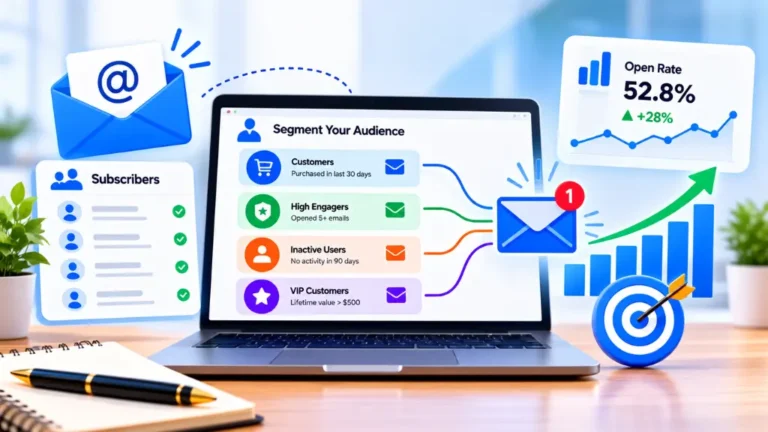
Segmentation decides whether this works. Start with simple rules:
- First-time festive buyers: the full sequence above.
- Returning customers: skip onboarding, go straight to loyalty content.
- Gift buyers: thank-you, then an invitation to shop for themselves.
- High-value orders: a personal, plain-text style check-in.
- Discount-only buyers: longer gaps, value content first, tested incentives later.
For a more advanced split, RFM segmentation scores customers on recency, frequency and monetary value. It is defined in Search Savvy’s email marketing glossary, alongside terms like frequency caps and suppression lists that you will need when festive-season lists get large.
Protect deliverability after a big sale#
A festive blast can damage the very channel you need for retention. Google’s email sender guidelines ask senders to keep spam complaint rates below 0.10% and never reach 0.30%, and bulk senders (5,000 or more messages a day to Gmail) must offer one-click unsubscribe and honor requests within two days. Authenticate your domain with SPF, DKIM and DMARC, and watch Google Postmaster Tools.
In practice, that means suppressing people who never engaged during the sale, capping frequency, and making unsubscribing easy. A smaller, healthier list protects inbox placement for every later email.
Consent and privacy: the India angle#
If you email customers in India, plan for the Digital Personal Data Protection framework. The government notified the DPDP Rules in November 2025 with an eighteen-month phased compliance period, which puts most operational obligations around May 2027. The rules emphasize clear consent notices and the right to withdraw consent. Review how you collect festive-sale email consent now, and speak to a qualified lawyer for your specific situation, since this article is not legal advice.
How to measure retention instead of opens#
Open rates have become unreliable because of mail privacy features, so judge the program by outcomes:
- Repeat purchase rate within 60 and 90 days of the festive order.
- Time to second order, which shows whether emails speed up buying.
- Revenue per recipient for each flow, compared against your own baseline.
- Complaint and unsubscribe rates, as an early warning.
- Review and photo collection rate, as a proxy for engagement.
Compare discounted and non-discounted groups using a holdout. Send the value sequence to everyone, but test an incentive on a small segment so you can see whether discounts add repeat orders or just give away margin. Marketing automation tools handle this branching; the marketing automation glossary explains the workflow terms involved.
Connect email with the rest of your retention program#
Email works best when it is not alone. Sync your purchaser list to paid channels so you stop showing acquisition ads to people who just bought, and use those slots for accessories or loyalty messages instead. Search Savvy’s performance marketing services cover this kind of cross-channel audience planning. Educational content also feeds the sequence: guides, how-tos and care articles give your emails something genuinely useful to link to, which is where content marketing support fits.
If you want to compare your approach with common terms and tactics, the e-commerce marketing glossary covers retention-related definitions.
Common mistakes to avoid#
- Discounting every email. It erodes margin and trains customers to wait.
- Sending the same message to gift buyers and self-buyers. Intent differs, so the follow-up should too.
- Promoting inside transactional emails. It risks compliance and deliverability trouble.
- Ignoring suppression. Mailing unengaged festive contacts raises complaints.
- Measuring opens only. Track repeat orders and revenue per recipient.
- Forgetting consent. Festive-season sign-up forms are often the weakest consent record you hold.
Frequently asked questions#
Is a post-festive email retention strategy worth it for small stores?#
Yes. A short automated sequence costs little to run and works on your existing buyers, who are cheaper to reach than new ones. Start with three emails: thank-you, product help, and a review request.
How soon after a festive sale should you send retention emails?#
Begin the same day with the order confirmation and thank-you, then follow the delivery and usage timeline. Delay promotional content for at least a couple of weeks so customers receive value before a pitch.
Should you offer discounts in retention emails?#
Use them sparingly. Start with value, early access and loyalty perks, then test a discount only on customers who have not responded. A holdout test will show whether it truly lifts repeat orders.
How often should you email customers after a sale?#
Fewer than during the sale. A common approach is one or two emails a week at most, adjusted to your catalog and engagement. Use a frequency cap and watch unsubscribe and complaint rates.
What is the difference between a retention email and a transactional email?#
A transactional email confirms or supports an action, such as an order or delivery. A retention email is marketing meant to encourage future purchases or loyalty, so it needs consent and an unsubscribe option.
What metrics show that retention emails work?#
Look at repeat purchase rate, time to second order, revenue per recipient and complaint rate. Open rate alone is a weak signal, because mail privacy features distort it.
Bottom line#
After the festive rush, the best use of your email list is to help customers enjoy what they bought and give them a reason to return that is not a coupon. Build a simple sequence, segment gift buyers from self-buyers, protect your sender reputation, and measure repeat orders rather than opens. Your next step is small: map your first 30 days after the sale, write the thank-you and product-help emails, and hold back one segment as a control. If you want help planning the wider retention program, Search Savvy’s team can walk through where email fits alongside your other channels.