

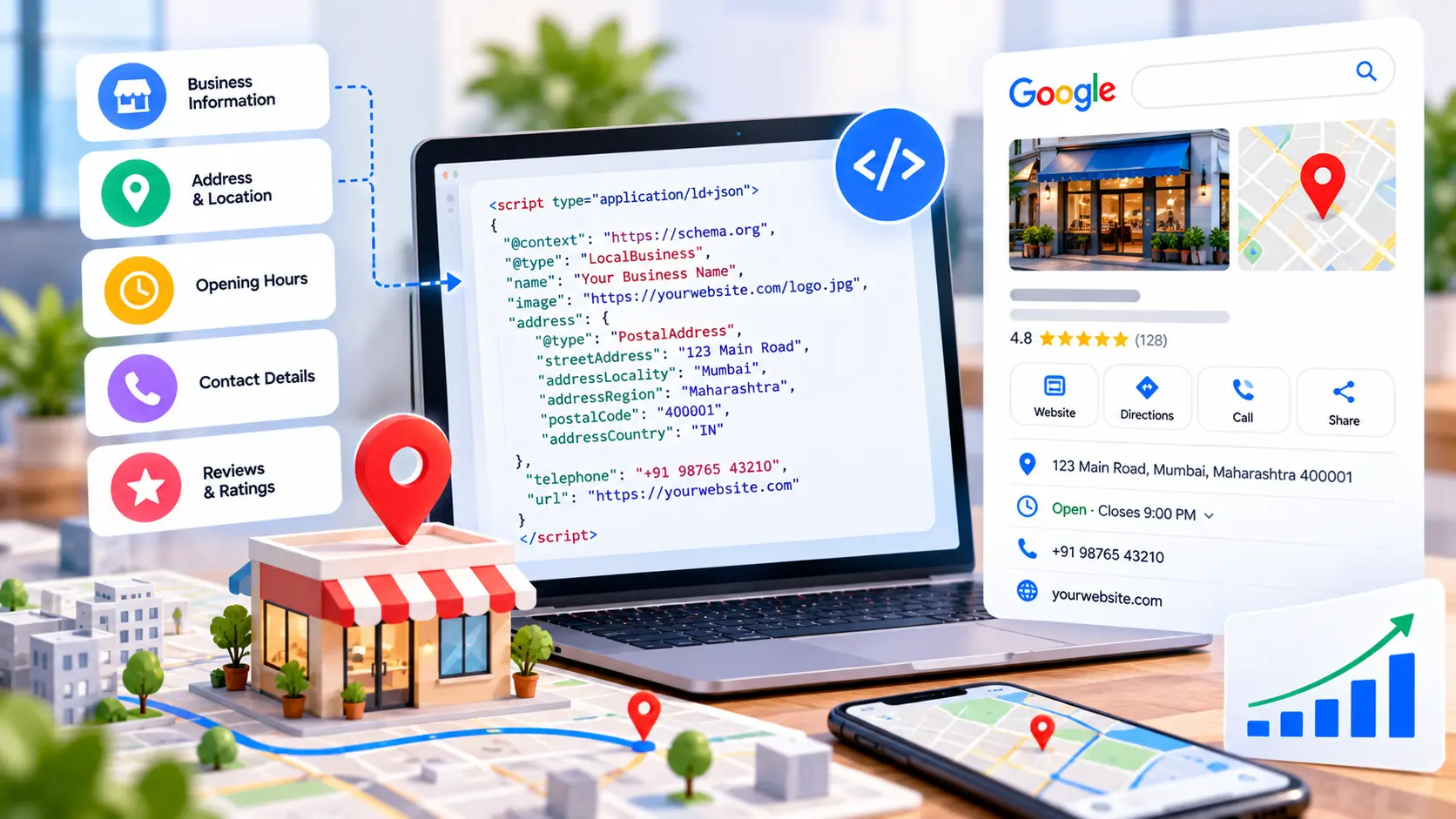

Local schema markup is a block of structured data, usually JSON-LD, that tells search engines your business name, address, phone number, hours, and location in a format machines can read without guessing. For most small businesses, the setup comes down to five steps: choose the right business type, collect accurate details, write the markup, validate it, and keep it consistent with everything else you publish online.
This guide walks through each step, explains what Google actually requires, and covers the mistakes that cause markup to be ignored.
What Is Local Schema Markup?
Short answer: Local schema markup is LocalBusiness structured data from the schema.org vocabulary, added to your website’s code to describe a physical business or service location.
Schema.org defines LocalBusiness as a particular physical business or branch of an organization. It has more specific subtypes, such as Restaurant, Dentist, Electrician, and HealthClub. Google reads this data to understand your business details and, in some cases, to show them in search features like knowledge panels.
Two points set realistic expectations:
- It is not a magic ranking switch. Google describes structured data as a way to become eligible for enhanced search appearances. It does not present local schema markup as a direct ranking boost.
- It supports, rather than replaces, your Google Business Profile. Your profile remains the main source for Maps and local pack results. Markup reinforces the same facts on your own site.
Why Does Local Schema Markup Matter for Small Businesses?
Short answer: It removes ambiguity. When your website states your details in a standard format, search engines can match them to other sources without interpretation.
The practical benefits include:
- Clearer entity understanding. Markup helps separate your business from similarly named ones.
- Consistency checks. Structured data gives Google a clean, machine-readable version of your NAP (name, address, phone) to compare with your listings.
- Eligibility for local features. Google’s documentation says search results may display a knowledge panel with business details, and that local business structured data lets you tell Google about hours, departments, and more.
Google also states plainly that it does not guarantee features that use structured data will appear in results. Treat markup as groundwork, not a promise.
What Does Google Require for LocalBusiness Schema?
Short answer: Google lists only two required properties for LocalBusiness: name and address. Everything else is recommended, but recommended fields make the data more useful.
According to Google’s local business documentation (last updated September 2026 at the time of writing), the properties break down like this:
| Property | Status | What to include |
| name | Required | The business name exactly as customers know it |
| address | Required | A PostalAddress with street, city, region, postal code, country |
| telephone | Recommended | Primary customer phone number with country and area code |
| url | Recommended | A working link to the page for that specific location |
| geo | Recommended | Latitude and longitude, at least five decimal places |
| openingHoursSpecification | Recommended | Opening and closing times by day |
| priceRange | Recommended | A relative range such as “$$”; under 100 characters |
| department | Recommended | Nested entries for distinct departments, such as a pharmacy inside a store |
| image | Commonly included in Google’s examples | Photos that represent the business |
Google also advises using the most specific subtype available, and it recommends following its Organization guidance too, since LocalBusiness is a subtype of Organization.
How to Set Up Local Schema Markup: Step by Step
Step 1: Choose the most specific business type
Browse the subtypes on schema.org and pick the closest match. A dentist should use Dentist, not the generic LocalBusiness. If your business fits several types, Google says to list them as an array, for example [“Electrician”, “Plumber”, “Locksmith”]. Google notes that additionalType is not supported for this purpose.
Step 2: Collect and verify your details
Gather the exact name, address, phone number, hours, and coordinates. Copy them from your Google Business Profile so the website matches. This is where NAP consistency starts: the same spelling, abbreviations, and formatting everywhere.
Step 3: Write the JSON-LD
JSON-LD is the format Google’s examples use, and it is the easiest to maintain because it sits in one block rather than being woven through your HTML. Here is an example for a fictional business:
<script type=”application/ld+json”>
{
“@context”: “https://schema.org”,
“@type”: “Dentist”,
“name”: “Example Family Dental”,
“image”: [
“https://www.example.com/photos/clinic-1×1.jpg”,
“https://www.example.com/photos/clinic-4×3.jpg”,
“https://www.example.com/photos/clinic-16×9.jpg”
],
“url”: “https://www.example.com/”,
“telephone”: “+14155550123”,
“address”: {
“@type”: “PostalAddress”,
“streetAddress”: “100 Main Street”,
“addressLocality”: “Springfield”,
“addressRegion”: “IL”,
“postalCode”: “62701”,
“addressCountry”: “US”
},
“geo”: {
“@type”: “GeoCoordinates”,
“latitude”: 39.78172,
“longitude”: -89.65015
},
“openingHoursSpecification”: [
{
“@type”: “OpeningHoursSpecification”,
“dayOfWeek”: [“Monday”, “Tuesday”, “Wednesday”, “Thursday”, “Friday”],
“opens”: “09:00”,
“closes”: “17:00”
},
{
“@type”: “OpeningHoursSpecification”,
“dayOfWeek”: “Saturday”,
“opens”: “09:00”,
“closes”: “13:00”
}
]
}
</script>
Replace every value with your real details. If you would rather not hand-code it, the Search Savvy LocalBusiness schema generator builds the same structure from a form.
Step 4: Place it on the right page
Google says you can add LocalBusiness markup to any page, though it makes more sense on a page that describes the business, such as the homepage, contact page, or a dedicated location page. Multi-location businesses should give each location its own page and its own markup, with a url that points to that location.
Step 5: Validate before you publish
Run the code through Google’s Rich Results Test and fix critical errors. For a broader syntax check that is not limited to Google features, use the Schema Markup Validator or the official schema.org validator. Then use the URL Inspection tool in Search Console to confirm Google can access the page.
Step 6: Request recrawling and monitor
After deploying, you can ask Google to recrawl the URL. Google warns it may take several days for a page to be found and crawled. Check Search Console’s enhancement and structured data reports for errors afterward.
How Does NAP Consistency Connect to Schema?
Short answer: NAP consistency means your business name, address, and phone number appear identically across your website, Google Business Profile, and directories. Schema markup should mirror those details exactly, because contradictions weaken the clarity markup is meant to provide.
Check these places for mismatches:
- Website header, footer, and contact page
- Your JSON-LD block
- Google Business Profile
- Facebook, Instagram, LinkedIn, and other profiles
- Industry and local directories
Small variations such as “Street” versus “St.” or a tracking phone number on one listing are common culprits. Choose one canonical format and apply it everywhere. If a call-tracking number is necessary, keep the primary number in your markup and Business Profile consistent with what your site shows. Search Savvy’s local SEO services typically start with this kind of citation and NAP review because inconsistent data undermines every later step.
Should You Use Review or Rating Markup on Your Own Business?
Short answer: Usually not. Google’s documentation says the review and aggregateRating properties are only recommended for sites that capture reviews about other local businesses.
Marking up testimonials about your own company is a common shortcut that can draw a manual action under Google’s structured data guidelines. Google warns that violating its guidelines may lead to a manual action. Leave review markup out unless you operate a review site, and keep your genuine reviews on your Business Profile, where they belong.
What About Organization and Service Schema?
LocalBusiness describes a place. Two related types fill gaps:
- Organization schema describes your brand as a whole, including logo and social profiles. Google recommends following its Organization fields alongside the local ones. An organization schema generator can help.
- Service schema describes specific offerings, which is useful for service-area businesses. See the service schema generator.
Keep each type consistent with the others. Do not create conflicting entities with different names or addresses.
Common Local Schema Mistakes to Avoid
- Marking up content that is not visible on the page. Google’s general guidelines expect markup to reflect the page.
- Using a generic type when a specific one exists. Choose the subtype.
- Mismatched NAP. The markup says “Suite 4” but the footer does not.
- Wrong hours format. Use hh:mm and the openingHoursSpecification structure. For a business open 24 hours, Google’s example uses an opens time of “00:00” and a closes time of “23:59”.
- Low-precision coordinates. Google asks for at least five decimal places.
- Self-serving review markup. See the section above.
- Setting and forgetting. Update seasonal hours, relocations, and phone changes immediately. Seasonal closures can use validFrom and validThrough dates.
- Blocking the page. A noindex tag, robots.txt rule, or login wall prevents Google from reading your markup.
How Do You Know If It Is Working?
Success is not instant, and it is not always visible. Look for these signals:
- No errors or warnings in the Rich Results Test and Search Console.
- Business details in your knowledge panel that match your markup.
- Consistent NAP data across the listings you audit.
- Improved clarity in Search Console’s performance data for branded and local queries over time.
If your page passes validation but no special result appears, that is normal. Google says it does not guarantee that structured data features will show.
Frequently Asked Questions
Does local schema markup improve rankings?
Google does not present it as a direct ranking factor. It helps Google understand your business and makes you eligible for certain features. Strong local rankings still depend on relevance, distance, prominence, and a well-maintained Business Profile.
Which schema format should I use: JSON-LD, Microdata, or RDFa?
JSON-LD is the format used in Google’s examples and is generally easier to maintain, because it lives in a single script block. Google supports other formats, but JSON-LD is the practical default for most small sites.
Do I need schema markup if I have a Google Business Profile?
They do different jobs. Your profile feeds Maps and the local pack. Markup describes your business on your own website. Using both gives search engines two consistent sources.
Can I add markup with a WordPress plugin?
Yes. Google notes that a CMS plugin may be easier than writing code by hand. Check the output with the Rich Results Test, because plugins sometimes emit incomplete or duplicate data.
How many locations can I mark up?
Each physical location should be its own LocalBusiness entity with its own address and page. Avoid putting all locations in one block on a single page unless that page truly lists them.
How long until Google reads my markup?
Google says to allow time for recrawling and re-indexing, and notes it can take several days after publishing for a page to be found and crawled. Submitting a sitemap and requesting indexing can speed up discovery.
The Practical Takeaway
Start with the basics: pick the most specific business type, supply name and address, add your phone, URL, hours, and coordinates, and validate before publishing. Then guard NAP consistency across your site and listings, since consistent facts matter more than a long list of optional properties.
If you want help auditing your markup, citations, and Business Profile together, Search Savvy’s free schema markup generator is a quick place to start, and the team can take a closer look when you need more than a template.