
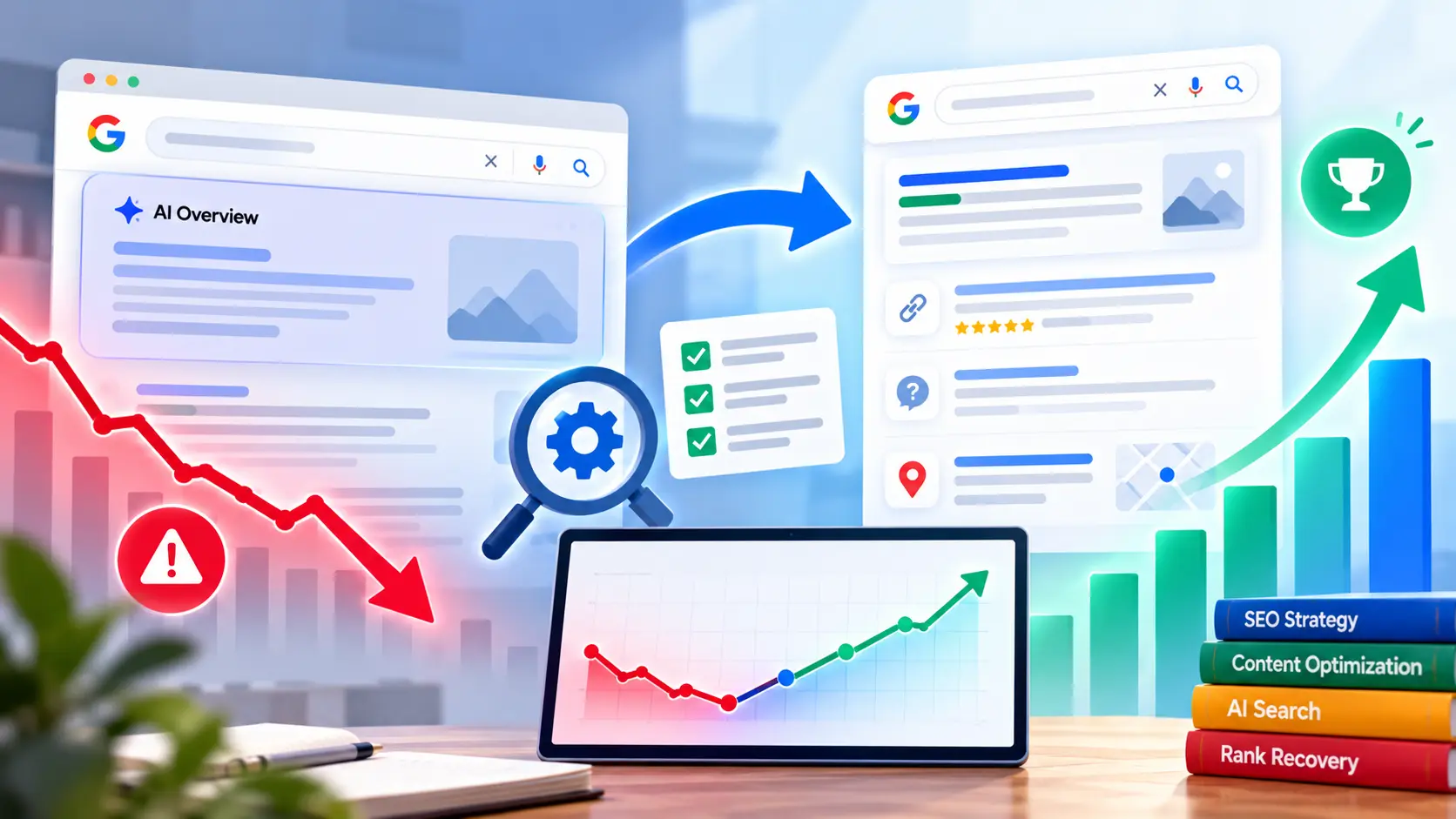

To recover rankings from AI Overviews, first confirm what you actually lost. In most cases the page still ranks, but fewer people click it. Then rebuild the page around what a summary cannot compress: first-hand experience, original data, and depth. Finally, make sure Google can cite you.
This guide covers how to diagnose the loss, which pages are worth saving, and how to earn citations inside the AI Overview itself.
Did You Lose Rankings, or Did You Lose Clicks?
Short answer: If your average position held steady but clicks fell, AI Overviews are the likely cause. If your position dropped, you probably have a different problem, such as a core update, technical issues, or stronger competitors.
Many “AI Overview traffic loss” reports are really organic CTR decline. Check this in Google Search Console before changing anything:
| Pattern in Search Console | Likely cause | Next step |
| Impressions stable, position stable, clicks down | AI Overview or other SERP feature absorbing clicks | Differentiate content, pursue citations |
| Position dropped across many queries at once | Algorithm update or quality issue | Audit against the update timeline |
| Position dropped on a few pages only | Competitor gains, cannibalization, or technical faults | Page-level audit |
| Impressions down sharply, position stable | Lower search demand or fewer AI Overview-free queries | Check seasonality and query mix |
Compare a 90-day window before and after the drop, and filter to informational queries. If the timing lines up with a confirmed core update, the Search Savvy Google algorithm update tracker helps you match your decline to a specific rollout. If the drop is a ranking loss rather than a click loss, you need a different playbook, such as search engine recovery services built around penalty and update diagnosis.
How Much Traffic Do AI Overviews Actually Take?
Short answer: Studies disagree on the exact figure, but the direction is consistent. Ahrefs found that for position one, AI Overviews correlate with a 58% lower click-through rate as of December 2025, up from 34.5% in its April 2025 study. That analysis covered 300,000 keywords, half with an AI Overview and half without.
Other research points the same way:
- Pew Research Center analyzed browsing data from 900 U.S. adults. Users clicked a traditional result 8% of the time when an AI summary appeared, versus 15% when it did not, and only 1% of visits with a summary produced a click on a cited source.
- Seer Interactive reported that brands cited in AI Overviews earned 35% higher organic CTR, which is a strong argument for pursuing citations.
- Seer’s April 2026 update added a twist: the decline in AI Overview click-through rates has slowed, with organic CTR rebounding 85% in the first two months of 2026. Treat that as a signal that the picture is still moving, not as a reason to relax.
Two cautions apply. These are correlational studies, so they do not prove that every lost click is an AI Overview’s fault. And your own Search Console data matters more than any benchmark, because impact varies heavily by query type.
Ryan Law of Ahrefs, who wrote that study, put it bluntly: AI Overviews “siphon away the majority of the clicks” once available to top-ranking pages.
Which Queries Are Worth Fighting For?
Short answer: Prioritize pages where a click still has value to the searcher, and stop spending effort on queries a summary fully answers.
Pew found that longer searches are more likely to produce an AI summary, and simple factual queries are the easiest for a summary to satisfy. Sort your lost-click pages into three groups:
- Fully answerable queries (definitions, quick facts, simple how-tos). A summary handles these well. Keep the pages current but do not expect clicks to return.
- Judgment queries (comparisons, “which should I choose,” troubleshooting). Searchers still need nuance, evidence, or someone’s real experience. This is where recovery is realistic.
- Transactional and branded queries. These tend to hold up better, so protect them with strong product and service pages.
Start with group two. A page that previously earned clicks by explaining a topic generically has the most to gain from a rewrite.
What Is a Content Differentiation Strategy?
Short answer: A content differentiation strategy means publishing information a summary cannot reproduce from other pages: original data, first-hand testing, expert judgment, and tools. If an AI Overview could write your page from existing sources, searchers have no reason to click it.
Google’s own quality guidance supports this direction. The Search Quality Rater Guidelines describe high-quality main content as showing effort, originality, talent, or skill, and they note that pages that summarize other sources add little value. Pages that are essentially repackaged summaries sit at the low end of that scale.
Add first-hand experience content
First-hand experience content is the most practical differentiator. The raters’ guidelines treat “Experience” as the first E in E-E-A-T, asking whether the creator has real, hands-on familiarity with the topic. Concretely:
- Replace “Tips for X” with what you tested, what failed, and what you would do differently.
- Show original screenshots, measurements, and before-and-after results from your own work.
- Name the author and explain why they are qualified, with a real bio and credentials.
- State limits honestly. “This worked for a 40-page site and may not scale” is more credible than a universal claim.
Publish what summaries cannot compress
Original datasets, calculators, templates, checklists, and decision frameworks all give someone a reason to visit. A comparison table can be summarized, but a working tool cannot. For example, our free schema markup generator is the kind of utility page that earns a visit because the user needs to do something, not just read something.
Build topical depth
Isolated posts are easy to summarize. A connected cluster that answers the follow-up questions, alternatives, and edge cases is harder to replace. Search Savvy’s content strategy and topical authority services are built around this idea: map the full set of questions around a topic, then publish in a way that shows a coherent point of view.
How Do You Get Cited in an AI Overview?
Short answer: Make the page indexable and eligible for a snippet, answer the question clearly near the top, and cover the related subtopics Google may fan out to. Google states that no special markup or machine-readable file is required.
Google’s documentation says that specific optimization isn’t required for AI Overviews and AI Mode, and that existing SEO fundamentals still apply. It also explains that both features may use a “query fan-out” technique, issuing multiple related searches across subtopics. That has a practical implication: a page covering one narrow angle may lose to a page that addresses the surrounding questions.
A working checklist for AI Overview citation:
- Confirm eligibility. The page must be indexed and allowed to show a snippet. Check robots directives and nosnippet settings.
- Lead with the answer. Put a direct 40 to 60 word answer under each question-style heading, then expand.
- Cover the fan-out. List the sub-questions a searcher would ask next and answer each under its own heading.
- Use clear entities and definitions. Name products, standards, and people precisely so the page is easy to interpret.
- Keep facts current and sourced. Link to primary sources and date your data.
- Maintain basic structured data hygiene. Valid article schema will not guarantee a citation, but it helps clarify page type and authorship.
Our own AI search optimization (AEO/GEO) services follow this same logic. If the terminology is new to you, the AEO, GEO, and AI search glossary defines the core terms.
Citation Versus Click: Why Both Matter
A citation is not the same as traffic. Pew’s data shows cited links rarely get clicked. But being named still shapes brand recall, and Seer’s data suggests cited brands tend to see stronger CTR on the same queries. Track citations as a visibility metric and clicks as a traffic metric. Do not treat either as a proxy for the other.
What Should You Measure Now?
Rankings and sessions alone will mislead you. Build a dashboard around:
- Clicks and CTR by query group in Search Console, split into informational and commercial.
- Branded search volume, which often grows when a brand is repeatedly cited.
- Conversions per organic session, since fewer visits can still mean better leads.
- Citation presence for your priority queries, checked manually or with a tracking tool.
- Engagement quality, such as scroll depth and return visits.
Google has said that clicks from pages with AI Overviews tend to be higher quality, meaning visitors spend more time on the site. That is a company claim, so verify it against your own engagement data instead of assuming it.
Google has also begun testing new Search Console insights on how pages appear in generative AI features, starting with a subset of site owners in the UK. If it reaches your property, use it.
Common Mistakes When You Try to Recover Rankings From AI Overviews
- Rewriting everything at once. Fix your highest-value judgment-query pages first and measure the result.
- Blocking AI features to protect clicks. Google notes that sites that opt out of generative AI features will not receive traffic or impressions from them. Decide deliberately, not reactively.
- Mass-producing AI content. Google’s guidance warns that generating many pages without adding value may violate its policy on scaled content abuse, and the rater guidelines rate such pages Lowest.
- Chasing every keyword. Some queries will never send clicks again. Redirect effort toward ones that do.
- Ignoring technical health. Slow, poorly indexed pages are weak candidates for any SERP feature. A website audit can surface these problems before you invest in rewrites.
A Simple 30-60-90 Day Recovery Plan
| Phase | Focus | Output |
| Days 1-30 | Diagnose and prioritize | Query groups, list of pages with click loss but stable position |
| Days 31-60 | Rewrite and differentiate | Pages with first-hand evidence, direct answers, and fuller subtopic coverage |
| Days 61-90 | Measure and iterate | CTR, citations, branded search, and conversion changes by page |
Frequently Asked Questions
Can you recover traffic lost to AI Overviews?
Partly. For queries a summary fully answers, traffic may not return. For comparison, troubleshooting, and experience-driven queries, differentiated content can recover clicks and earn citations.
Do AI Overviews hurt rankings or only clicks?
Mostly clicks. A page can hold its position while its CTR falls. Check position and impressions in Search Console to tell the two apart.
How do I know if an AI Overview caused my traffic drop?
Look for stable position and impressions with falling clicks on informational queries. Rank trackers that show SERP features can confirm whether an AI Overview appears for those keywords.
Does schema markup help me appear in AI Overviews?
Not directly. Google says no special markup is needed. Schema can still clarify page type and authorship, and it supports other search features.
Should I block Google’s AI features from using my content?
Only if you accept losing the traffic and impressions those features provide. Weigh this against your goals, since opting out removes you from citations too.
How long does recovery take?
Expect weeks for crawling and reprocessing, and often several months to see stable CTR and citation changes. Results depend on query mix and competition.
The Practical Takeaway
You usually cannot out-rank an AI Overview, but you can give searchers a reason to click past it. Confirm whether you lost clicks or rankings, focus on judgment-based queries, and rebuild those pages around first-hand evidence, original assets, and clear answers. Then measure citations and conversions alongside traffic.
If you would like a second opinion on which pages to prioritize, Search Savvy can help you review your Search Console data and build a plan through AI search optimization and content strategy support.