
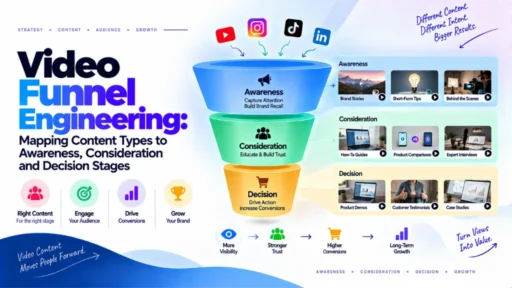
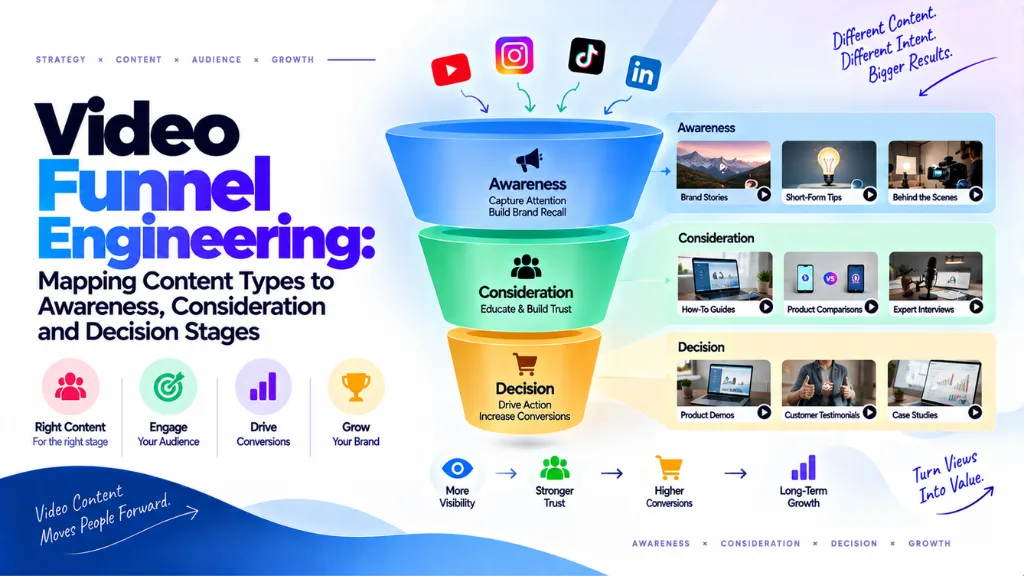

Ninety-one percent of businesses now use video as a marketing tool, according to Wyzowl’s 2026 survey data. Most are still making the same mistake: producing one style of video and publishing it everywhere, expecting it to spark awareness, build trust, and close a sale all at once. Video funnel engineering is the deliberate practice of matching specific video formats to specific stages of the buyer journey – awareness, consideration, and decision – rather than treating video as a single, undifferentiated content type.
The stakes are higher than a vague “video helps” argument suggests. Eighty-four percent of consumers report being convinced to make a purchase after watching a brand’s video, and video content across a properly built funnel has been linked to 66% more qualified leads than campaigns without it. This article breaks down what belongs at each funnel stage, how to diagnose where your existing video library is leaking prospects, and the metrics that correctly measure success at each point.
What Is Video Funnel Engineering?
Video funnel engineering is the process of intentionally designing a video content library around the distinct jobs each funnel stage requires – introducing a problem at awareness, building understanding and trust at consideration, and removing final risk at decision – rather than producing video content ad hoc and hoping it happens to land wherever a viewer encounters it. The core principle is straightforward: a video optimized to spark broad awareness and a video optimized to close a hesitant buyer are solving fundamentally different problems, and no single format handles both well.
Why One Video Can’t Do Everything
The temptation to make one video “work everywhere” is understandable – it’s cheaper and faster than producing distinct assets for each stage. But a single edit attempting to serve all three stages simultaneously usually serves none of them well, because each stage calls for a different tone, length, and level of product specificity. An awareness video needs to be broadly relatable and short enough to earn attention from someone who doesn’t yet know they have a problem; a decision-stage video needs to address specific objections for someone already actively evaluating a purchase. Compressing both jobs into one asset dilutes the effectiveness of each.
This mismatch also shows up as a common budget allocation problem: most brands over-invest in awareness content relative to decision content, producing plenty of brand films and social clips but leaving the bottom of the funnel – case studies, comparisons, detailed demos – comparatively thin. That imbalance means a video program can generate real top-of-funnel attention while still underperforming on actual conversion, simply because the content needed to close prospects who are already interested doesn’t exist yet.
Mapping Content Types to Each Funnel Stage
The specific video types that perform best at each stage are consistent enough across B2B and B2C contexts to build a working reference.
| Funnel Stage | Effective Video Types | Typical Length | Primary Job |
| Awareness | Brand storytelling, short-form social video, founder thought-leadership, animated concept videos | 15–60 seconds | Earn attention, introduce a problem the viewer may not yet recognize |
| Consideration | Explainer videos, product walkthroughs, webinars, how-it-works videos, behind-the-scenes content | 60–90 seconds to several minutes | Build understanding of the approach and trust in the brand |
| Decision | Case studies, testimonials, comparison videos, live product demos, personalized sales videos | 2–5 minutes, often longer for demos | Provide proof, address specific objections, reduce final purchase risk |
Explainer videos sit in an interesting middle position – versatile enough to work at both awareness and consideration, since they introduce a product simply enough for a first-time viewer while still providing the substance a more informed prospect needs. Product and demo videos similarly straddle consideration and decision, since they answer the practical “how does this work for me” question that becomes more urgent the closer a buyer gets to a purchase decision.
Diagnosing Where Your Funnel Is Leaking
A quick audit of an existing video library against these three stages typically reveals exactly where the biggest gap sits, and the fix depends entirely on which symptom is present:
- If overall awareness is low – limited reach, minimal new audience growth – the gap is at the top of the funnel, and the priority is producing more short-form, broadly shareable content rather than more mid-funnel explainers.
- If prospects are engaging but not converting – decent watch time and traffic, but few actual leads or sales – the gap sits in the consideration stage, and the fix is usually deeper explainer or webinar content that builds the specific trust needed to move someone forward.
- If late-stage deals stall – prospects reach a sales conversation but don’t close – the gap is almost always at the decision stage, and case studies, comparison videos, and live demos addressing specific objections tend to be the highest-leverage fix.
The right next video to produce is the one that addresses the specific bottleneck the audit reveals, not the video type that happens to be easiest or most familiar to produce.
Metrics That Actually Match Each Stage
Judging every video by the same metric – typically views or watch time – obscures whether a video is actually doing its job at its intended stage. Each stage calls for its own success measure:
- Awareness metrics: reach and new audience growth. A successful awareness video is judged by how many new people it exposed to the brand, not by conversions it was never designed to drive directly.
- Consideration metrics: watch time, retention rate, and engagement. Comments, shares, and how far into a longer video viewers actually watch indicate whether the content is building the understanding and trust this stage requires.
- Decision metrics: click-through rate, conversions, and attributed revenue. A decision-stage video’s entire job is prompting action, so its success measure should track directly to that action – a demo request, a trial signup, a completed purchase.
Applying an awareness-stage metric like reach to a decision-stage video, or judging an awareness video by conversion rate, produces a misleading read on performance in both directions – the video may be doing exactly what it should for its stage while looking like a failure against the wrong yardstick.
Repurposing Source Footage Across Stages Without Diluting It
The same source footage can often be re-cut to serve multiple stages, which is why a planned, funnel-aware production approach pays off over ad hoc filming. A single interview or product demo shoot can yield a short, attention-grabbing awareness clip, a longer consideration-stage explainer, and a focused decision-stage testimonial – but each cut needs to be edited specifically for its stage’s job, not simply trimmed to different lengths from the same unedited sequence. The distinction is planning the derivatives during production, not attempting one master edit that tries to satisfy every stage simultaneously.
Search Savvy’s content calendar and creative production services build this kind of stage-aware derivative planning into video production from the start, so a single shoot produces genuinely distinct assets rather than one video stretched across jobs it wasn’t built for.
Video Funnel Engineering for AI Search Visibility
A newer consideration worth building into the funnel-planning process: AI search engines including ChatGPT, Claude, Perplexity, and Gemini increasingly cite video content that includes clear narration, structured information, and definitive answers rather than purely visual, unnarrated footage. This means consideration-stage explainer and how-to videos in particular – content genuinely built to answer a specific question – carry a secondary benefit beyond their direct funnel role: they’re more likely to surface and get cited in AI-generated answers, extending the video’s reach well beyond viewers who found it through the original platform or campaign. Search Savvy’s AI search optimization (AEO/GEO) services increasingly factor video narration and structure into broader AI visibility planning, treating well-structured consideration-stage video as an AI-citable asset, not just a funnel-stage tool.
A Practical Framework for Building a Video Funnel
- Audit your existing video library against the three stages before producing anything new, identifying which stage is thinnest relative to where your actual funnel bottleneck sits.
- Assign each planned video a single primary stage before scripting, resisting the temptation to make it “work for everyone.”
- Match length and tone to the assigned stage, using the reference lengths above as a starting point rather than a rigid rule.
- Plan derivative cuts during the shoot, not after, so a single production session yields genuinely stage-specific assets rather than one edit stretched across multiple jobs.
- Measure each video against its stage-appropriate metric, not a single blended engagement number applied across the whole library.
- Link the funnel together explicitly – an awareness video’s call to action should point toward consideration content, and consideration content should point toward a decision-stage offer, so the funnel functions as a connected path rather than disconnected assets.
Common Mistakes in Video Funnel Engineering
- Producing one video type and expecting it to work everywhere. A single asset trying to serve all three stages typically underperforms at each of them.
- Over-investing in awareness while under-investing in decision content. This is the most common imbalance, and it caps conversion even when top-of-funnel reach is strong.
- Judging every video against the same metric. Applying a conversion benchmark to an awareness video, or a reach benchmark to a decision video, misreads whether the content is actually succeeding at its intended job.
- Filming without a stage-specific derivative plan. Attempting to extract multiple funnel-stage assets from footage shot for a single generic purpose usually produces a compromised result for all of them.
- Ignoring narration and structure in consideration-stage videos. Well-structured, clearly narrated explainer content increasingly gets cited by AI search engines, a benefit purely visual content misses out on.
The Bottom Line
Video funnel engineering treats video as a connected system rather than a collection of one-off assets, matching specific formats, lengths, and metrics to the specific job each funnel stage requires. Diagnosing where a video library is thinnest – usually decision-stage content, given how commonly brands over-invest in awareness – and producing stage-specific derivatives from planned shoots consistently outperforms hoping a single video type happens to work at every point in the buyer journey.
The practical next step is auditing your current video library against the three stages and identifying which one is thinnest relative to your actual conversion bottleneck. Search Savvy’s creative production planning and content strategy and topical authority work help teams build exactly this kind of connected, stage-aware video funnel rather than another disconnected batch of one-off assets.
Frequently Asked Questions
What is video funnel engineering? It’s the practice of intentionally matching specific video content types, lengths, and formats to specific stages of the buyer journey – awareness, consideration, and decision – rather than producing video ad hoc and expecting a single format to work at every stage.
Why doesn’t one video work for the whole funnel? Each funnel stage requires a different tone, length, and level of product specificity – awareness needs to be broad and quick, while decision content needs to address specific objections in more depth. A single edit trying to serve all three stages typically underperforms at each individually.
What video types work best for the decision stage? Case studies, comparison videos, live product demos, and personalized sales videos tend to perform best at the decision stage, since their job is providing proof and addressing specific objections for someone already actively evaluating a purchase.
How do I know which funnel stage my video content is missing? Low overall reach points to a gap in awareness content. Strong engagement without conversions points to a gap in consideration content. Deals that stall late in the sales process point to a gap in decision-stage content like case studies and comparisons.
Should I measure every video with the same metric? No. Awareness videos should be measured by reach and new audience growth, consideration videos by watch time and engagement, and decision videos by click-through rate, conversions, and attributed revenue. Applying one metric across all three stages misreads performance.
Can the same footage be used across multiple funnel stages? Yes, but each stage’s cut needs to be edited specifically for its job rather than simply trimmed to different lengths from one master edit. Planning the derivative cuts during the shoot, rather than after, produces genuinely stage-specific assets instead of a compromised single video.