
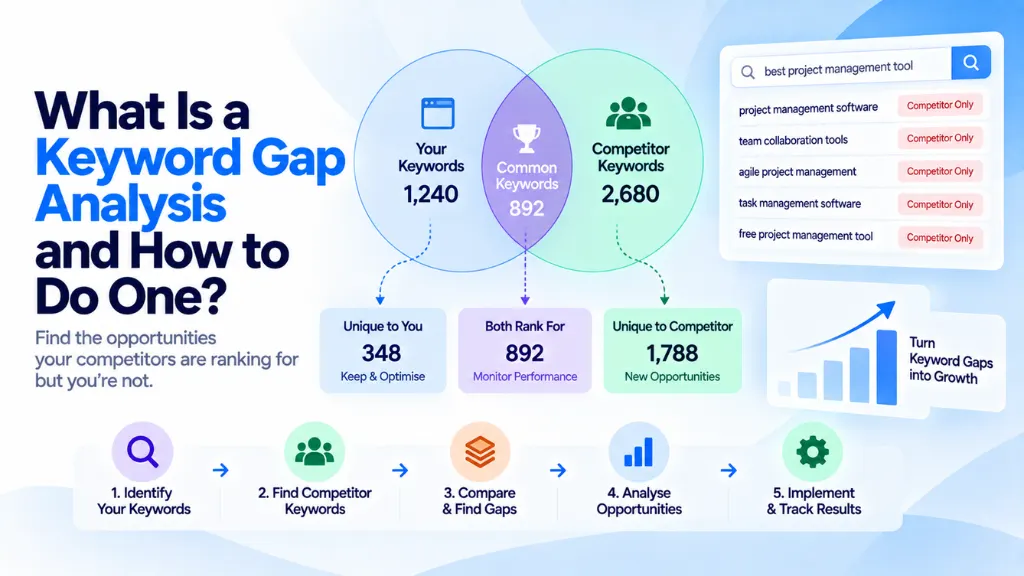

You can publish a well-researched, well-written article and still watch it underperform – not because the writing is weak, but because your competitors have already built out ten adjacent pages your site never mapped. That’s a coverage problem, not a content-quality problem, and it’s exactly what a keyword gap analysis is built to find.
This guide explains what a keyword gap analysis actually is, the specific keyword categories it produces, how to run one using both paid tools and free alternatives, and how to turn a gap list into a prioritized content plan instead of an overwhelming spreadsheet.
What Is a Keyword Gap Analysis?
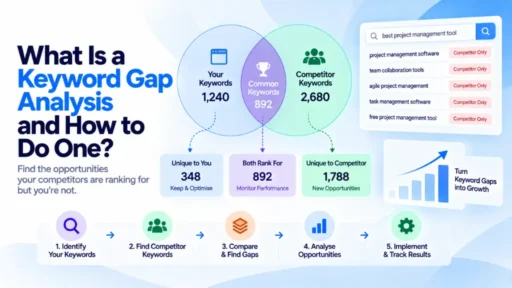
A keyword gap analysis is the process of comparing your website’s organic keyword rankings against one or more competitors to identify terms they rank for that you don’t, along with terms where you rank but noticeably weaker than they do. The goal isn’t just spotting differences – it’s finding specific, addressable opportunities where creating or improving content could realistically close the distance.
It’s a narrower, more tactical cousin of a broader content gap analysis, which also considers content quality, freshness, and depth beyond just keyword rankings. A keyword gap analysis focuses specifically on the ranking data itself: who ranks for what, and where the clearest openings sit.
The Five Keyword Categories a Gap Analysis Produces
Most keyword gap tools sort results into a consistent set of categories, and understanding what each one means is the difference between a useful analysis and an overwhelming export nobody acts on.
| Category | What It Means | Priority |
| Missing | Competitors rank for this keyword; you have no ranking at all | High – clearest content gap |
| Untapped | At least one competitor ranks for this keyword; you don’t | High – often overlaps with Missing |
| Weak | You rank, but noticeably lower than competitors | Medium – an optimization opportunity, not a new-content one |
| Strong | You outrank competitors on this keyword | Low priority for action – worth protecting, not chasing |
| Unique | Only your site ranks for this keyword | Informational – shows where you already own a niche |
Missing and Untapped keywords represent the most direct opportunities, since they point to topics you haven’t addressed at all. Weak keywords matter too, but the fix is usually improving or expanding an existing page rather than creating a new one – a distinct workflow from filling a genuine content gap.
How to Do a Keyword Gap Analysis: Step by Step
Step 1: Identify Your Real SEO Competitors
Your business competitors and your SEO competitors are often different sites. A regional service business might compete for customers against three local companies, but compete for search visibility against a national directory site or a well-ranked blog that neither of those local competitors touches. Build your comparison list from sites that consistently appear in the same search results as your target keywords, not simply the companies you compete with commercially.
Start with three to five close competitors. Comparing against too many at once – or against sites far larger than your own – produces a gap list padded with keywords you have little realistic chance of competing for in the near term.
Step 2: Run the Comparison in a Keyword Gap Tool
Both major platforms support this natively:
- Semrush’s Keyword Gap tool (under Competitive Research) lets you compare your domain against up to four competitors and sorts results into Shared, Missing, Weak, Strong, Untapped, and Unique buckets, with a Venn-style overlap view.
- Ahrefs’ Content Gap tool (under Competitive Analysis) works similarly – enter your domain plus up to ten competitors and Ahrefs surfaces every keyword where a defined number of them rank but you don’t.
Both tools let you scope the comparison to a specific subfolder or URL rather than the whole domain, which is useful if you only want to analyze how your blog, or one service line, compares against the equivalent section of a competitor’s site.
Step 3: Filter Aggressively Before Reviewing Anything
Raw exports from a gap comparison frequently return tens of thousands of keywords, most of which aren’t worth pursuing. Before reviewing the list manually, apply filters for:
- Minimum search volume – cutting out extremely low-volume terms with no realistic traffic impact keeps the list manageable.
- Relevance – remove keywords unrelated to your actual products, services, or audience, even if a competitor happens to rank for them.
- Keyword difficulty – for a newer or lower-authority site, prioritize terms where competitors rank in more attainable positions rather than dominant top-three spots.
- Search intent – filter by informational, commercial, or transactional intent depending on what stage of content you’re planning for.
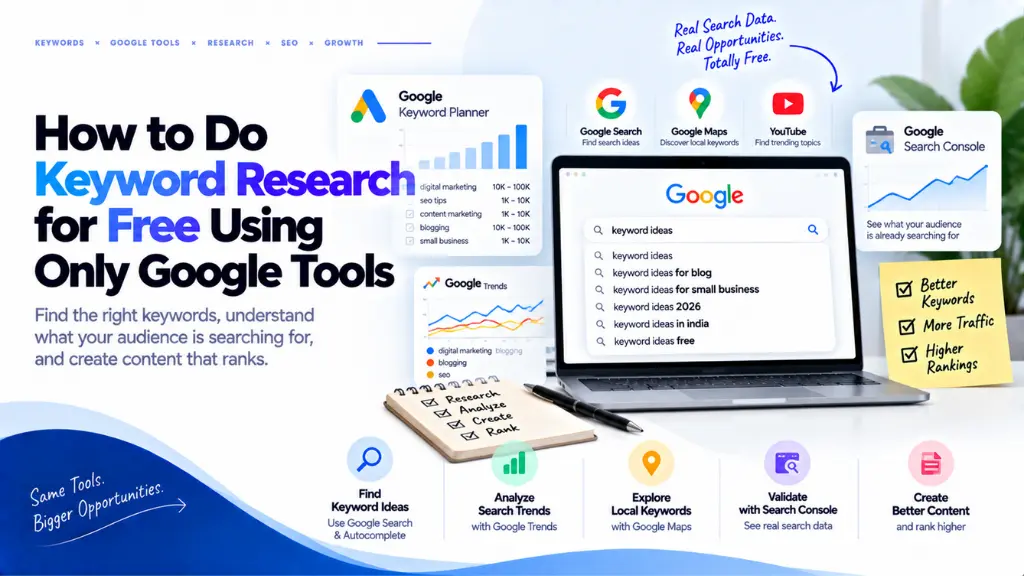
Step 4: Use Google Search Console for a Free Alternative
If a paid tool isn’t in budget, Search Console’s Performance report can approximate a gap analysis using your own data: sort by impressions, filter to page-two average positions, and you’ll find queries where you already have some visibility but aren’t converting it into clicks – often the fastest wins available, since you’re improving an existing foothold rather than starting from zero. This approach won’t show you what competitors rank for that you don’t touch at all, but combined with manually checking competitor rankings for your core topics, it covers much of the same ground without a subscription.
Step 5: Prioritize Missing and Untapped Keywords First
Ask three questions of every keyword that survives your filters:
- Is it genuinely relevant to what your business offers?
- Does the search volume justify the content investment?
- Is the ranking difficulty realistic given your site’s current authority?
Keywords that pass all three move to the content plan. Weak keywords go into a separate optimization backlog – updating an existing page’s structure, depth, and on-page elements rather than creating something new.
Step 6: Map Each Priority Keyword to a Specific Action
A gap list only becomes useful once every keyword is tied to something concrete: a new page to create, an existing page to expand, or a page to leave alone because it’s not a strong fit. Group related Missing and Untapped keywords into single content pieces where they share intent, rather than creating a separate thin page for every individual term.
How Often Should You Run a Keyword Gap Analysis?
A quarterly full comparison, with lighter monthly spot-checks on your highest-priority competitors, is a reasonable cadence for most sites. Competitive SERPs shift as competitors publish new content and search behavior evolves, so a gap analysis run once and never revisited becomes stale quickly, particularly in faster-moving categories.
Keyword Gap Analysis in an AI Overview Era
Organic search still accounts for a large share of overall website traffic, but AI Overviews now measurably reduce click-through on many of the queries a gap analysis surfaces – some tracking shows click-through drops of roughly 50% or more on affected queries. This doesn’t make gap analysis less valuable; it changes how to weigh what you find. A Missing keyword prone to a heavy AI Overview presence may still be worth targeting for topical authority and potential citation, but it deserves a more realistic traffic expectation than a keyword unlikely to trigger one at all. Factoring this into prioritization – not just search volume and difficulty – is an increasingly important part of the filtering step.
Common Mistakes in Keyword Gap Analysis
- Comparing against aspirational competitors instead of real SEO competitors. Gap lists against sites many times your size and authority produce mostly unrealistic targets.
- Treating the raw export as the finished analysis. An unfiltered list of thousands of keywords isn’t a plan – filtering by relevance, volume, and difficulty is what makes it actionable.
- Ignoring Weak keywords entirely. They represent existing pages with an optimization opportunity, not just Missing and Untapped opportunities for new content.
- Creating one page per keyword. Related Missing keywords sharing the same intent are usually better served by one comprehensive page than several thin ones.
- Running the analysis once and never again. Competitive rankings shift constantly; a gap analysis has a shelf life measured in months, not years.
Frequently Asked Questions
What’s the difference between a keyword gap analysis and a content gap analysis? A keyword gap analysis focuses specifically on ranking data – which keywords competitors rank for that you don’t. A content gap analysis is broader, also considering content quality, depth, and freshness across a topic, using keyword gap findings as one input among several.
Can I do a keyword gap analysis without a paid tool like Ahrefs or Semrush? Yes, though with more manual effort. Google Search Console’s Performance report can surface page-two queries where you already have partial visibility, and manually checking which pages rank for your core topics gives a rougher, but free, approximation of the same insight.
How many competitors should I include in a keyword gap analysis? Three to five close competitors is a reasonable starting range. Comparing against too many, or against sites far larger and more established than your own, dilutes the analysis with opportunities that aren’t realistically achievable in the near term.
Should I prioritize Missing keywords or Weak keywords first? It depends on your goals. Missing and Untapped keywords represent entirely new content opportunities, while Weak keywords represent existing pages that could be optimized rather than rebuilt. Many teams tackle Weak keywords first, since improving an existing page is often faster than producing new content from scratch.
Do AI Overviews make keyword gap analysis less useful? No, but they change how to weigh what the analysis finds. Some Missing keywords are more likely to trigger an AI Overview and see reduced click-through even if you rank well, which is worth factoring into prioritization alongside traditional metrics like search volume and difficulty.
How often should a keyword gap analysis be repeated? A full comparison roughly every quarter, with lighter monthly checks on top competitors, keeps the analysis current without becoming a constant time sink for most sites.
The Bottom Line
A keyword gap analysis turns “why is a competitor outranking us” from a vague frustration into a specific, prioritized list of Missing, Untapped, and Weak keywords worth acting on. The value isn’t in the raw export – it’s in the filtering, the SERP-intent check, and mapping each surviving keyword to a concrete piece of content or an optimization task. Run it against real SEO competitors, revisit it quarterly, and weigh AI Overview exposure alongside volume and difficulty when deciding what to build first. Search Savvy’s keyword research services build directly on this kind of competitive gap analysis, and pairing it with content strategy and topical authority services turns a filtered gap list into a structured plan rather than a spreadsheet nobody revisits.