Auction Theory in Google Ads: Advanced Bidding Strategy Beyond Smart Bidding

Most advertisers think of Google Ads bidding as a simple rule: bid higher, win more auctions. That’s not actually how the system works, and understanding the real mechanism is exactly what separates accounts that plateau on Smart Bidding from accounts that keep finding efficiency gains years into a campaign’s life. Google Ads runs on a specific, well-studied auction design called a Generalized Second Price (GSP) auction – and it has real game-theoretic properties that automated bidding only partially navigates on your behalf.
In this article12 sections
There’s a certain irony worth sitting with here. Larry Page and Sergey Brin, before AdWords even existed, wrote in their original 1998 Stanford research paper describing the search engine that would become Google that they expected “advertising funded search engines will be inherently biased towards the advertisers.” That tension – between an auction mechanism designed to maximize Google’s revenue and an advertiser trying to maximize their own return – is precisely the game every Google Ads account manager is playing, whether they realize it or not.
This guide, shaped by the account-level bidding work we do for clients at Search Savvy, goes past the standard “trust the algorithm” Smart Bidding advice and into the auction mechanics underneath it: how Ad Rank actually works, where Smart Bidding’s blind spots are, and the advanced levers experienced bidders use to compete more intelligently within the auction rather than just feeding it more budget.
What Kind of Auction Is Google Ads, Really?#
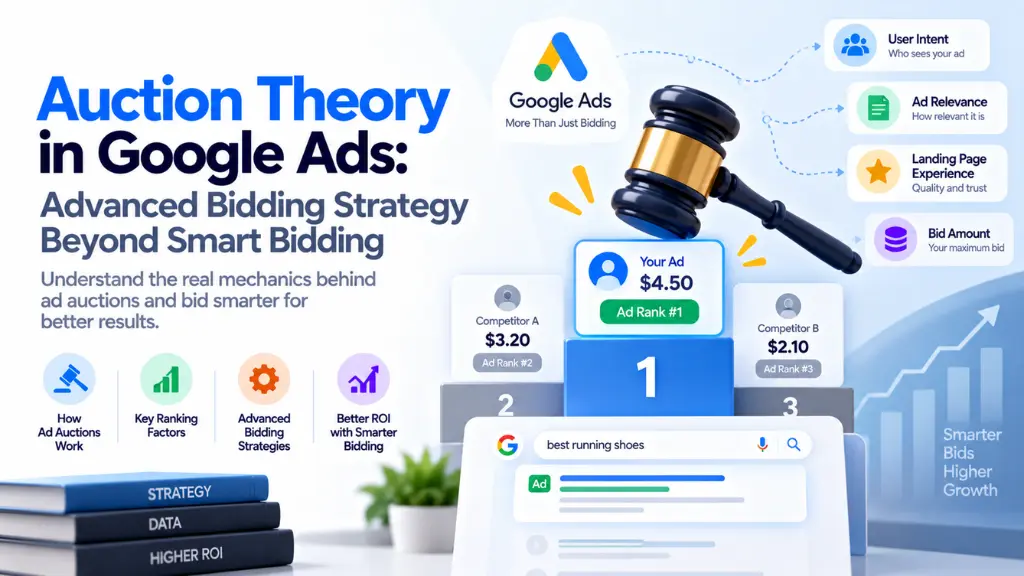
Google Ads uses a Generalized Second Price auction, not a first-price auction and not a pure Vickrey (second-price) auction, even though people often use those terms loosely. In a GSP auction, the advertiser with the highest Ad Rank wins the top position, but doesn’t pay their own bid – they pay the minimum amount needed to maintain their Ad Rank above the next-highest competitor, converted back into a cost-per-click figure. This same logic cascades down every position on the page, which is why it’s called “generalized” – it extends second-price logic across multiple ad slots rather than just one.
The academic groundwork was laid out almost simultaneously by two influential 2007 papers: Benjamin Edelman, Michael Ostrovsky, and Michael Schwarz’s “Internet Advertising and the Generalized Second-Price Auction,” and Hal Varian’s “Position Auctions,” published while Varian was serving as Google’s chief economist. Both reached a conclusion that still shapes how sophisticated advertisers think about bidding today.
Is Google’s Ad Auction a Vickrey Auction?#
No, and this distinction matters more than it might seem. In a true Vickrey (second-price) auction for a single item, bidding your true value is the dominant, mathematically optimal strategy – you have no incentive to bid above or below what the item is actually worth to you. Google’s GSP auction doesn’t preserve that property across multiple ad positions. Because winning a higher position at a GSP auction can mean paying a price influenced by a bidder two or three ranks below you, truthful bidding isn’t guaranteed to be optimal the way it is in a simple Vickrey auction. This is exactly why bid strategy in Google Ads isn’t simply “bid what a click is worth to you and let the auction sort it out” – the position-auction literature specifically shows that strategic, not purely truthful, bidding can be rational in this environment.
How Ad Rank Actually Works: More Than Bid Times Quality Score#
The old shorthand – Ad Rank equals your bid multiplied by Quality Score – was never the complete picture, and it’s even less complete today. Google’s current documentation describes Ad Rank as a function of your bid amount, the real-time quality of your ads and landing page (expected click-through rate, ad relevance, landing page experience), the competitiveness of that specific auction, the context of the search itself (device, location, time of day, and the nature of the search terms), and the expected impact of ad extensions and formats. The 1-to-10 Quality Score you see in the interface is a helpful diagnostic proxy, not the literal number plugged into each auction – the real-time calculation is more granular and contextual than the account-level score suggests, a distinction we walk clients through often at Search Savvy.
This has a genuinely practical implication for advanced bidders: improving your Quality Score isn’t a separate, SEO-adjacent housekeeping task sitting apart from your bidding strategy. It’s one of the most direct levers you have for lowering your effective cost per click at any given Ad Rank, because a stronger quality signal means you need less raw bid to clear the same competitive threshold.
Where Smart Bidding’s Blind Spots Actually Are#
Smart Bidding – Target CPA, Target ROAS, Maximize Conversions, Maximize Conversion Value – uses machine learning to set a bid for each auction based on the contextual signals available at that moment. It’s a genuine improvement over static, manually-set bids, and for most accounts it should be the default starting point, not something to avoid. But it has real limitations advanced practitioners need to actively manage rather than assume the algorithm has solved.
Does Smart Bidding Need a Minimum Number of Conversions to Work Well?#
Yes. Google’s own guidance points to needing a reasonably steady flow of conversions – commonly cited as around 30 conversions in the trailing 30 days per campaign – for Target CPA and Target ROAS strategies to have enough data to optimize reliably. Below that volume, the machine learning models work with too little signal to distinguish genuine patterns from noise, and bidding can become erratic or overly conservative. This is exactly why account structure still matters in a Smart Bidding world: consolidating enough conversion volume into a campaign, rather than fragmenting it across dozens of low-volume campaigns, is itself an advanced bidding decision.
Smart Bidding is also only as good as what you tell it to optimize for. If your conversion tracking counts a low-value newsletter signup the same as a high-value purchase, the algorithm will happily chase more of the cheap conversions, because from its perspective, a conversion is a conversion.
Advanced Concept #1: Bid Shading and the First-Price Shift#
In 2019, Google’s ad exchange infrastructure for display and programmatic inventory moved from a second-price to a first-price auction model – a major structural shift across the broader ad-tech industry, not just Google. Under a first-price auction, the winner pays exactly what they bid, reintroducing a classic auction theory problem: bidding your true value risks systematically overpaying, since there’s no second-price mechanism cushioning the gap between your bid and the actual competitive price. In response, platforms including Google developed bid shading models – algorithms that estimate an auction’s likely clearing price and reduce a bid accordingly, aiming to win the impression closer to the minimum necessary price rather than the buyer’s full stated value.
The practical takeaway for advertisers running both search and display or programmatic campaigns: these aren’t the same auction mechanism, and treating them with identical bidding logic ignores a real structural difference. Search still runs on GSP; much of the programmatic and display ecosystem now runs first-price with automated bid shading layered on top.
Advanced Concept #2: Value-Based Bidding and Conversion Value Rules#
A flat Target CPA or Target ROAS treats every conversion as equally valuable, which is rarely true in practice. Conversion value rules let advertisers adjust the value Smart Bidding assigns to a conversion based on real business context – a new customer might be worth meaningfully more than a returning one, a conversion from a high-margin product category more than a low-margin one, a mobile purchase behaving differently from a desktop one. Layering this into your bidding setup aligns the algorithm’s actual optimization target with your real unit economics, addressing one of the more common weaknesses in accounts that adopt Smart Bidding but never move past a single blended target.
Advanced Concept #3: Reading Auction Insights as Competitive Intelligence#
The Auction Insights report is frequently treated as a vanity metric dashboard, but it’s genuinely useful game-theoretic intelligence when read correctly. Metrics like impression share, overlap rate, outranking share, and position above rate reveal how competitors’ behavior is shifting over time – a sudden jump in a competitor’s impression share or top-of-page rate often signals a deliberate bid increase or a Quality Score improvement on their end, which is exactly the kind of shift that should prompt a review of your own bidding assumptions rather than treating your Target CPA as a fixed, permanent setting.
Advanced Concept #4: Diminishing Returns and Portfolio-Level Strategy#
As a Target CPA or Target ROAS gets pushed more aggressively to capture more volume, the marginal quality of the additional traffic won typically declines – a textbook diminishing returns curve familiar from broader auction theory. Pushing harder to win more auctions eventually means winning auctions you were previously and correctly losing, often at a worse price-to-value ratio. Portfolio bid strategies, which pool multiple campaigns under a single automated strategy, help address this by letting the algorithm allocate budget toward whichever campaigns are currently sitting on the more favorable part of that curve, rather than optimizing each campaign in isolation and potentially over-investing in a campaign that’s already hit its point of diminishing returns.
A Practical Framework for Advanced Bidders#
- Consolidate conversion volume into fewer, higher-signal campaigns before trusting Smart Bidding fully, rather than fragmenting an account into low-volume segments the algorithm can’t learn from effectively.
- Build conversion value rules that reflect actual business economics, not a flat per-conversion assumption.
- Review Auction Insights regularly as competitive intelligence, watching for shifts in competitor impression share or position that signal a change worth responding to.
- Treat Quality Score work as bidding strategy, not a separate task, since it directly lowers the cost needed to clear any given Ad Rank threshold.
- Test portfolio bid strategies across related campaigns rather than assuming isolated, per-campaign optimization is capturing the full picture.
- Run structured experiments using Google Ads’ built-in testing tools before rolling out a major bidding change account-wide, since the auction’s underlying signals shift constantly and yesterday’s optimal target may not hold today.
This kind of auction-level strategic thinking is exactly what separates a managed account from a genuinely optimized one, and it’s the layer we focus on for clients at Search Savvy once the basics of Smart Bidding are already in place. Our Google Ads PPC Services page covers how we typically structure this kind of advanced account work, and our Performance Marketing Services page has more on how paid and organic strategy connect across a broader account.
FAQ: Auction Theory in Google Ads#
What type of auction does Google Ads use? A Generalized Second Price (GSP) auction, where the winner of a position pays the minimum amount needed to maintain their Ad Rank above the next-highest competitor, rather than paying their own bid outright.
Is it optimal to bid your true value in Google Ads? Not necessarily. Unlike a true Vickrey second-price auction for a single item, Google’s multi-position GSP auction doesn’t guarantee that bidding your exact true value is the mathematically optimal strategy, which is why strategic bid-setting matters.
Does Smart Bidding replace the need to understand auction mechanics? No. Smart Bidding optimizes individual auctions using machine learning, but it depends on sufficient conversion volume, accurate conversion values, and periodic human review of competitive shifts to perform well – it doesn’t eliminate the value of understanding the underlying auction.
How many conversions does Smart Bidding need to work effectively? Google’s general guidance points to around 30 conversions in the trailing 30 days per campaign for Target CPA and Target ROAS strategies to have enough data to optimize reliably.
What’s the difference between Quality Score and Ad Rank? Quality Score is a 1-to-10 diagnostic estimate shown in the interface. Ad Rank is the actual real-time calculation used in each auction, incorporating bid, ad and landing page quality signals, auction competitiveness, search context, and expected impact of extensions and formats.
Do Google’s display and search auctions work the same way? No. Search auctions run on the Generalized Second Price model. Much of Google’s display and programmatic inventory shifted to first-price auctions in 2019, which changed optimal bidding behavior and led to the development of bid-shading techniques.
The Bottom Line#
Smart Bidding is a genuinely useful tool, but it’s an optimizer working within an auction system, not a replacement for understanding that system. Advanced bidders get better results not by second-guessing the algorithm on every auction, but by feeding it better inputs – accurate conversion values, sufficient data volume, and account structures that give it room to work – while staying alert to the competitive and structural signals the algorithm alone won’t flag. Understand the auction, and Smart Bidding becomes a much sharper tool in your hands rather than a black box you’re hoping performs.