Facebook Ads vs Organic Reach in 2026: What Small Businesses Should Expect

Facebook organic reach 2026 data tells a consistent story: small and uneven. Socialinsider’s study of 872,075 brand-page posts, as summarized by Edgar, puts the average organic reach rate at about 1.25% of followers per post. Socialinsider’s own benchmarks put average engagement at 0.15% of followers, flat year over year.
In this article16 sections
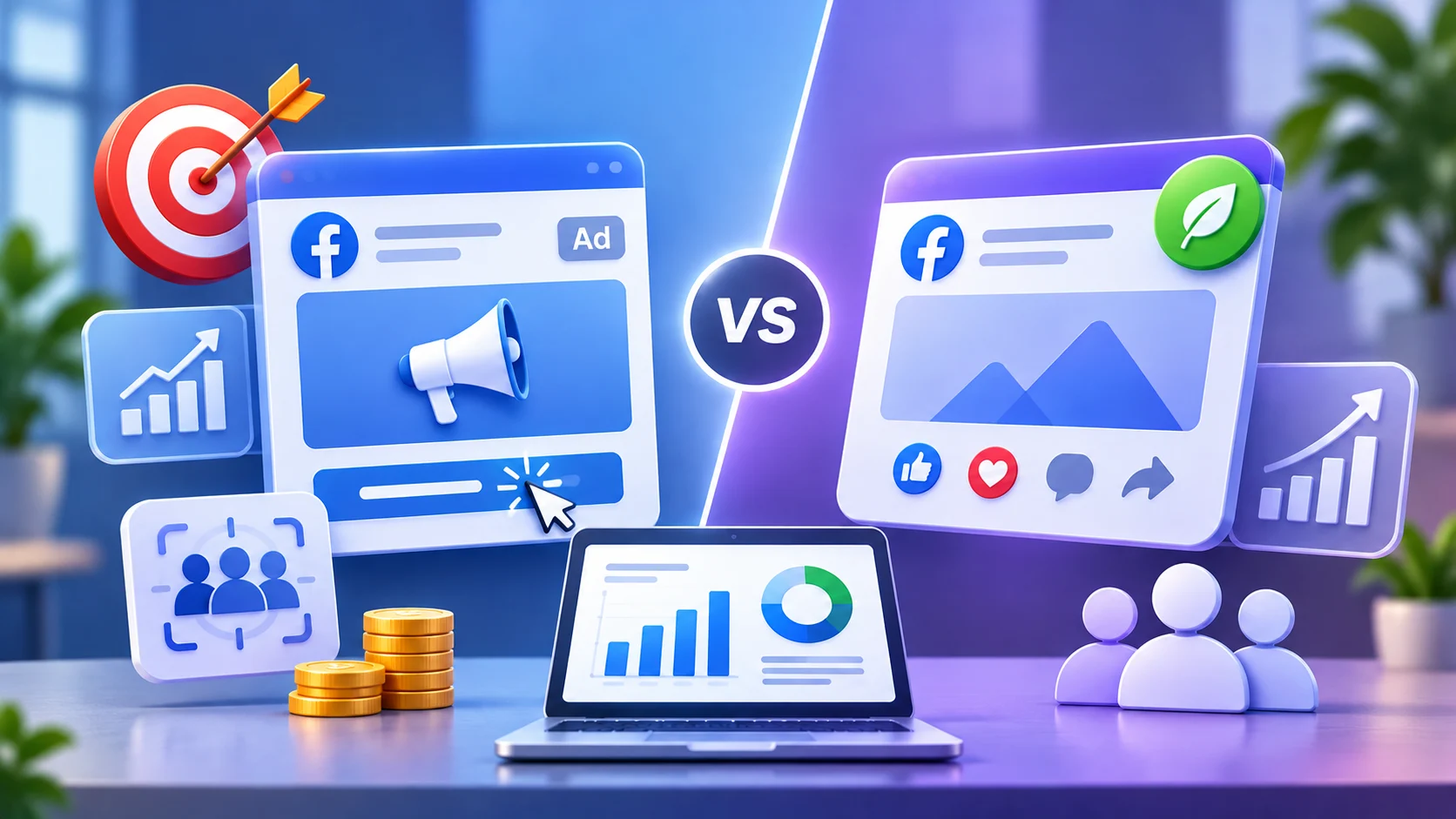
That does not make organic posting pointless, and it does not make ads automatic winners. Organic builds trust and gives ads something worth boosting; paid delivers predictable reach and measurable results. This article explains realistic reach numbers, what Meta changed in its algorithm and ad targeting, when to boost a post versus build a campaign, and a hybrid plan a small team can run.
What Is Facebook Organic Reach in 2026?#
Facebook organic reach is the number of unique people who see your Page’s unpaid posts. Reported as a rate, it is reach divided by followers. In 2026 most pages reach only a small percentage of their followers per post, and smaller pages generally reach a larger share than big ones.
The same Socialinsider data, as summarized by Edgar, shows how strongly size matters:
| Page followers | Average organic reach rate |
| 1K to 5K | 4.35% |
| 5K to 10K | 3.40% |
| 10K to 50K | 2.70% |
| 50K to 100K | 1.50% |
| 100K to 1M | 0.50% |
In practice, a page with 1,000 to 5,000 followers would average roughly 44 to 218 people reached per post at that rate. By format, the same summary lists images at 1.20%, albums at 1.15%, status posts at 0.80%, Reels at 0.55%, and link posts at 0.20%.
Treat all of this as directional. Benchmarks disagree because vendors calculate differently. One comparison of three sources found engagement figures ranging from 0.063% (Rival IQ) to 1.3% (Hootsuite), partly because formulas and samples differ. Your own page engagement rate, measured the same way each month, is a better yardstick than any industry average.
Which Facebook Algorithm Changes Matter in 2026?#
The most concrete change is about originality. In March 2026, Meta said it is prioritizing original content in Feed and Reels while reducing the reach of unoriginal content. It defines duplicated posts, or posts with only minor edits to another creator’s work, as unoriginal and deprioritized. Accounts posting mostly unoriginal material risk losing recommendation eligibility.
For a small business, the implications are practical:
- Photos you took of your own products, staff, and customers are safer than reposted supplier images.
- A reshared industry video needs your own added value, such as commentary or a how-to angle.
Meta does not publish its full ranking signals, so treat claims about exact formulas with caution. What the company has stated publicly is the direction: original, creative work gets the benefit of the doubt.
Facebook Ads vs Organic Reach: What Does Each Do Best?#
| Factor | Organic posts | Paid ads |
| Cost | Staff time and creative | Ad spend plus creative |
| Reach predictability | Low and variable | Much higher, set by budget |
| Targeting | Existing followers and shares | Audience controls and suggestions |
| Speed | Slow to build | Can start the same day |
| Measurement | Engagement, reach | Cost per result, conversions |
| Best for | Trust, community, proof | Sales, leads, launches |
Organic content works as your shop window. People who see an ad often check your Page before trusting you, so a recent, active Page supports paid results. Ads handle the job organic cannot: reaching people who do not yet follow you, on a schedule you control.
Boosted Posts vs Ads: Which Should You Choose?#
A boosted post promotes an existing Page post with a few simple settings. An Ads Manager campaign gives you more objectives, targeting choices, and placement control. Boost for quick visibility on a specific post; use Ads Manager when you want leads, sales, or tests.
| Feature | Boosted post | Ads Manager campaign |
| Setup | One screen, minutes | More steps, more decisions |
| Objectives | Limited, mostly engagement or traffic | Wide range, including leads and sales |
| Targeting | Basic | More options |
| Placements | Limited control | Full control |
| Creative changes | Create a new post to change it | Edit ads freely |
These distinctions are consistent across Hootsuite’s comparison and other guides drawing on Meta’s help documentation. Boosting suits a local event or a post that already performed well. A campaign aimed at enquiries or purchases belongs in Ads Manager, where you can pick the matching objective.
How Has Meta Ad Targeting Changed?#
Meta ad targeting now leans on automation. According to AdsUploader’s 2026 summary of Meta’s documentation, age, gender, detailed targeting, and custom or lookalike audiences are treated as suggestions by default, while location, languages, minimum age, and exclusions remain hard controls. The same source notes that Meta removed detailed-targeting exclusions on March 31, 2025. Jon Loomer’s independent guidance adds that detailed targeting and lookalike inputs act as suggestions for most performance goals, and that the audience-limiting button was relabeled “I need a specific audience.”
What this means for a small advertiser:
- Creative becomes the targeting. The people who respond to your ad shape who sees it next.
- Interests are starting points. Do not build five ad sets around five interests and expect separate audiences.
- Customer lists still help. Exclude existing customers when you want new ones, since custom audience exclusions remain available.
- Plan for change. Meta consolidated and retired interest options during 2025 and into 2026, so old ad sets may need review.
How Do You Improve Page Engagement Rate?#
Page engagement rate is usually total interactions (reactions, comments, shares) on a post divided by followers, multiplied by 100. Using Socialinsider’s 0.15% average, a page with 2,000 followers would average about three interactions per post. Improve it by posting original, specific, useful content and prompting real replies.
A simple routine:
- Calculate your last 20 posts using the same formula each time.
- Sort by format and topic to find your top five.
- Make more of those, with your own photos or short video.
- Ask a specific question, such as “Which size are you ordering?”, rather than “Thoughts?”
- Reply to every comment within a day.
- Retire formats that consistently underperform, such as link-only posts.
Search Savvy’s content calendar and creative production page outlines how planned posting can keep this routine manageable, and its short-form video production page covers Reels, which Meta names alongside Feed in its original-content rules.
A Practical Hybrid Plan for Small Businesses#
- Set a baseline. Record reach, engagement rate, and website clicks for 30 days.
- Post organically with a purpose. Aim for proof (reviews, behind-the-scenes), education, and offers.
- Test one paid objective at a time. Run a small campaign for leads or sales, rather than boosting random posts.
- Feed ads with your best organic content. Posts that earn real comments often make better ad creative.
- Review monthly. Compare cost per result with organic traffic, and adjust the split.
A strategy audit can reveal where effort is being wasted before spend increases, and paid social advertising services are the next step if you want help running campaigns. Reporting matters too: Search Savvy lists analytics and performance reporting as a service area for tracking what changes.
Common Mistakes to Avoid#
- Judging organic by 2015 expectations. Reach rates are far lower now.
- Boosting everything. Boosts without a goal spend money on engagement that rarely becomes revenue.
- Reposting other people’s content. Meta says it deprioritizes it.
- Over-narrowing targeting. Targeting inputs are suggestions, so strong creative matters more.
- Ignoring Page activity. A dead Page undermines trust in your ads.
Bottom Line#
Plan for low, unpredictable organic reach: treat Facebook organic reach 2026 as a channel for trust and proof, not your only growth channel. Use paid ads for predictable delivery, start with one clear objective, and let strong, original creative do the targeting work. If you want a second opinion on your mix, Search Savvy’s social media services cover strategy, creative, and paid. Otherwise, record your baseline this week and run one test campaign next month.
Frequently Asked Questions#
Is organic reach on Facebook dead in 2026?#
No, but it is low. Reported averages are around 1.25% of followers per post, with small pages doing better than large ones. Organic still builds credibility and gives your ads material to work with.
What is a good Facebook engagement rate in 2026?#
Socialinsider’s average is 0.15% of followers. Beating that is a reasonable target, though other vendors report very different figures, so track your own trend.
Are boosted posts worth it for small businesses?#
They can be for simple goals, such as promoting an event or a post that already performs well. For leads or sales, an Ads Manager campaign offers more suitable objectives.
Does posting more often increase organic reach?#
Not reliably. Meta’s stated direction rewards original content, so a few strong posts usually beat frequent repetitive ones.
Can I still target a narrow audience on Meta ads?#
Partly. Location, languages, minimum age, and exclusions are hard controls, while interests and demographics mostly act as suggestions unless you limit the audience manually.
Should I stop posting organically if I run ads?#
No. Active Pages support ad credibility, and your best organic posts often become your best ad creative.