
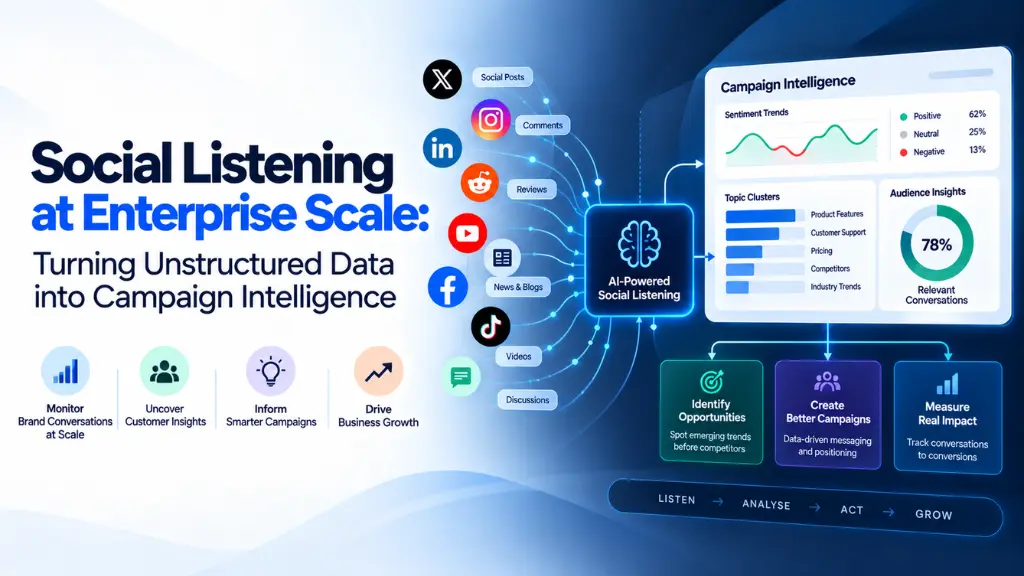

Somewhere across your brand’s social channels, review sites, forums, and comment sections, thousands of people are saying things about you right now – most of it messy, unstructured, and never destined to become a formal survey response. Social listening at enterprise scale is the discipline of turning that noise into something a marketing team can actually act on: which narrative is gaining momentum, where sentiment is quietly shifting, and what your next campaign should say.
Jeff Bezos understood the stakes of this shift before most marketers did. Warning early on about the internet’s ability to amplify word of mouth, he pointed out that an unhappy customer online “can each tell 6,000 friends” – a scale of amplification that simply didn’t exist in the physical world. Social listening exists because that amplification is now permanent, searchable, and happening across more channels than any human team could manually track – which is exactly the gap we help enterprise clients close at Search Savvy. The hard part isn’t collecting the data anymore; every major platform can ingest millions of mentions a day. The hard part is turning unstructured, emotional, sarcastic, multilingual human conversation into intelligence that shapes a campaign brief before a competitor gets there first.
What Does “Social Listening at Enterprise Scale” Actually Mean?
Social listening at enterprise scale means continuously analyzing conversation across social platforms, forums, review sites, news, podcasts, and broadcast media – often hundreds of millions of sources at once – to detect sentiment shifts, emerging narratives, and competitive openings before they show up in a quarterly report. At an enterprise level, this isn’t a single brand manager checking mentions once a day; it’s a system built to handle volume, multiple languages, and multiple business units simultaneously, feeding insight into teams well beyond marketing, including product, PR, and customer experience.
Gary Vaynerchuk, who has built much of his career around exactly this discipline, has said plainly that “social listening” has been the foundation of his business career since his early days running Wine Library. That’s worth sitting with, because it reframes social listening as something more fundamental than a marketing tool – it’s how a business actually learns what its audience wants, at whatever scale that audience happens to exist.
Social Monitoring vs. Social Listening: What’s the Difference?
This is one of the most common points of confusion, so it’s worth answering directly. Social monitoring tracks specific mentions and responds to them – a customer complaint, a tagged post, a support request. Social listening goes a level higher: it looks at the aggregate pattern across thousands or millions of mentions to answer bigger questions, like whether sentiment toward a product feature is trending down, or whether a competitor is quietly losing ground in a particular audience segment. Monitoring is reactive and individual; listening is strategic and aggregate. Enterprises need both, but it’s listening that actually informs campaign strategy.
Why Unstructured Data Is the Real Challenge
Most of what brands need to understand lives in unstructured formats – free-text posts, comments, images, video, voice notes, and audio from podcasts and broadcast media. Unlike a structured survey response, none of it arrives pre-categorized. A single sentence can carry sarcasm, mixed sentiment, cultural context, and an emoji that flips the entire meaning, and a listening system has to correctly parse all of that at a volume no human team could manually review.
This is exactly where the technology has moved fastest. Sentiment analysis has evolved well past simple positive/negative/neutral tagging into genuine emotion detection – distinguishing frustration from disappointment, or excitement from relief – which matters enormously for campaign tone and timing. Some platforms have also pushed into multimodal analysis: Talkwalker, for example, applies AI-powered visual analysis to identify logos, scenes, and objects in images and video on platforms like Instagram and TikTok, not just text mentions. That matters because a growing share of brand conversation today isn’t written down at all – it’s shown.
Can AI Really Understand Sarcasm and Emotional Nuance in Social Posts?
To a meaningfully better degree than a few years ago, yes – but not perfectly. Modern natural language processing models are considerably better at picking up on context, cultural nuance, and mixed signals than the keyword-based sentiment scoring that dominated social listening a decade ago. Enterprise platforms increasingly market emotion clustering as a core differentiator rather than an add-on. Still, ambiguous language, heavy irony, and fast-moving internet slang remain genuinely hard problems, which is why human review of edge cases hasn’t disappeared – it’s just been redirected to the mentions that matter most instead of the entire firehose.
How AI Is Changing Social Listening in 2026
The shift underway isn’t just “listening got faster.” It’s a change in what listening is actually for. Traditional social listening told you what already happened – a mention spike, a sentiment dip. AI-driven listening in 2026 is increasingly built to answer a different, forward-looking question: what’s about to happen, and what should the organization do about it before it escalates or peaks.
That shift shows up clearly in how marketers are prioritizing their AI investment. According to data from customer experience platform Emplifi, roughly 30% of marketers say predictive analytics is their top planned use case for AI in 2026 – ahead of automated content creation and AI-driven ad targeting. That’s a meaningful signal: teams increasingly want listening tools that surface an emerging trend early enough to build a campaign around it, not just confirm a trend after competitors have already capitalized on it.
The market is scaling to match that demand. Industry research from Coherent Market Insights values the global social media listening market at roughly $11.91 billion in 2026, projected to reach close to $29.63 billion by 2033 – a compound annual growth rate of nearly 14%. Much of that growth is being driven by exactly this pattern: enterprises moving from basic mention tracking toward AI-powered anomaly detection, narrative clustering, and predictive modeling that can flag a brewing PR issue or a viral opportunity while there’s still time to act on it.
From Data to Campaign Intelligence: Making Listening Actually Useful
Collecting sentiment data is the easy half. The harder, more valuable half is turning it into something a campaign team can execute against. A few patterns that consistently work at enterprise scale:
Sentiment gap analysis against competitors. Comparing sentiment and share of voice against direct competitors reveals where a rival is genuinely vulnerable – a recurring complaint, an unmet need – and where your own brand already has an emotional advantage worth leaning into creatively.
Narrative and crisis-velocity tracking. Rather than waiting for a spike in raw mention volume, enterprise teams increasingly track how fast a specific narrative is accelerating and clustering across sources, which gives PR and marketing teams meaningfully more lead time to respond before a story fully forms.
Feeding creative and content calendars directly. The emerging topics and emotional themes surfacing in listening data are a genuinely underused input for content planning – what people are actually asking about, worried about, or excited about right now should shape editorial calendars, not just keyword research alone.
Audience and psychographic segmentation. Beyond simple demographic slicing, some enterprise platforms now support genuine audience profiling based on interests and behavior patterns detected in conversation, which sharpens targeting well beyond a standard buyer persona document.
How Can Social Listening Actually Improve Campaign Performance?
It improves campaign performance mainly by shrinking the gap between when something starts trending and when your team responds to it. A brand that spots an emerging complaint, question, or cultural moment two weeks before it peaks has time to build a genuinely relevant campaign around it. A brand that only notices after the fact ends up either ignoring the moment entirely or publishing something that reads as late and reactive. The strategic value isn’t the dashboard – it’s the lead time it buys your team.
Choosing the Right Enterprise Social Listening Setup
There’s no single “best” platform, because enterprise needs vary enormously by industry, region, and use case. A few criteria genuinely matter more than brand-name recognition when evaluating options:
- Data coverage and channel breadth – how many social networks, review sites, forums, and broadcast or podcast sources the platform actually indexes, since a narrow data set produces a distorted picture regardless of how good the AI layer is.
- Depth of sentiment and emotion analysis – whether the platform goes beyond basic polarity scoring into genuine emotional and contextual understanding.
- Predictive and anomaly-detection capability – whether the tool can flag an accelerating narrative early, not just report on volume after the fact.
- Integration with existing marketing and CX systems – listening data that stays siloed in its own dashboard rarely makes it into an actual campaign brief; integration with your CRM, content calendar, or CX platform is what turns insight into action.
A pitfall worth naming directly: many enterprise teams still set up listening the same limited way they did years ago – tracking their own brand name plus a handful of competitor keywords – and then wonder why the insights feel thin. Broader, more deliberately structured queries, built around themes and audience language rather than just brand terms, tend to surface far more useful intelligence.
Social listening also increasingly overlaps with how brands show up in the AI-driven side of search and discovery – the same conversations that shape sentiment often shape what AI Overviews, ChatGPT, and other assistants say about a brand when asked. If that connection is relevant to your team, our AI and Search blog category at Search Savvy digs into that overlap in more depth.
Building This Into Your Marketing Operation
None of this requires ripping out your existing stack overnight. Start by auditing what your current listening setup actually covers, whether it goes beyond basic keyword tracking, and whether the insights it generates are reaching the people who plan campaigns – or just sitting in a monthly report nobody outside PR reads. Bezos’ point about amplification cuts both ways: the same scale that lets one unhappy customer reach 6,000 friends also means one early, well-handled signal can protect a campaign, a launch, or a reputation long before it becomes a crisis. Our Social Listening & Reputation Monitoring services page at Search Savvy walks through how we typically structure that for enterprise clients, and our social media marketing glossary is a useful shared reference if terminology in this space is still unfamiliar to parts of your team.
FAQ: Social Listening at Enterprise Scale
What is the difference between social monitoring and social listening? Social monitoring tracks and responds to individual mentions in real time. Social listening analyzes the aggregate pattern across large volumes of mentions to identify broader sentiment trends, emerging narratives, and strategic opportunities.
How much data does enterprise social listening actually cover? Leading enterprise platforms monitor well beyond core social networks, pulling in forums, review sites, blogs, podcasts, and broadcast media – some indexing hundreds of millions of news and content sources in addition to social platforms.
Can social listening predict a PR crisis before it happens? It can significantly shorten response time by detecting an accelerating negative narrative early, sometimes called crisis velocity tracking, though it can’t guarantee prediction with certainty – it buys lead time, not certainty.
Does social listening only apply to marketing teams? No. Enterprise listening insights commonly feed product development, customer experience, PR, and executive strategy, not just marketing campaigns, since sentiment and emerging complaints often reveal product or service issues before formal customer feedback channels do.
How is AI changing social listening compared to a few years ago? AI has shifted listening from simple keyword tracking and basic sentiment scoring toward genuine emotion detection, multimodal analysis of images and video, and predictive analytics designed to flag trends before they peak rather than just report on what already happened.
What’s the biggest mistake enterprises make with social listening? Setting up narrow queries limited to a brand name and a few competitor keywords, which produces a thin, incomplete picture of the conversation compared to broader queries built around themes, audience language, and industry topics.
The Bottom Line
Social listening at enterprise scale isn’t really about the volume of data you can collect anymore – every serious platform can handle that. It’s about building the discipline to turn unstructured, emotional, multilingual conversation into decisions your campaign teams act on while the moment is still relevant. Bezos was describing a risk when he talked about 6,000 friends hearing about one bad experience; Vaynerchuk built a career treating that same dynamic as an opportunity. Enterprise social listening, done well, is how a brand chooses which of those two outcomes it gets.