

Search volume used to be the whole game: find a term with enough monthly searches, write a page that targets it, and wait for traffic. That approach still produces results, but it’s no longer sufficient on its own – a growing share of informational queries now get answered directly on the results page or inside an AI chat window, before a person ever reaches a website. Keyword research in 2026 still starts with finding what people search for, but it now has to account for where that search happens and whether it produces a click at all.
This guide covers what keyword research actually is, why search intent and topic clusters matter more than raw volume today, the specific tools and steps to run the process yourself, and how to prioritize the keywords worth targeting first.
What Is Keyword Research?
Keyword research is the process of identifying the words and phrases people type or speak into search engines and AI assistants, understanding the intent behind those queries, and using that data to decide what content to create and how to structure it.
Good keyword research answers three questions before a single word gets written: what are people actually searching for, what do they expect to find when they search for it, and is there a realistic path to reaching them with content built around that search.
Why Keyword Research Looks Different in 2026
Three structural shifts have changed how keyword research needs to work, and ignoring them means investing effort into content that gets summarized on the results page before anyone visits the site.
Zero-click search has become the norm for many informational queries. Independent tracking from Similarweb and others shows that when an AI Overview appears on a search results page, users click through to an organic result in roughly 8% of cases, compared to about 15% when no AI Overview is present – a nearly 50% drop in click-through likelihood for the exact queries a “how to” or “what is” article is written to answer. Longer, conversational, question-style queries of eight or more words are also disproportionately likely to trigger an AI Overview in the first place, which means the classic long-tail informational keyword is often the one most likely to get answered without a click.
AI chat platforms produce a similar outcome, often with even less visibility into what happened. A meaningful share of buyer research increasingly happens inside a conversational assistant rather than a search engine, and citation rates back to source websites from these tools remain low, meaning a keyword can generate real influence on a decision without ever showing up as a visit in analytics.
Search intent classification needs to be more granular than the old four-category model. Labeling a keyword as simply “informational” or “transactional” isn’t precise enough anymore – a query like “best running shoes for flat feet” looks transactional on the surface, but the actual top-ranking pages are often comparison guides and forums addressing a more specific mix of comparative and reassurance-driven intent. Checking the real SERP for a keyword, not just guessing from its wording, is now a required step rather than an optional refinement.
None of this means keyword research matters less. It means the output of keyword research needs to guide content toward formats and depth that can still earn a click, a citation, or a brand impression, even on queries where a full visit is increasingly uncommon.
Search Intent: The Foundation of Modern Keyword Research
Every keyword carries an intent – the reason behind the search – and matching content to that intent matters more than matching the literal keyword phrase. The traditional categories are a useful starting point:
| Intent Type | What the Searcher Wants | Example Query | Best Content Format |
| Informational | An answer, explanation, or definition | “what is keyword research” | Guide, blog article, glossary entry |
| Navigational | A specific website or brand | “google keyword planner login” | N/A – brand owns this by default |
| Commercial investigation | Comparison before a decision | “best keyword research tools 2026” | Comparison guide, listicle |
| Transactional | Ready to buy or convert | “buy ahrefs subscription” | Product or pricing page |
In practice, many keywords carry a mixed or narrower intent than this table suggests, which is why checking the actual search results for a candidate keyword – not just its wording – remains the single most reliable way to confirm what kind of content Google already considers a good match.
How to Do Keyword Research: Step by Step
Step 1: Start With Seed Keywords
Write down the core topics, products, or services your content needs to cover, based on what you actually offer and what your audience is trying to solve. These seeds don’t need to be sophisticated – broad terms like “keyword research” or “email marketing automation” are enough to start expanding from.
Step 2: Expand Seeds Into Candidate Keywords
Feed your seed terms into research tools to generate related phrases, questions, and variations:
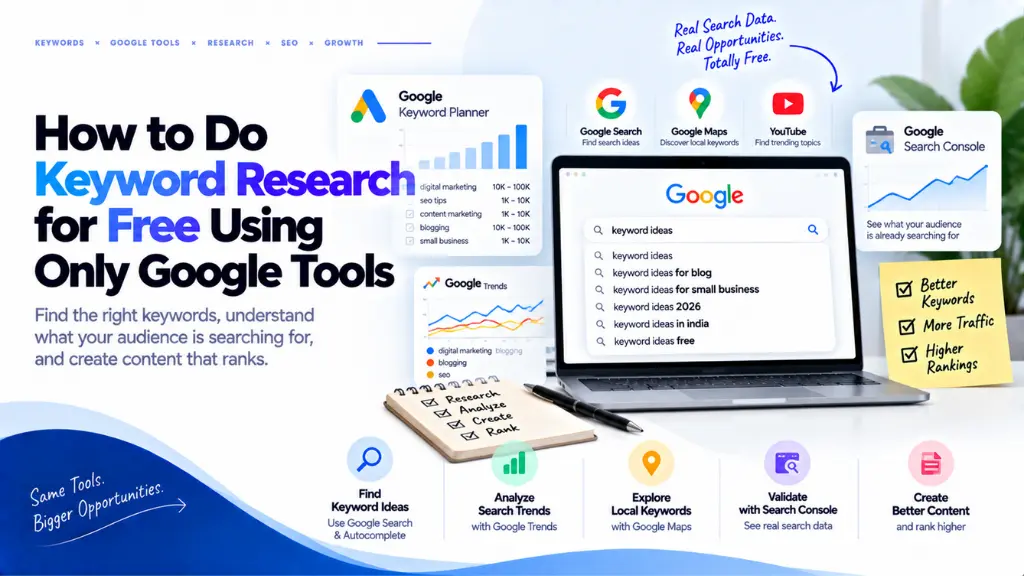
- Google Keyword Planner – free within Google Ads, and still the most direct source of Google’s own search volume estimates, even though it’s built for advertisers.
- Google Search Console – if your site already exists, the Performance report shows queries you already get impressions for, often on page two, which are frequently the fastest opportunities to expand into a dedicated page.
- People Also Ask and autocomplete – pulling the actual questions and phrasing tied to a topic surfaces sub-intents a head-term search alone won’t reveal.
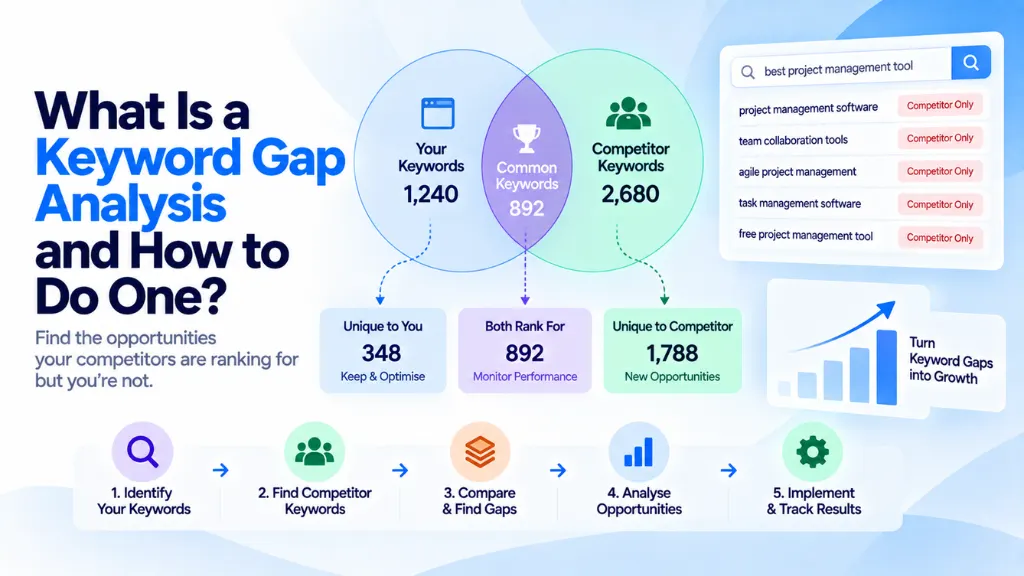
- Competitor gap analysis – checking which terms competing pages rank for that your own site doesn’t yet cover.
Step 3: Check the Real SERP for Intent, Not Just the Keyword’s Wording
For every serious candidate keyword, open the actual search results and look at what’s currently ranking. If the top results are all listicles and comparison content for a keyword that looks transactional on paper, that’s the intent to build for – not the intent implied by the words alone.
Step 4: Record the Metrics That Matter
For each keyword, capture:
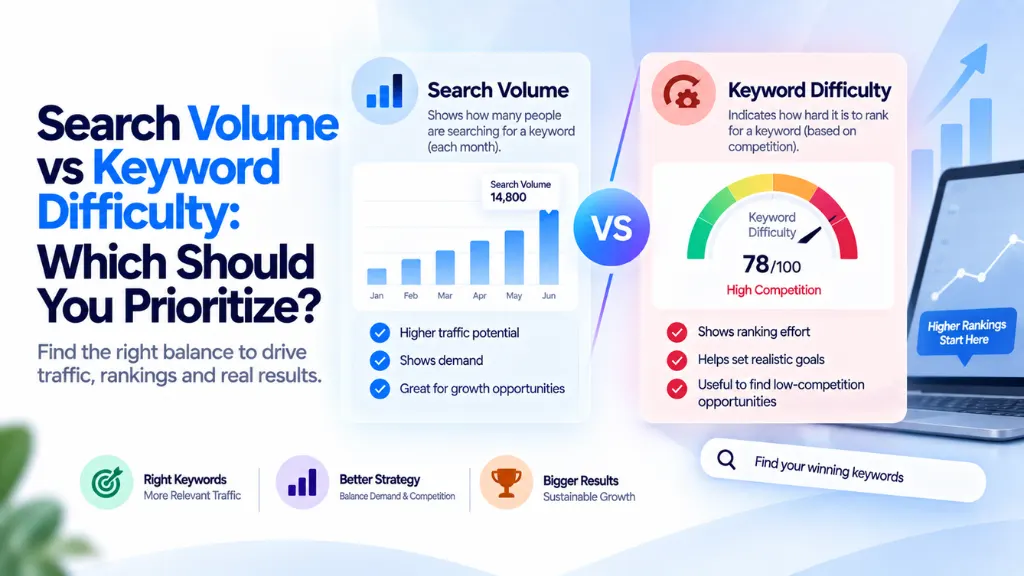
- Search volume – useful for prioritization, but not the deciding factor on its own.
- Keyword difficulty – a rough estimate of how hard the term is to rank for organically.
- Zero-click likelihood – whether the query is likely to trigger an AI Overview or featured snippet that reduces click-through even at a strong ranking position.
- Business value – how directly this keyword connects to a decision your audience is trying to make.
Step 5: Group Keywords Into Topic Clusters
Bundle keywords that share the same underlying intent into clusters, with one broader “pillar” keyword at the center and several narrower, related keywords supporting it. Rather than one page per keyword, this structure produces one comprehensive page per pillar, with supporting content linking back to it – a pattern that demonstrates depth on a subject rather than scattered coverage across many disconnected pages, which is increasingly what determines topical authority.
Step 6: Prioritize Before You Write Anything
Score each keyword or cluster on two axes: how much business value it carries, and how realistically achievable ranking for it actually is given your site’s current authority. A high-value, low-achievability keyword is a long-term target to build toward, not a starting point – a new or smaller site is generally better served targeting lower-competition terms with more modest but realistic search volume than competing directly for a high-volume head term it has little chance of ranking for in the near term.
What Search Volume Should You Target?
There’s no universal number, and chasing the highest-volume term in a topic is one of the most common keyword research mistakes. A new or lower-authority site is typically better served by targeting keywords in a more modest, achievable volume range with lower competition than by fighting for head terms it has no realistic path to ranking for. Low-volume, high-intent terms frequently produce more revenue per visit than high-volume informational keywords that were never likely to convert in the first place.
Common Keyword Research Mistakes
- Chasing volume and ignoring intent. A high-volume keyword that doesn’t match the content format Google already rewards for that query is unlikely to rank regardless of how well the content is written.
- Dismissing long-tail keywords. Individually low-volume terms add up to the majority of total search volume across most topics, and they typically convert better because they reflect more specific intent.
- Skipping the SERP check. Assuming intent from a keyword’s wording alone, rather than looking at what’s actually ranking, leads to building the wrong content format.
- Treating every keyword as a standalone page. Scattering content across unrelated one-off keywords doesn’t build the topical depth that increasingly determines whether a site is trusted for a subject.
- Ignoring zero-click risk entirely. Not every keyword is worth deprioritizing because of AI Overview exposure, but factoring in the realistic click-through ceiling for a query changes how much content investment it deserves.
Frequently Asked Questions
Is keyword research still worth doing with AI Overviews and AI search taking over more queries? Yes. Keyword and topic research still determines what people are looking for and how to structure content around it – what’s changed is that the research now needs to account for which queries are likely to be answered without a click, so effort can be directed toward formats and topics that still earn traffic or citations.
What’s a good search volume to target for a new website? There’s no fixed number. A newer or lower-authority site is generally better served targeting keywords with modest, realistic volume and lower competition rather than competing directly for high-volume head terms it’s unlikely to rank for in the near term.
What free tools can I use for keyword research? Google Keyword Planner, Google Search Console (if your site already has data), Google’s autocomplete and “People Also Ask” results, and the “searches related to” section at the bottom of a search results page cover most of what a smaller site needs without paid tools.
What is a topic cluster, and why does it matter for keyword research? A topic cluster groups a broad pillar keyword with several narrower, related keywords, each supported by its own content that links back to the pillar page. This structure demonstrates topical depth, which search engines increasingly use to judge whether a site deserves to rank across an entire subject area, rather than just a single page.
How is search intent different from a keyword’s literal meaning? A keyword’s wording can look like one intent type while the actual top-ranking content reflects something more specific – checking the real search results for a candidate keyword is the only reliable way to confirm what searchers and search engines both expect, rather than guessing from the phrase alone.
Should I still do keyword research for content aimed at ChatGPT or Perplexity, not just Google? Traditional keyword research remains the foundation, since the topics people care about are largely the same across search engines and AI assistants. The additional step is considering how a topic might be phrased as a natural-language question or prompt, since AI platforms respond to conversational queries rather than short keyword fragments.
The Bottom Line
Keyword research in 2026 still starts with the same core question it always has – what is my audience actually searching for – but the answer now needs to account for where that search happens and whether it’s likely to produce a visit at all. Build around intent and topic clusters rather than isolated keywords, check the real SERP before assuming what content format wins, and prioritize keywords your site can realistically compete for today rather than the highest-volume term on the list. Search Savvy’s keyword research services apply exactly this kind of intent-first, cluster-based process for clients building out new content, and pairing it with content strategy and topical authority services helps turn a keyword list into a structured content plan rather than a scattered set of one-off articles.