

If your content team is stuck debating whether to publish more often or publish longer, more comprehensive pieces, the honest answer is that the debate itself is framed wrong. The evidence doesn’t point to velocity or depth as the winning strategy – it points to velocity above a genuine quality floor, applied selectively depending on what a given topic actually needs. Treating this as a binary choice is how teams end up either drowning in thin content or publishing so slowly they never build the coverage a real content strategy requires.
This guide, shaped by the content strategy work we do for clients at Search Savvy, lays out what the data actually shows about publishing frequency, where depth genuinely earns its keep, and a practical framework for deciding which approach fits which piece of content – rather than picking a company-wide philosophy and applying it everywhere.
What Do “Content Velocity” and “Content Depth” Actually Mean?
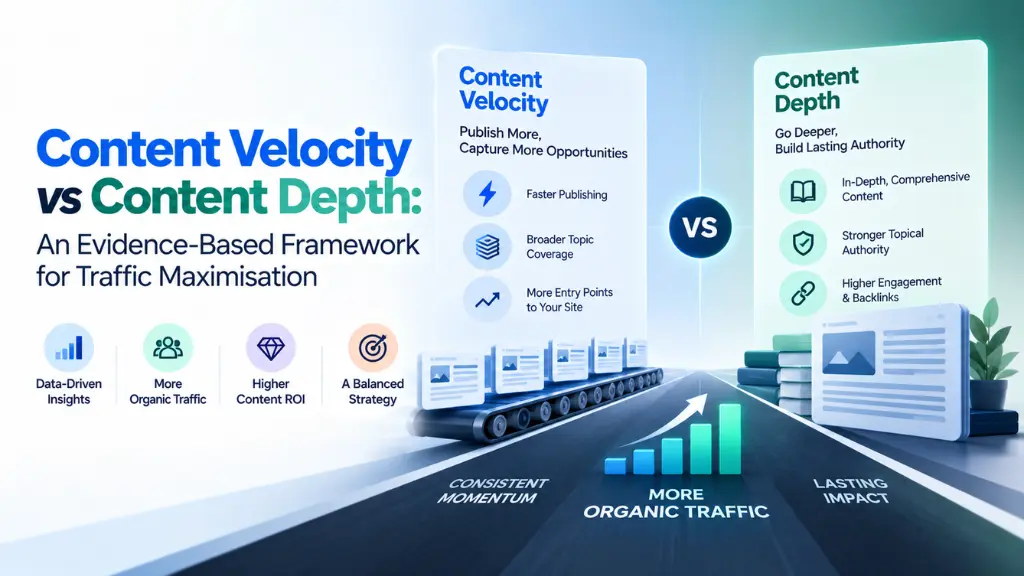
Content velocity refers to how quickly and how often a team publishes new content – measured in pieces per week or month. Content depth refers to how comprehensively a single piece covers its topic – the breadth of subtopics, level of detail, and thoroughness of a given page. Critically, these two things are not opposites of quality. A shallow post can still be well-written and accurate; a long, comprehensive post can still be poorly researched padding. Confusing depth with quality, or velocity with carelessness, is where most of this debate goes wrong before it even starts.
Is More Content Always Better for SEO?
Not unconditionally. Publishing more content increases the number of keywords, entry points, and internal linking opportunities a site can capture, which is a genuine structural advantage. But that advantage only holds if each additional piece clears a real quality and usefulness bar. Once volume outpaces the team’s actual capacity to research, fact-check, and genuinely add value, additional content can dilute a site’s overall quality signal rather than strengthen it – a risk Google’s own systems are specifically designed to catch.
What Does the Data Actually Say About Publishing Frequency?
HubSpot’s blogging benchmark research has repeatedly found a striking gap: companies publishing 16 or more blog posts per month generate roughly 3.5 times more traffic than companies publishing between zero and four posts per month. That’s a meaningful data point, and it’s the number most “publish more” arguments lean on.
But the finding comes with an important caveat that’s easy to skip past: that traffic advantage assumes the higher-volume content still clears a genuine quality bar. Teams that interpret the data as “publish anything, as often as possible” consistently see the opposite result – a site with hundreds of thin, interchangeable pages competing against itself for the same rankings, none of them strong enough to win. The correlation between frequency and traffic is real, but it describes teams that scaled quality alongside volume, not teams that scaled volume alone.
Why Google’s Own Systems Complicate the “Just Publish More” Strategy
This is where the evidence gets genuinely instructive rather than just directional. Google’s Helpful Content system, first introduced as a standalone classifier in 2022 and folded directly into the core ranking systems as of the March 2024 core update, was built specifically to identify and demote content that appears to have been produced primarily to attract search traffic rather than to genuinely help the person searching. Mass-produced content with no meaningful expertise or original value behind it is precisely the pattern this system was designed to catch, regardless of how well individual pages might otherwise be optimized.
Rand Fishkin, the founder of Moz and one of the most widely cited voices in modern SEO, captured this shift succinctly: “Better content is outweighing more content.” That’s not a rejection of publishing frequency – Fishkin has separately made the case that quantity and quality aren’t strictly opposed – but it is a direct challenge to the idea that raw output alone still works the way it once did.
Does Google’s Helpful Content System Punish High-Volume Publishing?
Not inherently, and this distinction matters. The system doesn’t penalize volume itself – plenty of high-volume publishers rank well because every piece genuinely serves a real search intent. What it targets is volume achieved by sacrificing genuine usefulness: content generated primarily to fill a publishing calendar or capture a keyword, without the underlying expertise, originality, or depth a reader actually needs. A site can publish frequently and remain entirely in the clear, provided each individual piece would still be worth reading if search rankings didn’t exist at all.
The Bill Gates Reframe: “Content Is King” Was Never About Word Count
It’s worth revisiting the phrase that started the entire “content is king” mindset in digital marketing, because it’s often misapplied to this exact debate. In his 1996 essay of that title, Microsoft co-founder Bill Gates argued that the internet’s real economic opportunity would come from content itself – the information and experiences that would draw people back to a platform, the way great programming had done for television decades earlier. Nowhere in that argument is a case for volume over value; if anything, Gates’ point was that content earning genuine attention would be what mattered, in a landscape that would eventually be flooded with far more content than anyone could reasonably consume. Thirty years on, that’s essentially the exact problem the content velocity versus depth debate is trying to solve.
Where Depth Genuinely Wins: Competitive and High-Stakes Topics
For competitive commercial queries, detailed comparison content, and anything touching on health, finance, or other genuinely consequential decisions, depth tends to outperform for a specific reason: these topics usually carry complex search intent that a single comprehensive resource satisfies far better than several thinner pieces scattered across a site. Depth also signals the kind of expertise and thoroughness that supports E-E-A-T (Experience, Expertise, Authoritativeness, Trustworthiness) evaluation, which matters more for topics where getting the answer wrong carries real consequences for the reader. A single, genuinely comprehensive guide to a competitive topic will typically outrank multiple shallow posts covering the same ground.
Where Velocity Genuinely Wins: Long-Tail Coverage and Compounding Authority
The opposite holds for long-tail, lower-competition topics, where breaking a broad subject into several focused, atomic pieces – each targeting a specific, narrower query – tends to outperform trying to cram everything into one exhaustive page. This approach also compounds faster: each new piece creates another internal linking opportunity, another entry point for search traffic, and another signal of genuine topical depth across a cluster, provided the pieces are genuinely linked together with deliberate architecture rather than published as disconnected posts. Our Technical SEO blog category covers the internal linking mechanics that make this kind of cluster structure actually work, which pairs naturally with a velocity-driven content calendar.
An Evidence-Based Framework for Deciding, Piece by Piece
Rather than picking velocity or depth as a company-wide philosophy, apply the decision at the level of each content piece:
- For competitive, commercial, or high-stakes topics – prioritize a single, genuinely comprehensive asset over splitting the topic across multiple thinner pages.
- For long-tail, lower-competition topics – prioritize velocity, publishing focused, atomic pieces that build out a cluster rather than one page trying to cover everything.
- Set a non-negotiable quality floor regardless of cadence – genuine expertise, factual accuracy, and original value are not negotiable trade-offs for speed, and Google’s Helpful Content system exists specifically to catch content that treats them as such.
- Match publishing volume to your actual quality capacity, not the other way around. If maintaining a real quality bar means publishing eight pieces a month instead of twenty, eight well-made pieces will outperform twenty mediocre ones nearly every time.
- Measure traffic and engagement per piece, not just total published volume, since a declining average performance per page as output increases is the clearest early warning that velocity has outrun quality capacity.
How Do I Know If My Content Strategy Is Too Fast or Too Slow?
Track average organic traffic and engagement per published piece over rolling quarters – a diagnostic we run regularly for clients at Search Savvy – not just total output. If that per-piece average is climbing alongside publishing volume, your quality floor is holding and velocity is working. If per-piece performance is declining as volume increases, that’s a direct signal the team is publishing faster than it can maintain genuine quality, and it’s usually a clearer, earlier warning sign than an aggregate traffic dip, which can take months to show up.
Bringing It Together: The Hybrid Model That Actually Works
In practice, the most resilient content strategies don’t choose a side in this debate at all – they run a hybrid model. A genuinely comprehensive pillar page anchors a competitive topic with real depth, while a faster-published set of atomic cluster articles targets the long-tail queries around it, each linking back to strengthen the pillar. This is the approach we build out for clients at Search Savvy, because it captures the traffic advantage of velocity without abandoning the depth that competitive rankings and genuine reader trust actually require. Our Content Marketing Services page covers how we typically structure that balance, and our Content Marketing glossary is a useful reference if your team needs to align on shared terminology before mapping out a content calendar.
FAQ: Content Velocity vs Content Depth
Does publishing more content always increase organic traffic? Only when each additional piece meets a genuine quality bar. Higher publishing frequency correlates strongly with more traffic in industry benchmarking data, but that advantage disappears or reverses when volume is achieved by sacrificing genuine usefulness.
Does Google penalize sites for publishing too frequently? No, not for frequency alone. Google’s Helpful Content system targets content that appears designed primarily to capture search traffic without genuinely helping the reader, regardless of how often a site publishes.
Is a longer article always better for SEO than a shorter one? Not automatically. Length matters most for topics with complex or high-stakes search intent, where thoroughness genuinely serves the reader. For narrower, long-tail topics, a focused, shorter piece can outperform an unnecessarily padded one.
What’s a reasonable content publishing frequency for a small business? There’s no universal number, since it depends entirely on your capacity to maintain quality. A team that can only genuinely research and fact-check four strong pieces a month should publish four, not stretch to sixteen at the cost of depth.
How do I know if my content strategy has too much velocity and not enough depth? Track traffic and engagement per published piece, not just total output. A declining average per-piece performance as publishing volume increases is a clear sign quality hasn’t kept pace with speed.
Can content velocity and content depth work together? Yes, and for most competitive niches this hybrid approach outperforms either strategy alone – a comprehensive pillar page providing depth on a core topic, supported by faster-published, focused cluster content covering the long-tail queries around it.
The Bottom Line
Content velocity versus content depth was never really a fair fight, because the honest answer depends entirely on what a given topic and audience actually need. Set a genuine quality floor you won’t compromise regardless of publishing pace, reserve depth for the competitive and high-stakes topics that genuinely require it, and use velocity to build out the long-tail coverage around them. The teams that win this debate aren’t the fastest publishers or the most thorough ones – they’re the ones disciplined enough to know which approach a given piece of content actually calls for.