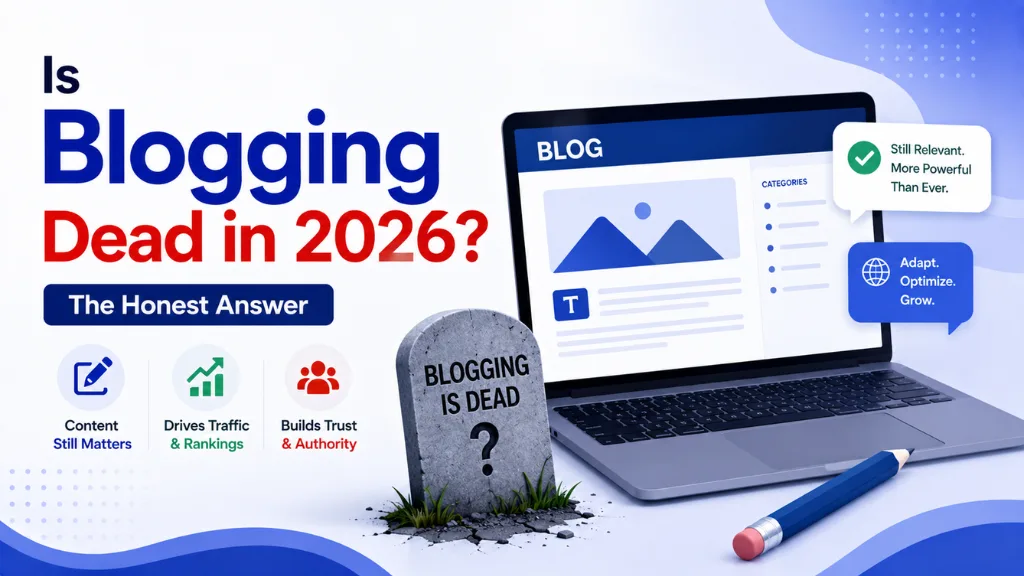
Is Blogging Dead in 2026? The Honest Answer

Somewhere on LinkedIn or Reddit right now, someone is publishing yet another post declaring blogging officially dead. This happens every single year, and every single year the data tells a more complicated story than the headline suggests.
In this article7 sections
Blogging dead in 2026 is a genuinely fair question to ask, given what the traffic numbers show. Global publisher traffic from Google fell 33% year over year as of early 2026, with U.S. sites down 38% specifically, and small publishers pulling 1,000 to 10,000 daily views lost roughly 60% of their search traffic, according to ChatAds’ 2026 affiliate blogging statistics report, citing Chartbeat, Axios, and Reuters Institute data. Those are not small numbers to explain away.
At Search Savvy, we get asked this exact question by clients almost every month, and the honest answer is neither the doom the traffic charts suggest nor the denial some optimistic guides offer. This guide breaks down what the current 2026 data actually shows, and what it means for whether blogging still deserves a place in your strategy.
Why Does the Question “Is Blogging Dead in 2026?” Keep Coming Back?#
Blogging dead in 2026 remains such a persistent question because the traffic-side numbers really have shifted significantly – this is not a manufactured panic without any basis.
Google AI Overviews now reach over 1.5 billion users monthly across more than 200 countries, and Gartner projects traditional search volume will drop 25% by the end of 2026, according to DevTripathi’s 2026 analysis. Chegg’s learning platform, for example, reported a 49% decline in non-subscriber traffic between January 2024 and January 2025, directly tied to AI Overviews answering study questions that previously sent visitors to their site.
Blogging dead in 2026 is also a recurring headline precisely because it keeps getting proven wrong at the aggregate level, even as individual blogs genuinely struggle. Search volume for “is blogging dead” stays steady year after year, largely because writers and marketers want permission to quit a channel that has gotten harder, according to The Stacc’s 2026 data-driven guide. Over 600 million blogs exist worldwide, and roughly 7.5 million new posts publish every single day.
People Also Ask: Has blog traffic actually declined in 2026? Short Answer: Yes, significantly, for many publishers. Global publisher traffic from Google fell roughly 33% year over year as of early 2026, with small publishers hit hardest at around a 60% traffic loss. However, this decline is uneven across blog types, not universal.
What Does the Real 2026 Data Say About Blog Traffic?#
Blogging dead in 2026 requires looking past the panic headlines and toward what specific, sourced numbers actually show – and the picture genuinely splits by blog type, size, and content category.
The clearest evidence of decline sits in comparison and affiliate content specifically. Affiliate sites saw the steepest declines of any tracked category following Google’s March 2026 core update, with 71% of monitored affiliate sites experiencing ranking declines, according to ChatAds’ 2026 report. Queries like “best wireless mouse” are exactly the comparison-shaped questions an AI Overview is built to summarise in three sentences, meaning the reader never sees the post that took days to research and write.
At the same time, blogs remain disproportionately cited by AI systems compared to other content types. A Search Engine Land study found that blogs appear in 23% of the top five Google positions – no other content type shows up that often, according to BloggersPassion’s 2026 analysis. AI Overviews intercept a meaningful share of clicks, but 58% of Google searches in the U.S. now end without anyone clicking any website at all – a zero-click trend affecting all content types, not blogging specifically.
People Also Ask: Which type of blog content has suffered the most in 2026? Short Answer: Affiliate and comparison-shopping content has been hit hardest, since AI Overviews can summarise “best X” and “X vs Y” queries directly on the results page. Blogs offering genuine expertise, original data, or depth continue performing comparatively well.
Does Being Cited by AI Actually Compensate for Lost Clicks?#
Blogging dead in 2026 misses an important counterweight: the clicks that do survive AI search exposure are measurably more valuable than the ones that disappeared.
Brands that get cited inside AI answers earn 35% more organic clicks and 91% more paid clicks than brands that are not cited – even accounting for the overall click-through decline, according to DevTripathi’s 2026 analysis. This is not a minor consolation; it is a genuinely stronger result for the specific traffic that remains, precisely because AI-cited visitors arrive already informed and higher-intent.
Blog content also still influences business outcomes even when it never generates a click at all. AI systems pull from multiple sources – blog content, YouTube clips, forums – and reward blogs that fulfil specific requisites around structure and depth, according to Lasso Up’s 2026 guide. Being the source an AI system cites, quotes, or paraphrases still builds brand recognition and trust, even without the traffic to prove it in a traditional analytics dashboard.
People Also Ask: Is it worth optimising a blog for AI citation if it doesn’t send traffic? Short Answer: Yes. Brands cited inside AI answers see meaningfully higher click-through rates on the traffic that does come through, plus broader brand visibility and trust-building even without a click – making AI citation a genuine, if different, form of ROI.
Do Readers Still Actually Read Blog Posts in 2026?#
Blogging dead in 2026 assumes reader demand has collapsed alongside search traffic, but the underlying audience data tells a genuinely different story.
77% of internet users still read blog posts regularly, representing roughly 4 billion people – more than double the monthly active user base of TikTok, according to The Stacc’s 2026 guide, citing Hostinger’s 2026 research. The reading audience has not meaningfully shrunk. What has changed is that attention has fragmented across a much larger volume of published content, which is exactly why publishing cadence and differentiation matter more than they used to.
Businesses with an active blog also continue to outperform those without one on concrete business metrics. Businesses that blog generate 67% more leads and are 13 times more likely to see positive ROI than businesses that do not, according to The Stacc’s 2026 blogging statistics report. Long-form content specifically – 3,000 words or more – gets roughly three times more traffic than average-length posts.
People Also Ask: Do people still read long blog posts, or has attention shifted entirely to video? Short Answer: People still read blog posts regularly – roughly 4 billion internet users globally, according to 2026 research. Long-form content specifically continues to outperform shorter posts, generating roughly three times more traffic on average.
Which Blogs Are Actually Struggling, and Which Are Growing?#
Blogging dead in 2026 is a misleading framing precisely because it treats all blogs as one category, when the real 2026 data splits sharply between two genuinely different outcomes.
Standalone, ad-revenue-driven blogs with a weak future are struggling – the old model built entirely on volume, generic comparison content, and display ad revenue from a large but shallow audience. Business blogs tied to a genuine product, service, or revenue channel show a considerably stronger outlook, according to The Stacc’s 2026 analysis. The dividing line is not “blogging” as a category – it is business model.
The same pattern shows up in one blogger’s honest, self-described opinion: Chad Wyatt’s 2026 analysis argues that blogging is genuinely difficult for new starters chasing organic traffic alone, but remains “just fine” for business blogs and already-established, reputable sites with existing authority and distribution beyond Google search.
- Struggling – new, traffic-only blogs; affiliate comparison content; sites with no secondary distribution channel
- Growing or stable – business blogs tied to a product or service; blogs with an email list or community; blogs demonstrating genuine, differentiated expertise
People Also Ask: Is it harder to start a new blog from scratch in 2026 than it used to be? Short Answer: Yes, meaningfully. New blogs relying entirely on organic search traffic face a much steeper climb than in previous years. Blogs with an existing audience, secondary distribution channels, or a clear business purpose beyond ad revenue face a considerably easier path.
What Should You Actually Do If You’re Blogging in 2026?#
Blogging dead in 2026 should not be the framing that determines your strategy – the more useful question is what specific adjustments make a blog resilient against the traffic shifts already underway.
According to Search Savvy’s insights from managing content strategy across client industries, the businesses seeing the strongest results are the ones treating their blog as one node in a broader distribution system, not a standalone traffic engine dependent entirely on Google.
A practical adjustment checklist for 2026:
- Structure content for AI extraction – direct answers in the first one to two sentences, clear question-based headings, and FAQ sections that AI tools can cite easily
- Build at least one secondary distribution channel – email, LinkedIn, YouTube, or a community – so traffic is not entirely dependent on Google
- Go deeper, not just longer – long-form content still outperforms, but only when it contains genuine expertise, not padded word count
- Update existing content every three to six months – outdated statistics and broken links quietly erode both rankings and reader trust
- Use AI for production speed, not strategy – 94% of marketers now use AI in their content workflow, but strategic direction and voice still need human judgment
- Measure beyond raw pageviews – track lead quality, AI citation frequency, and email signups alongside traditional traffic metrics
At Search Savvy, we recommend starting with an email list specifically, even a small one – it is consistently the fastest way to build a traffic source that does not depend on any single search algorithm’s decisions.
FAQ: Is Blogging Dead in 2026?#
Q1: Is blogging dead in 2026? A: No, but the old traffic-first model built entirely on Google clicks is genuinely struggling. Blogs tied to a real business, differentiated expertise, and multiple distribution channels continue to perform well and generate real leads and revenue.
Q2: How much has blog traffic actually declined in 2026? A: Global publisher traffic from Google fell roughly 33% year over year as of early 2026, with small publishers experiencing losses closer to 60%. The decline is uneven, hitting affiliate and comparison content hardest while genuinely expert, original content fares better.
Q3: Should I stop blogging and focus entirely on video or social media instead? A: Not necessarily. Blogging and video serve complementary roles – blog content still gets cited disproportionately by AI search systems, and long-form written content supports SEO, authority building, and email nurturing in ways short-form video generally does not replicate alone.
Q4: Is it too late to start a new blog in 2026? A: It is harder than it used to be, particularly for blogs relying solely on organic Google traffic. Starting with a clear business purpose, a secondary distribution channel like email or social media, and a specific, differentiated niche significantly improves the odds.
Q5: Do AI Overviews mean my blog traffic will never recover? A: Not necessarily. Blogs that adapt – structuring content for AI citation, building non-search-dependent audiences, and focusing on genuine depth over volume – are seeing comparatively stable or growing results, even as the overall search landscape shifts.
Q6: What is the single biggest mistake bloggers make in 2026? A: Relying entirely on Google for traffic with no secondary distribution channel. Bloggers who diversified into email, LinkedIn, YouTube, or community-building before their search traffic declined generally weathered the 2026 shifts far better than those who did not.
Not sure whether blogging still makes sense for your business in 2026? Visit Search Savvy to speak with a content strategy expert who can build a plan grounded in what’s actually working right now.