What Is Content Marketing and How Does It Work in 2026?
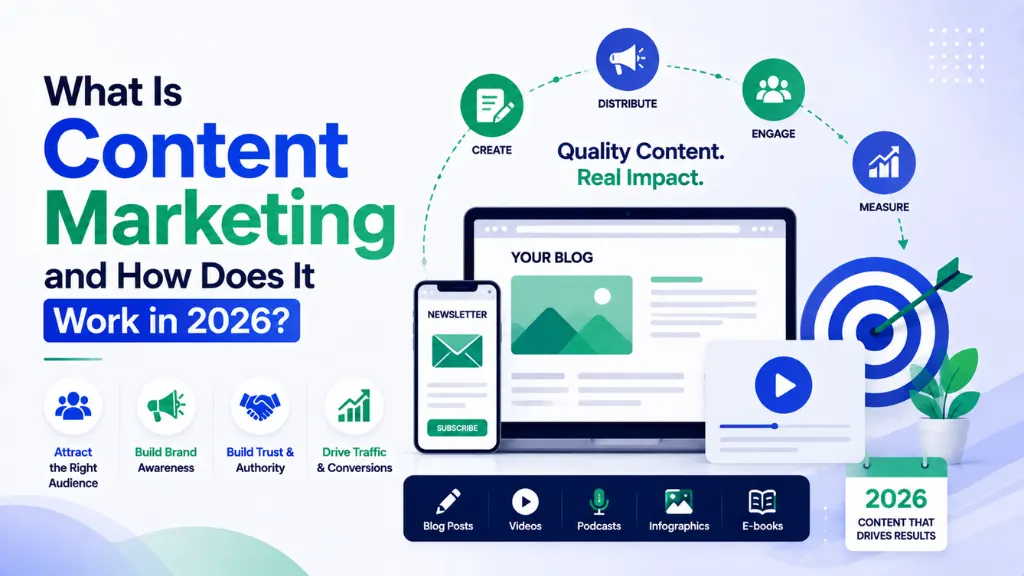

Every business technically “does content” in some form – a blog post here, a social caption there. Content marketing is something more deliberate than that: a documented strategy built around a specific audience, a consistent publishing rhythm, and a measurable business goal.
In this article8 sections
Content marketing generates roughly three times more leads at about 60% lower cost than outbound tactics, returning close to $3 in revenue for every $1 invested, compared to roughly $1.80 per $1 for many paid advertising benchmarks, according to SQ Magazine’s 2026 content marketing statistics report. That gap is exactly why 97% of B2B marketers now report having a documented content strategy in place.
At Search Savvy, content marketing sits at the core of nearly every client engagement we run, because it remains one of the few marketing channels whose return compounds over time rather than resetting the moment spend stops. This guide breaks down exactly what content marketing is, how it works in 2026, and what the current data shows about doing it well.
What Is Content Marketing, Exactly?#
Content marketing is a strategic approach to creating and distributing valuable, relevant content – consistently, and built around a specific audience – with the goal of attracting and retaining customers, rather than interrupting them with a direct sales pitch.
Unlike traditional advertising, content marketing works by earning attention through genuinely useful information, entertainment, or education, then converting that attention into trust and eventually revenue. Companies with a documented content strategy are 3.5 times more successful than those without one, according to Omnibound’s 2026 ROI statistics, citing Content Marketing Institute research – the “strategy” part is not optional if the approach is going to work.
Content marketing spans a genuinely wide range of formats in 2026. The most common content types marketers use are online articles, videos, product reviews, case studies, and webinars, according to EntrepreneursHQ’s 2026 statistics report, citing Content Marketing Institute data. Blogs specifically remain foundational – 79% of marketers are still actively running one, according to DemandSage’s 2026 report.
People Also Ask: How is content marketing different from advertising? Short Answer: Advertising interrupts an audience with a direct sales message. Content marketing earns attention by providing genuinely useful information, entertainment, or education first, building trust that leads to a purchase decision over time rather than immediately.
How Does Content Marketing Actually Work in 2026?#
Content marketing works through a documented, repeatable strategy – not through publishing content sporadically whenever inspiration strikes or a competitor does something noteworthy.
73% of B2B marketers and 70% of B2C marketers now have a documented content marketing strategy, and organizations with documented strategies generate three times more leads per dollar spent than those without, according to DigitalApplied’s 2026 statistics report. That gap continues widening as AI tools make strategic execution more efficient specifically for teams that already have a clear framework in place.
Content marketing budgets have grown to reflect this shift. Content marketing budgets have risen to roughly 26% of total marketing spend in 2026, with the average marketing organization now allocating more than a quarter of its total budget to content, per the same DigitalApplied analysis. This budget growth reflects genuine measured returns, not just industry momentum – 61% of B2B marketers plan to increase content-related spend specifically in 2026, according to SQ Magazine’s data.
People Also Ask: Does having a documented content strategy actually improve results? Short Answer: Yes, substantially. Companies with a documented content strategy are 3.5 times more successful than those without one, and generate roughly three times more leads per dollar spent, according to 2026 industry research.
Why Has AI Changed How Content Marketing Works?#
Content marketing has shifted meaningfully in 2026 because generative AI tools are now embedded throughout the content creation workflow, changing both how fast content gets produced and what skills actually differentiate strong content from generic output.
89% of marketers now use generative AI tools as part of their content marketing process, according to EntrepreneursHQ’s 2026 report, and 68% of businesses report seeing increased content marketing ROI specifically because of AI adoption, per DemandSage’s 2026 statistics. The typical AI workflow splits clearly by task: 74% of content marketers use AI for ideation, 61% for outlining, and 44% for drafting, according to The Stacc’s 2026 report, citing Siege Media data – AI handles research and structure, while humans still handle voice and strategy.
This shift has also introduced genuine new concerns worth naming honestly. 29% of marketers cite AI-generated content oversaturation as their top concern in 2026, and 59% of digital media professionals worry specifically about AI content inaccuracies and hallucinations harming brand quality, according to SQ Magazine’s 2026 report. This tension – genuine efficiency gains alongside genuine quality risk – defines much of the current content marketing conversation.
People Also Ask: Do marketers still write content themselves, or does AI do it all? Short Answer: Mostly a hybrid approach. Most marketers use AI heavily for ideation, outlining, and initial drafting, but retain human judgment for final voice, strategy, and accuracy checks – full AI automation without human review is generally discouraged given documented hallucination and quality risks.
How Should Content Marketing Adapt to Declining Organic Clicks?#
Content marketing now has to account for a structural shift in how search traffic behaves, since a meaningful share of searches never result in a click through to any website at all, including yours.
Google AI Overviews now reduce position-one click-through rates by roughly 58%, and 44% of consumers now describe AI as their primary search source, according to QuickSEO’s 2026 content marketing ROI report. Separately, 60% of searches now end without any click at all, and 30% of marketers report decreased organic traffic specifically tied to growing consumer reliance on AI search tools, per Realize’s 2026 statistics report.
Despite this shift, organic search remains the largest single traffic source most businesses have. Organic search still drives 53% of all trackable website traffic – more than any other single channel – according to Omnibound’s 2026 report, citing BrightEdge data. This is exactly why 92% of marketers now say they specifically optimize content for AI search engines, per The Stacc’s 2026 statistics, rather than treating traditional and AI search as entirely separate content strategies.
People Also Ask: Is content marketing still worth it if AI search is reducing clicks? Short Answer: Yes. Organic search still drives more trackable traffic than any other single channel, and content cited within AI search results still builds brand awareness and trust, even when it does not always produce a direct click.
What Content Formats Perform Best in Content Marketing in 2026?#
Content marketing performance varies significantly by format, and 2026 data shows a fairly clear hierarchy emerging between the formats generating strongest engagement and those simply maintaining baseline presence.
Short-form video generates roughly 2.5 times more engagement than long-form video, according to The Stacc’s 2026 report. Video overall remains a major traffic driver – video marketing has helped 87% of marketers increase website traffic, per EntrepreneursHQ’s 2026 data, citing Wyzowl research. Email marketing continues to deliver the strongest raw ROI of any content channel, returning $36–$42 for every $1 spent, according to Omnibound’s 2026 statistics.
A practical format priority breakdown:
- Blogs and long-form articles – foundational for SEO authority; still used by 79% of marketers
- Short-form video – strongest engagement rate; ideal for awareness and top-of-funnel reach
- Case studies – used by 75% of B2B marketers; strong for mid-to-late-funnel trust building
- Email newsletters – highest raw ROI; most effective for nurturing existing leads
- Webinars – used by 72% of marketers; strong for high-consideration B2B decisions
People Also Ask: What content format delivers the highest ROI in 2026? Short Answer: Email marketing delivers the highest raw ROI of any content channel, returning $36–$42 for every $1 spent. Short-form video delivers the strongest engagement rate specifically, making it particularly effective for top-of-funnel brand awareness.
How Do You Actually Measure Content Marketing Success?#
Content marketing measurement remains a genuine, widely acknowledged weak point across the industry – most businesses invest heavily in content without a reliable way to prove what that investment actually returned.
Only 42% of marketers can accurately prove content marketing ROI, yet being in that measuring group unlocks 3.1 times greater budget growth, according to DigitalApplied’s 2026 analysis. Separately, 56% of B2B marketers struggle to attribute ROI to content efforts specifically, according to Omnibound’s 2026 report, citing Content Marketing Institute and Genesys Growth data.
According to Search Savvy’s insights from managing client content programs, the businesses that measure well typically track a consistent, small set of metrics rather than chasing every available data point:
- Revenue impact – the most direct, though hardest to attribute cleanly, tracked by 33% of marketers as their primary ROI metric
- Lead quality and conversion rate – tracked by 27% of marketers, often more actionable than raw lead volume
- Organic traffic and search visibility – a leading indicator, particularly important given the shift toward AI search visibility
- Content-assisted pipeline – tracking how content contributes across the full customer journey, not just the final touchpoint before conversion
People Also Ask: Why do so many marketers struggle to measure content marketing ROI? Short Answer: Attribution complexity is the main reason – content often influences a purchase decision well before the final conversion touchpoint, making it hard to cleanly credit a single piece of content. Only 42% of marketers currently manage to measure ROI accurately.
How Should You Build a Content Marketing Strategy That Actually Works?#
Content marketing strategy should start with documentation and measurement built in from day one, rather than treated as an afterthought once content is already being produced regularly.
At Search Savvy, we recommend a practical starting framework for any business building or refreshing a content marketing strategy:
- Document your strategy formally – even a simple one-page framework outperforms an undocumented, ad-hoc approach significantly
- Define your primary and secondary content formats based on where your specific audience spends attention, not just industry trend chasing
- Set a small number of measurable goals – revenue impact, lead quality, or organic visibility – rather than tracking everything at once
- Build AI into your workflow deliberately – for ideation, outlining, and drafting speed – while keeping human review for accuracy and brand voice
- Optimise content for both traditional and AI search simultaneously, since both remain genuine, overlapping traffic and visibility sources
- Review performance quarterly and adjust format mix based on what the data actually shows, not assumptions carried over from the previous year
According to Search Savvy’s insights from working with Indian and international clients, the single biggest predictor of content marketing success is not the specific tools or formats used – it is whether the strategy is actually documented, measured, and revisited on a regular schedule.
FAQ: Content Marketing#
Q1: How long does content marketing take to show measurable results? A: Generally three to six months for initial traction, with more substantial results building over six to twelve months. Content marketing compounds over time, unlike paid advertising, which stops generating results the moment spend stops.
Q2: Is content marketing only relevant for B2B businesses? A: No. While B2B adoption rates are well documented, B2C brands use content marketing extensively too, particularly through video, social content, and email, with 90% of marketers overall using social media specifically to share and distribute content.
Q3: How much of a marketing budget should go toward content marketing? A: There is no universal figure, but 2026 data shows the average marketing organization now allocates roughly 26% of total marketing spend to content specifically. The right figure depends on your industry, sales cycle, and current content maturity.
Q4: Does AI-generated content perform as well as human-written content? A: It depends heavily on how it is used. AI-assisted content combined with human review and strategic direction can perform well, but fully automated content without human oversight risks inaccuracies and generic quality that measurably hurts brand trust.
Q5: What is the biggest mistake businesses make with content marketing? A: Publishing without a documented strategy or clear measurement plan. Businesses with a documented content strategy are 3.5 times more successful, yet a majority of marketers still struggle to accurately measure what their content investment is actually returning.
Q6: Should content marketing strategy change because of AI Overviews and AI search? A: Yes, in emphasis rather than fundamentals. Content should still prioritise genuine usefulness and clarity, but now also needs deliberate structuring for AI extraction and citation, alongside traditional SEO, since both remain significant visibility sources in 2026.
Want help building a documented, measurable content marketing strategy for your business? Visit Search Savvy to speak with a content marketing expert who can build a plan tailored to your goals.