

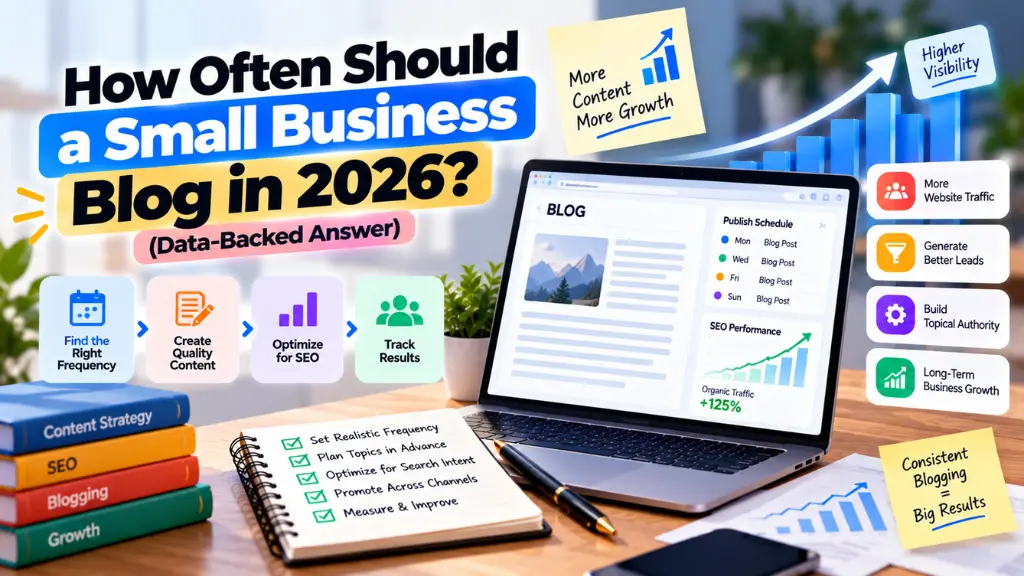

For most small businesses, 2–4 well-researched blog posts per month, published on a schedule you can sustain for at least a year, produces better SEO results than publishing more often with less care. That’s the short answer. The longer answer – and the one that actually matters – is that publishing frequency is not a direct Google ranking factor. It’s a proxy for two things that are: topical coverage and consistency. Get those two right, and the specific number of posts per month matters far less than most advice implies.
This guide breaks down what the current research actually shows about blogging frequency and SEO, why “more content” stopped being a safe strategy once AI made it trivial to produce, and how to pick a cadence that fits your business stage instead of copying a number from a blog post that doesn’t know your resources.
Is There an Ideal Blogging Frequency for SEO?
There’s no single ideal number, but most credible research converges on a practical range: 2–4 posts per month for established small businesses, and 4–8 per month for newer sites still building topical coverage. Google’s own representatives have repeatedly stated that publishing frequency itself is not a ranking signal – what matters is whether each piece of content is genuinely useful and whether the site maintains a consistent standard across everything it publishes.
Former Google Search Advocate John Mueller has made this point directly in Google’s own “Search Off the Record” discussions, comparing attempts to substitute quantity for quality to trying to get children to prefer kale over ice cream simply by serving more kale – the volume doesn’t change the underlying appeal. The practical implication: publishing eight thin posts a month will not outperform four thorough ones, and it can actively hurt you by diluting the average quality signal Google’s Helpful Content system evaluates across your site.
What Independent Data Shows About Publishing Frequency
Several content platforms have published longitudinal data on this question in 2026, and the pattern is consistent. One 12-month analysis across 77 blogs found that a “steady” cadence of 6–20 posts per month produced a median organic growth rate of around 153%, actually outperforming a “heavy” cadence of 21–100 posts per month, which landed closer to 139%. The same research also documented a counterintuitive finding worth taking seriously: one site’s organic traffic grew 29% during a four-month stretch with zero new publishing, because existing posts continued climbing in rankings while the site’s Helpful Content standing held steady.
That doesn’t mean publishing doesn’t matter – it means content compounds, and a burst of new posts followed by silence produces different (and often worse) results than steady, moderate output sustained over time.
Blogging Frequency and SEO: What the Correlation Actually Means
Businesses that blog more frequently tend to show stronger lead generation numbers, but the relationship is correlational, not causal – the businesses with resources to sustain high-frequency publishing are often the same businesses with the content strategy, internal linking, and distribution to make each post work. HubSpot’s long-running benchmark research has found that companies publishing 16 or more posts a month generate roughly 4.5x more leads than those publishing 0–4 times a month. That’s a striking number, but it describes companies with content teams large enough to sustain that pace without sacrificing quality – not a guarantee that any business hitting 16 posts a month will see the same lift.
For context on where most small businesses actually sit: Orbit Media’s ongoing blogger survey research has repeatedly found that the average business blog publishes somewhere between two and four posts per month, which lines up with what most SEO practitioners consider a realistic, sustainable baseline rather than an aspirational minimum.
A separate, more directly relevant data point: content marketing research has found that smaller businesses are about 23% more likely than average to report positive ROI from blog content specifically, even though they typically publish far less than the 16+ posts per month associated with the highest lead-generation numbers. The takeaway isn’t “publish more” – it’s that a focused, well-targeted blog can outperform a high-volume one even at a fraction of the output, provided the content is built around topics your actual customers search for.
Content Publishing Cadence by Business Stage
The right cadence depends heavily on where your site currently stands, not a fixed industry rule. Use this as a starting framework rather than a mandate.
| Business Stage | Recommended Cadence | Why |
| New site, fewer than 20 posts | 4–8 posts/month | You need topical coverage before you need depth – Google has little to evaluate yet |
| Established site, growing | 2–4 posts/month, plus one content update per new post | Coverage exists; the priority shifts to depth, freshness, and internal linking |
| Established and plateaued | 1–2 posts/month, with most effort spent updating older content | New posts alone won’t move a mature site; refreshing underperforming pages often has higher ROI |
A newer site benefits from a faster initial pace because it’s competing from a standing start with few indexed pages capable of ranking for anything. Once a business has solid coverage of its core topics – the questions its customers actually ask before buying – the marginal value of a ninth post in a month drops sharply compared to improving the four posts already published.
Blog Consistency Matters More Than Raw Frequency
Blog consistency – publishing on a predictable schedule you can maintain indefinitely – matters more for SEO than hitting any specific number of posts per month, because an erratic pattern of bursts and long gaps signals an inactive or abandoned site to both readers and search engines. A business that commits to two posts a month and holds that pace for two years will typically outperform one that published twelve posts in January and nothing again until September.
This is also a practical resourcing issue. A genuinely useful, well-researched blog post that meets current quality expectations typically takes several hours of research, writing, and editing to produce properly – rushing that process to hit an artificial frequency target is the most common way small businesses end up with a blog full of thin, forgettable content that does nothing for rankings or conversions. Search Savvy sees this pattern often with new clients: a business that was publishing weekly on autopilot gets far better results after cutting back to a slower pace built around an actual content strategy and topical authority plan than it ever did chasing a frequency target.
Content Quality vs. Quantity: Why This Debate Is Mostly Settled
Content quality consistently outweighs publishing quantity in SEO outcomes, because Google’s Helpful Content system evaluates the proportion of genuinely useful pages on a site rather than rewarding raw volume, and publishing low-value content at scale can drag down how the system perceives your entire domain. This is not a new finding, but it has sharpened considerably since AI writing tools made it trivial to generate large volumes of mediocre content quickly.
Google has been explicit that AI-assisted content isn’t penalized for how it was produced – the evaluation is based on whether the content is helpful, accurate, and demonstrates real expertise, regardless of the tools used to create it. The practical risk for small businesses isn’t using AI in the writing process; it’s mistaking speed for strategy and publishing content that restates generic information already available on a hundred other sites, just because the production cost dropped to nearly zero. A thin AI-generated post and a thin human-written post face the same ceiling under Google’s quality evaluation.
Where this leaves most small businesses: it is entirely possible to see meaningful SEO results from one genuinely excellent, deeply researched post a month, provided it targets a specific, low-to-moderate competition topic your customers are actually searching for. It is equally possible to publish daily and see nothing move, if every post repeats what’s already ranking.
Building a Posting Schedule for SEO That You Can Actually Keep
- Audit your current coverage. List the questions your sales or support team gets asked most often – these are usually the highest-intent topics you’re missing, and a better starting point than keyword tools alone.
- Pick a frequency you can sustain in month eleven, not week one. The schedule that survives a busy quarter beats the ambitious one that collapses after six weeks.
- Build a simple content calendar that maps each post to a specific customer question or stage of the buying journey, so frequency has a purpose attached to it rather than existing for its own sake.
- Reserve time for updates, not just new posts. Refreshing an older post that already has some rankings or impressions is frequently higher-leverage work than publishing something new from zero.
- Track engagement and conversions, not just publishing volume. If increasing frequency improves traffic, time on page, and leads together, keep the pace. If it doesn’t move any of the three, the content needs more depth before it needs more volume.
- Connect posts internally so new content strengthens existing pages rather than competing with them for the same keyword – this is a core part of how keyword research should inform a publishing calendar rather than happening as an afterthought, which is one of the first gaps Search Savvy looks for when auditing an underperforming blog.
Common Mistakes Small Businesses Make With Blogging Frequency
- Copying a competitor’s publishing pace without the resources or content strategy behind it, producing thinner posts just to match volume.
- Front-loading a burst of content, then going silent for months, which undermines the consistency signal more than publishing slowly from the start would have.
- Treating frequency as the goal instead of the byproduct of a working content strategy aimed at specific customer questions.
- Ignoring older posts entirely in favor of new ones, even when a refresh of an underperforming page would move the needle faster.
- Using AI to scale volume without adding original research, examples, or expertise, which produces content indistinguishable from dozens of competing pages.
- Abandoning a schedule after a few months with no visible results, when most SEO content – regardless of frequency – takes three to six months to show meaningful ranking movement.
The Bottom Line
The honest, data-backed answer to “how often should a small business blog” is: as often as you can sustain real quality, and not once more than that – with 2–4 posts a month as a realistic baseline for most established small businesses, and a faster initial pace for brand-new sites still building coverage. Frequency is a proxy for consistency and topical depth, not a ranking factor in itself, so a business publishing less but researching more will generally outperform one chasing a number it can’t sustain. At Search Savvy, this is usually the first conversation we have with new clients before building out a publishing calendar, because a schedule that collapses after two months does more damage to a site’s momentum than a slower, honest cadence ever would. If your blog’s current output isn’t translating into rankings or leads, the fix is rarely “publish more” – it’s usually a gap in content marketing strategy that no amount of extra volume will close on its own.
Frequently Asked Questions
Is publishing frequency a Google ranking factor? No. Google’s representatives have repeatedly confirmed that how often you publish is not a direct ranking signal. It correlates with rankings because consistent publishing tends to build broader topical coverage and signals an active, maintained site – those are the actual mechanisms behind the correlation.
How many blog posts per month should a small business publish? Most established small businesses see solid results with 2–4 well-researched posts per month. Newer sites with little existing content often benefit from a faster initial pace of 4–8 posts per month to build topical coverage before shifting to a steadier, lower-volume schedule.
Can I get SEO results blogging only once a month? Yes, if each post is deep, original, and targets a specific, realistic-competition topic your customers are actually searching for. One excellent post a month consistently outperforms several thin ones.
Does AI-generated content need to be published less often? No – frequency isn’t the issue, depth is. Google’s guidance states that AI-assisted content is judged the same way as any other content: on whether it’s genuinely helpful and demonstrates real expertise, not on the tool used to produce it.
How long does it take for a new blog post to start ranking? Most posts take three to six months to show meaningful ranking movement, depending on competition, site authority, and content quality. Some see early impressions within weeks, but durable rankings generally build over a longer horizon.
Should I focus on new posts or updating old ones? Both, but updating underperforming older posts is often the higher-leverage move, since those pages may already have some history, impressions, or backlinks that a brand-new post would need to build from zero.