How to Write a Blog Introduction That Stops People from Bouncing
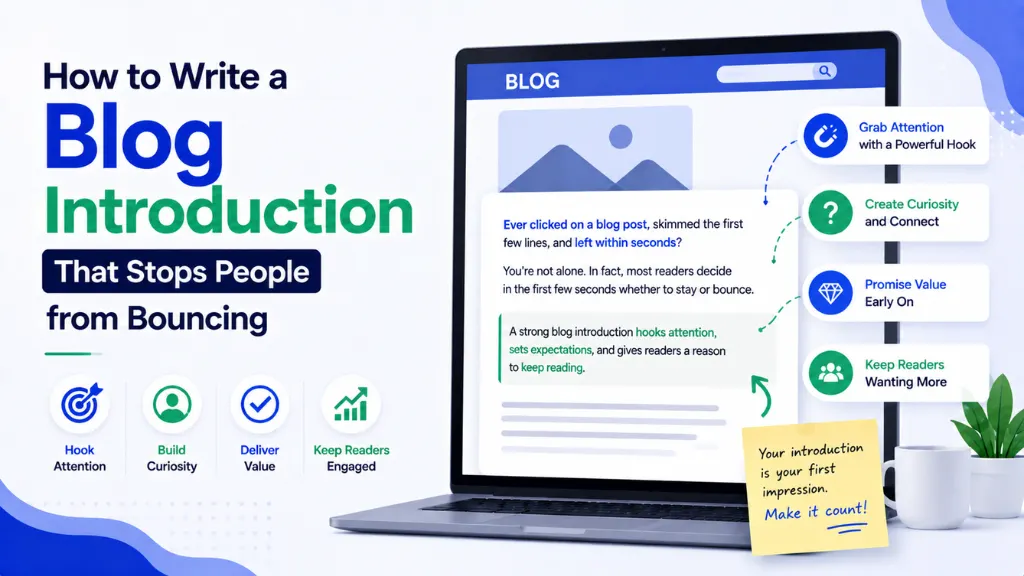

You have roughly ten seconds, maybe less, before a reader decides whether your blog post is worth their time. Everything you spent hours researching and writing lives or dies on the strength of the first few sentences someone actually reads.
In this article8 sections
Write a blog introduction that fails to earn attention immediately, and the rest of the post essentially does not matter – because most readers never get there. Blogs and content-heavy websites experience some of the highest bounce rates of any site category, typically running 70% to 90%, according to Causal Funnel’s 2026 industry benchmark report. A well-crafted introduction is one of the few genuinely controllable levers standing between a reader staying and a reader leaving.
At Search Savvy, introduction quality is one of the first things we review when auditing underperforming client content, because it is consistently the highest- leverage, lowest-effort fix available. This guide breaks down exactly how to write a blog introduction that keeps readers scrolling, using current 2026 data and proven structures.
Why Does It Matter So Much How You Write a Blog Introduction?#
Write a blog introduction with real intention, because the decision to stay or leave happens within seconds – long before a reader has any real sense of whether your content will actually answer their question.
In just a few seconds, readers decide whether to stay or leave a page, making the opening section genuinely powerful – a weak intro increases bounce rate, while a strong one keeps visitors scrolling, according to The Ocean Marketing’s 2026 guide on reducing bounce rate. This is not a minor stylistic concern – it is the moment where months of SEO, strategy, and promotion either pay off or get wasted entirely.
Write a blog introduction while keeping context in mind, since not every bounce is actually bad. A 65% bounce rate on a blog post that fully answers a single, specific question can be perfectly healthy, while the same number on a page meant to drive deeper engagement is a real warning sign worth investigating, according to Cufinder’s 2026 bounce rate guide. Understanding this distinction matters before assuming every bounce reflects a weak introduction.
People Also Ask: What is considered a normal bounce rate for a blog in 2026? Short Answer: Blogs typically see bounce rates between 70% and 90%, considerably higher than e-commerce or SaaS sites, largely because many readers arrive through search, get their answer, and leave. Context matters more than the raw percentage – a single-question post bouncing high can still be healthy.
What Should the First Sentence of a Blog Introduction Actually Do?#
Write a blog introduction where the first sentence carries the heaviest lift of the entire post – it is consistently described as the single most critical element in determining whether a reader stays or leaves.
The first sentence should instantly capture attention and spark curiosity without being misleading or exaggerated, according to The Ocean Marketing’s 2026 guide. A powerful hook can take the form of a bold statement, a relatable problem, a surprising statistic, or a genuinely thought-provoking question – but whichever format you choose, it needs to feel earned by the content that follows, not exaggerated purely to grab attention.
This opening line is often called the lead sentence, and it carries the core idea of the entire article. Without a strong lead sentence, creating a genuinely interesting introduction becomes significantly harder, according to SmartWriter’s 2026 analysis of emotionally effective blog intros. A compelling opening line measurably increases how deeply readers engage with the content that follows it.
People Also Ask: What makes a strong first sentence in a blog introduction? Short Answer: A strong first sentence is a bold statement, a relatable problem, a surprising statistic, or a genuine question – delivered without exaggeration or misleading claims. It should instantly connect to what the reader was searching for, not simply try to shock or surprise.
What Is the Proven Structure Behind a Blog Introduction That Works?#
Write a blog introduction using a repeatable three-part structure, rather than starting from a blank page each time – a consistent framework makes strong introductions achievable at scale, not just occasionally, when inspiration strikes.
A well-built introduction generally follows three parts: hook, transition, and preview, according to SmartWriter’s 2026 guide. The hook attracts the reader with a brief, specific, and genuinely interesting opening; the transition moves the reader from that hook into the substance of the post; and the preview signals clearly what the article will actually deliver.
- Hook – a bold statement, relatable problem, surprising statistic, or open-ended question; kept brief and specific
- Transition – a bridge sentence connecting the hook to the article’s actual subject, signalling the reader is moving into the substance
- Preview – a clear signal of what the post will cover, so the reader knows exactly what they are committing their time to
People Also Ask: Do all blog introductions need to follow the same three-part structure? Short Answer: Not rigidly, but the hook-transition-preview pattern is a reliable, repeatable framework. Even introductions that feel more creative or narrative usually still accomplish these three functions, just with more stylistic variation in how they get there.
How Does Write a Blog Introduction Connect to Search Intent?#
Write a blog introduction that aligns tightly with what the reader was actually searching for, since a mismatch between search intent and opening content is one of the fastest ways to lose a reader within seconds of arrival.
A well-crafted introduction aligns with search intent, provides immediate clarity, and builds trust – this reduces hesitation and increases the likelihood of deeper interaction with the rest of the content, according to The Ocean Marketing’s 2026 guide. A reader who searched a specific question and lands on an introduction that meanders before addressing it has already begun mentally drafting their exit.
This intent-matching also supports deeper engagement across your broader site, not just the single page. Engaged readers who trust an introduction’s relevance are more likely to continue navigating related sections of a website afterward, creating a smoother user journey that supports both retention and overall site value, per the same source – meaning a strong introduction’s benefit extends well beyond the single post it opens.
People Also Ask: Why does matching search intent matter more than clever writing in an introduction? Short Answer: Because a reader who arrived searching a specific question wants confirmation, fast, that your content actually answers it. Clever or creative writing that delays that confirmation risks losing the reader before they ever discover whether your content is genuinely useful to them.
How Should You Write a Blog Introduction for Skimmers Versus Readers?#
Write a blog introduction that works for both behaviours simultaneously, since most visitors arrive intending to scan first and commit to reading only once the scan confirms genuine relevance.
Content should be easily scannable, ensuring readers know exactly what they are getting into even before reading the full introduction closely, according to Digital Web Solutions’ 2026 bounce rate guide. This means formatting choices – short paragraphs, clear structure, and an easily digestible opening – matter nearly as much as the actual wording of the introduction itself.
Practical formatting principles for scannability:
- Keep introduction paragraphs short – two to four sentences maximum per paragraph
- Avoid burying the core promise of the article several sentences deep into the introduction
- Use simple, direct sentence structures rather than long, complex ones requiring careful parsing
- Make the article’s value obvious within the first two sentences, even to someone only skimming
People Also Ask: Should a blog introduction be written differently for mobile readers? Short Answer: The core structure stays the same, but shorter paragraphs and simpler sentence construction matter even more on mobile, since mobile sessions bounce at a noticeably higher rate than desktop – roughly 12 percentage points higher, according to 2026 benchmark data.
Do Mobile Readers Bounce More From Weak Introductions?#
Write a blog introduction with mobile behaviour specifically in mind, since mobile visitors consistently show a meaningfully higher bounce rate than desktop visitors across nearly every industry and content type.
Mobile sessions bounce at 51.8%, compared to 39.7% on desktop – a 12.1-point gap that has not closed in three years despite widespread mobile-first design investment across the industry, according to DigitalApplied’s 2026 bounce rate benchmark report. Given that a majority of blog readers now arrive via mobile devices, this gap makes introduction quality – specifically brevity and immediate clarity – an even higher priority than it might otherwise be on a desktop-only analysis.
A bounce in 2026 is technically defined as a session shorter than 10 seconds with zero conversion events and zero secondary pageviews – and half of all sessions across the open web currently meet that definition, per the same DigitalApplied analysis. This tight window is exactly why the opening sentences of a blog introduction carry so much weight relative to everything that follows.
People Also Ask: How is a “bounce” technically defined in 2026 analytics? Short Answer: A bounce in 2026 is generally defined as a session shorter than 10 seconds with zero conversion events and zero secondary pageviews. Roughly half of all sessions across the open web currently meet this definition, underscoring how quickly readers make their stay-or-leave decision.
How Should You Actually Write a Blog Introduction Step by Step?#
Write a blog introduction using a repeatable process rather than relying purely on inspiration for every single post – consistency in approach produces more reliably strong openings across an entire content calendar.
According to Search Savvy’s insights from reviewing and rewriting introductions across client content, most weak introductions share the same root problem: they warm up for several sentences before actually addressing what the reader came to find, rather than leading with it directly.
A practical step-by-step writing process:
- Identify the exact question or problem the reader searched to land on this page
- Write the hook first – a bold statement, relatable problem, surprising statistic, or direct question tied to that exact search intent
- Add one transition sentence connecting the hook to what the article will cover
- Preview the specific value the reader will get, without vaguely promising “everything you need to know”
- Cut the introduction by at least 20% on the first revision – most first drafts run longer than necessary
- Read it aloud – if it does not sound genuinely interesting spoken, it likely will not read as interesting either
At Search Savvy, we recommend writing the introduction last, even though it appears first – once the full post is written, it becomes easier to identify the single most compelling hook already buried somewhere in the content.
FAQ: Writing Blog Introductions That Stop Bouncing#
Q1: How long should a blog introduction be? A: Generally three to five short sentences, or roughly 50–100 words, is sufficient for most blog posts. Longer introductions risk losing the reader before reaching the actual substance of the article, particularly on mobile.
Q2: Should every blog introduction include a statistic? A: Not necessarily. A statistic is one effective hook format among several, including a relatable problem, a bold statement, or a direct question. The right choice depends on what genuinely fits the specific topic and audience, not a fixed formula.
Q3: Is it bad if a reader bounces after reading only the introduction? A: Not always. If the introduction and article fully answer a specific, narrow question, a bounce can reflect the reader getting exactly what they needed. Context – page purpose and traffic source – matters more than the raw bounce percentage alone.
Q4: Should I write my blog introduction before or after the rest of the article? A: Writing it last is often more effective, even though it appears first in the final published post. Once the full article exists, it becomes easier to identify the single strongest, most specific hook available within the content already written.
Q5: Does the introduction affect SEO, or only reader engagement? A: Both. A strong introduction reduces bounce rate and increases time on page, both of which are engagement signals that can indirectly support search rankings, alongside directly determining whether a reader continues consuming your content.
Q6: What is the most common mistake in weak blog introductions? A: Delaying the core point. Many introductions spend several sentences warming up with background or context before addressing what the reader actually searched for, giving the reader time to lose interest and leave before the real content even begins.
Want help auditing and rewriting your blog introductions for better engagement? Visit Search Savvy to speak with a content expert who can identify exactly where your posts are losing readers.