

Most sites treat internal linking as an afterthought – a few related-post links dropped in after an article is already published. That approach leaves most of a site’s authority stranded on pages that already rank, instead of channeling it toward the pages that need it. Internal linking architecture is the deliberate design of that link graph: which pages link to which, in what order, and with what anchor text, so that authority, crawl priority, and topical relevance flow to the pages you actually want to rank.
This article covers how internal links function inside Google’s systems, how to design a pillar-cluster structure that passes PageRank efficiently, and the mistakes that quietly cap a site’s topical authority even when the content itself is strong – the same structural questions Search Savvy works through before recommending any content build-out.
What Is Internal Linking Architecture?
Internal linking architecture is the planned structure of hyperlinks between pages on the same domain, designed to distribute link equity, establish topical relationships, and control crawl priority – rather than links added incidentally after content is written. It treats the site as a directed graph, where every link is a deliberate decision about where authority should flow next.
Getting this right matters because internal links aren’t read by a single Google system. The crawler uses them to discover new URLs, the indexing system reads anchor text and surrounding context to assign topical signals to the destination page, and the ranking system uses the full link graph to compute PageRank, the document-importance score Google has used since its original 1999 patent and continues to rely on as part of ranking. An architecture that only satisfies one of those three systems is incomplete.
How Does PageRank Flow Through Internal Links?
PageRank flows from a linking page to a linked page each time a crawlable hyperlink connects them, with the amount passed depending on the linking page’s own authority and how many other outbound links compete for that same equity. A page with strong backlinks and few outbound links passes proportionally more authority through each link than a page with weak authority and dozens of competing links.
Pages with no internal links pointing to them are called orphan pages, and they receive no PageRank flow at all – the single most common reason large sites have well-written content that never gets indexed or ranks poorly, because nothing in the architecture tells Google it matters.
The Pillar-Cluster Model
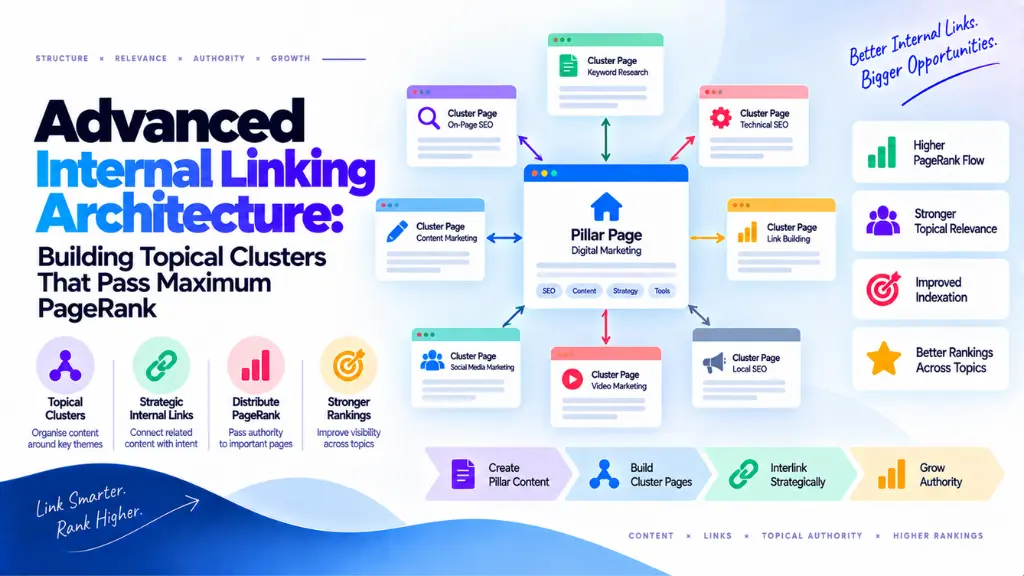
The dominant internal linking architecture for topical authority in 2026 is the pillar-cluster model. A broad pillar page comprehensively covers a topic; narrower cluster pages each address one subtopic in depth and link back up to the pillar, while the pillar links down to every cluster page it supports. This bi-directional structure concentrates authority on the pillar and signals to Google that the cluster is a coherent, deliberately built body of work rather than a set of unrelated posts.
The mechanics reinforce themselves over time: when the pillar earns external backlinks, that authority cascades down into every cluster page through the pillar-to-cluster links; when a cluster page earns a backlink independently, the cluster-to-pillar link sends authority back up, strengthening the pillar. Neither page has to earn all its authority alone.
Pillar Page vs Cluster Page: What’s the Difference?
A pillar page is a comprehensive, broad-topic page – typically 3,000 to 5,000 words – that addresses a subject at a high level and links out to every supporting cluster page beneath it. A cluster page is a narrower, single-subtopic page that goes deeper on one facet of the pillar’s theme and links back to the pillar, plus laterally to two or three closely related cluster pages.
| Pillar Page | Cluster Page | |
| Scope | Broad topic, comprehensive coverage | Narrow subtopic, deep coverage |
| Typical length | 3,000–5,000 words | 1,200–2,000 words |
| Primary link direction | Links down to every cluster page | Links up to the pillar |
| Lateral links | Occasional, to reinforce structure | 2–3 links to related cluster pages |
| Role in authority flow | Concentrates and redistributes authority | Feeds authority up when it earns its own backlinks |
A thin pillar page undermines the entire cluster’s authority signal, since every cluster page reinforces a hub that isn’t substantial enough to anchor the topic. Most established sites already have the raw content needed for a cluster – what’s usually missing is the deliberate linking structure that turns scattered articles into a functioning unit, and retrofitting that structure is often faster than starting a cluster from scratch, since the existing pages already carry index history and PageRank.
How Many Internal Links Should a Page Have?
There’s no fixed number, but a useful working range exists. A typical 1,500-word cluster article can reasonably carry 5 to 8 contextual in-content internal links; a pillar page, designed to distribute authority broadly across its whole cluster, can support up to 15 to 20. Google’s guidance avoids a hard cap – there’s “no magic number” for ideal link count – while still emphasizing that every important page needs at least one internal link pointing to it. The more useful constraint is relevance, not quantity: a link only serves its purpose if the anchor text and surrounding context genuinely describe the destination, and stuffing links in to hit a target count creates a pattern both search engines and readers can detect.
Anchor Text Strategy
Anchor text does more than provide a clickable path – it’s one of the signals Google’s indexing systems use to determine what a destination page is about, alongside the surrounding paragraph context. A useful test is whether the anchor text still makes sense read on its own; generic phrases like “click here” fail that test and tell Google nothing about the destination.
Anchor diversity also correlates with performance. An analysis by Zyppy of 23 million internal links found that pages with at least one exact-match anchor received roughly five times more traffic than pages without one – though the authors flagged this as a correlation, not proof that exact-match anchors alone cause the difference. The safest approach mixes anchors that closely match the destination page’s target keyword with natural variations, so the profile reads like something a human wrote rather than a template. The most common failures are repeating an identical anchor for every link to the same page, using generic phrases that carry no topical signal, linking anchor text to a destination it doesn’t describe, and forcing an anchor into a sentence where it reads unnaturally.
Click Depth and Crawl Priority
Click depth – how many clicks a page sits from the homepage – is a structural signal search engines read as a proxy for importance. Pages that require four or more clicks to reach face materially higher risk of infrequent crawling, since burying a page that deep implicitly tells Google it isn’t a priority. The practical target is keeping important pages within three clicks of the homepage, and no cluster page more than one click from its pillar.
Google specifically calls out crawl budget as a concern once a site passes roughly 1 million pages or updates 10,000+ pages daily, at which point click depth directly affects how much of the site gets crawled. For smaller sites, depth still matters, since it shapes how PageRank is distributed even once every page is crawled. There’s no universal cutoff, but risk increases sharply past three to four clicks – and the fix isn’t always a flatter sitemap. Category hub pages, pagination links, and cross-links from higher-authority posts can bring a deep page’s effective click depth down without restructuring the entire site.
Avoiding Keyword Cannibalization in Clusters
The most common failure mode in cluster architecture is topical overlap between the pillar and its own cluster pages. If a cluster page covers ground too close to what the pillar already addresses, Google can struggle to determine which page should rank for a shared query, and neither page ends up ranking as well as a single, clearly-differentiated page would. The fix is to map cluster topics – ideally starting from proper keyword research – before writing a single page, so each cluster page owns a distinct subtopic, and to merge or redirect any pages that already overlap once cannibalization is identified.
Building the Architecture: A Practical Sequence
- Map the topic before creating any pages, defining the pillar’s scope and every subtopic a cluster page should own.
- Publish or identify the pillar first; a thin pillar undermines every cluster page linking up to it.
- Link every cluster page to the pillar, varying anchor text rather than repeating an identical phrase.
- Add lateral links between two or three related cluster pages so authority moves sideways, not just up and down.
- Check click depth – no cluster page more than one click from its pillar, and priority pages within three clicks of the homepage.
- Audit for orphan pages and cannibalization on a recurring schedule, since new content constantly reshapes the graph.
This sequence – mapping the cluster before a single page is written, rather than retrofitting links onto existing content – is what separates a content strategy and topical authority program from a simple content calendar, and it’s the starting point Search Savvy uses on every cluster build.
Internal Linking and AI Search Visibility
Internal link architecture is no longer read only by Googlebot. LLM-based crawlers used by AI answer engines also traverse a site’s link graph to understand which pages are authoritative and how topics relate to one another, so the same structural discipline that builds topical authority for classic search also shapes whether content gets surfaced and cited in AI Overviews, ChatGPT, and Perplexity. A clear pillar-cluster structure gives these systems an easier path to understanding topic depth than a flat collection of disconnected posts – one reason internal linking increasingly overlaps with AI search optimization for AEO and GEO rather than sitting in a separate technical-SEO silo.
None of this replaces a proper technical foundation. Crawlability issues, broken redirects, and indexing problems elsewhere on a site can undercut even a well-designed link graph, which is why this work is usually paired with a broader technical SEO review rather than treated in isolation.
Common Mistakes
- Adding links only after publishing. Retroactive linking finds keyword mentions and hyperlinks them, but rarely builds a deliberate authority-flow structure – it decorates a finished page instead of architecting the site.
- Treating link count as the goal. A page with fifteen internal links and no topical coherence performs worse than one with six links that are all genuinely relevant.
- Linking only downward from pillar to cluster, never laterally, which leaves the cluster looking like a hub-and-spoke rather than a genuinely interconnected topic.
- Ignoring orphan pages. Content with zero inbound internal links receives no PageRank and is often the quiet reason an otherwise strong article never ranks.
- Letting cluster pages cannibalize the pillar, confusing ranking systems about which page should surface for a shared query.
- Burying priority pages too deep in the site hierarchy. A page four or more clicks from the homepage signals low importance to Google, regardless of the content’s actual quality.
Search Savvy’s audits typically catch these issues together, since orphan pages, cannibalization, and thin anchor diversity tend to appear on the same sites for the same underlying reason – links were never planned as a structure to begin with.
Frequently Asked Questions
What is the difference between internal linking and internal linking architecture? Internal linking is any hyperlink between pages on the same site. Internal linking architecture is the deliberate design of that entire link graph – which pages link to which, in what direction, and with what anchor text – built to control authority flow rather than added incidentally.
How many internal links does a page need to rank well? There’s no fixed number Google enforces, but 5–8 contextual links is a reasonable range for a typical cluster article, with pillar pages supporting more. Relevance matters far more than hitting a specific count.
What is an orphan page and why does it matter? An orphan page has no internal links pointing to it from anywhere on the site. It receives no PageRank flow and is harder for Google to discover, which is one of the most common reasons well-written content fails to rank.
Does internal linking still matter if a page already ranks from backlinks? Yes. Even a page with strong external backlinks benefits from internal links that clarify its topical relationship to the rest of the site and help that authority cascade to related cluster pages.
Can too many internal links hurt a page? Excessive links dilute the authority passed through each one and can make anchor placement feel forced. The risk isn’t a specific number being “too many” – it’s links that don’t serve a genuine purpose.
Should every cluster page link back to the pillar? Yes. Bi-directional linking is the core mechanic that lets authority flow both up and down the cluster; a cluster page that never links to its pillar breaks that structure.
Bottom Line
Internal linking architecture isn’t a checklist item you run once a content library is already built – it’s the structural decision that determines whether that library behaves like a coherent topical authority or a pile of disconnected pages competing for the same crawl budget and PageRank. Map the pillar and its clusters before writing, link deliberately in both directions, keep priority pages within reach, and audit the graph on a recurring basis rather than treating it as finished work. Sites that invest in this structure early tend to see new content rank faster, since it inherits authority from established pages on day one instead of waiting to earn its own.