
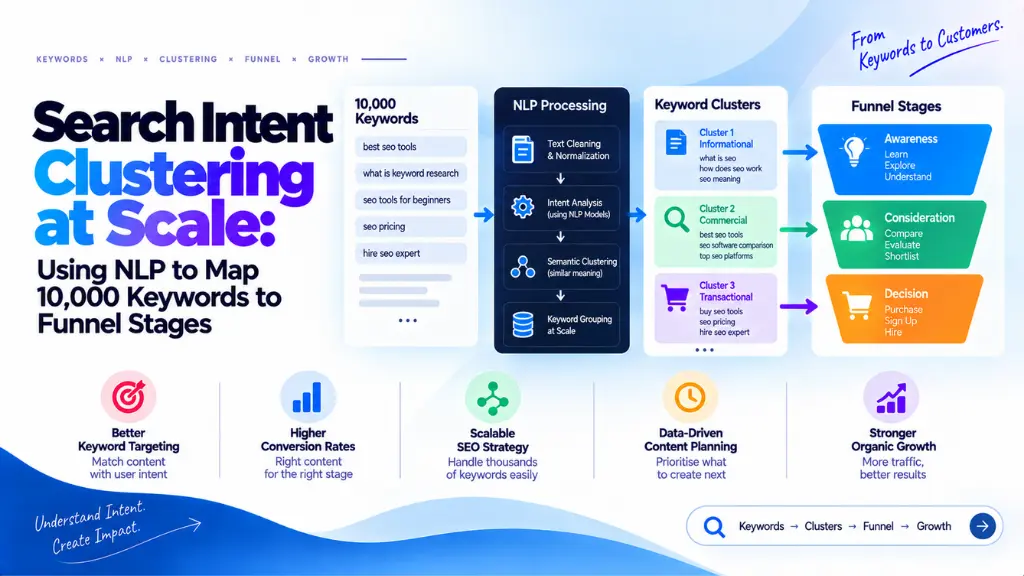

Tagging a few hundred keywords by intent is a spreadsheet exercise. Tagging ten thousand isn’t – not manually, and not reliably. Past a certain volume, human reviewers start missing the subtle cases: two keywords that share almost no words but represent the exact same underlying need, or two keywords that look nearly identical on the page but sit at completely different points in a buyer’s decision. Search intent clustering at scale exists specifically to solve that problem, using natural language processing to group keywords by what a searcher actually wants, not just what words they typed.
This matters well beyond keeping a spreadsheet tidy, and it’s a discipline we spend a lot of time refining for larger keyword sets at Search Savvy. Getting intent clustering right is what determines whether your content plan actually matches searcher expectations at every stage of the funnel, or whether you end up with duplicate pages competing for the same query and gaps at exactly the stage where prospects are deciding between you and a competitor.
What Is Search Intent Clustering, and Why Does It Matter at Scale?
Search intent clustering is the process of grouping keywords not by shared words, but by the underlying need or goal behind the search – so that keywords representing the same user intent end up mapped to the same page, and keywords representing genuinely different intents get separate treatment even if they look similar on the surface. The concept has real academic roots: computer scientist Andrei Broder formalized the foundational framework in his widely cited 2002 paper, arguing that the need behind a web search is often not informational at all – it can be navigational, aimed at reaching a specific site, or transactional, aimed at completing an action like a purchase. Two years later, researchers Daniel Rose and Danny Levinson refined that model further, splitting out a fourth category – commercial investigation – to capture the enormous volume of searches where someone is actively comparing options before deciding.
What Are the Four Types of Search Intent?
- Informational – the searcher wants to learn something (“how does compound interest work”).
- Navigational – the searcher wants to reach a specific site or page (“Search Savvy blog”).
- Commercial investigation – the searcher is comparing options before deciding (“best CRM for small teams”, “X vs Y”).
- Transactional – the searcher is ready to complete an action (“buy noise-cancelling headphones online”).
This four-category model, built directly on Broder’s original taxonomy and Rose and Levinson’s later refinement, remains the backbone of how modern SEO tools and search engines themselves interpret query intent, even as the underlying technology for detecting it has changed dramatically.
Why Manual Keyword Tagging Doesn’t Scale Past a Few Hundred Terms
Manually reviewing a keyword list works fine for a hundred terms, because a human reviewer can hold the nuance of each query in mind and make a reasonably accurate judgment call. That approach breaks down fast at real scale, for two compounding reasons. First, it’s simply too slow – reviewing ten thousand keywords one at a time isn’t a realistic workflow for any team with a launch deadline. Second, and more importantly, human reviewers are inconsistent at catching ambiguous or blended intent. A query like “best running shoes for flat feet” looks informational on its face, but the actual searches ranking for it are often comparison and buying guides – meaning the true intent is commercial investigation, not pure information-seeking. Multiply that kind of surface-level misjudgment across thousands of keywords, and a manually tagged funnel map ends up systematically wrong in ways that are hard to catch until traffic and conversion data reveal the mismatch months later.
How NLP Actually Clusters Keywords by Intent at Scale
This is where natural language processing earns its place in the workflow, and it happens through three main methodological approaches, each with real trade-offs.
Rule-based grouping matches keywords against known intent-signaling modifiers – words like “best,” “buy,” “how to,” “vs,” or “review” that reliably correlate with a particular intent category. It’s fast, transparent, and easy to quality-check, but it has an obvious ceiling: it only catches intent signals that show up as literal words, missing queries where intent is implied rather than stated.
SERP-based clustering takes a different approach entirely: it groups keywords together based on how much overlap exists between the actual pages Google ranks for each one. The logic here is elegant – Google has already done the hard work of interpreting intent for every query it serves, so if two keywords return substantially the same ranking pages, they almost certainly share the same underlying intent, regardless of how differently worded they are.
Semantic clustering using embeddings is the approach that scales best to genuinely large keyword sets. Embeddings are numeric representations of meaning generated by language models – the same underlying technology behind modern transformer-based systems – which allow two keywords with completely different wording to be recognized as conceptually related if the vectors representing their meaning sit close together in that model’s mathematical space. This is precisely the capability Google itself brought into its own ranking systems with the 2019 rollout of BERT. As Pandu Nayak, Google’s Fellow and Vice President of Search, explained when the update launched, the underlying transformer architecture is “particularly useful for understanding the intent behind search queries” – because it evaluates the full context of a phrase rather than matching isolated keywords. Intent-clustering tools that rely on embeddings work on the same basic principle: they’re modeling meaning, not string similarity, which is exactly why they catch relationships a rule-based or purely lexical approach misses entirely.
Which Clustering Method Should You Use: SERP-Based or Semantic?
In practice, neither method alone is ideal at real scale, which is why the emerging standard for large keyword sets is a hybrid workflow: cluster semantically first using embeddings to catch conceptually related keywords regardless of wording, then validate those clusters against actual SERP overlap data to confirm the grouping reflects how Google is actually interpreting and ranking those queries in practice. Semantic clustering alone can occasionally group keywords that are conceptually adjacent but don’t actually share a search intent in practice; SERP validation catches that gap before it turns into a cannibalization problem or a mismatched content brief.
Mapping Clusters to Funnel Stages
Once keywords are grouped into intent-coherent clusters, mapping them to funnel stages is the next step – informational clusters generally map to top-of-funnel awareness content, commercial investigation clusters map to middle-funnel consideration content, and transactional clusters map to bottom-funnel decision content, with navigational queries typically excluded from funnel mapping entirely since they’re searches for something the user already knows exists.
Does Every Keyword Cluster Map Cleanly to One Funnel Stage?
Not always, and this is one of the more common mistakes in large-scale intent mapping. Commercial investigation queries in particular occupy what’s sometimes called the “messy middle” of the funnel – a searcher comparing options is neither a pure information-seeker nor ready to buy, and content built for that stage needs to do real comparative work rather than either a generic educational post or a hard sales pitch. Some informational-looking queries also carry genuine bottom-funnel intent in specific contexts – a “how to install X” search can sit right before a purchase decision if the searcher is evaluating whether a product fits their setup. Treating funnel-stage assignment as a one-time, purely mechanical label rather than something worth periodically re-validating against actual SERP behavior is how funnel maps drift out of sync with reality over time.
A Practical Workflow for Clustering 10,000+ Keywords
- Export the full keyword list with search volume and, where available, existing SERP ranking data for each term.
- Generate embeddings for every keyword using an NLP model, converting each term into a numeric representation of its meaning.
- Run a clustering algorithm on those embeddings to group keywords with high semantic similarity into initial clusters.
- Manually validate a sample – reviewing 20 to 30 keywords by hand before trusting the tool across the full set gives a real accuracy benchmark rather than assuming the output is correct.
- Cross-check ambiguous clusters against SERP overlap data to confirm the grouping reflects actual ranking behavior, not just conceptual similarity.
- Assign an intent label and funnel stage to each validated cluster, rather than to individual keywords, since the cluster is the unit that should map to a single page.
- Map each cluster to exactly one URL in the content plan, which is the single most effective way to prevent keyword cannibalization across a large content build.
Common Pitfalls When Clustering at Scale
A few mistakes show up repeatedly in large clustering projects: collapsing keywords into one cluster because they share surface vocabulary despite representing genuinely different searcher goals; trusting embedding-based clusters without any SERP validation, which lets subtle intent mismatches slip through; treating a funnel-stage assignment as permanent rather than revisiting it periodically as SERPs and searcher behavior evolve; and over-fragmenting clusters into too many narrow groups, which creates more content than a site can realistically maintain and support with internal linking.
This kind of large-scale intent work is exactly what we build out for clients at Search Savvy, since getting the funnel mapping right at the start saves months of content rework later. Our Keyword Research Services page covers how we typically structure this process for larger keyword sets, and our Keyword Research blog category has more on the fundamentals this kind of clustering builds on.
FAQ: Search Intent Clustering at Scale
What are the four main types of search intent? Informational, navigational, commercial investigation, and transactional. This framework builds on Andrei Broder’s original 2002 taxonomy, with commercial investigation added later by researchers Daniel Rose and Danny Levinson to capture the large volume of comparison-driven searches.
Why doesn’t manual keyword tagging work for large keyword lists? It’s too slow at scale and prone to missing ambiguous or blended intent, where a keyword’s surface wording doesn’t match what the actual top-ranking pages reveal about true searcher intent.
What’s the difference between SERP-based and semantic keyword clustering? SERP-based clustering groups keywords by overlap in the actual pages Google ranks for them. Semantic clustering uses NLP embeddings to group keywords by conceptual meaning, even when the wording is completely different. Most large-scale projects combine both for accuracy.
Does every keyword cluster map to exactly one funnel stage? Not always. Commercial investigation queries in particular often sit in a blended “messy middle,” and some informational-looking queries carry genuine bottom-funnel intent depending on context, so funnel mapping benefits from periodic revalidation rather than a one-time assignment.
How many keywords should I manually validate when using an automated clustering tool? Reviewing a sample of around 20 to 30 keywords by hand before trusting the tool’s output across a full list gives a reasonable accuracy benchmark for calibrating confidence in the clustering method.
Can search intent clustering prevent keyword cannibalization? Yes. Mapping each validated cluster to a single target URL, rather than letting multiple pages target overlapping intent-related keywords, is one of the most effective ways to prevent pages from competing against each other for the same rankings.
The Bottom Line
Search intent clustering at scale isn’t about running a fancier spreadsheet formula – it’s about recognizing that intent lives in meaning, not in matching words, and building a workflow that reflects that. Use NLP-based embeddings to catch the conceptual relationships a manual review would miss, validate those clusters against real SERP behavior, and map the results to funnel stages with enough flexibility to revisit as searcher behavior shifts. Get that foundation right, and every piece of content built on top of it has a far better chance of meeting the searcher exactly where they actually are.