

68.01% of U.S. Google searches ended without a single click in the first four months of 2026, according to SparkToro’s analysis of Similarweb clickstream data – up from 60.45% just two years earlier, and from roughly 49% in 2019. That’s not a gradual drift. SparkToro called it the fastest two-year acceleration in zero-click search it has ever recorded, and the driver is clear: AI Overviews now answer queries directly inside the search results page, often before a user ever sees a blue link.
For a small business, this isn’t an abstract search-industry trend. It changes what “ranking well” actually buys you. A business can hold the top organic position for a valuable keyword and still receive fewer clicks than it did two years ago, because a growing share of searchers never make it past the AI-generated answer at the top of the page. This article breaks down what’s driving zero-click search, what still works to earn visibility inside it, and where to focus limited SEO resources in 2026.
What Is a Zero-Click Search?
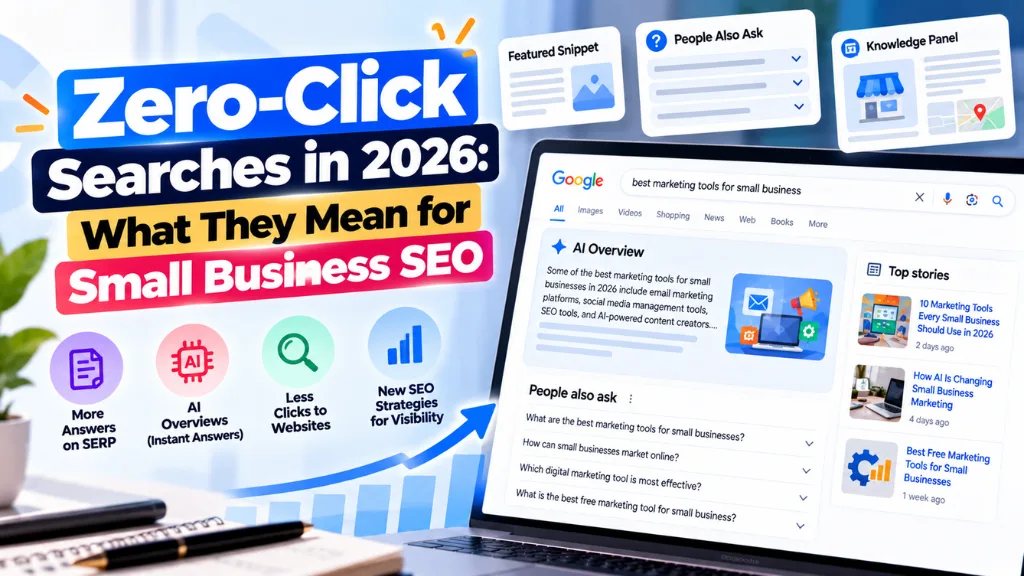
A zero-click search is a query where the user finds the information they need directly on the Google results page and never clicks through to any website. This happens through featured snippets, AI Overviews, knowledge panels, “People Also Ask” boxes, local packs, and direct answers for things like weather, definitions, unit conversions, and simple facts.
Zero-click search isn’t new – Google has displayed direct answers for over a decade – but its scale changed dramatically with the rollout of AI Overviews. When an AI Overview appears, click-through rates to organic results drop sharply: one 2026 study published on SSRN found organic clicks fell 38% and the zero-click rate on those specific queries jumped from 54% to 72% once an AI Overview was present. Separate research from Bain & Company found an even higher zero-click rate – around 83% – specifically on queries where an AI Overview appears.
Why Zero-Click Search Is Accelerating in 2026
Three things are compounding at once, and none of them are temporary.
AI Overviews are expanding in coverage and prominence. They now appear on a meaningful share of Google searches and are increasingly positioned as the default way Google answers informational queries, pulling together multiple sources into a single synthesized block above all organic listings.
Search behavior is shifting toward staying inside Google. SparkToro’s 2026 data found that the share of searches leading to another Google search – rather than a click to any website – rose 7.2 percentage points between 2024 and 2026, meaning more search sessions now resolve entirely within Google’s own ecosystem rather than reaching the open web at all.
Query type still matters enormously. Informational queries (“what is,” “how does,” “when did”) are far more likely to trigger a zero-click result than transactional queries with clear purchase intent. One 2026 analysis found informational queries running around 74% zero-click, compared with roughly 31% for transactional ones – which is genuinely good news for small businesses, because most commercial, “near me,” and buy-ready searches still send a click somewhere.
Does Zero-Click Search Mean SEO Is Dead?
No – zero-click search changes what SEO success looks like, but it does not eliminate the value of ranking well, because commercial and local intent queries still convert into clicks, calls, and visits at a far higher rate than informational ones. The businesses losing the most ground are those relying heavily on top-of-funnel blog traffic for broad informational keywords, where an AI Overview can now fully satisfy the searcher without a visit to any site.
For a local service business, a restaurant, or an ecommerce store, the picture looks different. Searches with clear buying or visiting intent – “plumber near me,” “best running shoes for flat feet,” “[restaurant name] hours” – are exactly the queries where AI Overviews are least likely to fully satisfy the user, because the searcher ultimately needs to take an action a search results page can’t complete on its own. This is a strong argument for small businesses to weight their keyword research toward commercial and local intent rather than chasing broad informational traffic that was already drying up.
Featured Snippet Optimization: Still Worth It in 2026?
Featured snippet optimization is still worth pursuing for queries where Google displays a traditional snippet rather than an AI Overview, but the two features increasingly compete for the same slot, and AI Overviews are winning more of that competition on purely definitional queries. One analysis tracking SERP features found featured snippet visibility fell sharply through 2025 as AI Overviews absorbed many of the “what is” and simple factual queries snippets used to own.
That said, featured snippets haven’t disappeared, and the underlying optimization work isn’t wasted even where an AI Overview takes the slot instead – because the content signals that win a featured snippet are largely the same signals that get a page cited as a source inside an AI Overview. A few practices still apply directly:
- Answer the question in the first sentence or two, in plain language, before expanding with detail. Both snippet algorithms and AI summarization systems favor content that states the direct answer immediately.
- Use the format the query implies. A “how to” query favors numbered steps; a comparison query favors a table; a “what is” query favors a concise paragraph definition.
- Rank on page one first. A page needs to already be ranking reasonably well for a query before Google will consider it for the snippet slot – position zero is drawn from existing organic results, not a separate competition.
- Keep content current. Google’s quality systems in 2026 weight demonstrated expertise and freshness heavily, especially since the flood of AI-generated content has made differentiating genuine expertise from generic summary more important to the algorithm, not less.
One structural detail worth knowing: since 2020, Google has stopped duplicating a snippet’s source in the regular organic listing beneath it. Winning the snippet effectively replaces your standard ranking position rather than adding a bonus slot on top of it – which matters when weighing whether chasing a specific snippet is worth the content investment for a given keyword.
SERP Feature Strategy: Where to Actually Focus
Instead of trying to win every possible SERP feature, small businesses get more return from matching their limited content and optimization effort to the features most likely to drive an actual visit or call.
| SERP Feature | Typical Intent | Click Potential for Small Business |
| AI Overview | Informational, broad research | Low – rarely drives a click unless the business is cited as a source |
| Featured snippet | Informational, “how to,” definitions | Low-to-moderate – still some click-through, but shrinking |
| Local pack / Google Business Profile | “Near me,” local service intent | High – users often call or visit directly from the pack |
| People Also Ask | Related informational sub-questions | Low, but useful for expanding topical coverage |
| Standard organic listing | Commercial, transactional, branded | Highest – still the primary driver of clicks for buy-ready searches |
For most small businesses, this points toward a practical priority order: a well-maintained Google Business Profile and local SEO presence first, strong organic rankings on commercial and transactional keywords second, and featured snippet or AI Overview visibility as a secondary benefit rather than the primary goal. Search Savvy generally recommends this exact ordering to clients worried about falling traffic – it’s the core logic behind local SEO services becoming a higher-priority investment than broad content marketing for many small businesses navigating the current search landscape.
Protecting Brand Visibility in the SERP Without a Click
When a search doesn’t produce a click, a business’s best remaining opportunity is to be named, cited, or recognizable within the zero-click result itself – through AI Overview citations, knowledge panel presence, and strong brand signals that make the business recognizable even without a site visit. This shifts part of the SEO goal from “earn the click” to “earn the mention,” since a cited brand in an AI Overview still builds awareness even when it doesn’t generate immediate traffic.
A few ways small businesses can protect visibility inside zero-click results:
- Structured data and schema markup help search engines and AI systems understand exactly what a page is about, which supports both featured snippet eligibility and AI Overview citation. Properly implemented schema markup is one of the more accessible technical levers a small business can pull without a full site rebuild.
- A complete, accurate Google Business Profile remains one of the strongest zero-click assets a local business has, since it often appears directly in the local pack and knowledge panel without requiring any additional optimization work on the website itself.
- Clear, well-organized answers to the specific questions customers ask – not generic overviews of a topic – give AI summarization systems a cleaner, more citable source than a page padded with filler content.
- Consistent brand name, NAP (name, address, phone) data, and reviews across the web strengthen the entity signals that both Google’s knowledge panel system and AI Overviews draw on when deciding which business to surface or cite by name.
Search Savvy increasingly frames this as a shift from pure traffic generation to broader search visibility, since a business cited by name in an AI Overview – even without a click – is still building the kind of recognition that eventually shows up in branded search and direct visits.
Common Mistakes Businesses Make With Zero-Click Search
- Panicking and abandoning content investment entirely, when the actual fix is redirecting effort toward commercial and local queries rather than cutting content production altogether.
- Chasing every informational keyword that an AI Overview has already fully absorbed, instead of prioritizing topics where a click still has clear value.
- Treating Google Business Profile as a secondary asset when, for most local businesses, it’s now one of the highest-value zero-click surfaces available.
- Skipping structured data because it feels like a minor technical task, when schema markup is one of the clearer ways to improve eligibility for both snippets and AI citations.
- Measuring SEO success only by click volume, which misses the brand-awareness value of appearing – even without a click – in front of searchers who will remember the name later.
The Bottom Line
Zero-click search isn’t a sign that SEO has stopped working – it’s a sign that the payoff from ranking well has shifted, moving away from broad informational traffic and toward commercial, local, and branded queries where a click still has somewhere useful to go. For small businesses, the practical response in 2026 is to stop measuring success purely by organic traffic to top-of-funnel content, and start treating local search presence, structured data, and intent-matched keyword targeting as the core of the strategy. Search Savvy works through exactly this kind of prioritization with clients navigating a search landscape that keeps reshaping what “visibility” even means – and for most small businesses, that starts with tightening up technical SEO fundamentals before chasing any specific SERP feature.
Frequently Asked Questions
What percentage of Google searches are zero-click in 2026? SparkToro’s 2026 research found 68.01% of U.S. Google searches ended without a click in the first four months of the year, up from 60.45% in 2024.
Do AI Overviews cause zero-click searches? AI Overviews are a major contributor but not the only cause. Research published in 2026 found organic click-through rates dropped 38% and zero-click rates rose from 54% to 72% specifically on queries where an AI Overview appeared.
Should small businesses stop blogging because of zero-click search? No. Informational queries are far more likely to be zero-click than commercial or transactional ones, so the better response is shifting content focus toward buying-intent and local queries rather than stopping content production altogether.
Is featured snippet optimization still worth doing in 2026? Yes, though its reach has narrowed as AI Overviews absorb more definitional queries. The content structure that wins a snippet also improves a page’s chances of being cited inside an AI Overview, so the effort isn’t wasted even when the snippet itself disappears.
How can a small business get visibility if most searches don’t result in clicks? Focus on being cited or named within the zero-click result itself – through schema markup, a complete Google Business Profile, and consistent brand information across the web – while prioritizing SEO effort on the commercial and local queries that still reliably produce clicks.
Does position zero still exist the way it used to? The term survives, but Google stopped showing the same page twice (once in the snippet, once in regular results) back in 2020. Winning the featured snippet today replaces a business’s standard ranking position rather than adding an extra slot above it.