

Ranking used to be the finish line. In 2026, it’s closer to the starting point. Ahrefs data from March 2026 found that top-10 organic results now account for only 38% of AI Overview citations, down sharply from 76% in July 2025 – meaning a page can hold its position and still lose the visibility that position used to guarantee. A content differentiation framework is the structured set of decisions a team makes about what makes its content genuinely distinct, so it earns attention and citation even when a dozen competitors have published something that looks nearly identical, often generated by the same AI tools.
This matters because the SERP itself has changed shape. AI Overviews now appear on roughly 48% of queries, up from 31% just over a year earlier, and on AI Overview-triggered searches the first organic result is pushed down by more than 1,600 pixels. Ranking well and being seen are no longer the same outcome. This article lays out what a content differentiation framework actually consists of, and how to apply it so your content competes on substance rather than volume.
What Is a Content Differentiation Framework?
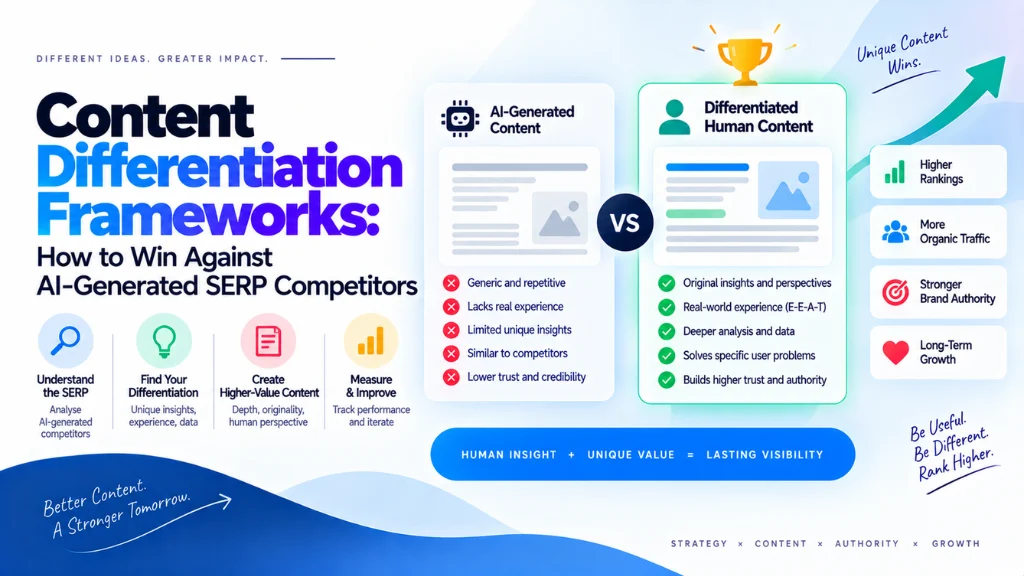
A content differentiation framework is a repeatable set of criteria a team uses to decide whether a piece of content offers something a reader – or an AI system summarizing that content – genuinely cannot get from the next ten search results. It’s not a style guide, and it’s not a checklist for SEO formatting. It’s a decision framework applied before content is commissioned: what does this piece know, show, or argue that nothing else currently ranking does?
The need for this has grown directly out of AI-assisted content production. When many competitors use similar tools with similar prompts to cover the same topic, their outputs converge toward the same structure, the same generic examples, and often the same phrasing patterns drawn from the same top-ranking sources. A differentiation framework exists specifically to counteract that convergence.
Why Ranking Alone No Longer Wins the Click
The gap between ranking and visibility has widened in a measurable, well-documented way. When a page does earn a citation inside an AI Overview, that citation carries real value: Seer Interactive’s 2026 research found cited content sees roughly a 35% CTR lift compared to competing content that isn’t cited for the same query. When it isn’t cited, even years of accumulated domain authority can leave a result sitting below more than a thousand pixels of AI-generated summary text that most users never scroll past.
This is why “differentiation” has shifted from a nice-to-have brand positioning exercise to a functional SEO requirement, and why it now belongs alongside core technical SEO work rather than sitting off to the side as a content-team-only concern. Content that reads as a composite of what’s already ranking – competent, accurate, but interchangeable – has less chance of being the one an AI system selects to summarize or cite, precisely because interchangeable content gives a retrieval system no reason to prefer one source over another.
Does Google Penalize AI-Written Content for Lacking Differentiation?
Not directly – but the outcome is similar. Google has consistently said it evaluates content on quality rather than production method. In practice, though, undifferentiated AI content tends to underperform on the same quality signals Google already rewards: one audit of 40 content pieces across two client sites found AI-drafted content that skipped subject-matter-expert review saw 23% lower average time-on-page than human-edited equivalents, with the ranking gap becoming visible within 90 days. The penalty isn’t for using AI – it’s for the thinness that comes from skipping the differentiation step.
The Four Pillars of a Content Differentiation Framework
Across the research on what actually earns citation and engagement in 2026, four categories of differentiation consistently separate content that stands out from content that blends in.
| Pillar | What It Looks Like | Why It’s Hard to Copy |
| Original research or proprietary data | Surveys, platform data analysis, first-party test results | AI systems can’t synthesize data that isn’t in their training set; competitors can’t replicate it without doing the work |
| Distinctive point of view | A clear editorial stance or contrarian framing on a debated topic | Generic AI drafts default to consensus summaries, not argued positions |
| Demonstrated first-hand experience | Specific outcomes, named tools, real numbers from direct use | Signals genuine E-E-A-T that generic synthesis can’t fabricate credibly |
| Structural differentiation for extraction | Answer-first sections, clear comparisons, unique framing of the same facts | Makes content easier for an AI system to select as the authoritative version to cite |
Original Research: The Hardest Pillar to Copy
Original research is the most durable form of differentiation precisely because it cannot be replicated without doing the underlying work. A survey doesn’t need to be large to be valuable – a well-scoped survey of fifty specific respondents in a defined niche can produce more citable insight than a broad industry report built entirely from secondary sources. The output – a chart, a benchmark number, a named finding – becomes something journalists and other publishers cite back to you, and something no AI system can generate on its own because it simply doesn’t exist anywhere else to be trained on.
Point of View: Taking a Position Instead of Summarizing One
Most AI-drafted content defaults to balanced summary because that’s what a broad training corpus rewards. A differentiated piece instead takes a specific, defensible position – recommending one approach over another, naming a common mistake by name, or pushing back on conventional advice with a clear reason. This is harder to produce at scale precisely because it requires a human editorial decision, which is exactly what makes it valuable as a differentiator.
First-Hand Experience: The E-E-A-T Layer AI Can’t Fabricate
Google’s guidance on quality content has long emphasized demonstrating real experience alongside expertise. In content terms, this means specific outcomes, named tools or platforms actually used, and details that only come from having done the thing being described – not generic advice that could apply to any company in any industry. This is also the pillar most likely to be reviewed by a real reader as authentic rather than templated.
Structural Differentiation: Winning the Extraction Layer
Even genuinely original content can lose the citation race if it’s structured the way everything else is. Content built around answer-first paragraphs, clearly labeled comparisons, and specific framing of otherwise-common facts gives an AI system a cleaner reason to select it as the source to summarize, rather than blending it into a synthesis drawn from several similar pages. Search Savvy’s AI search optimization (AEO/GEO) services focus specifically on this structural layer – making genuinely differentiated content easier for retrieval systems to find and cite in the first place.
Building Your Differentiation Framework: A Practical Process
- Audit what’s already ranking for your target query before writing a word – not to copy it, but to identify exactly what every top-10 result has in common, so you know what to avoid repeating.
- Pick at least one pillar deliberately, before drafting. Decide whether this piece will lead with original data, a specific point of view, first-hand experience, or a structural advantage – and brief that decision explicitly rather than leaving it to whoever drafts the content.
- Source the differentiator first. If the plan is original research, run the survey or pull the platform data before writing begins; a differentiation plan bolted on after a generic draft rarely reads as authentic.
- Have a subject-matter expert review before publishing, specifically checking whether the differentiator actually survived the editing process intact.
- Track citation and engagement separately from rank. A page that ranks steadily but never gets cited in AI Overviews for its target queries is a signal the differentiation didn’t land, even if the ranking data looks fine.
Search Savvy applies this same audit-first discipline inside its content strategy and topical authority engagements, mapping what’s already saturating a SERP before recommending where a client’s next piece should actually differ.
Common Mistakes in Content Differentiation
- Treating formatting as the differentiator. Better headings and cleaner structure help with extraction, but they don’t substitute for genuinely different substance underneath.
- Adding “expert commentary” after a generic draft. A quote or opinion bolted onto an otherwise composite piece reads as exactly that – bolted on, not integrated.
- Choosing a differentiation pillar that doesn’t fit the topic. Not every article needs original research; sometimes a sharper point of view or better structural clarity is the more honest, achievable differentiator.
- Skipping competitive audits entirely. Without checking what’s currently ranking, teams often “differentiate” by accident into territory that’s already saturated.
- Measuring only rank, never citation. A framework with no feedback loop on AI Overview citations or engagement metrics can’t tell whether the differentiation strategy is actually working.
The Bottom Line
Ranking is necessary but no longer sufficient – with the majority of AI Overview citations now coming from outside the traditional top 10, content differentiation has become a functional requirement rather than a brand exercise. A workable framework picks a deliberate pillar – original research, a genuine point of view, demonstrated experience, or structural clarity – before writing begins, and measures success by citation and engagement, not rank position alone.
The practical next step is auditing your next planned piece against what’s already ranking for its target query, and deciding explicitly which pillar it will lean on before drafting starts. Search Savvy’s content marketing services build this differentiation audit into the production process itself, so content earns visibility in both traditional search and the AI systems increasingly standing between a search and a click.
Frequently Asked Questions
What is a content differentiation framework? It’s a repeatable set of criteria used to decide, before content is written, what makes a piece genuinely distinct from what’s already ranking – whether through original data, a specific point of view, first-hand experience, or structural clarity for AI extraction.
Why doesn’t ranking well guarantee visibility anymore? Because AI Overviews and other AI-generated answers now absorb a large share of the visibility that used to come with a top-10 ranking. Data from March 2026 found that top-10 organic results account for only 38% of AI Overview citations, meaning a page can rank well and still go largely unseen.
Is original research always necessary for differentiation? No. Original research is the hardest pillar to copy, but a distinctive point of view or clearer structural framing of the same facts can also be effective differentiators, depending on the topic and what’s already saturating the SERP.
Does using AI to draft content prevent differentiation? No. AI is effective for research, outlining, and first drafts. The risk is stopping there – differentiation requires a human editorial decision about what makes the piece distinct, applied before and during the drafting process, not left to the tool.
How do I measure whether my differentiation strategy is working? Track AI Overview citation presence and engagement metrics like time-on-page alongside traditional rank data. A page that ranks steadily but is never cited in AI-generated answers for its target queries is a signal the differentiation isn’t landing with retrieval systems.
What’s the fastest way to start differentiating existing content? Audit your best-performing pages against what currently ranks for the same queries, identify what every top result has in common, and add the pillar that’s missing – usually first-hand specifics or a clearer point of view – rather than starting an entirely new content plan from scratch.