
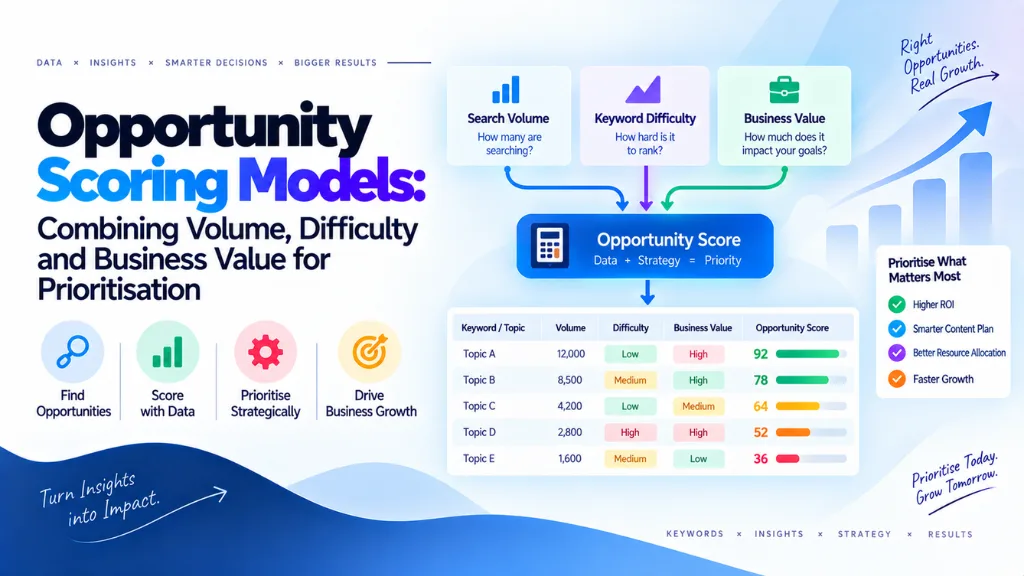

Sorting a keyword spreadsheet by search volume, descending, is the single most common reason SEO teams waste effort on the wrong content. It systematically favors high-competition, high-volume terms a site has no realistic chance of ranking for, while burying the lower-volume, high-conversion opportunities that would have actually moved revenue. An opportunity scoring model fixes this by combining search volume, ranking difficulty, and business value into a single weighted score, so prioritisation decisions are made on projected return rather than which number happens to be biggest in a spreadsheet column.
This isn’t a theoretical problem. One 2026 industry analysis of keyword research practices found that 78% of content teams lack a systematic prioritisation framework, defaulting instead to intuition or a single metric. This article breaks down what actually belongs in an opportunity scoring model, how to weight the inputs against each other, and why business value and difficulty deserve at least as much weight as raw demand.
What Is an Opportunity Scoring Model?
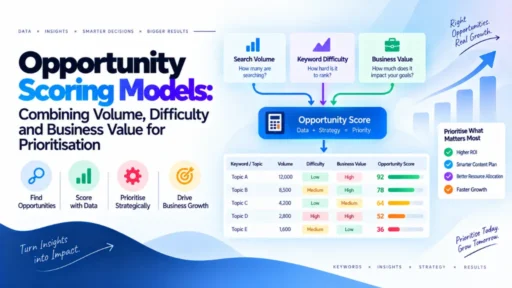
An opportunity scoring model is a weighted formula that ranks keyword or content opportunities by combining multiple inputs – typically search volume, ranking difficulty, and business or revenue value – into a single comparable score. Instead of debating whether a high-volume, high-difficulty keyword is “worth it” compared to a low-volume, high-relevance one, the model produces a number that makes the trade-off explicit and repeatable across an entire keyword list.
The approach borrows directly from portfolio theory in finance: rather than betting everything on one high-volume lottery ticket, a scoring model balances expected return (business value and traffic potential) against risk (ranking difficulty and effort), spreading investment across a portfolio of opportunities with a realistic chance of paying off.
Why Volume and Difficulty Alone Fail
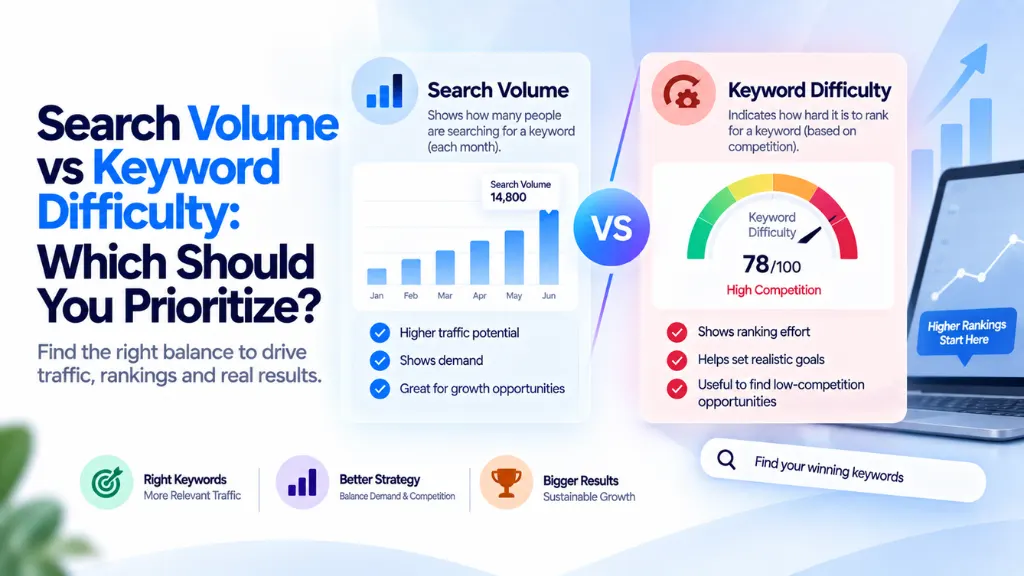
Consider a real pattern seen across B2B SaaS keyword research: a team targets “project management software” – 40,000 monthly searches, keyword difficulty 85 – instead of “project management for remote engineering teams,” which pulls only 800 searches but carries a difficulty score of 22. Volume and difficulty alone can’t distinguish which of these is the better investment. Once you factor in that the second keyword precisely matches an ideal customer profile and can realistically convert at several times the rate, it often wins decisively despite having 97% less volume.
This is the core failure of single-metric sorting: a high-volume keyword with zero business value is a distraction, and a keyword that’s easy to rank for but drives no business outcome is a vanity metric – a distinction covered in more depth in the SEO glossary entries on ranking difficulty and search intent. Both must score well simultaneously for an opportunity to be worth prioritising.
The Core Inputs of an Opportunity Scoring Model
Most credible 2026 frameworks converge on the same handful of inputs, grouped into two categories: business alignment and ranking economics.
| Input | Category | What It Measures |
| Search volume | Ranking economics | Raw demand – how many people search this term |
| Keyword difficulty | Ranking economics | How hard it is to realistically rank, given current domain authority and SERP competition |
| Business/revenue value | Business alignment | How closely the keyword aligns with a product, service, or ideal customer |
| Search intent alignment | Business alignment | Whether the content you can credibly produce actually satisfies what the searcher wants |
| Content/production effort | Ranking economics | Resources required to produce and maintain competitive content for this term |
| SERP displacement risk | Business alignment | How likely an AI Overview or other SERP feature is to absorb the click before it reaches your page |
A keyword needs to score reasonably across both categories, not just one. Perfect business alignment with impossible ranking economics is a resource sink; easy ranking economics with no business alignment is a vanity metric that inflates a traffic dashboard without moving revenue.
Building the Formula: A Worked Example
One practical version of an opportunity scoring formula expresses priority as:
Priority Score = (Search Volume × Relevance Score × Expected CTR) ÷ (Keyword Difficulty × Competitive Density)
This isn’t the only valid formula, and the exact weighting should shift depending on a site’s stage and goals, but the structure illustrates the principle clearly: volume and expected click-through sit in the numerator as upside, while difficulty and competitive density sit in the denominator as cost. A keyword with strong relevance and low competitive density can outscore a much higher-volume term buried in a saturated, high-difficulty SERP.
For teams without a business-relevance dataset already built, a simplified version works well as a starting point: score each keyword from 1 to 5 on business value, intent alignment, and ranking feasibility, multiply the three scores together, and rank the resulting products. It’s less mathematically precise than a full weighted formula, but it forces the same discipline – no single dimension can carry an opportunity to the top of the list on its own.
How Should Weights Change Based on Site Authority?
Newer or lower-authority sites should weight ranking feasibility more heavily, generally targeting keyword difficulty scores below 40 to 50, or within roughly 10 points of current domain authority. As authority grows, difficulty can be weighted less heavily relative to business value, since higher-difficulty terms become realistically attainable and the opportunity cost of ignoring them rises.
Accounting for AI Overview Displacement Risk
A factor that didn’t exist in most pre-2024 scoring models but now belongs in every 2026 framework is SERP displacement risk – the likelihood that an AI Overview or similar generative SERP feature will answer the query directly, absorbing the click before a user ever reaches an organic result. Keywords with high displacement risk are relatively less valuable even at high volume, because the traffic a ranking would have generated is increasingly captured above the organic results entirely.
Building this in doesn’t require a separate system: it can be added as a negative weighting factor in the same formula, applied after checking whether a target query already triggers an AI Overview or featured snippet for competitors. Keywords with low displacement risk – often longer-tail, comparison, or transactional queries that require depth an AI summary can’t fully substitute for – become relatively more valuable in this adjusted model, even when their raw search volume looks modest next to a heavily-displaced head term.
This is exactly the kind of layered scoring Search Savvy builds into its keyword research services, combining traditional volume and difficulty data with SERP-feature and AI-citation risk before a keyword ever reaches a content calendar.
Turning Scores Into a Prioritised Roadmap
A scoring model only pays off if it actually changes what gets produced next. In practice:
- Score the full keyword list, not just the shortlist you already had in mind – scoring models often surface overlooked opportunities buried below obvious head terms.
- Separate quick wins from long-term bets. Keywords with high business value and low difficulty deserve immediate production; high-value, high-difficulty terms belong on a longer roadmap tied to authority growth.
- Re-score quarterly, not once. Difficulty, displacement risk, and even business value shift as competitors publish and as a site’s own authority grows, so a scoring model built once and never revisited drifts out of date quickly.
- Feed actual performance data back into the weights. If a keyword scored highly but underperformed on conversion, that’s a signal to adjust the business-value or intent-alignment weighting for similar terms going forward.
Search Savvy applies this same score-then-reassess discipline inside its content strategy and topical authority engagements, treating the prioritisation model as a living system rather than a one-time spreadsheet exercise.
Common Mistakes in Opportunity Scoring
- Sorting by volume alone. The single most common failure mode, and the one an opportunity scoring model exists specifically to correct.
- Ignoring displacement risk entirely. A keyword’s raw search volume means less than it used to if an AI Overview already answers it for most searchers.
- Setting business value subjectively without a rubric. “This feels important” isn’t a repeatable score – define what counts as high, medium, and low business value in writing before scoring begins.
- Never revisiting scores after publishing. A static score calculated once at the planning stage misses shifts in competition, demand, and SERP features that change the calculus months later.
- Treating every keyword as equally weighted across factors. A B2B lead-gen site and a high-traffic media site should weight business value and volume very differently; a one-size-fits-all formula rarely fits either well.
The Bottom Line
An opportunity scoring model turns keyword prioritisation from a gut-feel exercise into a repeatable, defensible process – one that balances search volume and difficulty against business value, intent alignment, and increasingly, the risk that an AI Overview absorbs the click before it ever reaches your page. The formula matters less than the discipline behind it: no single input should be allowed to carry a keyword to the top of the list alone.
The practical next step is auditing your current content calendar against a simple three-factor score – business value, difficulty, and displacement risk – before committing to what gets written next. Search Savvy’s keyword prioritisation work and website audit services build this scoring discipline into the planning stage, so content investment goes toward opportunities with a realistic, measurable return rather than the biggest number in a volume column.
Frequently Asked Questions
What is an opportunity scoring model in SEO? It’s a weighted formula that combines search volume, ranking difficulty, and business value into a single comparable score, used to prioritise which keywords or content topics are worth pursuing rather than relying on a single metric like volume alone.
Why shouldn’t I just target the highest-volume keywords? High-volume keywords are often the most competitive and may carry little business relevance to your specific offering. A lower-volume keyword that precisely matches your ideal customer can convert at several times the rate, making it the better investment despite smaller search demand.
What’s a simple formula for scoring keyword opportunities? One practical version is: Priority Score = (Search Volume × Relevance Score × Expected CTR) ÷ (Keyword Difficulty × Competitive Density). Teams without detailed relevance data can start with a simpler 1-to-5 scoring rubric across business value, intent alignment, and ranking feasibility.
How does AI Overview risk affect keyword prioritisation? Keywords likely to trigger an AI Overview or similar generative summary carry a higher risk that the click is absorbed before it reaches an organic result. A 2026-ready scoring model applies a negative weighting for this displacement risk, making low-displacement, longer-tail keywords relatively more valuable.
How often should an opportunity scoring model be updated? Ideally quarterly. Difficulty, SERP features, and even business value shift as competitors publish new content and as a site’s own authority grows, so scores calculated once at the planning stage become outdated faster than most teams expect.
Do small or new sites need a different scoring approach than established sites? Yes. Newer sites should weight ranking feasibility more heavily, generally targeting difficulty scores below 40 to 50, while established sites can weight business value more heavily since higher-difficulty terms become realistically attainable as domain authority grows.