
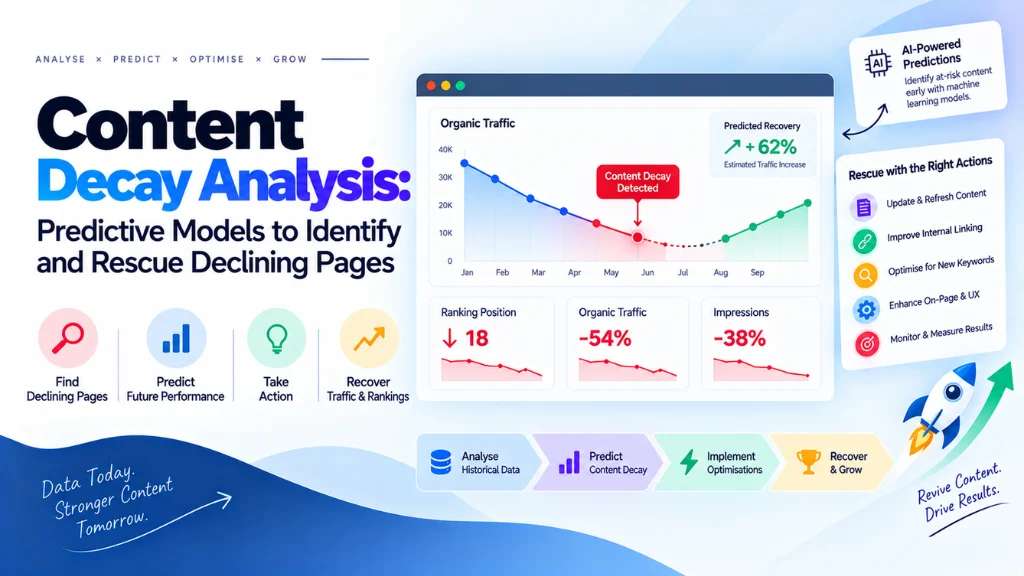

Content decay analysis is the practice of detecting when a page’s organic performance is deteriorating – and, increasingly, predicting it before the traffic graph shows the drop. Most teams still find decaying content the hard way: someone notices a page has quietly lost half its traffic during a quarterly review, months after the decline started. A predictive approach flips that timeline, using historical Search Console signals to flag at-risk pages while there’s still time to intervene.
This matters more in 2026 than it did a few years ago. Decay is no longer a single, slow curve caused by aging content and improving competitors. It now has two separate dimensions – organic ranking and AI citation – that can move in opposite directions on the same page, which means a detection system built only around rank tracking will miss half the picture.
What Is Content Decay Analysis?
Content decay is the gradual, sustained loss of a page’s organic traffic, rankings, and relevance over time. It’s distinct from a sudden drop caused by a manual penalty, a broken redirect, or a major algorithm update – those are visible immediately. Decay is quiet. Traffic erodes over months, sometimes years, and because month-over-month numbers look similar, it rarely triggers an alert until a meaningful share of the page’s value is already gone.
Content decay analysis is the systematic process of catching that erosion early: pulling historical performance data, defining what “declining” actually looks like for a given page type, and prioritizing which pages are worth the cost of a refresh versus consolidation or retirement.
How Long Does Content Typically Take to Decay?
Research examining nearly 720 published pieces found a median time-to-peak of about four months, with a sharp fall afterward – the typical piece lost roughly 76% of its peak traffic within three months of that peak. This pattern, reported by content marketing agency Fractl, suggests that by the time a page’s decline is obvious in a monthly traffic report, most of the damage has already happened.
Why Quarterly Audits Miss Decay Until It’s Too Late
Manual, calendar-based audits – checking Search Console once a quarter, or worse, once a year – are structurally too slow for this lifecycle. If a page peaks in month four and loses three-quarters of its traffic by month seven, a quarterly cadence can easily miss the entire decline window between checks.
The signals that indicate decay is starting are also easy to overlook in a manual scan: organic traffic down more than 20% over a rolling 90-day window, a ranking drop of more than five positions, click-through rate declining while impressions stay flat, or no new referring domains arriving in six months or more. Any one of these should be enough to flag a page for scoring – but catching them consistently across a large content library requires automated tracking, not a manual once-a-quarter pass.
The Two Dimensions of Decay in 2026: Organic Rank and AI Citation
What’s genuinely new in 2026 is that decay is no longer a single-axis problem. A page can hold its organic ranking position and still lose the visibility that used to come with it, because AI Overviews and AI search assistants are answering the underlying query before the user ever scrolls to organic results. Conversely, a page can slip in traditional rankings while still being actively cited inside AI-generated answers.
Industry analysis has found that the overlap between top-10 Google rankings and AI Overview citations has narrowed considerably since mid-2025, meaning a page ranking well organically is no longer a reliable predictor of whether it will be surfaced inside an AI answer. This means a complete content decay analysis in 2026 needs to track two separate signal sets: traditional rank/CTR/impression data from Search Console, and a proxy for AI citation presence, such as whether the page still appears in AI Overview snapshots for its target queries.
Pages cited inside an AI Overview have also been shown to earn meaningfully more clicks per impression than pages that aren’t cited for the same query, according to 2026 research from Seer Interactive – which makes AI-citation decay a real revenue signal, not just a vanity metric.
Building a Predictive Decay Model: The Signals That Matter
A predictive model doesn’t need to be a black box. At its core, it’s a scoring system that weighs a handful of measurable signals to flag pages before their decline becomes visible in a simple traffic chart.
| Signal | What It Captures | Why It Predicts Decay |
| 90-day traffic trend | Rolling change in organic sessions | Early, gradual decline often precedes a visible cliff |
| CTR vs. impressions divergence | Falling clicks while impressions hold steady | Signals a SERP feature (like an AI Overview) is absorbing clicks without a ranking change |
| Position drift | Average ranking position moving down over weeks | Direct evidence of competitive or relevance loss |
| Referring domain velocity | New backlinks acquired over a rolling window | Pages that stop earning links lose the authority signal that sustained their ranking |
| Content age since last substantive update | Time since meaningful content changes, not just timestamp edits | Older, unmaintained content is more exposed to fresher competitor pages |
| Cannibalization overlap | Multiple owned URLs ranking for the same query cluster | Split authority across pages can look like decay on any single URL |
A Real-World Example of a Predictive Decay Model
A published machine learning project offers a useful, concrete illustration of how far this can be taken. Using roughly 78 million rows of Search Console and Analytics data, a researcher built a feature-engineering pipeline in Python – using pandas, DuckDB, and scikit-learn – that scored pages by risk of future decline based on rolling 90-day traffic windows and related engineered features. The resulting Random Forest model reached a 0.750 ROC-AUC score and identified declining pages in its top recommendations roughly 3 to 4 times more accurately than a naive recency-based baseline. That gap between a naive heuristic and a properly engineered model is the entire case for predictive decay analysis: recency alone is a weak predictor, but a model trained on multiple converging signals catches far more true declines with far fewer false alarms.
You don’t need 78 million rows to apply the same logic at a smaller scale. Even a simple weighted score across the six signals above – flagging any page that crosses two or more thresholds simultaneously – outperforms a single-metric alert on traffic alone, because it captures decay that shows up first in CTR or position before it’s visible in raw sessions. This is the kind of lightweight scoring system Search Savvy builds into ongoing content programs, so decay is flagged from the data teams already have rather than requiring a dedicated data science build.
Turning Predictions Into a Rescue Playbook
Identifying at-risk pages is only half the job. The other half is deciding what to actually do with each one, and that decision should follow the type of decay detected rather than a blanket “refresh everything” approach.
- Refresh pages with intact backlinks and indexed history that are losing ground primarily to content-gap or freshness issues – this is usually the highest-return intervention, since the page keeps its accumulated trust signals.
- Consolidate pages that are cannibalizing each other for the same query cluster, merging the weaker page into the stronger one with a proper redirect.
- Expand pages that rank reasonably (commonly positions 5 through 20) but lack the depth or structure that top-ranking competitors now have.
- Retire or redirect pages where the underlying demand has genuinely declined and no realistic refresh would restore relevance.
Prioritizing by position band matters here: pages sitting in positions 5 through 20 reward a refresh far more reliably than page-one leaders or page-three-and-beyond stragglers, because they’re close enough to compete but clearly missing something a top-3 result already has. This is exactly the diagnostic work Search Savvy runs as part of its content strategy and topical authority engagements – scoring an existing content library against these signals before recommending which pages get refreshed versus retired, with the SEO glossary as a useful reference for teams building out their own internal scoring vocabulary.
Common Mistakes in Content Decay Analysis
- Tracking traffic alone. A traffic-only view misses decay that first shows up in CTR or position, arriving weeks or months later than it should.
- Treating all decay the same way. A page losing organic rank and a page losing AI citations need different fixes; conflating them wastes refresh effort.
- Refreshing on a fixed schedule instead of a signal-based one. Calendar-based refresh cycles (e.g., “update everything every 12 months”) both waste effort on healthy pages and miss faster-decaying ones.
- Ignoring cannibalization as a root cause. A page that looks like it’s decaying may actually be losing ground to another page on the same site competing for the same query.
- Skipping AI citation tracking entirely. Since organic rank and AI Overview presence no longer move together reliably, a decay model built only on GSC rank data has a blind spot that’s only growing larger.
The Bottom Line
Content decay is predictable, not just observable after the fact. A page’s traffic trend, CTR-to-impression ratio, position drift, and link velocity all move before a decline becomes obvious in a simple traffic chart, and a scoring model built on those signals – whether it’s a full machine learning pipeline or a weighted checklist – consistently outperforms recency-based guessing at catching real decay early.
The practical next step is to stop treating content audits as a quarterly calendar event and start tracking these signals continuously, especially now that organic rank and AI citation can decay independently of each other. Search Savvy’s website audit services and AI search optimization (AEO/GEO) services are built around exactly this dual-track diagnosis, helping teams catch decay across both dimensions before it compounds into a traffic problem that’s much harder to reverse.
Frequently Asked Questions
What is content decay analysis? It’s the process of tracking a page’s organic performance signals over time – traffic, CTR, position, and backlink velocity – to detect and, ideally, predict a sustained decline before it becomes obvious in a simple traffic report.
How is content decay different from a sudden traffic drop? A sudden drop usually points to a specific, identifiable cause – a manual penalty, a broken redirect, or a major algorithm update – and is visible immediately. Content decay is gradual, unfolding over months, which is exactly why it’s harder to catch without systematic tracking.
Can a page decay in organic rankings but still perform well in AI search? Yes, and the reverse is also true. Research shows the overlap between top-10 Google rankings and AI Overview citations has narrowed since mid-2025, meaning organic rank and AI citation now need to be tracked as two separate signals rather than assumed to move together.
What data do I need to build a basic predictive decay model? At minimum, rolling Search Console data on clicks, impressions, CTR, and average position over a 90-day window, plus a record of when content was last substantively updated and backlink acquisition data if available. A full machine learning pipeline is optional; a weighted scoring system across these signals already outperforms tracking traffic alone.
Should every declining page be refreshed? No. Pages losing ground due to genuine demand decline are usually better candidates for consolidation or retirement than a refresh. Pages ranking in the 5-to-20 position range with intact backlinks typically offer the best return on a refresh investment.
How often should I run a content decay analysis? Ideally continuously, or at minimum monthly for high-value pages, rather than on a fixed quarterly or annual schedule. Decay signals like CTR divergence and position drift often appear weeks before a traffic drop is visible, so infrequent checks miss the earliest and most actionable warning window.