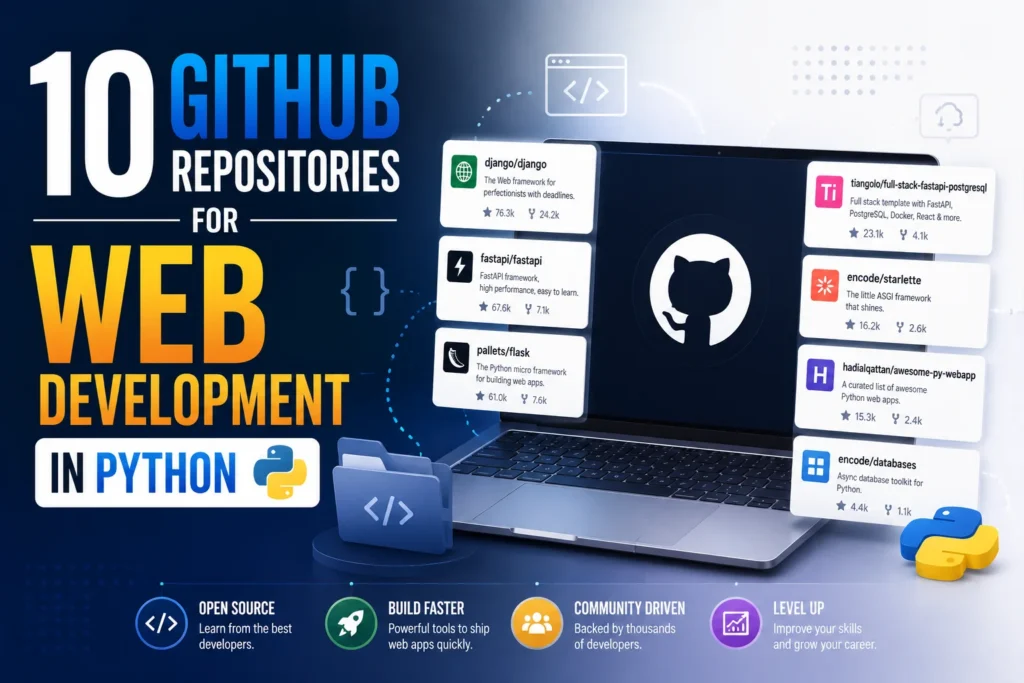
10 GitHub Repositories for Web Development in Python

Python is no longer just the language of data science, automation, and machine learning scripts. In 2026, it is one of the most practical choices for building full-stack web applications, production-grade APIs, interactive data dashboards, AI demos, and large-scale web scraping systems.
In this article14 sections
The Python web ecosystem has expanded significantly. Frameworks that did not exist five years ago – FastAPI, Reflex, and Gradio – now attract tens of thousands of GitHub stars and power applications at Microsoft, Netflix, Uber, and Hugging Face. Meanwhile, the established frameworks – Django and Flask – continue to be the bedrock of millions of production applications worldwide.
Web development in Python is not a compromise. It is a deliberate choice that gives developers one language, one ecosystem, and one mental model for the full stack – from API endpoints to frontend interfaces to data pipelines.
At Search Savvy, we work with businesses on their digital infrastructure – and more development teams are asking us about Python web stacks than at any point in the last five years. Whether you are a developer evaluating your next project’s stack, a technical lead choosing tooling for your team, or a product builder who wants to minimise the number of languages in your codebase, this list of 10 GitHub repositories for web development in Python is your 2026 starting point.
Why Is Web Development in Python Growing So Rapidly in 2026?#
Web development in Python has reached an inflection point driven by two converging forces: the rise of AI-integrated applications and the maturation of Python-first full-stack frameworks.
FastAPI’s popularity skyrocketed from just 15,000 stars in 2020 to over 88,000 stars by 2026 – overtaking Flask in active adoption for modern Python web development. The driver is clear: as AI and machine learning move from research to production, the teams building those models want to deploy them as web applications in the same language they used to train them. Switching to JavaScript or Go for the web layer creates a context-switching cost that Python-first web frameworks eliminate entirely.
Python is now used for web application development far more than many people think. Developers and teams use frameworks like Django and Flask to build internal systems, admin portals, dashboards, and fully functional websites. Python is no longer just for scripting, automation, and data science – it has become one of the most practical choices for building APIs, dashboards, machine learning apps, internal tools, and full-stack web applications.
With that context established, here are the 10 GitHub repositories that define Python web development in 2026.
People Also Ask: Is Python good for web development in 2026? Short Answer: Yes – significantly more so than in previous years. Python’s web development ecosystem has matured with frameworks like FastAPI (88k+ GitHub stars), Reflex for full-stack apps, Streamlit for data applications, and Gradio for AI interfaces. Python is the language of choice for teams building AI-integrated web applications, internal tools, APIs, dashboards, and ML demo interfaces in 2026.
What Are the 10 Best GitHub Repositories for Web Development in Python?#
Web development in Python spans multiple categories – full-stack frameworks, API frameworks, data apps, AI interfaces, and scraping infrastructure. These 10 repositories represent the breadth and capability of the Python web ecosystem in 2026.
1. Django – The Full-Stack Powerhouse#
Web development in Python most commonly starts here. Django 84,400+ stars is the most feature-complete Python web framework available – a batteries-included toolkit that provides an ORM, authentication, admin interface, form handling, security middleware, and template engine in a single cohesive package.
Django’s “convention over configuration” philosophy means you build faster when your requirements match its assumptions – and those assumptions are well-calibrated for content management systems, SaaS platforms, e-commerce sites, and data-driven web applications.
Best for: CMS platforms, SaaS products, e-commerce, admin portals, enterprise web applications Why it matters in 2026: Django has 250K+ Stack Overflow discussions and remains the most widely deployed Python web framework globally. Its security-first architecture – protecting against CSRF, XSS, SQL injection, and clickjacking by default – makes it the framework of choice for any application handling sensitive data.
2. FastAPI – The Modern API Framework#
Web development in Python for API-first applications has a clear winner in 2026. FastAPI 88,000+ stars is the fastest-growing Python web framework in the ecosystem – backed by Microsoft, Netflix, and Uber, and specifically designed for building high-performance APIs with automatic documentation, type safety, and async-first architecture.
FastAPI uses Python type hints to generate interactive Swagger UI and ReDoc documentation automatically – eliminating a category of manual documentation work entirely. Its ASGI architecture supports async handlers natively, delivering performance that approaches Go and Node.js for I/O-bound workloads.
Best for: REST APIs, microservices, AI model serving endpoints, production backend services Why it matters in 2026: After analysing 50,000+ GitHub repositories and surveying 1,200 developers, FastAPI is emerging as the dominant choice for modern Python web frameworks – particularly for teams integrating AI models into web backends. Its performance and developer experience make it the default choice for new API projects in Python.
3. Flask – The Flexible Micro-Framework#
Web development in Python for smaller, more customised applications has long relied on Flask 66,000+ stars. Unlike Django’s opinionated structure, Flask gives you a minimal foundation and lets you choose your own ORM, authentication library, template engine, and architecture pattern.
Flask is a lightweight WSGI web application framework ideal for small to medium-sized applications, microservices, and internal tools where Django’s scope would be excessive. Its simplicity is its primary advantage – a minimal Flask application is four lines of Python.
Best for: Microservices, internal tools, lightweight APIs, developer-chosen architecture projects Why it matters in 2026: Flask is plateauing at 60,000+ stars while FastAPI grows, but it remains the right choice for projects where architectural freedom is more valuable than built-in batteries. For experienced Python teams with strong preferences about each component, Flask’s non-opinionated design is a feature, not a limitation.
4. Reflex – Full-Stack Python Without JavaScript#
Web development in Python for full-stack applications without any JavaScript is now possible through Reflex 20,000+ stars. Reflex allows you to build the frontend, backend, and application logic entirely in Python – when deployed, it compiles to a FastAPI backend paired with a React frontend.
Reflex extends FastAPI by adding a frontend layer and eliminating the boilerplate needed to connect backend and frontend. This significantly simplifies full-stack development. For teams that live in Python and do not want to context-switch to TypeScript or React for the UI layer, Reflex is the most significant development in the Python web ecosystem in the last two years.
Best for: Full-stack web applications in pure Python, internal tools with rich UIs, teams avoiding JavaScript Why it matters in 2026: As noted by KDnuggets (June 2026), the biggest shift for many Python-first developers has been moving from Next.js toward Reflex for full-stack applications. Being able to build the frontend, backend, and logic in Python makes it easier to stay in one ecosystem and move faster.
People Also Ask: Can you build full-stack web apps in Python without JavaScript in 2026? Short Answer: Yes. Reflex allows you to write the frontend, backend, and application logic entirely in Python. When deployed, it compiles to a FastAPI backend with a React frontend – but you never write a line of JavaScript. This makes it the preferred choice for Python-native teams building full-stack applications who want to avoid the context-switch to TypeScript or React.
5. Streamlit – Data Apps and Dashboards#
Web development in Python for data applications is dominated by Streamlit 36,000+ stars. Streamlit turns Python scripts into shareable, interactive web applications without requiring any front-end development experience. You write Python. Streamlit handles the UI.
Streamlit is especially useful for developers who want to quickly build data apps, visualisation tools, reporting dashboards, LLM demos, and machine learning interfaces using only Python. A basic Streamlit app that loads a CSV, displays a chart, and adds a filter slider is achievable in under 30 lines of code.
Best for: Data science dashboards, ML model interfaces, LLM demos, reporting tools, internal analytics apps Why it matters in 2026: As AI applications move from experiment to production, Streamlit serves as the rapid prototyping and deployment layer – turning a data science notebook into a shareable web interface in minutes. It is the fastest path from working model to usable web application for data scientists and ML engineers.
6. Gradio – ML and AI Demo Interfaces#
Web development in Python specifically for machine learning and LLM applications has a specialist tool in Gradio 35,000+ stars. Gradio is now maintained by Hugging Face and allows you to create web interfaces for models, functions, APIs, and demos with just a few lines of code.
Unlike Streamlit, Gradio is designed specifically for model demos – it provides components for image inputs, audio, file upload, text chat, and model comparison out of the box. Its native Hugging Face integration makes deploying a new model demo a single command.
Best for: ML model showcasing, LLM application demos, AI prototype interfaces, Hugging Face Spaces deployment Why it matters in 2026: Gradio is the default interface layer for the Hugging Face ecosystem – the largest model-sharing platform in the world. Any developer wanting to make their model accessible to non-technical users uses Gradio. Its built-in sharing feature creates a public URL for any demo in seconds with no infrastructure configuration.
7. Dash – Interactive Analytics Applications#
Web development in Python for enterprise analytics and interactive data visualisations is served by Dash 21,000+ stars. Dash is a Python framework for building interactive data applications and dashboards using the Plotly charting library. It provides callbacks for interactivity – a slider that updates a chart, a dropdown that filters a table – entirely in Python.
Dash sits above Streamlit in enterprise adoption due to its more structured architecture and its integration with Plotly Enterprise. It is the framework of choice for analytics teams building investor-facing dashboards, operational monitoring tools, and regulatory reporting interfaces.
Best for: Enterprise analytics dashboards, interactive financial visualisations, regulatory reporting tools Why it matters in 2026: Dash’s enterprise tier (Dash Enterprise) provides authentication, deployment infrastructure, and collaboration features that Streamlit’s free tier does not. For organisations where dashboard security, access control, and brand consistency are requirements, Dash is typically the professional choice.
8. Scrapy – Industrial Web Scraping and Crawling#
Web development in Python for data collection and web scraping at scale relies on Scrapy 52,000+ stars. Scrapy is a high-performance, asynchronous web crawling and scraping framework that handles URL queuing, concurrent requests, item pipelines, middleware, and export to multiple formats from a single, coherent architecture.
Scrapy is not a simple scraper – it is a full framework for building spiders that crawl entire websites, follow links, parse structured data, and persist results to databases, CSV files, or data pipelines. It is maintained by Zyte (formerly Scrapinghub) and widely used in SEO tooling, price monitoring, research, and content aggregation.
Best for: Large-scale web crawling, price monitoring, SEO data collection, content aggregation pipelines Why it matters in 2026: As AI systems require training data and business intelligence requires web-sourced competitive data, Scrapy provides the production-grade infrastructure for collecting it at scale. Its async architecture handles thousands of concurrent requests efficiently – essential for any meaningful crawling operation.
9. Starlette – The ASGI Toolkit#
Web development in Python at the framework level often involves Starlette 10,000+ stars – the lightweight ASGI toolkit that FastAPI is built on. Starlette provides the routing, middleware, request/response handling, WebSocket support, and background task infrastructure that underpins modern Python async web development.
Starlette is the right choice when you want the power of an async Python web framework without FastAPI’s opinionated API conventions – or when you are building a framework, tool, or application that requires direct ASGI control. It also excels at WebSocket-heavy applications like real-time chat, live dashboards, and notification systems.
Best for: Custom async web frameworks, WebSocket applications, real-time features, framework development Why it matters in 2026: Understanding Starlette is essential for any developer working with FastAPI, since FastAPI wraps it entirely. It is also the toolkit of choice for Python teams building custom middleware, authentication layers, and application servers that require full ASGI control without a heavier framework overhead.
10. AIOHTTP – Async HTTP for APIs and Clients#
Web development in Python for high-concurrency applications and HTTP client tasks is served by AIOHTTP 15,000+ stars. AIOHTTP provides both an async HTTP server and an async HTTP client in a single package – making it uniquely suited for applications that need to simultaneously serve requests and make external API calls without blocking.
AIOHTTP is particularly valuable for API gateway services, web scrapers that need async HTTP clients, webhook processors, and any service that needs to make a large number of outbound HTTP requests concurrently. Its async client is commonly used alongside FastAPI and Starlette in applications that integrate with external services.
Best for: High-concurrency HTTP applications, async API clients, webhook processors, API gateway services Why it matters in 2026: As Python applications increasingly integrate with multiple external APIs – LLM providers, payment gateways, social platforms – the ability to make concurrent HTTP requests without blocking is architecturally essential. AIOHTTP provides the client infrastructure that keeps async Python backends performant under concurrent load.
People Also Ask: Which Python web framework is best for AI and machine learning applications in 2026? Short Answer: FastAPI is the dominant choice for AI/ML integration – it is designed for API serving with async support, and its type-hint-based documentation generation is particularly well-suited to ML model endpoints. For demo interfaces, Gradio (Hugging Face) is the fastest path from model to shareable web app. For data dashboards and internal ML tools, Streamlit is the easiest starting point. The choice depends on whether you are building an API (FastAPI), a UI (Gradio/Streamlit), or a full application (Reflex).
How Do You Choose the Right Python Repository for Your Web Project?#
Web development in Python offers genuinely different tools for genuinely different requirements – and choosing the right one depends on three questions:
What are you building?
- Production web application or SaaS → Django
- REST API or microservice → FastAPI
- Internal tool or lightweight service → Flask
- Full-stack app in pure Python → Reflex
- Data dashboard or ML interface → Streamlit or Dash
- AI model demo or LLM interface → Gradio
- Web crawling or data collection → Scrapy
- Async-first or WebSocket application → Starlette or AIOHTTP
What is your team’s experience level?
Web development in Python has a clear accessibility gradient. Streamlit is the most accessible – you can build a useful web app in under an hour with no prior web experience. Django has the steepest learning curve due to its rigid project structure and extensive feature set. FastAPI sits in between – powerful and well-documented, but async programming and type hints require familiarity with modern Python patterns.
What is your performance requirement?
Web development in Python for high-performance applications should use FastAPI (ASGI async), Starlette, or AIOHTTP. For applications where request throughput is not a primary constraint, Flask and Django’s WSGI synchronous model is easier to reason about and test.
According to Search Savvy’s insights from advising development teams on technology stack selection, the most common mistake is choosing Django for small internal tools (overbuilt) or choosing Flask for complex SaaS applications (underbuilt). The richness of the Python web ecosystem in 2026 means there is a well-matched tool for every project size – the framework selection decision deserves more deliberate attention than it typically receives.
People Also Ask: Should I learn Django or FastAPI for Python web development in 2026? Short Answer: Learn FastAPI first if you are building APIs, working with AI/ML, or starting a new project in 2026 – its star count has surpassed Django’s growth trajectory and it is the direction the Python web ecosystem is moving. Learn Django if you need a complete, batteries-included web application framework with admin interface, ORM, authentication, and form handling out of the box. Both are valuable skills, but FastAPI is the higher-priority investment for developers entering Python web development today.
FAQ: Web Development in Python – Your Questions Answered#
Q1: Is Python web development suitable for production-scale applications in 2026? Yes, definitively. Python powers production applications at Instagram (Django), Netflix (FastAPI), Spotify (Flask), and Reddit (various). The performance argument against Python has been significantly mitigated by async frameworks (FastAPI, Starlette, AIOHTTP) that deliver throughput comparable to Node.js for I/O-bound workloads. For compute-intensive operations, Python services can offload processing to async workers or external services. Django and FastAPI both have proven production track records at significant scale.
Q2: How does Python web development compare to Node.js or Go for APIs in 2026? FastAPI and Starlette close the performance gap significantly compared to Django or Flask. For I/O-bound API workloads – the majority of real-world API operations – FastAPI performance is comparable to Node.js Express and meaningfully behind Go, but the gap is rarely the deciding production constraint. The decisive factors for most teams are developer productivity, ecosystem maturity, and team familiarity. For teams already working in Python (data science, ML, automation), staying in Python for the web layer eliminates a context-switch cost that consistently outweighs the raw performance difference.
Q3: Can beginners learn web development in Python without prior web experience? Yes – Streamlit and Gradio are specifically designed for this pathway. Both allow developers to build functional, shareable web applications from Python scripts without writing HTML, CSS, or JavaScript. For traditional web development, Flask is the most beginner-accessible framework. Django’s learning curve is steeper – the first hour involves understanding URLs, views, templates, models, and migrations simultaneously – but the investment pays off for complex applications. Start with Streamlit for data apps or Flask for web apps if you are learning Python web development from scratch.
Q4: Which of these repositories are most used in Indian companies in 2026? Django and Flask dominate the Indian enterprise and startup landscape for traditional web development, primarily because of the large Python developer talent pool and extensive deployment documentation. FastAPI is rapidly gaining adoption in Indian product companies and AI startups – particularly those building model serving APIs. Streamlit is widely used in Indian data science teams and analytics departments for internal dashboarding. Scrapy is heavily used by Indian digital marketing agencies and SEO tool developers. At Search Savvy, we see increasing Python web development adoption across Indian digital product teams as AI integration becomes a standard requirement.
Q5: What is the difference between Streamlit and Gradio for Python web apps? Both are Python frameworks for building web UIs without frontend development experience – but they serve distinct purposes. Streamlit is optimised for data science dashboards, reporting tools, and interactive data applications. Gradio is optimised specifically for machine learning model demos – it provides components for image input/output, audio, file upload, and chatbot interfaces out of the box. Streamlit apps tend to be more complex data applications; Gradio apps tend to be simpler model demonstrations. The best choice depends on whether your primary use case is data exploration (Streamlit) or model showcasing (Gradio).
Q6: How do these GitHub repositories help with SEO for web applications built in Python? Web development in Python using Django, FastAPI, or Flask can achieve excellent technical SEO – clean URL structures, fast page loads, schema markup, sitemaps, and structured meta tags are all manageable in Python web frameworks. Django has built-in sitemap generation and URL routing that supports SEO-friendly slug structures. FastAPI enables fast API responses that support performance-optimised frontend architectures. For developers integrating Python backends with frontend frameworks (React, Next.js, Astro), FastAPI’s clean JSON API design makes the integration straightforward. Core Web Vitals performance depends on frontend implementation and hosting infrastructure – not the Python framework itself.
Building a web application, API, or data platform in Python and not sure which framework fits your use case best? Visit Search Savvy for a technical strategy consultation – and an honest assessment of which Python web development stack is right for your team, timeline, and growth goals.