Google Search Console Insights Just Got Smarter. Here’s Everything You’re Missing

If you opened Google Search Console this week and noticed something new – you are not imagining it.
In this article16 sections
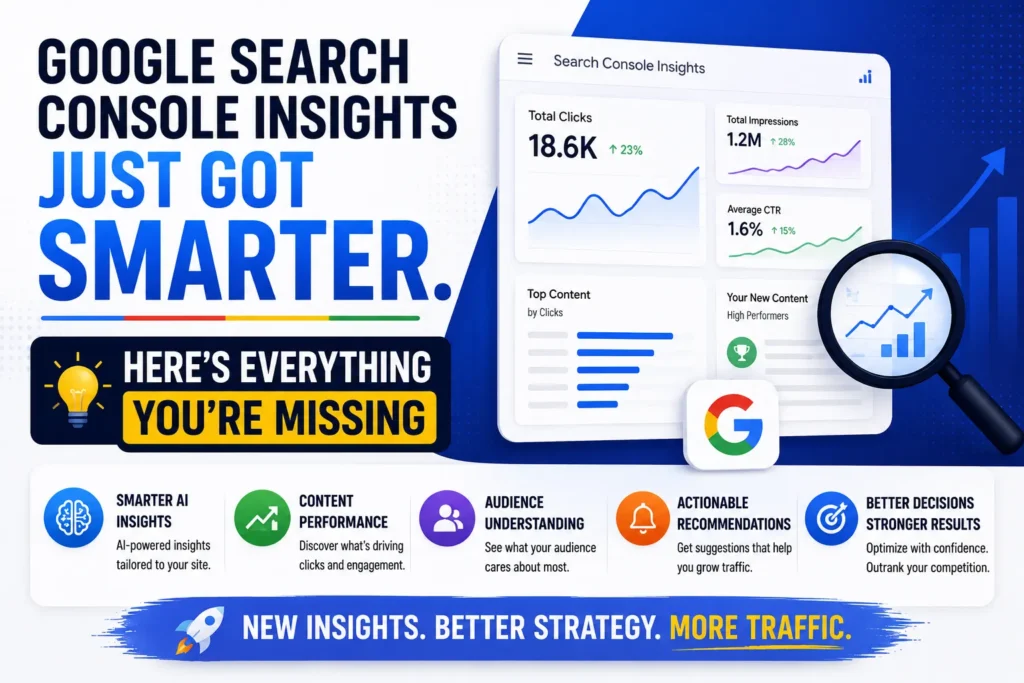
On June 3, 2026, Google published a landmark blog post titled “New opportunities, control and insights for website owners” on the Google Search Central Blog. It announced something the SEO community has been asking for since AI Overviews launched in 2023: a dedicated report showing how often your pages appear inside Google’s AI-generated search features – separate from your traditional organic performance data.
For the first time, Google Search Console Insights are not just about rankings and clicks. They are about AI visibility – and the two are no longer the same thing.
Google Search Console Insights have always been the most direct window into how Google sees your website. But until June 2026, they had a critical blind spot: everything that happened inside AI Overviews and AI Mode was invisible. Your page could be cited in an AI-generated answer thousands of times per month, influencing users who never clicked – and your Search Console dashboard would show zero data on any of it.
That blind spot has now been partially addressed. At Search Savvy, we have been tracking Search Console’s evolution closely – and the June 2026 update is the most significant expansion of the platform’s reporting capability since the Core Web Vitals report launched. This article covers every new feature, what the data means, and exactly how to use it to make smarter decisions about your content, SEO, and AI search strategy.
What Are the New Google Search Console Insights for AI Search in 2026?#
Google Search Console Insights launched a new category of reporting in June 2026 that fundamentally changes what performance data website owners can access: Search Generative AI performance reports.
Google’s official announcement confirmed: “We’re also starting to roll out new insights for website owners in Search Console about the appearance of their pages in generative AI Search features.”
These dedicated reports launched in June 2026 showing how often your URLs appear in Google’s AI-generated features – AI Overviews, AI Mode, and generative Discover – separate from standard organic data. Before this Google Search Console new update, AI-driven visibility was buried in aggregate numbers with no way to separate it from traditional organic traffic.
The context behind this launch matters. AI Overviews now has over 2.5 billion monthly active users, while AI Mode has surpassed one billion monthly users. Those are not niche features. They are the primary interface through which hundreds of millions of people now encounter search results – and, until now, website owners had no direct data on how their content was performing within them.
Specific metrics confirmed in the June 3, 2026 announcement:
- Impressions – How often URLs from your site appeared in generative AI features in Search and Discover
- Pages – Which specific URLs appeared within AI features
- Countries – Where in the world your AI search visibility is occurring, broken down by country
Google explicitly noted: “We’re continuing to work with website owners to understand what insights will be most helpful to inform their strategies, and we’ll introduce additional metrics over time.”
The three metrics available now are the beginning – not the complete picture. Clicks, CTR from AI features, and engagement data are expected to follow as the reporting framework matures.
People Also Ask: What new reports did Google add to Search Console in June 2026? Short Answer: On June 3, 2026, Google announced Search Generative AI performance reports in Search Console. These dedicated reports show how often your URLs appear in Google’s AI-generated features – AI Overviews, AI Mode, and generative Discover – separate from traditional organic performance data. The initial metrics include Impressions (how often your URLs appeared in AI features), Pages (which URLs appeared), and Countries (where your AI visibility is occurring).
What Is the AI-Powered Configuration Feature in Google Search Console?#
Google Search Console Insights took another major step forward earlier in 2026 with the launch of AI-powered configuration – a feature that changes how you interact with your performance data entirely.
The AI-powered configuration tool lets you interact with your Search Console performance reports using natural language prompts. Instead of manually applying filters – queries, pages, devices, countries, date ranges – you can describe the sort of analysis you want and the AI will instantly configure the report for you.
This matters because most marketers – particularly in-house teams and SMBs – underuse Search Console significantly. The manual filter workflow is intimidating, slow, and requires familiarity with how the tool is structured. Natural language queries remove that barrier completely.
What you can now ask the AI configuration tool:
- “Show me my top pages by impressions over the last 3 months compared to the same period last year”
- “Which queries had improving click-through rates in March 2026?”
- “Show me mobile performance for my blog content in India this quarter”
- “Which pages have high impressions but below-average CTR?”
- “What are my fastest-growing keywords by impression volume this year?”
Each of these queries would previously have required multiple manual filter steps, date comparisons, and export-and-compare workflows. The AI configuration answers them instantly – turning Search Console from a tool for SEO specialists into something a broader team can use effectively without technical training.
People Also Ask: Can you use AI to analyse Google Search Console data in 2026? Short Answer: Yes. Google launched an AI-powered configuration feature in Search Console in early 2026, allowing users to interact with their performance reports using natural language prompts. Instead of manually applying multiple filters, you can describe the analysis you want in plain language and the AI instantly configures the report. This feature is available to all users and significantly lowers the skill barrier for extracting actionable insights from Search Console data.
What Is the New AI Opt-Out Toggle in Search Console – and Should You Use It?#
Google Search Console Insights now include a control that no website owner has had before: the ability to decide whether your content appears in Google’s generative AI search features.
Google confirmed it is testing a new toggle inside Search Console designed to allow website owners to decide if their webpages appear in and help ground the company’s latest AI search features, including AI Overviews and AI Mode.
This is a significant development – and a double-edged one. On March 18, 2026, Google published a blog post responding to the UK Competition and Markets Authority’s consultation, stating it is “developing further updates to our controls to let sites specifically opt out of generative AI features in Search.” The opt-out toggle is the delivery of that commitment.
What opting out means:
- Your pages would stop appearing in AI Overviews, AI Mode, and generative Discover results
- You would lose the impression-level AI visibility that the new reports now measure
- You would also lose any click-through traffic that AI features generate via inline links and website previews
What opting out does NOT mean:
- It does not remove your pages from traditional organic search results
- It does not affect your rankings for standard blue-link results
- It does not prevent Googlebot from crawling your pages for traditional indexing
The commercial case for most businesses is strongly against opting out. AI Overviews include prominent links to websites, and Google has been increasing inline links directly within AI responses and adding website previews to encourage click-throughs. The AI citation traffic that flows through these links represents incremental visibility – not a replacement for organic clicks, but an additional discovery surface.
The exception is content behind a paywall or subscription model, where AI summarisation directly cannibalises paid access. Publishers and media brands with paid content strategies have the clearest commercial case for opting out.
According to Search Savvy’s insights from advising clients on AI search strategy, the opt-out decision should be made after reviewing the AI impression data the new reports provide – not before. Once you can see how many AI impressions your pages are generating and in which countries, the cost-benefit of opting out becomes quantifiable rather than theoretical.
How Does the New Google Search Console Compare to Bing Webmaster Tools on AI Reporting?#
Google Search Console Insights in June 2026 arrived in a competitive context worth understanding – because Microsoft launched its own AI search reporting tool four months earlier.
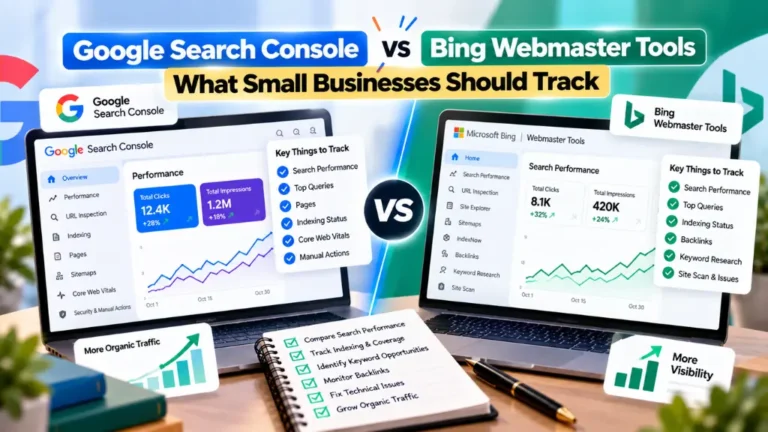
Microsoft launched AI Performance in Bing Webmaster Tools in beta on February 10, 2026. The feature lets site owners see where, and how often, their content is cited in AI-generated answers across Microsoft Copilot, Bing’s AI summaries, and select partner integrations. Bing Webmaster Tools shows which URLs are cited, which queries trigger those citations, and how citation activity changes over time.
The competitive dynamic is clear: both Google and Microsoft recognise that AI search visibility is a new category of performance data that website owners need to measure. The two platforms are implementing similar capabilities on slightly different timelines.
The practical implication for any business running an organic search strategy: both dashboards deserve setup and monitoring. Google Search Console covers AI Overviews and AI Mode – the largest AI search surfaces by user volume. Bing Webmaster Tools covers Copilot and Bing AI summaries – smaller volume, but with important overlap for business, enterprise, and international audiences.
For Indian businesses: Google dominates Indian search significantly, making Google Search Console AI reporting the primary priority. But ChatGPT (which increasingly draws on Bing data) has a substantial user base among India’s tech-forward professional and B2B audience – making Bing Webmaster Tools a worthwhile secondary tracking surface.
People Also Ask: Is Bing Webmaster Tools showing AI citation data in 2026? Short Answer: Yes. Microsoft launched AI Performance in Bing Webmaster Tools in beta on February 10, 2026 – four months before Google’s AI performance reports in Search Console. Bing’s tool shows which URLs are cited in Copilot and Bing AI summaries, which queries trigger those citations, and how citation activity changes over time. Both Google Search Console and Bing Webmaster Tools should now be part of any complete AI search visibility monitoring stack.
What Other Major Updates Did Google Search Console Receive in 2026?#
Google Search Console Insights have been expanding continuously through 2026, not just in the June announcement. Here is the full picture of what changed:
Natural Language Performance Report Queries (Early 2026)#
The AI-powered configuration feature arrived early in 2026, allowing plain-language questions against your performance data. This is available to all users at no additional cost and works across all Search Console report types – Performance, Coverage, Core Web Vitals, and Sitemaps.
AI-Powered Content Recommendations#
Google Search Console in 2026 now analyses your top-performing content and provides AI-generated suggestions for improving pages with declining performance. These recommendations draw on your specific site’s data rather than generic best practices – making them more contextually relevant than standard SEO audit outputs.
Improved Long-Term Benchmarking#
Previously, the standard comparison windows in Search Console were 24 hours, 7 days, 28 days, 3 months, and 12 months. A 2026 update improved comparison capabilities with more intuitive timelines for performance shifts – particularly helpful for identifying the impact of core updates and seasonal patterns. This update is especially helpful for marketers reporting performance to stakeholders or clients, providing clearer long-term benchmarks.
Discover Performance Separation#
The February 5, 2026 algorithm update focused on Google Discover, and Search Console reporting was updated to better separate Discover traffic from traditional organic search data. This makes it possible to understand whether traffic changes are driven by ranking shifts in Search or by content surfacing changes in the Discover feed – two very different problems requiring very different responses.
Enhanced Core Web Vitals Field Data#
Search Console’s Core Web Vitals report was updated with improved field data granularity, showing performance breakdowns that more clearly identify which specific pages are failing INP, LCP, or CLS thresholds – making technical SEO prioritisation faster and more precise.
People Also Ask: What is the biggest change to Google Search Console in 2026? Short Answer: The most significant change is the launch of Search Generative AI performance reports on June 3, 2026, which for the first time show website owners how their pages are performing inside AI Overviews, AI Mode, and generative Discover – separate from traditional organic data. This closes the measurement gap that existed since AI Overviews launched, allowing businesses to quantify their AI search visibility and optimise for it with real data.
How Should You Use Google Search Console Insights to Improve Your 2026 SEO Strategy?#
Google Search Console Insights in 2026 require a new set of workflows alongside the traditional ones. Here is the practical framework for using the updated platform:
Weekly Workflow: The Five-Report Stack#
At Search Savvy, we run five Search Console checks as a weekly standing agenda item. Now that AI performance data is available, the stack has expanded:
1. Performance Report – Queries and Pages Filter by your top 20 pages. Check impressions, clicks, and average position. Flag any page where impressions are growing but CTR is declining – a common signal that AI Overviews are answering the query without generating a click, even when your page is visible.
2. AI Performance Report (New – June 2026) Check AI impressions by page and country. Identify which pages are appearing in AI Overviews and AI Mode. Cross-reference against your traditional Performance Report. Pages with high AI impressions but low traditional clicks are your highest-priority content optimisation targets – the AI is using your content but the visitor never arrives.
3. Core Web Vitals Report Review failing and improving URLs. Prioritise any page flagging INP or LCP failures – these affect both traditional rankings and AI Overview citation eligibility.
4. Coverage Report Check for new crawl errors, noindex conflicts, and pages moving into “Discovered – currently not indexed” status. A page that cannot be indexed cannot appear in AI features.
5. Sitemaps Report Verify your submitted URL count versus indexed URL count. Any widening gap since last week signals a crawlability or quality issue requiring investigation.
Monthly Workflow: AI Visibility Trend Analysis#
Use the new AI impression data to build a monthly trend report. Track:
- Total AI impressions by month – is your AI visibility growing, stable, or declining?
- AI impressions by country – which markets show the strongest AI search presence?
- Pages with fastest-growing AI impression count – what content formats and topics are earning the most AI citations?
- Pages with AI impressions but zero traditional clicks – are these being cited in AI answers that satisfy the query without driving traffic?
This monthly view builds the first genuine picture of your site’s AI search authority – a metric that did not exist as a discrete, measurable data point before June 2026.
Using the Natural Language Query Tool#
Use the AI-powered configuration tool for the analyses that take the most time manually. The queries that deliver the highest value fastest:
- Year-over-year performance comparisons for your top 10 pages
- CTR analysis by device type and country for commercial pages
- Impression-to-click ratio analysis across your entire blog library
- Identification of queries where you rank in positions 4–10 with above-average impressions – these are your highest-priority featured snippet targets
The natural language interface makes these analyses accessible to team members who previously found the manual Search Console filter workflow too technical – expanding who in your organisation can contribute to SEO decision-making.
What Does the New AI Impression Data Actually Tell You About Your Content?#
Google Search Console Insights now provide something the industry has been asking for since AI Overviews launched: a way to separate “did my page appear?” from “did anyone click?”
AI Overviews often appear above traditional organic listings. Your content may influence an AI-generated answer without generating a click. This creates a new category of content performance – AI impression share – that is fundamentally different from organic rank-based visibility.
The implications for how you interpret your data:
High AI impressions + low traditional clicks = Informational content being consumed via AI summary. These pages are doing their job – informing users – but the AI is completing the information transaction without driving a visit. The fix is adding commercial depth: CTAs, case studies, pricing context, or proprietary data that gives the user a reason to click through even after the AI has answered their initial question.
High traditional impressions + zero AI impressions = Content not meeting AI citation criteria. Pages that rank well but never appear in AI features lack the structural and authority signals that AI citation requires – schema markup, first-hand evidence, named expert attribution, or the freshness signals that make content citation-worthy. These pages are candidates for information gain improvements.
Growing AI impressions + stable or growing clicks = Positive citation dynamic. Pages in this category are being cited in AI answers and still generating click-throughs – the optimal outcome. These pages contain content that satisfies initial AI-driven discovery and provides enough additional value that users visit. Study what these pages have in common and replicate those qualities across your broader content library.
According to Search Savvy’s insights from working with clients across digital marketing, e-commerce, and professional services, the most surprising early finding from the June 2026 AI reporting rollout is how many pages have significant AI impression volume with near-zero corresponding traditional click data – indicating substantial audience reach that was completely invisible in previous reporting. For some clients, this represents a larger audience touchpoint than their traditional organic traffic – just one that was never measured.
People Also Ask: What does an AI impression mean in Google Search Console? Short Answer: An AI impression in the new Google Search Console reports means your URL appeared in a generative AI feature – AI Overviews, AI Mode, or generative Discover – at least once during a user’s search session. It does not necessarily mean the user clicked on your link. AI impressions measure visibility and authority signal within AI features, separate from the clicks and CTR that traditional organic reports track. High AI impressions with low clicks indicate your content is being used to generate AI answers without driving direct traffic.
FAQ: Google Search Console Insights 2026 – Your Questions Answered#
Q1: Where do I find the new AI performance reports in Google Search Console? The Search Generative AI performance reports are rolling out to website owners through June and July 2026. To access them, open Google Search Console, navigate to your property, and look for the AI Performance section in the left navigation panel. The rollout is gradual – if you do not see it yet, it will appear as Google expands access. Google confirmed it is actively monitoring feedback and will introduce additional metrics over time. Ensure your property is verified and that your sitemap is submitted to maximise the accuracy of the data Google collects about your site’s AI search visibility.
Q2: Should I use the AI opt-out toggle to prevent my content from appearing in AI Overviews? For most businesses, opting out would be a strategic mistake. AI Overviews and AI Mode are used by 2.5 billion and 1 billion monthly users respectively. Google has been increasing inline links within AI responses and adding website previews to drive click-through from AI features. Opting out removes your pages from these features – and from the impression-level brand exposure they provide – without improving your traditional organic rankings. The primary exception is publishers with paid content where AI summarisation cannibalises subscription value. For all other businesses, use the new AI impression data to optimise for better citation – do not opt out.
Q3: How is AI impression data different from traditional impression data in Search Console? Traditional impressions in Google Search Console count how many times your URL appeared in a traditional search results page – the blue-link results below any AI features. AI impressions count how many times your URL appeared inside an AI-generated feature – AI Overviews, AI Mode, or generative Discover. The two data streams are now separate, which means you can see the full picture of your search visibility for the first time. A page might have 5,000 traditional impressions and 8,000 AI impressions – meaning the AI surface is actually a larger audience touchpoint than traditional search for that page.
Q4: What should I do if my pages have high AI impressions but no click-through traffic? High AI impressions with low or zero clicks indicate your content is being used as source material for AI-generated answers – but the AI is satisfying the user’s query without triggering a visit. The strategic response is to add content depth that gives users a reason to click even after the AI has summarised the basic answer. This means: adding proprietary data or original research not available elsewhere, including case studies with specific outcomes, adding pricing or comparison detail that the AI summary omits, and using strong CTAs tied to content the AI cannot summarise (tools, templates, calculators, consultation offers). The goal is making your page the necessary next step after the AI answer, not just the source of the AI answer.
Q5: How does the AI-powered natural language query feature work in Google Search Console? The AI-powered configuration tool, launched in early 2026, allows you to interact with all Search Console performance reports using plain-language questions. Type a query like “show me my pages with declining impressions over the last 90 days” or “which queries have improving CTR on mobile this year” – and the AI instantly applies the appropriate filters, date ranges, and comparison settings to generate the report. The feature works across Performance, Core Web Vitals, Coverage, and Sitemaps reports. It is available to all Search Console users at no additional cost and does not require any technical configuration to activate.
Q6: Does appearing in AI Overviews improve my traditional organic rankings? Not directly – AI Overview citations are not a confirmed direct ranking signal for traditional organic results. However, the factors that make pages eligible for AI citation – E-E-A-T signals, content depth, schema markup, mobile page speed, and structured formatting – are the same factors that support strong traditional rankings. AI citation and organic ranking reinforce each other through the same underlying content quality signals. AI visibility should be treated as authority capital – building brand recognition and authority that compounds across both AI and traditional search surfaces over time. The two are not separate strategies but different outcomes of the same quality-first content investment.
Have you checked your AI impression data in Search Console yet – or are you still measuring your entire search performance with half the picture? Visit Search Savvy for a Google Search Console audit that covers both traditional organic and AI search visibility – and a clear strategy for improving both in 2026.