

Somewhere between opening their laptop and typing a search query, your potential customer did something different today.
They asked out loud.
“Hey Google, best digital marketing agency near me.” “Alexa, what’s the best SEO tool for small businesses?” “Siri, who can fix my website in Mumbai?” No keyboard. No screen tap. Just a question, spoken naturally into a device that is always listening – and expected to answer immediately with one single result.
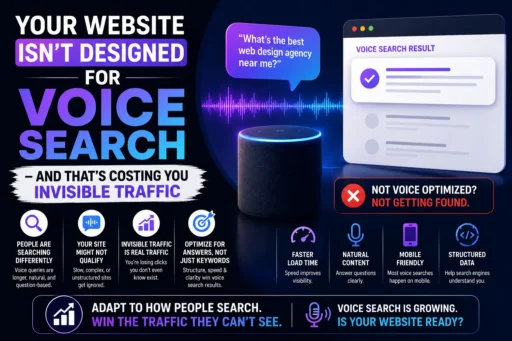
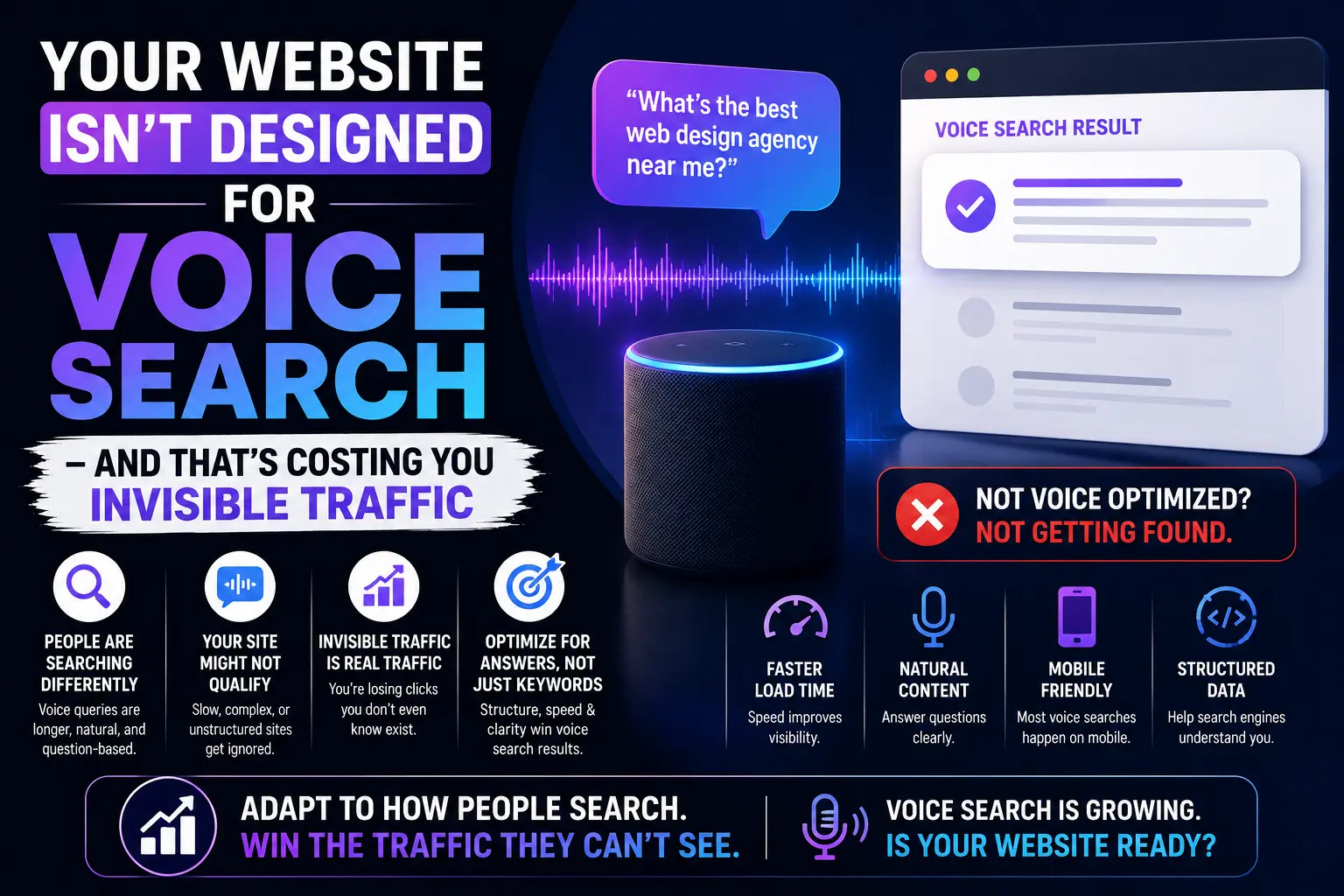
Voice search web design is not a future trend. It is present behaviour that is redirecting traffic away from websites that were built for how people type, toward websites that were built for how people speak. In 2026, voice search reached 27% of all global queries – more than one in four searches. The global count of active voice assistants has reached 8.4 billion. And 71% of consumers now prefer voice search over traditional typing for quick queries.
At Search Savvy, we audit websites regularly – and voice search readiness is one of the most consistently absent technical and content elements we find, across businesses of every size. This article explains exactly how voice search works, why your current website design is likely invisible to it, and what to change to capture the traffic you are currently sending to competitors who have already adapted.
What Is Voice Search Web Design – and Why Does It Matter in 2026?
Voice search web design is the practice of structuring, formatting, and optimising your website so that voice assistants – Google Assistant, Siri, Alexa, and the AI-integrated search interfaces now embedded in billions of devices – select your content as the answer to spoken queries.
It matters because voice search operates on a fundamentally different competitive model than traditional search. In a typed search, Google returns ten blue links. Your goal is to rank in the top three. In a voice search, the assistant reads one answer aloud. There are no second or third positions. Voice search results are winner-take-all: the search engine reads one answer, not ten blue links. Ranking third for a voice query drives nothing – because the assistant only reads the top result. Securing position zero is worth more traffic than ranking in positions two through ten combined for the same query.
The 2026 landscape makes this gap urgent:
- 8.4 billion active voice assistants deployed globally as of 2026
- 27% of all global search queries are now voice-initiated
- 71% of consumers prefer voice search over typing for quick queries
- 58% of people use voice search to find local businesses
- 76% of smart speaker users inquire about local businesses every week
- ₹40 billion+ in voice search-generated revenue projected in 2026
- India’s voice search usage grew 3× faster than text-based search
- Rural India shows 78% regular voice usage on mobile devices
Voice search web design is particularly urgent for Indian businesses. With smartphones dominating at roughly 72% of voice search usage and India’s rapid mobile internet expansion across both urban and rural markets, voice is not a secondary channel – it is often the primary search interface for a significant portion of your potential audience.
People Also Ask: How big is voice search in 2026? Short Answer: Voice search reached 27% of all global queries in 2026, driven by 8.4 billion active voice assistants across smartphones, smart speakers, and in-car systems. 71% of consumers prefer voice search over typing for quick queries. India’s voice search usage has grown 3× faster than text-based search, making it a particularly critical channel for Indian businesses targeting mobile-first audiences.
How Does Voice Search Work – and Why Is It Different from Typed Search?
Voice search web design starts with understanding the mechanism that determines which website gets chosen as the spoken answer – because it is structurally different from the mechanism that determines which website ranks on a SERP page.
Voice assistants use natural language processing (NLP) to understand the full conversational intent of a spoken query. They then retrieve an answer from the web, select the single most relevant and credible response, and read it aloud. The retrieval and selection process prioritises three sources in order:
Featured snippets power 40–60% of voice search answers. Google Assistant and Siri read featured snippets directly to users. The page that holds position zero for a question-based query is the page the voice assistant cites.
AI Overviews have created a second voice answer pipeline. Voice assistants increasingly draw from AI Overview citations for informational queries. Featured snippets and AI Overviews are the voice-result pipeline in 2026 – voice assistants almost exclusively read from one or the other.
Google Business Profile and local pack results serve the majority of “near me” and local voice queries – 22% of all voice searches have local geographic intent, and 76% of those local voice searches result in an in-store visit within 24 hours.
The critical structural difference from typed search: voice queries are 3–5 words longer than typed queries, almost always phrased as full questions, and oriented around immediate, local, or action-ready intent. Someone typing might enter “SEO agency Mumbai.” The same person speaking would say “What is the best SEO agency in Mumbai for small businesses?” The content structure that ranks for the short keyword often fails to answer the long conversational question.
Voice search results are typically 29 words long – short, direct, and immediately useful. The average voice search result page loads in 4.6 seconds – 52% faster than the average web page. Both dimensions – content brevity and page speed – are design requirements, not content preferences.
People Also Ask: Where do voice assistants get their answers from in 2026? Short Answer: Voice assistants primarily draw from three sources: featured snippets (position zero results), which power 40–60% of voice answers; AI Overview citations for informational queries; and Google Business Profile data for local intent queries. 75% of voice search results come from the top three desktop results. Pages with schema markup are 33% more likely to appear in voice results.
What Are the Most Common Voice Search Web Design Failures?
Voice search web design failures are almost always invisible in standard analytics and rank tracking – which is why they persist so long without being noticed. Your traffic report does not show you the voice queries you never appeared for. Your ranking report does not show you that someone asked a question your page could have answered but did not.
Here are the specific design and content failures that most commonly block voice search visibility:
Your Content Is Written for Keywords, Not Conversations
Voice search web design requires a fundamental shift in how content is written – not optimised after the fact, but conceived differently from the start. Voice queries are full questions averaging 7 to 10 words. Effective optimisation requires mapping complete natural-language questions to each page’s core topic, then structuring answers in concise 40-to-50-word blocks that voice assistants can read aloud without modification.
Most website content is written for typed search: short keyword phrases, fragmented sentences, and dense paragraphs that bury the answer after several lines of preamble. This structure works for scannable reading. It fails for voice extraction. A voice assistant looking for an answer to “What is the best time to post on Instagram in India?” needs a clear, direct, single-sentence answer – not a paragraph that eventually mentions this amid other advice.
No FAQ Sections That Mirror Real Spoken Questions
Voice search web design’s single most actionable content element is the FAQ section – because FAQ pages are built around answering questions directly, which is exactly how people use their voices to search. Each question should be phrased the way a real person would ask it. Then answer it clearly in two to four sentences.
Most business websites either have no FAQ pages at all, or FAQ pages with questions phrased in marketing language rather than natural human speech. “How can your services help my business grow?” is not a voice search question. “How much does SEO cost in India?” is. The gap between those two phrasings is the gap between invisible and cited.
Missing or Incomplete Schema Markup
Voice search web design has a technical prerequisite that many websites skip entirely: schema markup. Pages with schema markup are 33% more likely to appear in voice results. Structured data acts as explicit machine-readable signals that tell voice assistants exactly what your content represents – and why it is the correct answer to the query.
The specific schema types that most directly support voice visibility:
- FAQPage schema – even though FAQ rich results no longer appear in Google’s SERP display, FAQPage schema is still parsed by voice assistants and AI systems for answer extraction
- LocalBusiness schema – essential for local voice queries (“near me,” “open now,” “closest”), including address, hours, phone, and service area
- HowTo schema – for instructional content that answers “how do I” queries
- SpeakableSpecification schema – explicitly identifies sections of your page that are designed to be read aloud by voice assistants
Slow Mobile Page Speed
Voice search web design is inseparable from mobile performance. Page speed under 2 seconds is a prerequisite for voice search ranking. The average voice search result loads 52% faster than non-voice results. Core Web Vitals performance directly correlates with voice answer selection.
Smartphones represent 72% of voice search usage. A page that fails LCP (Largest Contentful Paint) thresholds or has poor mobile Core Web Vitals scores is structurally disadvantaged for voice search selection – regardless of how well its content matches the query. Google favours fast pages for voice results, and slow pages are deprioritised before content quality is even evaluated.
No Google Business Profile Optimisation
Voice search web design for businesses with any local dimension – a physical location, a service area, or a regional customer base – requires a fully optimised Google Business Profile. 58% of people use voice search to find local businesses. 76% of local voice searches result in a same-day visit.
When someone asks “best accountant near me” or “web agency open now in Bangalore,” the voice assistant draws from the Google Business Profile data of businesses in that area – not from their website. A website with excellent voice content but an incomplete or unverified Google Business Profile is invisible in local voice results entirely.
People Also Ask: Why is my website not showing up in voice search results? Short Answer: Voice search visibility failures trace to five root causes: content written for keywords rather than conversational questions, no FAQ sections with naturally phrased questions, missing schema markup (FAQPage, LocalBusiness, HowTo), mobile page speed failing the 2-second threshold voice results require, and an incomplete Google Business Profile for local queries. Any one of these can exclude your site from voice results regardless of your content quality.
How Do You Design and Optimise a Website for Voice Search in 2026?
Voice search web design improvements follow a specific sequence. Here is the implementation framework, ordered by impact:
Step 1: Audit Your Existing Content for Conversational Readiness
Voice search web design begins with identifying which pages are closest to voice-ready – and which need the most work.
For each of your top organic pages, run this check:
- Does the page open with a direct answer to the implied search question in the first 50 words?
- Does the page contain at least one FAQ section with questions phrased as natural speech?
- Is the main topic answer extractable in 40–60 words without reading the full page?
- Are question-based subheadings (H2/H3) used throughout the page?
Pages that fail three or more of these checks are your highest-priority voice search improvements.
Step 2: Restructure Content for Answer-First Formatting
Voice search web design’s core content principle is BLUF – Bottom Line Up Front. Every page should answer the primary question its target query implies in the first one to two sentences. Supporting context, detail, and examples follow.
Write in natural conversational language. Keep sentences short. Use simple words. Avoid jargon. A good rule of thumb: if you would not say it out loud to a customer, do not write it on your page. The reading level of voice search results averages 9th grade – the language that most naturally converts into spoken answers.
Use question-based subheadings throughout every content page – H2 and H3 headings phrased as the questions your audience would actually ask. “How much does website development cost in India?” converts more efficiently into a voice answer than “Website Development Cost Overview.”
Step 3: Add or Update FAQ Sections on Every Key Page
FAQ pages are the single most directly actionable voice search web design addition for most websites. Add a minimum of 5–8 FAQ entries to every core service page, product page, and blog article targeting conversational intent queries. Each FAQ entry should:
- Begin with the question phrased in natural speech, not marketing language
- Answer in two to four sentences – 40–60 words maximum
- Include the specific detail (price, location, timeframe, process step) the searcher is asking about
- Use FAQPage JSON-LD schema markup for every FAQ section
Step 4: Implement Voice-Relevant Schema Markup
Voice search web design requires a technical implementation layer. Add the following schema types where content warrants them:
- FAQPage schema on all pages with Q&A sections – use JSON-LD format and validate with Google’s Rich Results Test
- LocalBusiness schema on your homepage and Contact page – include Name, Address, Phone (NAP), opening hours, service area, and sameAs links to your Google Business Profile
- HowTo schema on all instructional content – helps voice assistants surface step-by-step answers for “how do I” queries
- Organisation schema – reinforces brand entity recognition that supports both AI citation and voice assistant attribution
Step 5: Hit the Mobile Speed Threshold
Voice search web design without mobile performance optimisation is an incomplete strategy. Run your key pages through Google PageSpeed Insights on mobile. Target:
- LCP under 2.5 seconds (voice result threshold is effectively 2 seconds)
- INP under 200 milliseconds
- CLS under 0.1
- Overall mobile PageSpeed score above 70
Compress hero images, implement lazy loading, defer non-critical JavaScript, and enable server-side caching. Every second of improvement in mobile load time increases your voice search eligibility.
Step 6: Optimise Your Google Business Profile Completely
Voice search web design for any business with local intent must include a fully completed Google Business Profile. Ensure: business name, address, and phone number are identical across your website, GBP, and all directories; opening hours are accurate and updated; service categories are specific and comprehensive; review responses are active and current; and photos are present and regularly updated. Local voice search has a 76% visit-within-24-hours conversion rate – the best conversion metric in digital marketing – and it is powered by your Business Profile data, not your website alone.
According to Search Savvy’s insights from voice search audits across Indian service businesses and e-commerce brands, the highest-ROI single change for most websites is adding structured FAQ sections with FAQPage schema to their top five organic pages. This one implementation addresses two of the three primary voice answer sources simultaneously – featured snippet eligibility and AI Overview citation readiness – and typically produces measurable results in featured snippet appearances within 4–6 weeks.
People Also Ask: How do I get my website to show up in voice search results? Short Answer: Target featured snippets by adding FAQ sections with naturally phrased questions answered in 40–60 words. Implement FAQPage, LocalBusiness, and HowTo schema markup. Ensure mobile page speed is under 2 seconds. Optimise your Google Business Profile completely for local voice queries. Write content in conversational language with question-based subheadings. Pages with these elements are 33% more likely to appear in voice results, and featured snippets power 40–60% of all voice answers.
Why Is India Particularly Important for Voice Search Web Design in 2026?
Voice search web design has an outsized urgency for Indian businesses because of India’s specific mobile-first internet context.
Rural India shows 78% regular voice usage on mobile devices – driven by the combination of low typing speeds in regional languages, high smartphone adoption, and the convenience of voice interaction for users who may have limited formal typing experience. India’s voice search usage grew 3× faster than text-based search over the measured period. Smartphones dominate device share for voice search in India, with roughly 72% of users preferring mobile compared to 35% using smart speakers.
Multilingual support covers 70+ languages in Google mobile voice search – meaning voice queries in Hindi, Tamil, Telugu, Kannada, Bengali, and other Indian languages are producing voice results from the same ranking systems that govern English queries. An Indian business website that has not considered regional language voice queries is missing a significant and fast-growing audience segment entirely.
At Search Savvy, we see this gap clearly in audits for Indian brands: English-language content optimised for typed search, with no consideration for the conversational intent patterns of voice users across multiple languages and platforms. The fix begins with recognising that your website’s traffic opportunity in India is not fully captured by your current keyword ranking report.
People Also Ask: Is voice search important for Indian businesses in 2026? Short Answer: Critically so. India’s voice search usage grew 3× faster than text-based search. Rural India shows 78% regular mobile voice usage. 72% of Indian voice searches occur on smartphones. Google supports 70+ languages for voice search, including major Indian languages. For businesses targeting audiences in Tier 2 and Tier 3 cities, or audiences more comfortable speaking than typing, voice search web design is one of the most significant visibility gaps currently unaddressed.
FAQ: Voice Search Web Design – Your Questions Answered
Q1: Does voice search optimisation help my traditional SEO rankings too? Yes – directly and significantly. The ranking factors that determine voice search selection overlap heavily with traditional SEO signals: mobile page speed, featured snippet eligibility, Core Web Vitals, E-E-A-T signals, and schema markup all improve both voice and traditional search performance simultaneously. Voice-optimised content – conversational language, question-based subheadings, answer-first formatting – also improves dwell time and user engagement metrics that feed traditional ranking algorithms. Voice optimisation is not a separate SEO track. It is good SEO with additional emphasis on conversational structure and schema implementation.
Q2: What is the most important schema type for voice search in 2026? For local businesses, LocalBusiness schema is the highest-priority implementation – local voice queries drive the majority of commercially valuable voice searches, and LocalBusiness schema directly feeds the Business Profile data voice assistants cite for “near me” and location-specific queries. For content-driven websites, FAQPage schema on key content pages is the highest-priority implementation – it increases voice result eligibility by approximately 33% and supports featured snippet capture that powers 40–60% of voice answers. Both should be implemented before considering niche schema types.
Q3: How is a voice search query different from a typed search query? Voice queries are 3–5 words longer than typed queries, almost always phrased as full questions, and oriented around immediate or local intent. Someone typing enters “SEO cost India” – 3 words. The same person speaking asks “How much does SEO cost for a small business in India?” – 12 words. The longer, conversational phrasing is a different search intent signal that requires different content structure to answer. Content optimised for short keyword phrases consistently fails to appear in voice results for the longer conversational equivalents.
Q4: Do I need to create entirely new content for voice search, or can I optimise existing pages? Primarily optimisation of existing pages rather than new content creation. The highest-impact voice search improvements are: adding FAQ sections to existing pages, restructuring opening paragraphs to lead with direct answers, adding schema markup to existing content, and improving mobile page speed. Only create new content where you identify specific high-intent voice queries that no existing page on your site addresses. Most websites have enough existing content to achieve significant voice search visibility gains through restructuring and schema implementation alone.
Q5: How long does it take to see results from voice search optimisation? Featured snippet appearances – the primary source of voice results – typically update within 4–8 weeks of implementing FAQ sections, answer-first content structure, and FAQPage schema on high-traffic pages. Local voice search visibility improvements through Google Business Profile optimisation can appear within 1–2 weeks as Google re-crawls and updates local signals. Mobile page speed improvements affect Core Web Vitals field data within 28 days as Chrome User Experience Report data updates. Full voice search visibility improvements across multiple pages and query types typically become measurable within 3–4 months of systematic implementation.
Q6: Should voice search optimisation be different for Hindi and regional Indian languages? Yes. Voice queries in Hindi and regional Indian languages follow the same conversational, question-based patterns as English queries – but the specific phrasing, cultural context, and query structure differ meaningfully from English equivalents. For businesses targeting non-English speaking audiences in India, creating FAQ content and conversational page sections in relevant regional languages significantly improves voice search visibility for those audience segments. Google’s 70+ language voice search support means regional language queries are fully indexed and ranked – businesses that create structured, answer-first content in regional languages can capture voice traffic from audiences their English-only competitors are entirely missing.