Zero-Party Data Strategy: Building Preference Centres That Replace Third-Party Cookies

One correction belongs at the top of this article: Google did not deprecate third-party cookies in Chrome. After years of delays, Google reversed the plan entirely on April 22, 2025, confirming Chrome would keep offering third-party cookies rather than phasing them out, and shut down most of the Privacy Sandbox APIs it had built as a replacement on October 17, 2025. If your zero-party data strategy is built on the premise that Chrome’s cookie apocalypse is imminent, that premise is wrong.
In this article9 sections
The signal loss is real anyway – it just arrived through several doors instead of one. Safari, Firefox, and Brave still block third-party cookies by default, accounting for roughly 17% to 20% of global browser traffic that’s already cookieless regardless of anything Chrome does. Apple’s App Tracking Transparency keeps mobile opt-in rates below half, and a growing number of US states now have comprehensive privacy laws requiring consent for non-essential tracking. Zero-party data strategy – collecting information customers deliberately and explicitly volunteer – remains the right long-term investment, just for reasons that have nothing to do with a Chrome deadline that never arrived.
What Is Zero-Party Data?#
Zero-party data is information a customer intentionally and proactively shares with a business, such as stated preferences, purchase intent, or profile details entered through a quiz or a preference centre. It’s a subset of first-party data, but the distinction matters because zero-party data requires no inference at all – you’re recording exactly what someone told you, not guessing from browsing behavior.
| Data Type | How It’s Obtained | Reliability |
| Zero-party | Customer directly and voluntarily shares it (preference centre, survey, quiz) | Highest – no inference involved |
| First-party | Collected through owned channels from observed behavior (site visits, purchases) | High – direct relationship, but inferred |
| Second-party | Another company’s first-party data, shared by agreement | Moderate – depends on the partner’s data quality |
| Third-party | Aggregated from many sources by a broker with no direct customer relationship | Lowest – increasingly unreliable and regulated |
This hierarchy explains why zero-party data commands more strategic attention in 2026 than it did even a couple of years ago: it carries the clearest consent of any data type, requires no inferential guesswork, and remains fully usable regardless of what any single browser decides to do with cookies.
Correcting the Cookie Deprecation Narrative#
The “cookieless future” as it was originally sold – a Chrome-led, Privacy Sandbox-backed transition with a hard cutoff date – never happened. Chrome keeps third-party cookies on by default, with a user toggle inside Privacy & Security settings rather than the standalone consent prompt Google had originally planned. Of the Privacy Sandbox technologies Google spent years building, only a handful of narrower features – CHIPS, FedCM, and Private State Tokens – survived the October 2025 retirement.
That doesn’t mean marketers who built first-party and zero-party data strategies over the past several years wasted the effort. The deadline framing was wrong, but the underlying direction of travel wasn’t: cookie-dependent targeting and measurement degrade year over year regardless of Chrome’s decision, driven by non-Chrome browser blocking, mobile tracking restrictions, and tightening privacy regulation rather than a single company’s roadmap. This is precisely why the adoption gap matters – one 2025 industry survey found 87% of marketers now prioritize first-party data, yet only 16% of organizations actually use zero-party data in their marketing activities. The strategic value is widely acknowledged; the execution is still lagging for most teams.
Why Preference Centres Are the Core Collection Mechanism#
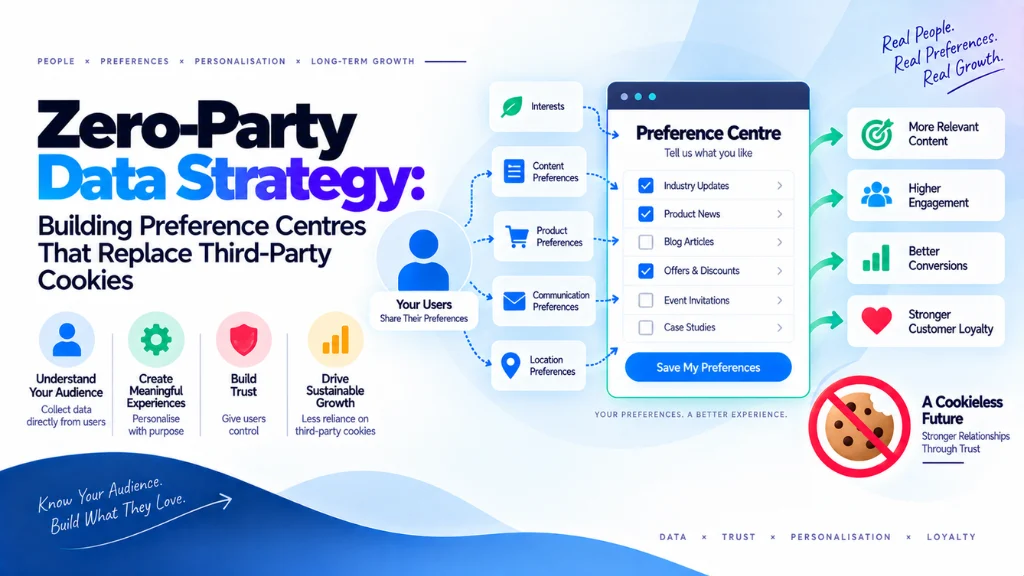
A preference centre is the primary interface through which zero-party data gets collected at scale: a page or in-app section where customers explicitly declare what they want – content topics, communication frequency, product categories, or budget range – rather than having a business infer those preferences from clicks and purchase history.
The engagement data supports this as a genuine two-way exchange rather than a one-time form fill. Research indicates 42% of consumers with access to a preference centre actively review and update their communication and data settings, which means a well-built preference centre isn’t just a collection tool – it’s a maintained, living source of increasingly accurate customer signal, provided customers have a real reason to keep coming back to it.
Does a Preference Centre Replace a Consent Management Platform?#
No. A consent management platform captures and stores legal permission for how data can be used; a preference centre captures what a customer actually wants, which is a separate and complementary function. Most 2026 first-party data strategies run both together – a consent layer for compliance, and a preference centre for the zero-party signal that actually powers personalization.
Designing a Preference Centre That Actually Gets Used#
A preference centre that sits unused isn’t collecting zero-party data – it’s just an unused settings page. A few design principles consistently separate the ones that get engagement from the ones that don’t:
- Lead with a clear value exchange. Customers share preference data more willingly when they understand exactly what they get in return – a personalized discount, more relevant content, or fewer irrelevant emails. A vague “help us serve you better” framing rarely motivates completion.
- Ask progressively, not all at once. A single long form at signup performs worse than a short initial quiz followed by periodic, contextual prompts asking for one or two additional preferences over time.
- Make updating as easy as the initial entry. If reviewing preferences requires digging through account settings, the 42% of customers inclined to update their preferences will simply stop bothering.
- Use the data visibly, quickly. If a customer selects a category preference and the next communication ignores it entirely, that erodes the trust the preference centre depends on for future participation.
- Keep individual asks short and contextual. A quiz asking about style, budget, and frequency in exchange for a starter discount performs better than a generic newsletter signup asking the same thing without context or incentive.
Search Savvy’s email marketing glossary covers the related consent and segmentation terminology teams often need when building this kind of preference infrastructure into an existing lifecycle marketing program.
Building a Zero-Party Data Strategy: A Practical Framework#
- Audit what you’re currently inferring versus what customers have told you directly. Most organizations already hold more zero-party data than they’re using – buried in old survey responses, quiz results, or account settings nobody built a strategy around.
- Identify the two or three highest-value preferences for your business. A subscription retail brand might prioritize style, budget, and frequency; a B2B SaaS company might prioritize role, company size, and use case. Trying to collect everything at once dilutes completion rates.
- Design the value exchange before building the form. Decide what the customer gets in return for each piece of information requested, and make that exchange explicit rather than implied.
- Standardize identity across systems. Tie preference data to a stable key – typically email address or account ID – so the same customer’s stated preferences aren’t fragmented across disconnected tools, and can be reflected consistently in analytics and reporting alongside behavioral data.
- Refresh data on a cadence, not a one-time collection event. B2B contact data has been shown to decay by roughly 2.1% a month, or over 22% a year, which means a preference centre populated once at signup and never revisited becomes stale faster than most teams expect.
Search Savvy applies this same audit-first framework inside its marketing automation and performance marketing services, building preference-centre infrastructure that feeds directly into lifecycle segmentation rather than sitting as an isolated settings page.
Common Mistakes in Zero-Party Data Strategy#
- Building around a Chrome cookie deadline that no longer exists. Google reversed its cookie deprecation plan; the case for zero-party data rests on regulatory pressure, non-Chrome browser blocking, and data quality, not a Chrome-specific countdown.
- Asking for too much, too soon. A long preference form at signup depresses completion rates compared to a short initial ask followed by progressive profiling over time.
- Collecting preferences without using them visibly. If stated preferences don’t change what a customer receives, engagement with the preference centre declines over subsequent visits.
- Treating zero-party data collection as a one-time event. Preferences and contact details decay over time; a strategy without a refresh cadence gradually loses the accuracy that made the data valuable in the first place.
- Confusing a preference centre with a consent management platform. The two serve different, complementary purposes and shouldn’t be built as a single combined interface without clear separation of function.
The Bottom Line#
Zero-party data strategy doesn’t depend on Chrome’s cookie decisions, and the record shows those decisions have already reversed once. The real case for a well-built preference centre is that it captures the clearest, most reliable customer signal available – explicitly volunteered, fully consented, and resilient to whatever any single browser or regulator does next – while most organizations still haven’t closed the gap between prioritizing first-party data and actually operationalizing the zero-party layer within it.
The practical next step is auditing your existing preference and survey data before building anything new, then designing one focused, value-exchange-driven ask rather than a comprehensive form nobody finishes. Search Savvy’s campaign and lifecycle marketing work builds this kind of preference-centre and lifecycle-segmentation infrastructure directly into ongoing campaign work, so zero-party data collection compounds into better targeting rather than sitting unused in a settings page.
Frequently Asked Questions#
What is zero-party data? Zero-party data is information a customer intentionally and directly shares with a business, such as stated preferences, purchase intent, or profile details entered through a preference centre or quiz. It requires no inference, unlike first-party data drawn from observed browsing or purchase behavior.
Did Google actually remove third-party cookies from Chrome? No. Google reversed its cookie deprecation plan on April 22, 2025, and Chrome continues to offer third-party cookies with a user-choice toggle rather than a forced removal. Google also shut down most of the Privacy Sandbox APIs it had built as a cookie replacement in October 2025.
If Chrome kept cookies, why does zero-party data still matter? Because signal loss is happening through other channels regardless of Chrome’s decision. Safari, Firefox, and Brave already block third-party cookies by default, mobile tracking opt-in rates remain low under Apple’s App Tracking Transparency, and privacy regulations continue tightening across multiple jurisdictions.
What’s the difference between a preference centre and a consent management platform? A consent management platform captures and stores legal permission for how data can be used. A preference centre captures what a customer actually wants – content topics, frequency, categories – and the two typically operate together rather than as a single combined tool.
How often should preference data be refreshed? Continuously rather than as a one-time collection event. Contact and preference data decays over time – B2B contact data specifically has been estimated to decay by roughly 2.1% a month – so a preference centre populated once and never revisited becomes progressively less accurate.
What’s the easiest way to start collecting zero-party data? Start with a clear value exchange at an existing high-traffic touchpoint, such as email signup or checkout, asking for one or two specific preferences in exchange for a tangible benefit like a discount or more relevant content, then expand through progressive profiling over subsequent interactions.