Crisis Communication in the Age of AI: Real-Time Brand Protection Strategies
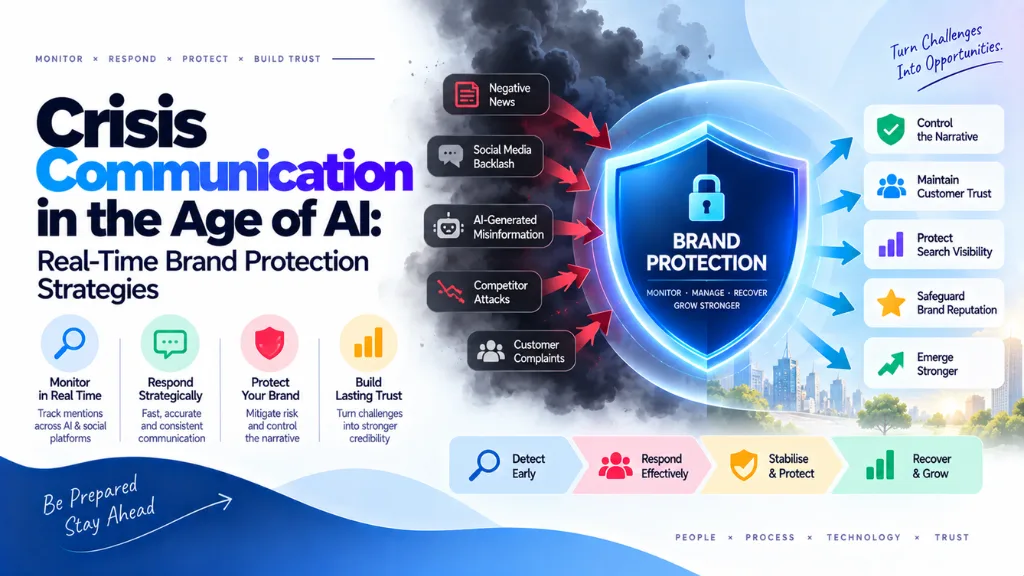

A cloned voice, a 30-second audio clip, and two minutes of effort are now enough to fake a CEO authorizing a wire transfer. That isn’t a hypothetical – a PR consultant demonstrated exactly this on himself in 2026, cloning his own voice and leaving his co-director a fake voicemail requesting a payment, at zero cost and with no special equipment. Brand protection strategies built for the pre-AI era assumed the biggest risks were slow-moving rumors and bad reviews. In 2026, the threat moves faster, looks more convincing, and can originate from content that never actually happened.
In this article9 sections
This article covers what brand protection strategies actually need to include now: the compressed response window crisis teams are working with, the specific threat patterns generative AI has introduced, and the monitoring and response framework that separates brands that contain a crisis from ones that get overtaken by it.
What Are Brand Protection Strategies in the AI Era?#
Brand protection strategies are the combination of monitoring, verification, and response protocols an organization uses to detect and contain threats to its reputation before they cause lasting damage. What’s changed in 2026 isn’t the goal – it’s the raw volume and realism of what needs to be monitored for. Generative AI can now mass-produce plausible, targeted falsehoods, including deepfakes, biased narratives, and coordinated bot-driven amplification, often blended convincingly with real news in a way that makes detection, context-checking, and response meaningfully harder than they were even two years ago.
The practical implication is that brand protection can no longer be a reactive function that activates once a crisis is already visible. It has to include continuous, automated detection running before an incident occurs, because by the time a synthetic video or cloned-voice scam is trending, the financial and reputational damage may already be done.
Why the Response Window Has Compressed to Under 90 Minutes#
According to Cision’s State of the Media 2026 research, the optimal crisis response window – from first detection of a false or damaging narrative to a brand’s initial response – has compressed to under 90 minutes. Beyond that window, a narrative typically gains enough independent momentum that a brand’s response is reacting to an established story rather than shaping one as it forms.
This compression is a direct consequence of how fast AI-generated content can spread and how convincingly it can be produced. Detection systems logged 3,142 deepfake incidents in March 2026 alone, a 720% jump from just five months earlier, and industry estimates project the overall volume of AI-driven false content could surge another 500% to 800% by the end of the year. A 90-minute window that once felt tight for a slow-moving PR issue is now the realistic ceiling for containing a synthetic-media incident before it compounds.
The New Threat Landscape: Four AI-Driven Crisis Patterns#
Not every AI-related brand threat looks the same, and the right response depends on recognizing which pattern is unfolding.
| Threat Pattern | What It Looks Like | Primary Risk |
| Executive impersonation for fraud | Synthetic audio or video instructing finance or IT staff to authorize a payment or access change | Direct financial loss, sometimes within minutes |
| Brand impersonation for misinformation | Synthetic content showing the brand or its spokespeople making statements they never made | Reputational damage, customer trust erosion |
| Personal attacks on executives or spokespeople | Deepfake content targeting individuals associated with the brand | Personal and organizational reputational harm |
| Market manipulation | Coordinated false content aimed at publicly traded companies with significant retail investor attention | Stock volatility, regulatory scrutiny |
Executive impersonation fraud carries the most immediate financial risk – a widely cited 2024 incident used AI-generated video-conference participants to authorize a $25 million transfer, and similar voice-cloning attempts have continued rising through 2026 as the underlying technology has become both cheaper and more convincing. Brand and market-focused threats move more slowly but can inflict damage that compounds over days rather than minutes if left unaddressed.
Building a Deepfake-Ready Crisis Communication Program#
A defensible preparation program is built before an incident occurs, not assembled during one. The elements that consistently appear across current crisis-communication guidance include:
- An authentication chain for executive content. A documented, verifiable process for confirming that video or audio attributed to leadership is genuine, used whenever high-stakes instructions are communicated outside normal channels.
- Relationships with deepfake detection vendors already in place, rather than researched for the first time mid-crisis.
- Legal pre-positioning by jurisdiction, since takedown and defamation remedies vary significantly across regions and speed matters more than thoroughness once an incident is live.
- Press relationships built specifically for verification, so journalists have a fast, trusted channel to confirm or deny a claim before it’s amplified further.
- An internal escalation protocol for surfacing suspicious content quickly, so the first person who notices a potential deepfake knows exactly who to alert and how fast.
- Crisis communication templates updated specifically for deepfake and synthetic-media scenarios, since a template written for a traditional PR crisis often doesn’t address the verification and authentication language a synthetic-media incident requires.
Building this program is exactly the kind of proactive infrastructure Search Savvy establishes through its crisis and reputation management services – putting escalation protocols and verification relationships in place before they’re needed under pressure.
Real-Time Monitoring: What to Actually Track#
Effective monitoring in 2026 has to cover more than text mentions. Social listening built for the current threat landscape should scan audio, video, and visual content across social platforms, news sources, and less-visible corners of the web, since a growing share of brand-damaging content is synthetic media rather than written commentary.
Key capabilities worth prioritizing in a monitoring setup include escalation-state tracking that classifies an emerging narrative’s severity – moving from calm through concern to an active incident or full crisis – and source-authority assessment that weighs how credible and far-reaching the originating account or outlet actually is before deciding how urgently to respond. Not every flagged mention warrants a public response; a low-authority source with limited reach may recede on its own, while the same content from a higher-authority source can require an immediate, coordinated response. Tracking whether a response actually contains a narrative, rather than assuming it worked, is the kind of performance reporting discipline that separates a documented crisis process from guesswork.
This is the operational core of what Search Savvy’s social listening and reputation monitoring work is built to deliver – continuous coverage across formats, not just a keyword alert on brand mentions in text.
The Decide-Act-Monitor Response Framework#
Once a potential threat is flagged, a consistent decision framework keeps the response fast without being reckless:
- Decide. Choose between three options: respond publicly with a correction backed by verifiable evidence, engage the platform directly to request removal of content violating its policies, or monitor without responding when a public reply risks amplifying a claim that would otherwise recede on its own.
- Act. Execute the chosen response quickly and specifically – a correction that doesn’t address the exact false claim, or evidence that isn’t clearly verifiable, tends to prolong a narrative rather than close it.
- Monitor. Track whether the narrative continues spreading or recedes after the response, continuing observation for at least 72 hours, since some false narratives resurface after an initial lull.
The decision between these three options depends heavily on reach, velocity, and source credibility – the same factors a good monitoring setup should already be surfacing before a human has to make the call under time pressure.
Common Mistakes in AI-Era Brand Protection#
- Treating crisis response as purely reactive. Waiting until a synthetic-media incident is already visible forfeits the 90-minute window that determines whether a response shapes or chases the narrative.
- Monitoring text mentions only. A growing share of brand-damaging content in 2026 is audio, video, or visual, and text-only monitoring misses it entirely.
- Responding to every flagged mention publicly. Amplifying a low-reach, low-authority claim by responding to it publicly can generate more visibility for the false content than it would have received on its own.
- Skipping the authentication chain for executive content. Without a documented verification process, finance and operations teams have no fast way to confirm whether an urgent instruction from “leadership” is genuine.
- Writing crisis templates for pre-AI scenarios only. A generic PR crisis template rarely includes the specific verification and authentication language a deepfake or synthetic-media incident requires.
The Bottom Line#
Brand protection strategies in 2026 have to assume that a plausible, damaging piece of synthetic content can appear at any time, and that the organization has roughly 90 minutes to detect, evaluate, and respond before a narrative gains independent momentum. The programs that hold up under this pressure are the ones built in advance – authentication chains, monitoring that covers audio and video as well as text, and a decide-act-monitor framework the team has already practiced before it’s needed for real.
The practical next step is auditing your current crisis plan against the four threat patterns above and confirming whether your monitoring setup actually covers synthetic audio and video, not just text mentions. Search Savvy’s crisis communication planning builds exactly this kind of AI-era readiness into a brand’s existing communications infrastructure, so a response is ready before the first 90 minutes start counting down.
Frequently Asked Questions#
What are brand protection strategies in the context of AI? They’re the combination of monitoring, verification, and response protocols used to detect and contain AI-generated threats to a brand’s reputation – including deepfakes, cloned voices, and synthetic misinformation – before they cause lasting financial or reputational damage.
How fast does a brand need to respond to a crisis in 2026? Research indicates the optimal response window has compressed to under 90 minutes from first detection. Beyond that window, a narrative typically gains enough independent momentum that a response is reacting to an established story rather than shaping one.
What is executive impersonation fraud, and how common is it becoming? It’s the use of synthetic audio or video to impersonate a company executive, typically to authorize a fraudulent payment or access change. Deepfake incidents surged 720% in a single reported period in 2026, and voice-cloning technology has become cheap and accessible enough that a convincing clone can be produced from a short audio sample in minutes.
Should a brand always respond publicly to a false claim? Not always. The decision depends on the reach, velocity, and credibility of the source. Responding publicly to a low-authority, low-reach claim can sometimes amplify it further than it would have spread on its own; monitoring without responding is sometimes the more effective choice.
What should real-time brand monitoring actually cover? Monitoring needs to extend beyond text mentions to include audio, video, and visual content, since a growing share of AI-driven brand threats are synthetic media rather than written commentary. Escalation-state tracking and source-authority assessment help prioritize which flagged content needs an urgent response.
How long should a brand keep monitoring after responding to a crisis? At least 72 hours after the initial response, since some false narratives recede briefly before resurfacing. Continuous monitoring during this window confirms whether the response actually contained the narrative or simply paused it temporarily.