

If you’ve ever wondered why ChatGPT cites a competitor’s blog post instead of yours, or why Google’s AI Overview keeps pulling from the same handful of sites in your industry, the answer usually isn’t luck, and it isn’t just backlinks either. It comes down to something most publishers have never had to think about before: training data provenance – essentially, whether an AI system can tell where your content came from, who made it, and whether it can be trusted.
This isn’t an abstract, back-end technical concept anymore. It’s become a live legal and commercial battleground in 2026, and novelist Scott Turow put the stakes in blunt terms after joining a lawsuit against Meta over its use of pirated books to train its Llama model: the AI future being promised to the public, he said, has in fact been “created with stolen words.” Whatever side of that legal argument you land on, Turow’s framing captures why what makes content trustworthy enough for an AI system to learn from – or cite – is no longer a purely technical question.
This guide, shaped by the AI-visibility work we do for clients at Search Savvy, breaks down what training data provenance actually means, why it’s suddenly a big deal, and what it means practically for anyone trying to get their content recognized, trusted, and cited by AI systems.
What Is Training Data Provenance, Exactly?
Training data provenance is the verifiable record of where a piece of content came from – its origin, its authorship, how it was created or edited, and whether it was obtained with permission. For AI companies, it answers a simple but increasingly consequential question: can we prove what this model was trained on, and can we trust that source?
It’s worth separating two related but distinct things, because marketers often conflate them:
- Training-time provenance – whether your content was part of the dataset used to originally build or fine-tune a model’s underlying knowledge. This happens once, during model development, and is largely outside your day-to-day control.
- Retrieval-time provenance – whether your content gets pulled in live, right now, when someone asks an AI Overview, Perplexity, or ChatGPT a question your page answers well. This is the layer most publishers can actually influence, and it’s where credibility signals do their real work.
Both layers care about the same underlying thing: is this a source worth trusting? A model trained partly on unreliable, unattributed, or scraped-without-permission content produces less trustworthy outputs – which is exactly why provenance has become as much a legal and governance issue as a technical one.
Why Is This Suddenly Such a Big Deal?
Three forces are colliding at once in 2026, and together they explain why “where did this content come from” has become boardroom-level language.
The litigation is real, ongoing, and increasingly decisive. In July 2026, Hachette Book Group, Cengage, Elsevier, and Scott Turow sued Google over its use of books and scholarly content to train Gemini, joining a growing list of cases testing whether training on copyrighted material without permission counts as fair use. The courts haven’t landed in one place on this question. In the case against Anthropic, U.S. District Judge William Alsup found that using books to train Claude “was exceedingly transformative” for fair-use purposes – a ruling that nonetheless didn’t stop Anthropic from later paying a $1.5 billion settlement over how the underlying books were originally obtained, since acquiring them from pirated sources was a separate legal problem from how they were subsequently used. That distinction – transformative use versus lawful acquisition – is exactly the kind of nuance that makes provenance a live legal issue rather than a settled one.
A licensing market has matured around the uncertainty. Rather than wait for courts to fully settle the fair-use question, AI companies have been signing direct licensing deals with content owners. News Corp’s deal with OpenAI, reported at more than $250 million over five years, remains one of the largest disclosed agreements, and OpenAI alone has struck close to two dozen publisher and data deals overall. Reddit’s licensing arrangement with Google has been reported at roughly $60 million a year, and OpenAI has funded local newsroom expansion at Axios as part of its own content partnership. The pattern is consistent: content with clear ownership, clean rights, and demonstrable origin has become genuinely monetizable in a way ordinary web content generally isn’t.
Industry and regulators are pushing for standardization. In 2026, a coalition of 19 Fortune 500 companies under the Data & Trust Alliance proposed new data provenance standards aimed at giving organizations a consistent way to document where training data came from and whether appropriate consent was obtained. Separately, the EU AI Act’s transparency requirements and California’s SB 942 both now require clearer disclosure around AI-generated content, and the Coalition for Content Provenance and Authenticity (C2PA) – an industry standard for cryptographically tracking content origin – has continued to gain adoption as the technical backbone for that kind of disclosure.
Does Having a Licensing Deal Guarantee AI Will Cite You?
No – and this is one of the more counterintuitive findings to come out of recent industry research. A large-scale analysis by AI search monitoring firm Otterly.ai, which cross-referenced tens of millions of cited URLs against confirmed AI licensing deals, found that a licensing agreement only reliably predicts more citations on two platforms: ChatGPT and Microsoft Copilot. On Perplexity, Google AI Overviews, Google AI Mode, and Gemini, licensed publishers showed no meaningful citation advantage over unlicensed ones once other factors were accounted for. In fact, some of the most frequently cited domains in that analysis – sites like NerdWallet, Healthline, and Bankrate – have no AI licensing deal at all. They earned their citation share through content quality and topical depth, not a contract.
That finding is the clearest evidence yet that provenance and credibility aren’t primarily about who you’ve paid or been paid by. For the vast majority of publishers who will never be offered a seven- or eight-figure licensing deal, this is genuinely good news: the signals that matter most for citation are ones you can build yourself, and it’s exactly where we focus our AI-visibility work at Search Savvy.
So What Actually Makes Content Trustworthy to an AI System?
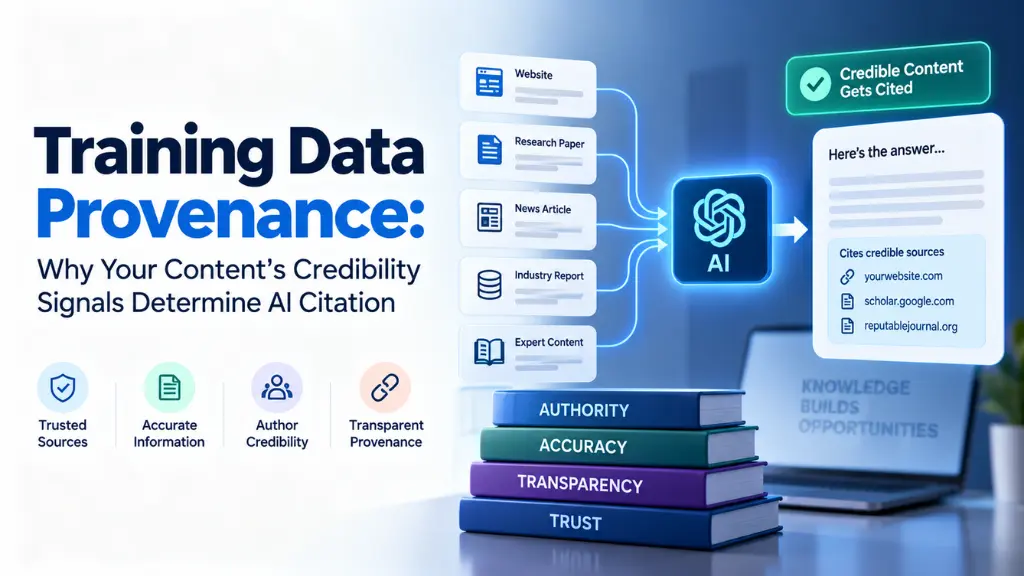
This is where Google’s long-standing E-E-A-T framework – Experience, Expertise, Authoritativeness, and Trustworthiness – turns out to be just as relevant to AI citation as it’s long been to traditional search rankings. AI systems performing retrieval don’t just check whether content is relevant to a query; they weigh whether the source is credible enough to attribute a claim to. In practice, several concrete signals feed into that judgment:
- Clear, verifiable authorship. A named author with a real bio, credentials, and a consistent presence across the web is easier for an AI system to evaluate than anonymous or generic “admin” bylines.
- Entity consistency. If your brand name, founder, and core claims are described the same way across your own site, your social profiles, and independent third-party coverage, AI systems can resolve who you are with more confidence. Fragmented or contradictory information makes attribution harder, and harder-to-attribute content gets cited less.
- Independent corroboration. Being referenced, quoted, or linked to by other credible, unaffiliated sources – industry publications, comparison sites, other subject-matter experts – signals that your claims hold up outside your own site.
- Freshness and accuracy. Content that’s visibly maintained and updated, rather than static and aging, is favored in systems designed to avoid citing outdated information.
- Original data or first-hand experience. Content built on original research, direct testing, or genuine first-hand expertise is harder to fake and more valuable as a citation than content that simply reformats what’s already been said elsewhere.
Do I Need C2PA Metadata for AI Systems to Trust My Content?
Not yet, for most text-based publishers – C2PA’s adoption so far has concentrated more heavily on images, video, and audio, where verifying authenticity is a more urgent problem given how convincingly AI can now generate visual media. But the direction of travel is clear: as disclosure requirements under laws like the EU AI Act and California’s SB 942 expand, this is worth watching rather than ignoring, especially if your content includes original photography, video, or data visualizations.
Building Verifiable Credibility Signals Into Your Content
None of this requires an enterprise legal team or a data licensing negotiation. A few practical steps make a real difference:
- Put real people behind your content. Full author bios, credentials, and a consistent author presence across your site and social profiles give AI systems something concrete to evaluate.
- Keep your entity information consistent everywhere. Your brand name, description, and key facts should match across your website, About page, structured data markup, and any third-party profiles or directories.
- Publish original insight, not just synthesis. Original data, case studies, or direct professional experience are far more citation-worthy than a well-written summary of what other sites already say.
- Earn independent references, not just links. A mention in an industry roundup or a citation from an unaffiliated expert carries more weight with AI credibility checks than a purchased backlink ever will.
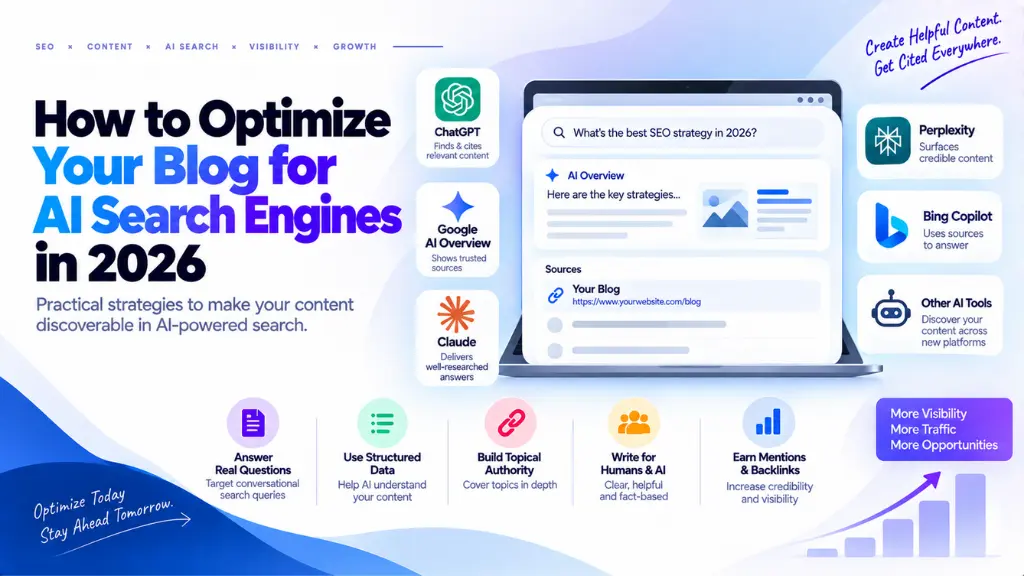
- Structure content for extraction. Clear headings, direct answers near the top of a section, and well-organized information make it easier for a retrieval system to lift an accurate, attributable passage from your page. We’ve covered the mechanics of this in more depth in our guide on how to get your website cited by ChatGPT and AI chatbots.
- Keep content current. A visible last-updated date, paired with content that’s actually been reviewed and refreshed, signals the kind of reliability AI systems are built to prefer.
This is a topic we track closely at Search Savvy, because provenance and credibility sit right at the intersection of traditional SEO and the newer discipline of generative engine optimization. If you’re building a broader strategy around this shift, our AI Search Optimization (GEO/AEO) services page and our AI and Search blog category go deeper into the tactics that support it.
FAQ: Training Data Provenance
What does “training data provenance” mean in simple terms? It means being able to verify where a piece of content used to train or ground an AI system actually came from – who created it, when, and whether it was obtained legitimately.
Can I stop AI companies from training on my content? You can restrict crawler access through your robots.txt file and specific AI-crawler directives, and some publishers pursue formal opt-outs or legal action, but enforcement is inconsistent across companies, and blocking training crawlers doesn’t necessarily stop your content from being retrieved for real-time answers if it’s publicly accessible.
Does a content licensing deal with an AI company guarantee I’ll be cited more often? No. Industry analysis has found licensing deals correlate with more citations on ChatGPT and Microsoft Copilot specifically, but show no consistent advantage on Perplexity, Google AI Overviews, Google AI Mode, or Gemini, where unlicensed but high-quality sources often out-cite licensed ones.
Is E-E-A-T still relevant now that AI search has taken off? Yes. Experience, Expertise, Authoritativeness, and Trustworthiness remain central to how both traditional search rankings and AI citation systems evaluate whether a source is credible enough to reference.
What is C2PA and does my website need it? C2PA (Coalition for Content Provenance and Authenticity) is an industry standard for cryptographically verifying content origin, mainly for images, video, and audio. Most text-focused websites don’t need it yet, but it’s increasingly relevant if you publish original visual or multimedia content.
Why are publishers suing AI companies instead of just licensing their content? It varies by publisher and case. Some, like News Corp, do both – licensing to companies willing to pay while suing others they allege scraped content without permission. Others, like Scott Turow and the Authors Guild, are using litigation to test whether training on copyrighted or pirated work without a license is legally permissible at all, which will shape licensing norms either way.
The Bottom Line
Training data provenance used to be an obscure concern for AI researchers and copyright lawyers. In 2026, it’s become directly relevant to anyone who publishes content and wants AI systems to trust, retrieve, and cite it. The reassuring part is that the underlying signals – real authorship, consistent entity information, original insight, independent corroboration, and content that’s genuinely kept current – are things you can build without a licensing deal or a legal team. Turow’s fight is about how the biggest models got built in the first place; yours, more practically, is about becoming a source worth trusting today. Win that fight, and the citations tend to follow.