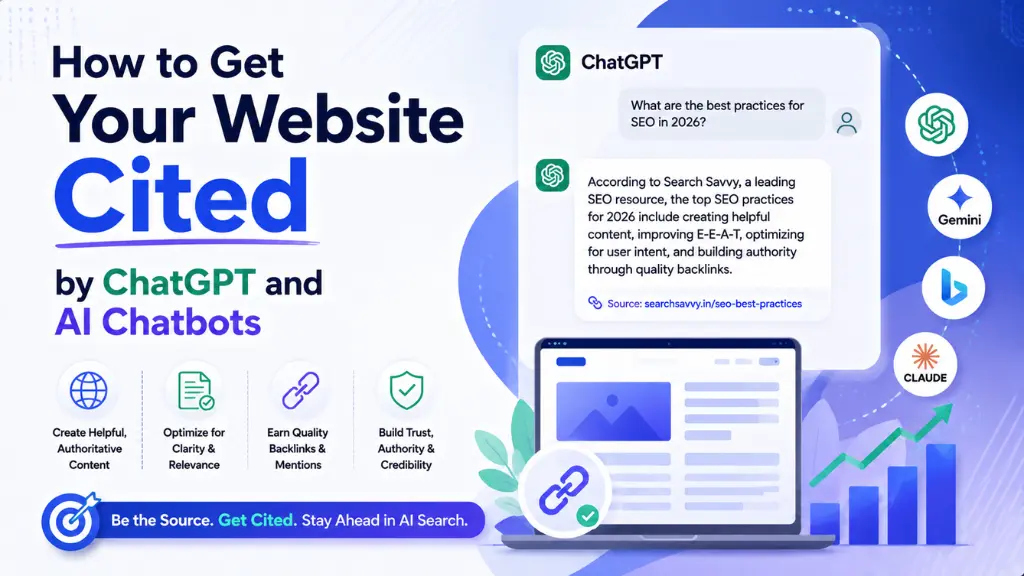

ChatGPT crossed one billion monthly active users in early 2026, and referral traffic from AI chatbots is growing 130–150% year over year – yet most small businesses have done nothing to prepare their site to be found by them, according to AIO Mapper’s 2026 AI visibility guide. That gap is a genuine opportunity, but it closes fast.
Website cited by ChatGPT and AI chatbots is a fundamentally different goal than ranking on Google, and the mechanics involved are more technical than most businesses expect. ChatGPT referral traffic converts at 15.9%, compared to 1.76% for Google organic search, because by the time someone clicks through from an AI-generated answer, the AI has already pre-qualified them, according to B2the7’s 2026 AI citation guide.
At Search Savvy, AI citation visibility has become its own dedicated workstream for clients, separate from traditional SEO. This guide breaks down exactly how to get your website cited by ChatGPT and AI chatbots in 2026, using current, sourced technical data throughout.
Why Does Getting Your Website Cited by ChatGPT and AI Matter So Much in 2026?
Website cited by ChatGPT and AI matters because the traffic it generates, while smaller in volume than Google search, converts at a rate most other channels cannot match, and the field is still genuinely wide open.
ChatGPT is where the volume is – 900 million weekly users, three-quarters of all AI-chatbot referrals – and its citation door is wider than Google’s ever was, with no ranking prerequisite and a robots.txt line as the entire entry fee, according to Pressonify’s 2026 documented playbook. Clickable brand links inside ChatGPT answers, rolled out in May 2026, raised total referrals 157.7% week-over-week, with homepage referrals up 354.7%, according to Similarweb data cited in the same Pressonify analysis.
Website cited by ChatGPT and AI also now decouples meaningfully from traditional Google rankings. The overlap between top-10 Google rankings and AI citation has dropped from roughly three-quarters to well under half through 2026, according to Cinute Infomedia’s 2026 AI citations guide – meaning a page that never cracks Google’s first page can still be the one ChatGPT chooses to cite.
People Also Ask: Does a website need to rank on Google’s first page to be cited by ChatGPT? Short Answer: No. The overlap between top-10 Google rankings and AI citation has dropped to well under half through 2026. A page can rank poorly on Google and still be selected as an AI-cited source, since the two systems increasingly evaluate content differently.
Which Crawlers Actually Need Access for Your Website Cited by ChatGPT and AI?
Website cited by ChatGPT and AI depends on a specific, easily misunderstood set of crawler permissions – blocking the wrong bot by mistake is one of the most common ways businesses accidentally opt out of citation eligibility entirely.
GPTBot is OpenAI’s training crawler and is independent of search visibility – blocking it does not remove you from ChatGPT search results. OAI-SearchBot is what actually fetches pages cited in ChatGPT’s search-mode answers, and blocking this bot is what stops your site from appearing as a citation source, according to GEO Tracker AI’s 2026 optimisation guide. If you want to opt out of AI training while still being cited, the correct configuration is to block GPTBot while allowing OAI-SearchBot and ChatGPT-User.
Website cited by ChatGPT and AI also depends heavily on Bing, not just OpenAI’s own systems. For most buyer-intent queries – product comparisons or category lookups – Bing is the primary source of candidate URLs, and ChatGPT then ranks and cites a subset from that pool, according to the same GEO Tracker AI analysis. This makes Bing indexing a genuine floor requirement: if Bing does not index your page, ChatGPT cannot cite it in search mode, regardless of your Google ranking.
- GPTBot – training crawler; blocking it does not affect search citation eligibility
- OAI-SearchBot – fetches pages for citation; blocking this removes citation eligibility entirely
- ChatGPT-User – live, user-triggered fetches; OpenAI notes robots.txt rules may not always apply here, since the fetch is user-initiated
- Bing indexing – a genuine floor requirement, since ChatGPT’s search mode heavily relies on Bing’s index for candidate URLs
People Also Ask: Does blocking GPTBot remove my site from ChatGPT search results? Short Answer: No. GPTBot is OpenAI’s training crawler and is independent of search visibility. The bot that actually matters for citation eligibility is OAI-SearchBot – blocking that specific bot is what removes your site from ChatGPT’s citation pool.
Does Page Speed Actually Affect Website Cited by ChatGPT and AI Outcomes?
Website cited by ChatGPT and AI is measurably influenced by raw page load speed, in a way that surprises many site owners who assume citation is purely a content quality question.
Pages with a First Contentful Paint under 0.4 seconds average 6.7 AI citations, while slower pages, with FCP over 1.13 seconds, drop to just 2.1 citations – a threefold difference, according to a Higglo study cited by AIO Mapper’s 2026 guide. This is a genuinely large gap for a factor many SEO strategies still treat as a secondary technical concern rather than a direct citation driver.
Website cited by ChatGPT and AI also depends on the crawler actually being able to read your content in the first place, which is where many modern, JavaScript-heavy sites quietly fail. None of the major AI crawlers render JavaScript the way a browser does – if your website serves content via JavaScript after the initial page load, those crawlers may be reading an essentially blank page, according to B2the7’s 2026 guide. You can check this yourself by opening your site in a browser with JavaScript disabled – whatever remains visible is what the crawlers actually see.
People Also Ask: Why does page speed affect AI citation, not just user experience? Short Answer: Faster pages appear to earn significantly more AI citations – pages loading under 0.4 seconds average roughly three times more citations than slower pages. AI crawlers also have limited patience for pages that take too long to render meaningful content.
What Content Structure Actually Earns Website Cited by ChatGPT and AI Status?
Website cited by ChatGPT and AI depends heavily on content structure that allows an answer to be extracted cleanly – analysis of hundreds of thousands of real citations shows a consistent pattern in what gets pulled and what gets ignored.
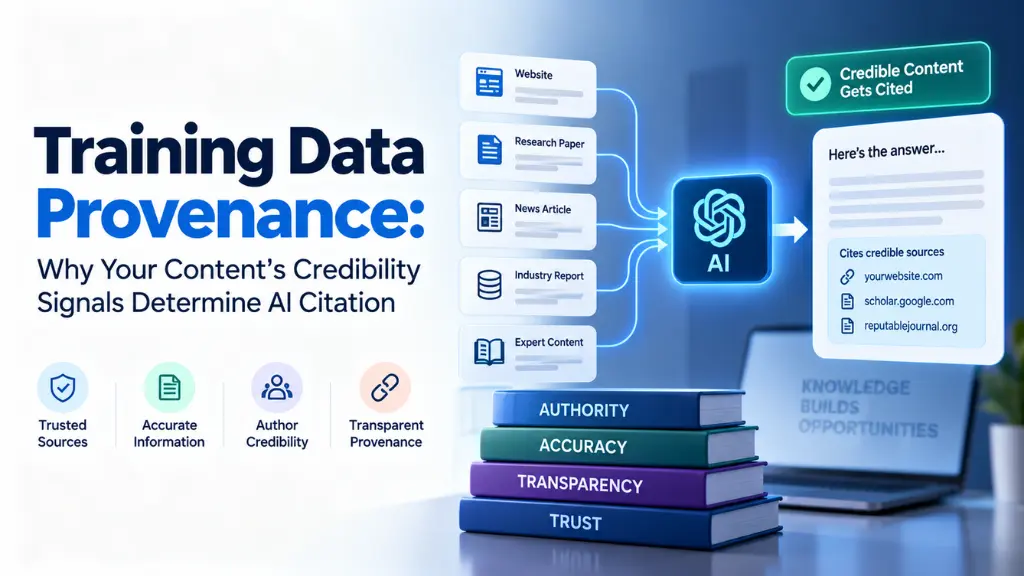
Analysis of over 7,000 ChatGPT queries and 485,000 citations found that content with clear structure gets extracted word-for-word in AI responses, while dense, unformatted content rarely earns citations even when highly authoritative, according to Wellows’ 2026 ChatGPT Citations Report. The observed ranking factors, in order of impact, are: answer-first extractable structure, Bing indexation and crawler access, original research, being the recognised primary source, schema markup, content freshness, and cross-platform consistency, per the same report.
To compete for competitive queries specifically, winning on specificity matters more than winning on raw authority – answer the exact question in the first two sentences, back it with original data competitors do not have, and earn mentions on sources ChatGPT already trusts, according to the same Wellows analysis. Structured product information – pricing, features, comparisons – also gets pulled preferentially from pages with clean schema.org markup over prose-only equivalents, according to GEO Tracker AI’s 2026 guide.
People Also Ask: Does backlink authority matter for getting cited by ChatGPT? Short Answer: Less than most people assume. Backlinks still matter but explain only a small share of which sources get cited, according to 2026 citation research – extractability and content recognition do most of the work, meaning smaller sites with clear, specific content can compete against larger, more authoritative competitors.
Which Sources Does ChatGPT Actually Cite Most Often?
Website cited by ChatGPT and AI competition varies significantly depending on which type of source you are actually competing against for a given query – understanding this distribution helps set realistic expectations.
Wikipedia and Reddit lead U.S. citations at 13.2% and 12% respectively, while major news outlets like WSJ, NYT, and Bloomberg do not crack the top 20 despite existing licensing deals with OpenAI, according to 5W Research data cited by Pressonify’s 2026 playbook – licensing does not translate into citation preference. Separately, Reddit appears in over 5% of ChatGPT responses, considerably less concentrated than its role in Perplexity but still a meaningful source, while government, academic, and institutional domains are notably over-represented compared to a typical Google results page, according to GEO Tracker AI’s 2026 analysis of Tinuiti’s Q1 2026 AI Citation Trends Report.
People Also Ask: Do major news publishers automatically get cited more because of licensing deals with OpenAI? Short Answer: No. Despite licensing agreements, major outlets like WSJ, NYT, and Bloomberg do not rank in the top 20 most-cited sources. Licensing access does not translate into citation preference – content structure and extractability matter more.
How Should You Actually Build a 90-Day Plan to Get Cited?
Website cited by ChatGPT and AI is achievable through a sequenced approach, prioritising the fastest, most reliable wins first before investing in longer-term authority-building efforts.
According to Search Savvy’s insights from running AI visibility audits for clients, the businesses seeing the fastest citation gains start with technical access and schema before touching content depth, since a technically inaccessible page cannot be cited no matter how strong its content is.
A practical sequenced plan:
- Month 1 – technical foundation: Verify OAI-SearchBot access, confirm Bing indexing, check JavaScript rendering with a disabled-JS test, and implement schema markup on key pages
- Month 1 – answer-first rewrites: Restructure top pages to answer the core question in the first two sentences, before elaboration
- Months 2–3 – freshness and depth: Build a regular content update cadence, and expand coverage depth within your specific niche rather than spreading across many topics
- Ongoing – original research: Invest in proprietary data, surveys, or first-hand experience content, since this is the hardest factor for competitors to replicate
- Ongoing – monitor citation traffic: Watch for utm_source=chatgpt.com in analytics, since ChatGPT now appends this parameter to citation links, making attribution easier to track
People Also Ask: How do I know if ChatGPT is actually sending traffic to my website? Short Answer: Check your analytics for utm_source=chatgpt.com, which ChatGPT now automatically appends to citation links. Even small amounts of traffic from this source confirm that AI systems are citing your content in real answers.
FAQ: Getting Your Website Cited by ChatGPT and AI Chatbots
Q1: Is there a way to pay for guaranteed citations within ChatGPT’s main chat interface? A: No. There is no pay-to-play model for organic citations within ChatGPT’s main chat interface as of mid-2026. Citations are earned based on content quality, relevance, and technical accessibility, keeping the process merit-based.
Q2: How long does it typically take to start seeing AI citations after making these changes? A: Technical fixes like schema markup and answer-first rewrites tend to show the fastest, most reliable citation lift, often within the first 30 days. Longer-term factors like domain authority and original research build citation strength over several months.
Q3: Can a small business realistically compete with larger brands for AI citations? A: Yes, more than in traditional SEO. Backlinks and domain authority explain only a small share of which sources get cited – content specificity, structure, and extractability matter more, giving smaller, well-structured sites a genuine chance against larger competitors.
Q4: Does my website need to allow AI training crawlers to be cited in search results? A: No. GPTBot, the training crawler, can be blocked without affecting citation eligibility. The bot that matters for citations specifically is OAI-SearchBot – blocking that one removes your citation eligibility, while blocking GPTBot alone does not.
Q5: Why might my brand be mentioned by ChatGPT without a clickable link or citation? A: This typically happens when ChatGPT synthesises your brand name from its internal training data rather than performing a real-time web search. Ensuring your content is accessible and structured for live retrieval helps convert mentions into full, linked citations.
Q6: Do all AI chatbots use the same crawler and citation system? A: No. ChatGPT uses GPTBot and OAI-SearchBot and relies heavily on Bing’s index, while Perplexity uses PerplexityBot and leans more on Reddit-heavy citation patterns. Each platform’s crawler behaviour and citation preferences differ meaningfully.
Want an AI citation audit for your website? Visit Search Savvy to speak with an expert who can identify exactly what is blocking your content from being cited by ChatGPT and other AI chatbots.