

If your engineering team is debating SSR versus CSR versus dynamic rendering right now, here’s the short answer before the long one: for anything you need search engines or AI systems to find, server-side rendering or static generation should be your default in 2026, client-side rendering is fine for interactive elements nobody needs to search for, and dynamic rendering is a temporary bridge for legacy sites, not a strategy to build new ones on. Google has said as much directly in its own documentation.
Even Brendan Eich, the engineer who created JavaScript at Netscape in 1995, has expressed real ambivalence about the interactive, script-dependent web his language made possible. Reflecting on modern web development years later, he remarked that interactive web pages are, in his view, “a curse that should not have been invented” – though it’s far too late to undo that now. That tension sits underneath this entire decision: JavaScript makes rich, dynamic experiences possible, but every one of those experiences still has to be discoverable by search engines and AI crawlers that weren’t built with interactivity in mind.
The reason this decision matters more than it used to isn’t just classic SEO. It’s that a second audience – AI crawlers powering ChatGPT, Perplexity, and Gemini – reads your site very differently than Googlebot does, and most of them can’t execute JavaScript at all. Getting the rendering strategy wrong at scale doesn’t just cost you rankings; it can make your content functionally invisible to an entire category of discovery that’s growing fast.
This guide breaks down what each rendering approach actually does, what changed in Google’s own guidance in 2026, and how to decide which strategy fits which type of page.
What Is JavaScript Rendering, and Why Does It Matter for SEO?
JavaScript rendering is the process of executing a page’s JavaScript to produce the final HTML that a browser – or a crawler – actually sees and uses. As Martin Splitt, a Search Developer Advocate at Google, has put it, JavaScript “requires an extra stage in the crawling and indexing process, the rendering stage” – meaning Google can’t simply read a JavaScript-dependent page the way it reads static HTML; it first has to execute the script in a headless browser to see what’s there. Google’s pipeline works in stages: crawl a URL, queue it for rendering, execute the JavaScript, then index the resulting HTML, including any content, links, and structured data the script added. Where a page’s content lives in that pipeline – present in the initial HTML, or only appearing after JavaScript runs – determines how reliably and how quickly it gets picked up.
Does Google Really Render JavaScript in 2026?
Yes, and Google has confirmed this directly. On its Search Off The Record podcast, Google stated plainly that it renders all web pages for Search, including JavaScript-heavy sites. The important qualifier is “provided the rendering completes successfully” – and that caveat is where most real JavaScript SEO problems still live in 2026. It’s rarely a question of whether Google can render JavaScript anymore; it’s whether your specific implementation renders correctly, completely, and without excessive delay at scale.
Notably, in March 2026, Google removed a long-standing accessibility warning from its official JavaScript SEO documentation – a section recommending pages stay functional without JavaScript – noting the guidance had become outdated. That’s a meaningful signal about how far Google’s rendering capability has matured, even as it underscores that Google’s rendering ability was never really the bottleneck for most sites.
Server-Side Rendering vs. Client-Side Rendering: What’s the Difference?
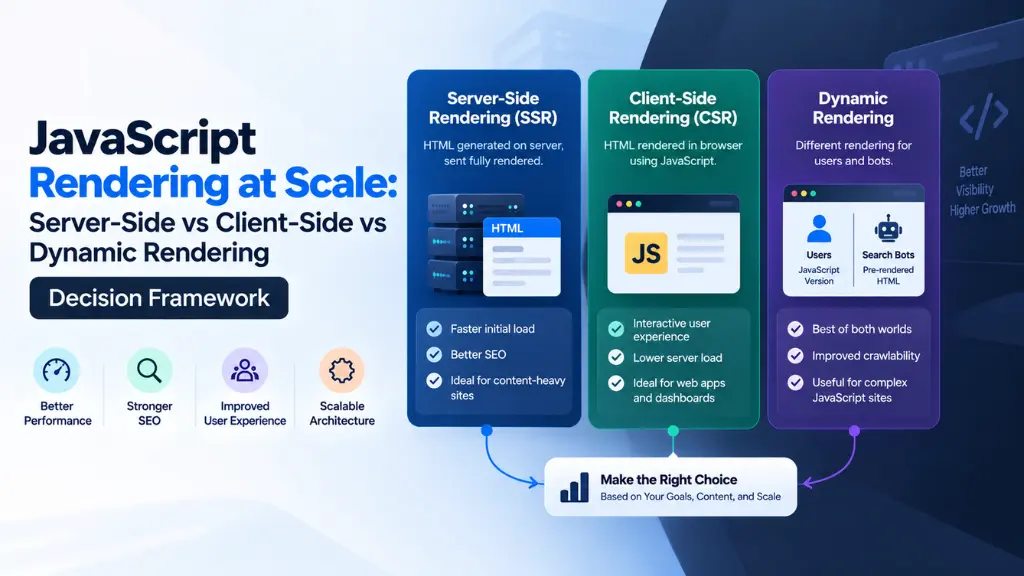
Server-side rendering (SSR) builds the complete HTML for a page on the server, per request, and sends that finished HTML to the browser or crawler – the content is there immediately, without waiting for client-side JavaScript.
Client-side rendering (CSR) sends a mostly empty HTML shell along with a JavaScript bundle, and the browser builds the page after that bundle downloads and executes – the classic single-page application pattern, well suited to highly interactive, app-like experiences.
A third option, static site generation (SSG), pre-builds HTML at deploy time rather than per request – the fastest of the three for pages that don’t change on every visit, since there’s no server-side computation needed at request time at all. This is a distinction we walk clients through constantly at Search Savvy, since picking the wrong one for the wrong page type is one of the most common technical SEO mistakes we see on audits.
Is Client-Side Rendering Bad for SEO?
Not inherently, but it introduces real risk at scale that SSR and SSG don’t carry. CSR content depends entirely on successful JavaScript execution before it becomes visible to a crawler, adding a rendering step, latency, and more points of potential failure – a script error, a timeout, or a dependency that doesn’t load can leave a crawler seeing a near-empty page. CSR also tends to hurt Core Web Vitals metrics like Largest Contentful Paint, since meaningful content arrives later than it would with server-rendered HTML. For pages where SEO visibility matters – blog content, product pages, category pages, documentation – relying exclusively on CSR is a real liability. For logged-in dashboards or interactive components never meant to be indexed, it’s a perfectly reasonable choice.
In practice, most strong sites in 2026 don’t pick one approach exclusively. A hybrid model – SSG for stable, evergreen pages and SSR for pages with frequently changing or personalized data – has become the common pattern, rather than forcing every page type into the same rendering strategy.
What About Dynamic Rendering? Why Google No Longer Recommends It
Dynamic rendering works by detecting whether a request comes from a crawler or a real user, and serving a pre-rendered HTML snapshot to bots while regular users get the full client-side-rendered experience. It was, for years, a legitimate workaround for JavaScript-heavy sites struggling with crawlability.
That guidance has changed. Google now explicitly frames dynamic rendering as a workaround rather than a recommended long-term solution, and current best-practice guidance treats it as a migration bridge for existing applications, not a foundation for new projects. The reasons are practical: dynamic rendering means maintaining two different versions of your website, a genuine maintenance burden; it carries real cloaking risk if the bot-facing and user-facing versions drift out of sync; and it depends on user-agent detection that’s inherently fragile, especially as new AI crawlers appear that your detection logic was never built to recognize. Add in that Google’s rendering has matured enough that the performance justification for dynamic rendering has largely disappeared, and it’s clear why it’s fallen out of favor for anything but temporary use during a migration to SSR or SSG.
The Complication Dynamic Rendering Can’t Solve: AI Crawlers Don’t Render JavaScript
Here’s the part of this decision that’s genuinely new for 2026, and it strengthens the case for server-rendered content well beyond classic Google SEO. Independent crawler analysis has found no evidence of JavaScript execution for major AI crawlers, including GPTBot, OAI-SearchBot, ClaudeBot, PerplexityBot, Bytespider, and Meta-ExternalAgent. In practical terms, if your critical content – product descriptions, article bodies, pricing, navigation – only renders after JavaScript executes, these bots may never see it at all.
This matters beyond a single crawl. When large language models are trained, the standard data-processing pipeline typically strips CSS and JavaScript before extracting the plain-text content used for training, meaning JavaScript-dependent content is systematically underrepresented in what these models learn from, not just in what they retrieve live. Newer agentic browsing tools, like OpenAI’s Comet and Perplexity’s Atlas, are working toward better JavaScript handling, but as of early 2026 neither approaches Google’s rendering fidelity. The practical takeaway: content you want cited in AI Overviews, ChatGPT, or Perplexity answers needs to exist in the initial HTML response, not solely in the post-JavaScript DOM. This is exactly the connection we help clients navigate at Search Savvy – our guide on how to get your website cited by ChatGPT and AI chatbots covers the citation side in more depth.
A Practical Decision Framework: Choosing the Right Rendering Strategy
Rather than picking one architecture for an entire site, match the rendering strategy to what each page type actually needs:
- Evergreen content – blog posts, guides, documentation, service pages: Static site generation is usually the strongest fit. Content doesn’t change on every request, so there’s no reason to pay a rendering cost per visit.
- Frequently updated but still public content – product pages, category pages, pricing pages: Server-side rendering, since content needs to be current per request but still fully visible to any crawler on first load.
- Large e-commerce catalogs with thousands of SKUs: A hybrid combining SSR with incremental regeneration tends to balance freshness against server load better than pure SSR or pure SSG alone.
- Logged-in dashboards, internal tools, highly interactive non-indexable UI: Client-side rendering is entirely appropriate, since there’s no SEO or AI-citation value to protect.
- Large legacy single-page applications mid-migration: Dynamic rendering can serve as a temporary bridge toward SSR or SSG – but it should come with an explicit sunset plan, not stand in as the permanent solution.
How Do I Decide Between SSR, SSG, and CSR for a Specific Page?
Ask three questions in order: Does this page need to be found by search engines or cited by AI systems? If not, CSR is fine. If yes, does the content change on every request, or is it effectively stable between deploys? Stable content points to SSG; frequently changing content points to SSR. And finally, regardless of the answer, make sure the critical content – the text, structured data, and links a crawler needs – lives in the initial HTML response rather than depending entirely on client-side JavaScript execution.
Framework choice matters less than the rendering configuration itself, but it’s worth noting that Next.js, Nuxt.js, and Astro have become the most commonly recommended options in 2026 specifically because they treat SSR and SSG as first-class, well-supported patterns rather than afterthoughts bolted onto a CSR-first framework.
Auditing Rendering at Scale
Once a strategy is chosen, verification matters as much as the initial decision, particularly on large sites where a rendering failure on one template can silently affect thousands of URLs. Compare what a crawler actually receives against what a browser renders, monitor Core Web Vitals – particularly Largest Contentful Paint and Interaction to Next Paint – across templates rather than just the homepage, and periodically check server logs to confirm crawlers of all kinds, not just Googlebot, are reaching your key pages. Treat this as recurring maintenance rather than a one-time launch check, especially as new AI crawlers continue to appear with rendering behavior that isn’t yet publicly documented anywhere.
This is exactly the kind of technical implementation work we help clients navigate at Search Savvy. Our Technical SEO services page covers how we typically structure this kind of rollout, and our Technical SEO blog category has more on the crawling and rendering fundamentals modern frameworks build on.
FAQ: JavaScript Rendering Strategies
What’s the difference between SSR, SSG, and CSR? SSR builds HTML on the server for each request; SSG pre-builds HTML at deploy time for pages that don’t change per request; CSR sends a minimal HTML shell and builds the page in the browser using JavaScript after it loads.
Is dynamic rendering still recommended for SEO in 2026? No. Google now treats it as a deprecated workaround suitable only as a temporary bridge during migration to SSR or SSG, not as a strategy for new projects, largely due to maintenance burden and cloaking risk.
Can AI chatbots like ChatGPT read JavaScript-rendered content? Generally, no. Independent research has found no evidence that major AI crawlers, including GPTBot, ClaudeBot, and PerplexityBot, execute JavaScript, meaning content that only appears after client-side rendering may be invisible to them.
Does using client-side rendering hurt Google rankings? It can create indirect disadvantages – slower Core Web Vitals, added rendering delay, and more points of failure – even though Google is technically capable of rendering JavaScript, provided the process completes successfully.
Which JavaScript framework is best for SEO in 2026? Next.js, Nuxt.js, and Astro are commonly recommended because they support SSR and SSG as first-class features, but the rendering strategy chosen matters more for SEO outcomes than the framework itself.
Should an entire website use one rendering strategy? Not necessarily. A hybrid approach – matching the strategy to each page type’s actual needs, such as SSG for stable content and SSR for frequently updated pages – is the common pattern among strong-performing sites in 2026.
The Bottom Line
The rendering decision isn’t really about which technology is trendiest – it’s about making sure the content you care about being found actually reaches the systems doing the finding, whether that’s Googlebot, an AI crawler, or a real visitor on a slow connection. Default to server-side rendering or static generation for anything that needs to be discovered, reserve client-side rendering for genuinely interactive, non-indexable experiences, and treat dynamic rendering as a short-term bridge at most. Eich may be right that the interactive web created its own headaches, but since it isn’t going anywhere, the sites that thrive are the ones that plan around that reality deliberately rather than accidentally.