Why Some Pages Get Cited in AI Overviews and Others Don’t: A Content Pattern Analysis
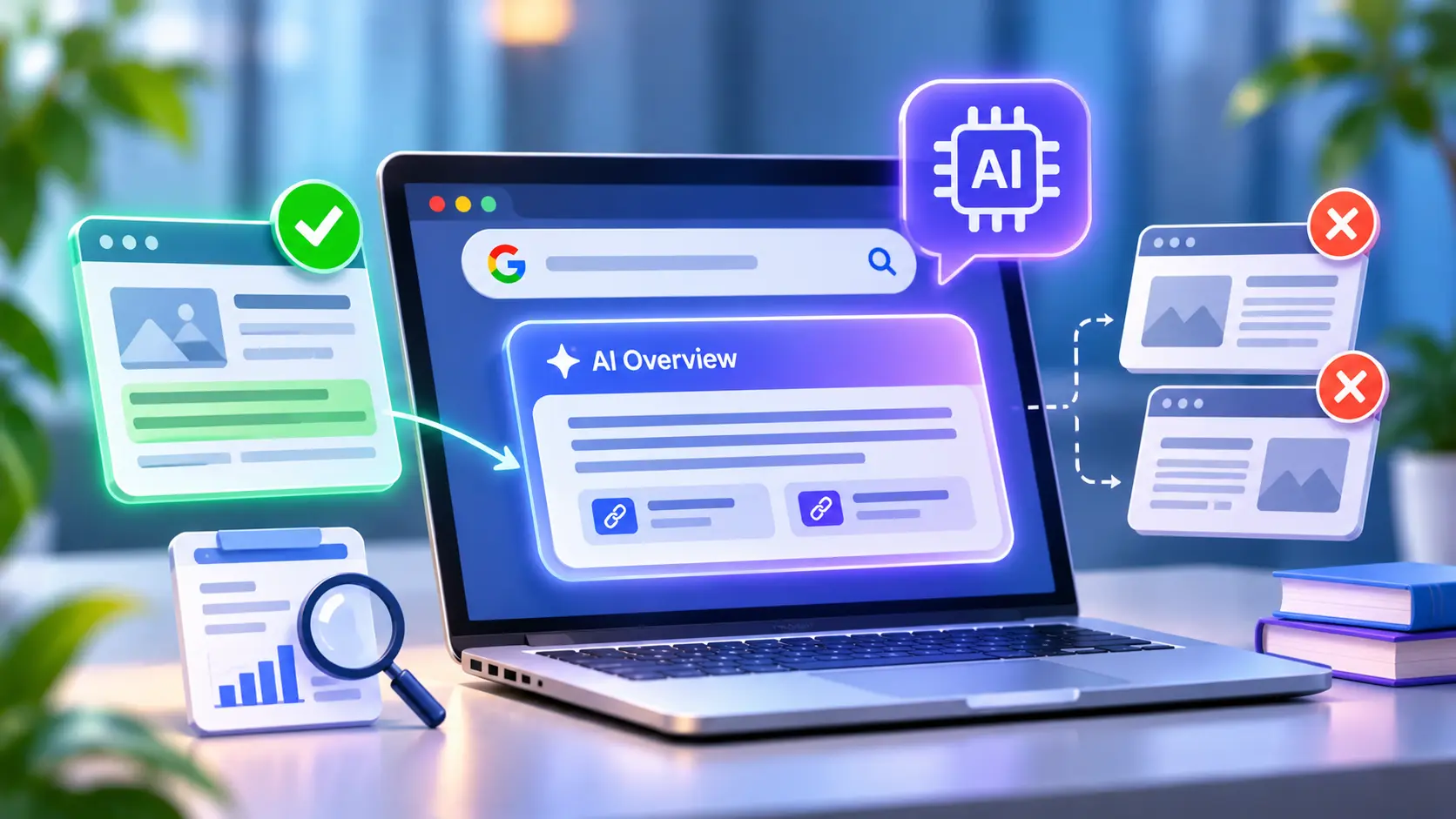

Two studies of Google AI Overviews reach very different conclusions about ranking. Ahrefs’ March 2026 analysis of 863,000 keyword SERPs found 37.9% of cited URLs appeared in the first ten results, while Surfer’s 2026 study found 67.82% of cited pages sat outside the top 10 for the query or its Gemini-generated fan-out queries. Both can be true, because they count different things. That tells you something useful: AI Overview citation patterns are real, but no single factor explains them.
In this article18 sections
Pages that get cited tend to rank reasonably well, open with a direct answer, stay current, show first-hand evidence, and use formats that are easy to lift a passage from. These are associations, not guarantees. This article reviews what published studies actually support, where they conflict, and how to apply the patterns without chasing myths.
What makes a page more likely to be cited in an AI Overview?#
A page must first be indexed and eligible to appear in Search with a snippet. Google’s documentation on AI features and your website says no additional requirements or special optimizations apply. Beyond that, studies associate citation with ranking, direct answers, freshness, first-hand experience, and extractable formats, but none proves causation.
This article is a synthesis of published research, not a new experiment, and the studies come mostly from vendors with commercial interests. Treat every figure as a pattern to test on your own queries.
Why do AI Overview citation studies disagree?#
They disagree because they use different denominators, rank ranges, and dates. Digital Applied’s comparison of 15 published studies makes the point clearly, and a few examples show how much the method matters:
| Study | What was counted | Finding |
| Ahrefs, July 2025 | Top three citations per Overview | 76.1% ranked in the top 10 |
| Ahrefs, March 2026 | Every cited URL | 37.9% in the first ten results |
| seoClarity, Oct 2025 | Keywords | 94% had at least one top-20 URL cited |
| seoClarity, Oct 2025 | All citations | 44% came from beyond the top 20 |
Before quoting any citation statistic, note the study, the date, the sample, and the denominator.
Pattern 1: Does ranking still matter?#
Yes, but it is not a gate. seoClarity’s analysis found a position-one URL appeared in the Overview 43% of the time, falling to 7% at position 20. Yet an academic measurement (arXiv 2605.14021) found 29.8% of cited domains were absent from the same results page. Ranking raises the odds, and a large minority of citations still come from pages that do not rank for the exact query.
The practical reading: keep earning rankings, but do not assume a lower-ranked page is excluded. Specific, well-structured pages on narrower topics can be pulled in.
Pattern 2: How important is extractable answer structure?#
It is one of the clearest associations in recent data. A study by TJ Robertson of TJ Digital, covering 193,507 AI answers across ChatGPT, Google AI Mode, and Google AI Overviews between August 27 and October 21, 2026, found that cited pages opened with a direct answer 20% of the time versus 5% of passed-over pages. Where the AI used the same answer, the gap narrowed to 23% versus 14%.
The author cautions that this is not proof of cause, and that the dataset reflects client questions, not all searches. Even so, the structure matches how readers work. An extractable answer structure typically includes:
- A heading phrased as the question or topic
- A one-to-three sentence answer immediately below it
- Supporting detail, conditions, and exceptions after the answer
- A self-contained passage that makes sense out of context
Search Savvy’s guide to writing content AI Overviews can extract cleanly covers the writing mechanics, and its explainer on content chunking addresses passage-level optimization. Note that Google’s documentation says no special optimization is required, so treat chunking as a clarity discipline, not a technical lever.
Pattern 3: Which content formats correlate with citations?#
Format correlations vary by engine, so check the engine behind each claim. Otterly’s September 2026 study of 617,985 citations found that of every 100 pages Google AI Overviews cited, 45 were listicles and 23 were forums or videos. The same study found forums and video made up roughly a quarter of citations in AI Overviews and AI Mode, with Reddit and YouTube as the main sources.
Robertson’s data adds page-level signals:
| Page characteristic | Association with citation |
| Table on the page | 69% higher odds |
| First-hand experience | 45% higher odds |
| Prices present where relevant | 28% higher odds |
| Published or updated in past 12 months | 88% higher odds |
The same study found product pages made up 28% of citations, more than any other page type, so ecommerce and service pages are not outside the picture. A table helps when it clarifies a real comparison. It is not a formatting trick.
Pattern 4: Does first-hand data earn more citations?#
It appears to. The 45% higher odds for pages showing first-hand experience fit a plausible mechanism: original testing, data, and specifics are harder to reproduce from generic summaries. A single study cannot prove that, so treat it as a reason to invest in evidence that only you hold.
What counts as first-hand evidence:
- Original measurements or survey results with methodology
- Test results from real use, with dates and conditions
- Case outcomes, described honestly, with limits
- Named expert input attributed to a real person
Pattern 5: Is freshness a real factor, or a myth?#
The evidence is mixed. Robertson found 88% higher odds for pages published or updated in the past 12 months. Ahrefs’ July 2025 study, by contrast, found AI Overview top-three citations averaged about 1,432 days old, according to Digital Applied’s register, and that finding has not been replicated. One plausible reconciliation is that freshness matters for time-sensitive queries and not for evergreen ones.
Two cautions follow. First, updating a date without updating the substance adds nothing for readers. Second, citations are unstable: Robertson found they reappeared only 24% to 28% of the time a week later and 11% to 16% after seven weeks. The guide to refreshing old content without losing rankings explains how to make updates meaningful.
What does not have good evidence behind it?#
Schema markup is the clearest example. Ahrefs ran a controlled test on 1,885 pages that added JSON-LD, and AI Overview citations fell 4.6% relative to matched controls, a result the authors called unexplained. AI Mode and ChatGPT changes were not distinguishable from zero. Cited pages were more likely to carry JSON-LD, which shows how correlation and controlled results can diverge.
That does not make schema useless. It still supports rich results and machine readability. Search Savvy’s article on schema types for AI search frames it that way. Just do not sell it as a citation lever.
How do you run your own citation frequency analysis?#
Measure citations on your own queries, with the method defined up front. Published averages cannot tell you what happens to your pages.
- Pick a fixed query set, such as 50 to 100 queries spanning your key topics and intents.
- Define the denominator before you start: per query, per citation, or per page.
- Record weekly, with date, location, and device.
- Log what was cited: your pages, competitors, forums, video.
- Tag page features: direct answer present, table, first-hand data, last updated.
- Compare cited and uncited pages on your own site and in your sector.
- Repeat for several weeks, because single snapshots mislead.
Search Savvy’s walkthrough on checking AI citations in ChatGPT and Perplexity shows how to log results.
What mistakes should you avoid?#
- Quoting a statistic without its denominator, which makes it meaningless
- Treating correlations as rules, such as adding a year to every title
- Restructuring everything at once, so you cannot tell what helped
- Using a single screenshot as proof of visibility
- Chasing schema or length as shortcuts, given the weak evidence
- Ignoring forums and video, which are a large citation source for Google’s AI features
The bottom line#
The consistent signals across studies are modest: be indexable, rank where you can, answer directly, keep information current, show real evidence, and measure on your own queries. If you want help auditing which pages are cited and why, Search Savvy’s AI search optimization services are a place to start.
FAQ#
How do pages get chosen for AI Overviews?#
Google says a page must be indexed and eligible for a snippet, with no special requirements beyond that. Studies find citation is associated with ranking, direct answers, freshness, and first-hand evidence.
Do pages need to rank in the top 10 to be cited?#
No. Studies disagree on the exact share because they count differently, but every one finds a sizeable minority of cited pages outside the top 10.
Does schema markup increase AI Overview citations?#
There is no evidence that it does. One controlled Ahrefs test saw citations fall 4.6%, and Google says no special structured data is needed.
Is longer content cited more often?#
The evidence is inconsistent, and some studies measure it with different methods. Focus on clear, specific passages instead of word count.
How often should you check AI Overview citations?#
Weekly is a workable rhythm, repeated over several weeks. Citations change frequently, so one check says little.
Are forums and videos really cited that much?#
In Otterly’s September 2026 study, forums and videos made up about a quarter of citations in Google’s AI Overviews and AI Mode, mainly from Reddit and YouTube. That is one vendor’s dataset, so test it on your queries.