
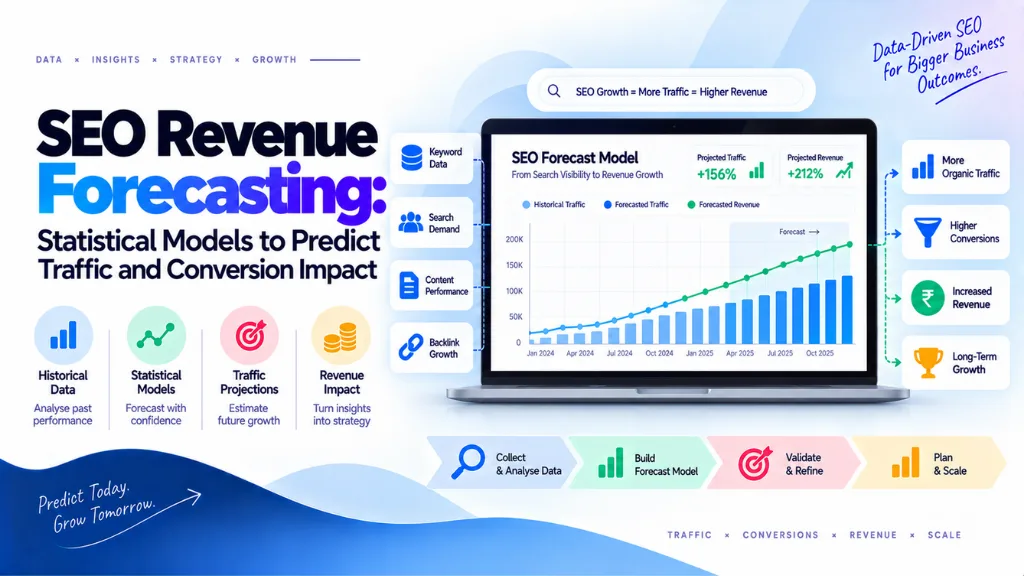

Leadership teams don’t approve SEO budgets based on traffic projections alone – they want the number that actually matters to the business: revenue. SEO revenue forecasting is the process of translating keyword rankings and search volume into projected visitors, then projected conversions, then projected income, so an SEO investment can be evaluated with the same rigor as any other line item competing for budget. Done well, it shifts the conversation from “trust me, this works” to “here’s the math” – the language leadership already uses to evaluate every other channel.
This article breaks down the core forecasting formula, the statistical methods behind more advanced models, and – critically – why 2026 forecasts need to account for a variable that didn’t meaningfully exist a few years ago: how often an AI Overview appears above your ranking and whether your brand gets cited inside it.
What Is SEO Revenue Forecasting?
SEO revenue forecasting is the practice of using historical performance data, keyword search volume, and expected click-through and conversion rates to predict the future business impact of organic search efforts – not just how much traffic a page might earn, but how much of that traffic translates into leads or sales, and ultimately revenue. It sits one layer beyond traditional SEO forecasting, which typically stops at projected traffic or rankings, by explicitly connecting those projections to average order value and customer acquisition cost.
Forecasts don’t need to be exact to be useful – they need to be directionally accurate enough to set realistic expectations and guide resource allocation. A forecast off by 15% that correctly signals which initiatives deserve investment is more valuable than a precise-looking number built on assumptions nobody can defend.
The Core Forecasting Formula
The foundational calculation behind most SEO revenue forecasts is straightforward: take a keyword’s monthly search volume, multiply it by the expected click-through rate at your target ranking position, multiply that by your site’s conversion rate, and multiply the result by average order value.
A worked example makes this concrete: a keyword with 5,000 monthly searches, ranked in the top position with an industry-standard CTR of 28%, produces roughly 1,400 visitors. Applying a 4% conversion rate yields 56 purchases, and at a $100 average order value, that keyword projects to approximately $5,600 in monthly organic revenue. The formula scales cleanly across an entire keyword portfolio, which is exactly why it’s the starting point for most forecasts, even sophisticated ones – the added complexity in more advanced models mostly comes from refining each input rather than changing the underlying structure.
Statistical Forecasting vs. Keyword-Level Forecasting
Two distinct approaches exist, and choosing the wrong one for your data maturity produces a forecast that looks precise but isn’t reliable.
Keyword-level forecasting builds projections bottom-up, from individual keyword search volumes, target rankings, and estimated CTR curves – it’s more intuitive, requires less historical data, and is the recommended starting point for most teams. Statistical forecasting, by contrast, analyzes a large historical dataset to model trends and project them forward, assuming no major disruptions to the underlying search environment. It’s a more advanced approach requiring substantially more historical data and forecasting expertise – and, as the next section shows, a riskier one currently, since its core assumption of environmental stability doesn’t hold as reliably as it once did.
Why 2026 Forecasts Need a New Variable: AI Overview Exposure
A well-documented case illustrates exactly why pure statistical forecasting has become harder to trust in the current environment. One research team built regression models on a full year of 2025 data and projected forward into the first quarter of 2026, predicting continued decline in organic click-through rate. Instead, CTR moved the other way, and every informational and transactional segment beat the projection – with the team’s own analysis putting the miss at 0.6 to 2.6 percentage points across every segment. The same methodology, applied to paid search data in the same period, predicted paid CTR to within 0.09 percentage points. The forecasting method wasn’t flawed; the assumption that organic search behaves like a stable system, the way paid search largely still does, was.
The reason for that instability traces directly to AI Overviews. A 2026 study covering 53 brands and 2.43 billion organic impressions found that informational queries displayed an AI Overview roughly 36% of the time, compared to about 5% for transactional queries. More importantly for forecasting specifically, the same ranking position produced meaningfully different click-through rates depending on AI Overview status: average organic CTR across a full year of informational queries was 3.35% when no AI Overview appeared, dropped to 2.07% when an AI Overview appeared and the brand was cited within it, and fell further to 0.94% when an AI Overview appeared without the brand being cited. That’s roughly a 3.5x difference in expected clicks for the exact same ranking position, depending entirely on a variable – AI Overview presence and citation status – that a forecast built only on historical position and volume data has no way to capture.
The practical implication is that a 2026-ready SEO revenue forecast needs to segment projected CTR by whether a target query currently triggers an AI Overview, and further by whether the site is likely to be cited within it, rather than applying a single flat CTR curve based on ranking position alone.
Building Confidence Intervals, Not Single Numbers
A forecast presented as a single precise figure – “$47,320 in organic revenue next quarter” – implies a false level of certainty most methodologies can’t actually support. A more defensible approach communicates a range with explicit assumptions behind it, alongside the confidence level those assumptions carry. Building traffic ranges rather than single-point estimates, and revisiting the forecast quarterly as fresh SERP and competitive data comes in, keeps the projection honest about its own uncertainty rather than manufacturing false precision.
Year-over-year comparisons also help neutralize seasonal fluctuations that would otherwise distort a forecast built purely on recent trailing months, and factoring in content production velocity – for example, observing that a consistent cadence of new pages correlates with a measurable lift in organic growth rate – gives a forecast a testable, revisable input rather than a static assumption baked in once and never revisited.
Segmenting Conversion Rates by Page Type and Query Intent
Applying a single, blended conversion rate across an entire forecast is one of the most common ways a projection ends up wrong even when the traffic estimate itself is accurate. Conversion rates typically vary significantly by page type and query intent – a blog post converting at 1.2% and a product page converting at 3.8% behave completely differently under the same traffic assumption, and blending them into a single average conversion rate systematically misrepresents both. A forecast that segments conversion rate by traffic source and page type produces a materially more accurate revenue projection than one applying a flat rate across every keyword in the portfolio.
Micro-conversions – newsletter signups, resource downloads, demo requests – are also worth incorporating even when they don’t directly represent revenue, since they indicate future revenue potential further down a longer sales cycle, particularly relevant for B2B and high-consideration purchases where the first organic visit rarely converts directly. Search Savvy’s keyword research services build this segmented approach into forecasting from the start, scoring keywords by realistic conversion potential rather than applying a single blended assumption across a portfolio with very different page types.
A Practical Framework for Building an SEO Revenue Forecast
- Start with keyword-level forecasting unless you have a genuinely large historical dataset and the statistical expertise to model it responsibly – it’s more transparent and easier for stakeholders to sanity-check.
- Segment expected CTR by AI Overview presence and citation likelihood, not just ranking position, since the same position can now produce meaningfully different click volumes depending on this variable.
- Apply page-type-specific conversion rates rather than a single blended average across the entire portfolio.
- Build a range, not a single number, and state the assumptions and confidence level behind it explicitly.
- Reforecast quarterly, incorporating fresh SERP composition data, competitor movement, and actual performance against the previous forecast.
- Connect the forecast to business KPIs, not just traffic, so the projection speaks the language leadership already uses to evaluate other channels.
Search Savvy’s content strategy and topical authority and AI search optimization (AEO/GEO) services work together to keep forecasts grounded in current SERP composition, factoring in both traditional ranking-based traffic and the AI-citation dynamics that increasingly determine actual click volume.
Common Mistakes in SEO Revenue Forecasting
- Applying a flat CTR curve regardless of AI Overview presence. The same ranking position can produce roughly 3.5 times the clicks depending on whether an AI Overview appears and whether the brand is cited within it.
- Blending conversion rates across page types. A single average conversion rate misrepresents both high-converting and low-converting page types simultaneously.
- Presenting a single number instead of a range. A precise-looking forecast implies certainty that most underlying methodologies can’t actually support.
- Choosing statistical forecasting without sufficient historical data. This approach requires substantial historical volume and expertise; keyword-level forecasting is the more reliable starting point for most teams.
- Forecasting once and never revisiting it. SERP composition and AI Overview prevalence change quickly enough that a forecast built on last year’s assumptions can be meaningfully wrong within a single quarter.
The Bottom Line
SEO revenue forecasting connects organic search work to the number leadership actually cares about, and doing it credibly in 2026 requires accounting for a search environment that’s genuinely less stable than it used to be – particularly the growing and unevenly distributed presence of AI Overviews across query types. Segmenting CTR by AI Overview status, applying page-type-specific conversion rates, and presenting a range with explicit assumptions rather than a single precise number all make the difference between a forecast that holds up in a boardroom and one that quietly falls apart the following quarter.
The practical next step is rebuilding your current forecast’s CTR assumptions to account for AI Overview presence on your highest-value keywords, rather than relying on a flat curve based on ranking position alone. Search Savvy’s keyword scoring work and content strategy services build exactly this kind of AI-aware forecasting into ongoing SEO planning, so projected revenue reflects the search landscape as it actually behaves today.
Frequently Asked Questions
What is SEO revenue forecasting? It’s the process of translating organic search projections – traffic, click-through rate, and conversion rate – into estimated revenue, connecting SEO work directly to a business outcome leadership can evaluate alongside other marketing investments.
What’s the basic formula for an SEO revenue forecast? Multiply a keyword’s search volume by the expected click-through rate at your target ranking position, then by your site’s conversion rate, then by average order value. This produces a projected revenue figure for that keyword, which can be summed across a portfolio.
Why do AI Overviews complicate SEO revenue forecasting? The same ranking position can produce meaningfully different click-through rates depending on whether an AI Overview appears for that query and whether the brand is cited within it – one 2026 study found roughly a 3.5x difference in CTR between these scenarios at the same position, a variable traditional forecasting models don’t account for.
Should I use statistical forecasting or keyword-level forecasting? Keyword-level forecasting is the recommended starting point for most teams, since it requires less historical data and is easier to sanity-check. Statistical forecasting can be more precise but requires a large historical dataset and forecasting expertise, and carries more risk in a search environment that’s currently less stable than it used to be.
Why shouldn’t I use a single blended conversion rate across my whole forecast? Conversion rates typically vary significantly by page type and query intent – a blog post might convert at a fraction of the rate a product page does. Applying one average rate across very different page types systematically misrepresents the resulting revenue projection.
How often should an SEO revenue forecast be updated? Quarterly, incorporating fresh SERP composition data, competitor activity, and actual performance against the prior forecast. SERP features and AI Overview prevalence change quickly enough that a forecast built on outdated assumptions can be meaningfully wrong within a single quarter.