

Publishing 500 pages on a topic doesn’t build authority. Publishing 500 interconnected pages that each answer a distinct question, written or reviewed by people who actually know the subject, does. That distinction is the entire difference between a content cluster that dominates a niche and a content farm that gets algorithmically dismantled – and Google’s March 2026 core update made that distinction explicit, rewarding sites with genuine topical depth while penalizing scaled content produced without original insight or verifiable expertise.
This guide covers what topical authority actually means, why the pillar-cluster architecture that works for 20 pages breaks down at 500, and the practical systems needed to scale content coverage without triggering the quality signals that now separate real authority from the appearance of it.
What Is Topical Authority?
Topical authority is the degree to which search engines and AI systems recognize a website as a comprehensive, trustworthy source on a specific subject – based on the depth, coherence, and expertise of its content, not just its backlink profile. A site can have modest domain-wide authority metrics and still rank strongly within one niche if its content coverage of that niche is genuinely complete.
This is a meaningfully different concept from generic domain authority scores, which aggregate backlink signals across an entire site regardless of topic. Topical authority is subject-specific: a site with deep, well-linked coverage of email marketing can outrank a higher-authority generalist site on email marketing queries specifically, while having no comparable strength in unrelated subjects.
How is topical authority different from keyword optimization? Keyword optimization targets individual search terms one page at a time. Topical authority targets the full universe of questions, subtopics, and related entities within a subject, so that no meaningful question in that space goes unanswered on the site. Google’s Helpful Content system, folded into core ranking since 2023, evaluates this breadth and coherence directly rather than rewarding isolated, well-optimized pages in a vacuum – the exact discipline behind dedicated content strategy and topical authority services.
The Pillar-Cluster Model: Where This Architecture Comes From
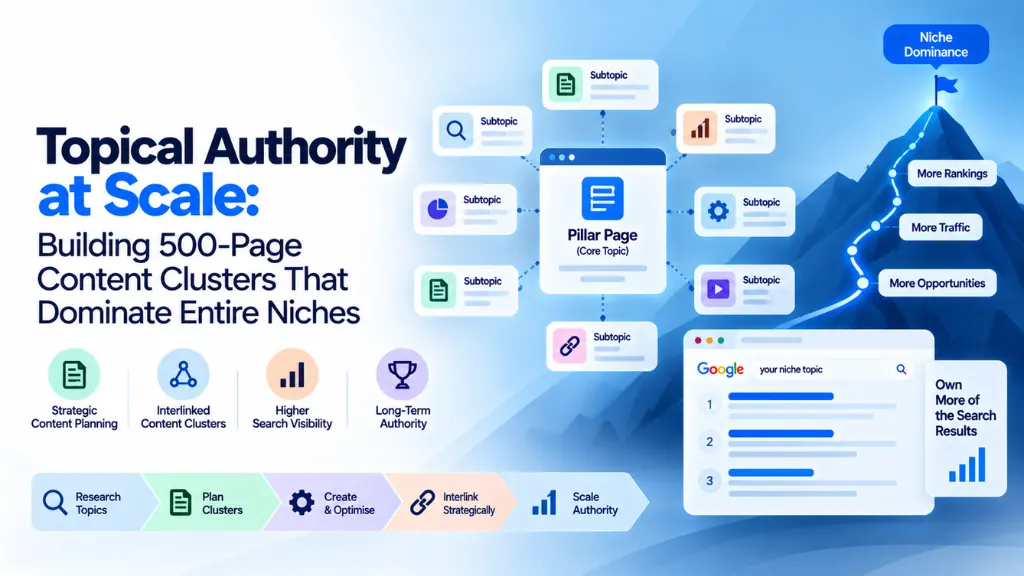
The dominant structure for building topical authority is the pillar-cluster model – one comprehensive pillar page covering a broad topic, supported by narrower cluster pages that each address a specific subtopic and link back to the pillar. HubSpot formalized this approach in an April 2017 report by content strategist Mimi An, building on internal research from 2015 that found pages gained rankings and impressions as more internal links were added between related content on HubSpot’s own blog.
Leslie Ye, the HubSpot strategist who led the reorganization of the company’s blog into this structure, described the test for identifying a genuine pillar page: it should answer every question a reader searching the core topic would have, while being broad enough to serve as an umbrella for 20 to 30 supporting posts. That test still holds at far larger scale – it’s simply applied across dozens of pillars instead of one.
| Component | Typical length | Function |
| Pillar page | 3,000–5,000 words | Broad, comprehensive overview of the full topic; links to every cluster page |
| Cluster page | 1,500–2,500 words | Deep coverage of one specific subtopic, question, or use case |
| Supporting page | Varies | FAQs, comparisons, case studies, or tools reinforcing a cluster |
Why 500 Pages Requires a Different System Than 20
A single pillar with 20–30 cluster pages can be planned in a spreadsheet and linked manually. At 500 pages spanning multiple pillars, that approach collapses under its own weight – link maintenance becomes unmanageable, topic boundaries blur, and duplicate or overlapping content starts competing with itself in search results (a problem known as keyword cannibalization).
Scaling topical authority to hundreds of pages requires treating the site as a system with explicit rules, not a growing pile of individual articles:
1. Build a topical map before writing anything. A topical map is a structured inventory of every subtopic, question, and related entity within your niche, organized by pillar. This is research work, not writing work – it draws on search query data, competitor content gaps, and the actual questions your audience asks, which is the foundation of proper keyword research services, and it should be complete (or substantially complete) before content production starts at scale.
2. Define clear boundaries between pillars. At 500 pages, overlapping pillars are the most common structural failure. If two pillars can plausibly claim the same cluster page, the topical map has a boundary problem that will produce cannibalization later. Each cluster page should belong to exactly one pillar.
3. Enforce internal linking as infrastructure, not an afterthought. Every cluster page links back to its pillar; pillars link to every cluster page they own; and closely related cluster pages link to each other where genuinely relevant. At scale, this requires a documented linking standard – and periodic audits – rather than relying on individual writers to remember it.
4. Stagger publication in coherent pillar batches, not randomly across topics. Publishing a complete pillar with its supporting clusters in a tight window sends a clearer topical signal than trickling out unrelated pages across many pillars simultaneously.
5. Audit and consolidate continuously. At scale, some cluster pages will underperform, overlap, or go stale. A quarterly audit that merges, redirects, or removes underperforming pages protects the authority of the pillars around them – thin or outdated pages sitting inside an otherwise strong cluster can drag down how the whole topic area is evaluated.
The March 2026 Lesson: Scale Without Substance Gets Penalized
Google’s March 2026 core update sharpened the consequences of getting this wrong. Multiple independent SEO analyses of the rollout converged on the same pattern: the update increased pressure on content produced at volume without meaningful editorial oversight or original information, while sites demonstrating genuine topical depth and verifiable author expertise saw more stability. Google’s own guidance frames the underlying question plainly: does the content provide original information, reporting, research, or analysis that isn’t already available elsewhere?
This matters directly for anyone planning a 500-page cluster strategy, because the instinct to scale fast – generating pages from templates to cover every long-tail variation – is exactly the pattern the update targeted. The sites that held up shared three properties: content that added something not already covered by competing top-ranking pages, identifiable author or reviewer expertise behind the content, and topical coherence – consistent, connected coverage of a defined subject rather than opportunistic expansion into unrelated areas to chase traffic.
The practical implication is that “at scale” cannot mean “at volume.” A 500-page cluster only builds authority if each page clears the same bar a 20-page cluster would: does this page say something the top five competing results don’t already say?
E-E-A-T at Scale: The Expertise Problem
Demonstrating Experience, Expertise, Authoritativeness, and Trustworthiness (E-E-A-T) across 500 pages is fundamentally a staffing and process problem, not a writing problem. A single expert author can credibly write or review 20 pages on a niche subject. Credibly attributing genuine expertise across 500 pages usually requires either a small team of subject-matter contributors, a documented editorial review process where domain experts check work produced by generalist writers, or both.
Sites that skip this step and rely on generic author bylines with no verifiable subject-matter background are the pattern Google’s quality systems are specifically built to identify at scale – a single thin author bio is a minor issue; the same bio repeated across 500 templated pages is a structural signal. This is typically where in-house teams lean on external content marketing services to pair subject-matter review with production capacity.
Topical Authority and AI Search Visibility
Topical authority increasingly determines which sources get cited in AI-generated answers, not just which pages rank in traditional search. AI answer engines like ChatGPT, Perplexity, and Google AI Overviews tend to draw on sources they’ve learned to associate with consistent, reliable coverage of a subject – which is a direct extension of the same topical-depth signal search engines have rewarded since the Helpful Content updates.
Search Savvy has observed this pattern consistently across client audits: sites with genuinely comprehensive, well-linked topic coverage tend to surface more often in AI-generated summaries than sites with a single strong page on the same subject, even when that single page is well-written. Building topical authority at scale isn’t just a traditional-SEO exercise anymore – it’s increasingly the foundation the AI search optimization (AEO/GEO) services approach is built on.
Common Mistakes When Scaling Content Clusters
- Chasing every long-tail keyword variation instead of the actual questions readers have, producing pages with no real differentiation from each other.
- Publishing across too many pillars at once, diluting topical coherence instead of establishing clear ownership of a smaller number of subjects.
- Treating internal linking as a launch-day task rather than ongoing infrastructure that needs auditing as the site grows.
- Skipping editorial review to hit publishing volume targets, producing content that reads as generated rather than expert-informed.
- Never consolidating or removing underperforming pages, letting thin or outdated content erode the authority of an otherwise strong cluster.
Frequently Asked Questions
What is topical authority in SEO? Topical authority is the degree to which a website is recognized as a comprehensive, trustworthy source on a specific subject, based on the depth and coherence of its content rather than generic backlink metrics alone.
How many articles do you need to build topical authority? There’s no fixed number – HubSpot’s original guidance suggested a pillar page should support roughly 20 to 30 cluster pages, but the real requirement is complete coverage of the relevant subtopics and questions within a niche, which can be fewer or far more depending on the subject’s breadth.
Does publishing more content always improve rankings? No. Google’s March 2026 core update specifically increased pressure on content published at volume without original insight or verifiable expertise. Volume without genuine differentiation from existing top-ranking content can hurt a site rather than help it.
What’s the difference between a pillar page and a cluster page? A pillar page broadly covers an entire topic and links to every supporting page within it. A cluster page covers one specific subtopic, question, or use case in depth and links back to its pillar.
Can a small site build topical authority in a competitive niche? Yes, if it narrows its scope. A smaller site with complete, deep coverage of a tightly defined subtopic can out-rank a larger, more generalist competitor on that specific subject, since topical authority is niche-specific rather than a function of overall site size.
How does internal linking affect topical authority? Internal links signal to search engines which pages belong to the same topic and how authoritative each page is within that cluster. A well-linked cluster distributes ranking signals across related pages; a poorly linked one leaves individual pages competing in isolation.
The Bottom Line
Building topical authority at 500-page scale is a systems problem before it’s a content problem: a documented topical map, clear pillar boundaries, enforced internal linking, and a real editorial process for demonstrating expertise across contributors. Skip any of those and scale works against you, especially after Google’s March 2026 core update raised the bar on what “depth” actually needs to look like. Before committing to a large-scale cluster build, map your topic completely and confirm your team can genuinely staff the expertise it requires – Search Savvy generally recommends starting with one fully realized pillar as a proof of concept before scaling the same standard across an entire niche.