

Two sites can publish an identical 2,000-word article on the same keyword, and one will outrank the other within days while the second struggles for months. The difference usually isn’t the article – it’s everything else the ranking site has already published on that subject. That accumulated trust is topical authority, and it’s become one of the clearest advantages a smaller site can build against competitors with bigger budgets and stronger backlink profiles.
This article explains what topical authority actually is, how Google’s systems recognize it, the structural work required to build it, and the sequencing decisions that let some sites build it in months while others spend years without ever getting there.
What Is Topical Authority?
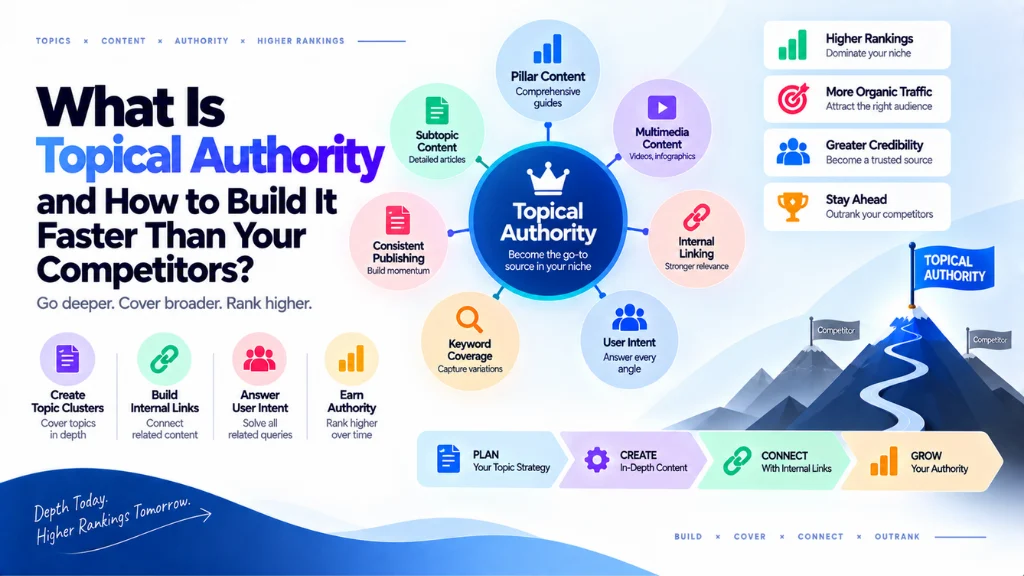
Topical authority is the degree of trust and expertise a search engine assigns to a website based on how comprehensively and consistently it covers a specific subject, rather than any single page’s individual quality. It’s earned across an entire body of content, not by one article – a site that has thoroughly covered a subject from foundational concepts through advanced edge cases is treated as an authority on it, and a new article on that site tends to rank faster and more easily than an equally strong article published on a site with no other relevant content.
SEO strategist Koray Tuğberk Gübür, credited with formalizing the concept for the industry, summarizes it as a simple equation: “Topical Authority = Topical Coverage + Historical Data.” Coverage is the breadth and depth of what you’ve published on a subject; historical data is the track record Google accumulates about how well that content has served searchers over time. Neither factor alone is sufficient – a site with broad coverage published yesterday hasn’t accumulated the historical signal yet, and a site with years of history on a narrow slice of a topic hasn’t demonstrated the coverage.
How Is Topical Authority Different From Domain Authority?
Domain authority is a third-party metric estimating a site’s overall link-based strength across every subject it touches. Topical authority is subject-specific: a site can have strong topical authority on one narrow subject and none at all on an unrelated one, regardless of its overall domain strength. A well-linked general news site, for example, may have high domain authority but weak topical authority on a specialized subject like enterprise SEO, while a smaller specialist site with fewer backlinks overall can outrank it specifically within that niche.
Why Topical Authority Matters More in 2026
Search engines have moved from matching individual keywords to understanding topics, entities, and the relationships between them. That shift means a site’s demonstrated depth on a subject increasingly outweighs any single page’s on-page optimization. It also extends beyond classic search: AI answer engines like Google AI Overviews, ChatGPT, and Perplexity draw more readily on sites they can recognize as comprehensive, reliable sources on a topic when assembling an answer, which is why topical authority work increasingly overlaps with AI search optimization for AEO and GEO rather than sitting in a separate discipline.
What Happens When a Site Has Strong Topical Authority?
New content on a topically authoritative site tends to rank noticeably faster than equivalent content on a site without that history – sometimes within days of indexing rather than weeks or months – because the domain has already demonstrated trustworthiness on the subject. Established authority also tends to hold up better through core algorithm updates: sites with genuine topical depth typically retain more visibility during ranking volatility than sites that built superficial coverage across the same keywords.
How Topical Authority Is Built: The Cluster Model
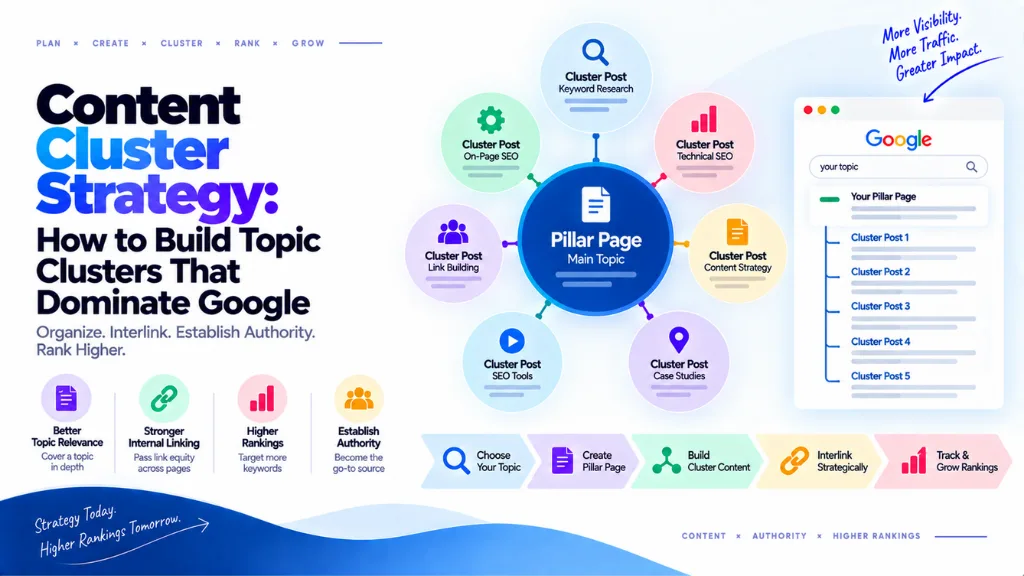
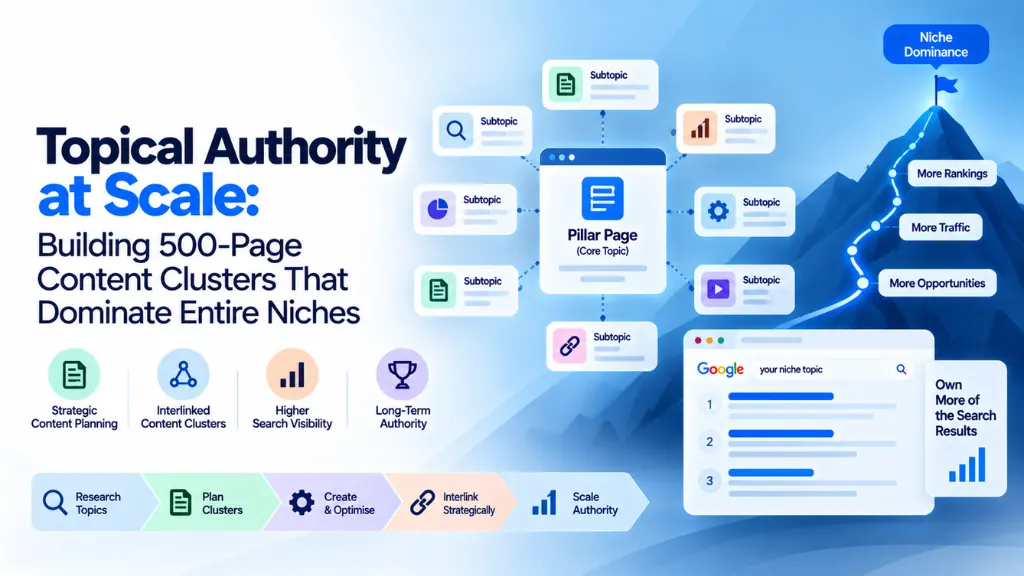
The dominant structure for building topical authority is the pillar-cluster model: a comprehensive pillar page anchors the core topic, and narrower cluster pages each address one specific subtopic in depth, linking back to the pillar to reinforce the relationship. Google’s crawlers read that bi-directional linking as evidence of a deliberately built, coherent body of work rather than a collection of unrelated posts competing for the same crawl budget.
| Building Block | Purpose | Practical Guidance |
| Pillar page | Anchors the topic comprehensively | 3,000–5,000 words, links to every cluster page |
| Cluster pages | Cover individual subtopics in depth | 1,200–2,000 words, link back to the pillar |
| Internal links | Distribute authority and signal topical relationships | Bi-directional between pillar and cluster, plus lateral links between related clusters |
| Content depth | Demonstrates comprehensive coverage, not just keyword targeting | Address the full range of questions a searcher has, not just the primary keyword |
| Consistency | Builds the historical-data component of authority | Regular publishing and updates rather than a one-time content push |
This structure only works if the underlying topic mapping happens before writing begins – deciding what the pillar covers and which subtopics deserve their own cluster page, rather than discovering the gaps after publishing scattered content and trying to retrofit links between them. It’s also the step Search Savvy sees skipped most often, even on sites with genuinely strong individual articles.
The Fastest Path: Narrow Before You Broaden
The single most common mistake in building topical authority quickly is choosing a niche too broad to cover convincingly within a reasonable timeframe. A narrower topic that a site can cover comprehensively builds authority faster than a broad topic covered thinly, because Google’s systems reward demonstrated completeness on a subject, not partial coverage of a large one.
How Narrow Should a Topic Be to Build Authority Quickly?
Choose a topic narrow enough that a realistic content plan – typically 10 to 20 supporting cluster articles around one comprehensive pillar – can genuinely cover every major subtopic a searcher would expect. If the honest answer to “can we cover this better than the sites currently ranking” is no, the topic needs to be narrowed further before any content gets written.
Only after the core topic is genuinely covered should a site expand into adjacent subjects. Expanding too early – publishing on tangentially related topics before the core subject is comprehensively covered – dilutes the topical signal instead of reinforcing it, because search engines start reading the site as broad and shallow rather than narrow and deep.
Building Topical Authority: A Practical Sequence
- Define a topic narrow enough to cover completely, testing whether you can realistically out-cover the sites currently ranking for it.
- Map every subtopic before writing, using keyword research and real searcher questions rather than guessing at what a cluster should include.
- Publish a comprehensive pillar page first; a thin pillar undermines every cluster page that links up to it.
- Build out cluster pages systematically, each covering one subtopic in genuine depth rather than a rephrased slice of the pillar.
- Link bi-directionally between pillar and cluster, and laterally between closely related cluster pages, so authority moves in every direction the topic map calls for.
- Publish and update consistently rather than in a single burst, since the historical-data component of authority accumulates over sustained time, not a launch date.
- Only then expand into adjacent topics, once the core subject is genuinely comprehensive.
Search Savvy runs this sequence as the starting point for every content strategy and topical authority engagement, since skipping the mapping step is the most common reason clusters underperform even when the individual articles are well written.
How Long Does It Take to Build Topical Authority?
Meaningful ranking improvement from a new content cluster typically takes three to six months to become visible, even when the cluster is well built, because the historical-data half of the equation accumulates over time rather than appearing immediately after publishing. Sites that treat topical authority as a short-term sprint – publishing a burst of cluster content and then stopping – tend to plateau, while sites that keep publishing and refreshing content consistently continue compounding their advantage well past that initial window.
This is also where the “faster than competitors” part of building topical authority actually plays out. A narrower, better-mapped cluster with consistent publishing will typically outpace a broader, loosely connected content library, even if the broader library has more total articles and a longer publishing history – coverage quality and interconnection matter more than raw volume.
Common Mistakes That Slow Topical Authority
- Choosing a topic too broad to cover convincingly. Broad coverage published thinly signals scattered effort rather than depth, and slows authority-building rather than accelerating it.
- Publishing without mapping the cluster first. Retrofitting links onto disconnected articles rarely produces the same signal as a cluster built with the pillar-cluster relationship planned from the start.
- Treating it as a short-term project. Authority compounds over months of consistent publishing and updating, not a single content sprint.
- Expanding into adjacent topics too early. Diluting focus before the core topic is comprehensively covered weakens the signal for the subject the site is trying to own.
- Ignoring technical SEO foundations. Crawlability issues, slow page speed, and duplicate content can undermine topical authority signals no matter how strong the content itself is – a recurring technical SEO review catches these before they compound.
- Letting content go stale. A cluster that isn’t refreshed loses relevance over time even if it was comprehensive when first published; ongoing updates are part of what sustains the historical-data component of authority.
Frequently Asked Questions
What is the difference between topical authority and keyword ranking? Keyword ranking measures how a single page performs for a single term. Topical authority measures how comprehensively and consistently a site covers an entire subject, which influences how quickly and easily every individual page within that subject ranks.
Can a small site build topical authority faster than a larger competitor? Yes, provided the smaller site chooses a narrower topic it can cover more completely than the larger competitor’s broader, thinner coverage of the same subject. Depth on a focused topic often beats breadth spread thin.
How many articles are needed to establish topical authority? There’s no fixed number, but a realistic starting cluster is typically one comprehensive pillar page supported by 10 to 20 cluster articles that together cover every major subtopic a searcher would expect.
Does topical authority replace the need for backlinks? No. Backlinks still matter, particularly to the pillar page, where they cascade authority down into the cluster through internal links. Topical authority reduces how dependent new content is on earning its own backlinks immediately, but it doesn’t eliminate the value of earning them.
How long before a new content cluster starts ranking? Meaningful improvement typically takes three to six months, even for a well-structured cluster, because part of the signal depends on accumulated historical data rather than initial publication alone.
Does topical authority help with AI search visibility as well as Google rankings? Yes. AI answer engines tend to draw more readily on sites they can recognize as comprehensive, trustworthy sources on a subject, which makes topical authority relevant to citation likelihood in AI Overviews, ChatGPT, and Perplexity, not just classic organic rank.
Bottom Line
Topical authority isn’t a ranking trick layered on top of an existing SEO strategy – it’s the structural foundation the rest of the strategy depends on. Choose a topic narrow enough to cover completely, map every subtopic before writing, build the pillar and cluster pages with deliberate bi-directional linking, and keep publishing and refreshing consistently rather than treating the cluster as a one-time project. Do that with more discipline than competitors who are still chasing individual keywords, and new content on your site starts ranking faster than theirs – which is the entire advantage topical authority is built to deliver.