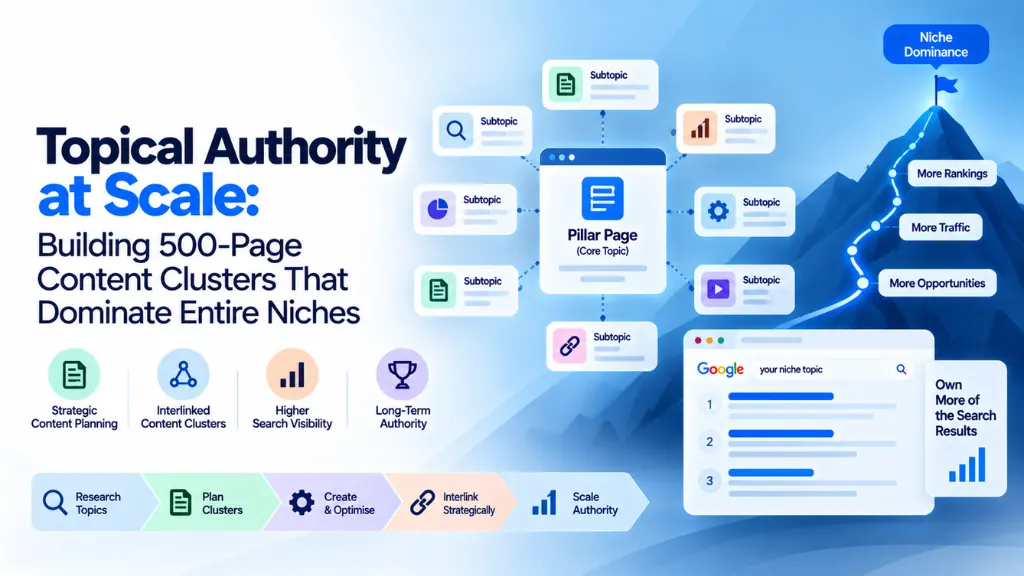

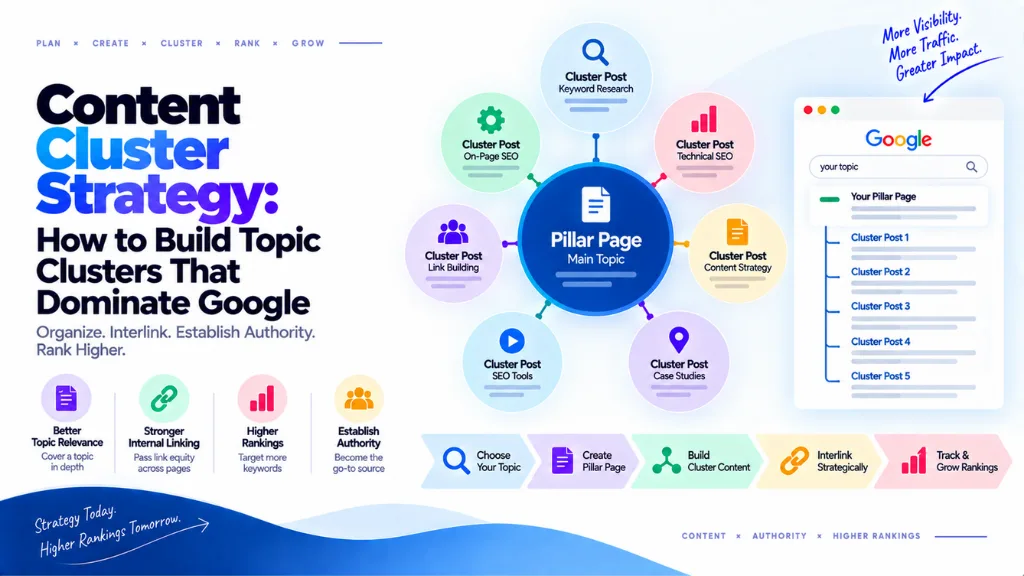

Publishing more blog posts isn’t the same as building a content strategy – and most teams that plateau in organic traffic are doing the former while thinking they’re doing the latter. A content cluster strategy is the planning discipline that turns a list of blog ideas into an architecture: one comprehensive pillar, a deliberately sized set of supporting articles, and a link structure that tells Google exactly what subject you own.
This article covers how to plan a cluster before writing a single article, how big a cluster actually needs to be, the cadence that keeps clusters compounding instead of stalling, and how to measure whether a cluster is working – the operational side of cluster building that most guides skip in favor of restating what a pillar page is.
What Is a Content Cluster Strategy?
A content cluster strategy is the documented plan for which topics a site will build deep coverage around, how each topic’s pillar and supporting articles are structured, and how they interlink – as distinct from a content calendar, which is simply the publishing schedule that executes the plan. The topic cluster model itself – a central pillar page supported by narrower cluster articles that link back to it – was first formalized publicly by HubSpot in 2017, in response to search engines shifting from matching individual keywords toward understanding topics and the relationships between pages.
A cluster strategy answers three questions before any content gets written: which topics deserve a dedicated cluster, how many supporting articles each one needs, and in what order they should be built and interlinked. Skipping that planning step and instead brainstorming article ideas one at a time – the pattern Search Savvy sees most often when auditing an underperforming content library – is the most common reason a site ends up with dozens of loosely related posts instead of a cluster that actually functions as one.
Pillar Page vs Cluster Article: Defining the Roles
A pillar page is the comprehensive, single-best treatment of a core topic on the site – broad enough to cover the subject at a high level and link out to every supporting article beneath it. A cluster article goes narrower, covering one specific subtopic or long-tail question in real depth, and links back to the pillar using varied, descriptive anchor text.
| Pillar Page | Cluster Article | |
| Scope | Broad, comprehensive treatment of the core topic | Narrow, in-depth treatment of one subtopic |
| Typical length | 3,000–5,000 words | 1,200–2,000 words |
| Target keyword | Broad, often competitive head term | Specific, usually long-tail |
| Link direction | Links out to every cluster article | Links back to the pillar, plus sideways to related clusters |
| Job in the strategy | Anchors the topic and distributes authority | Captures long-tail traffic and reinforces depth |
Neither role works without the other. A pillar with no supporting articles is just a long page with no depth behind it; cluster articles with no pillar to link to are scattered posts with no anchor to reinforce.
How Big Should a Content Cluster Be?
There’s a real trade-off between the number of clusters a site builds and how deep each one goes, and depth wins. A handful of clusters developed to real comprehensiveness – each with enough supporting articles to cover the topic’s full range of subtopics – will typically outperform a larger number of clusters built only a few articles deep, because Google and AI answer engines reward demonstrated completeness on a subject rather than partial coverage spread across many subjects.
How Many Articles Does a Topic Cluster Need?
Most well-developed B2B clusters run somewhere between 10 and 20 supporting articles around one pillar, though highly competitive or broad subjects can justify considerably more. The right number isn’t a fixed target – it’s however many articles are needed to answer every major question a searcher in that topic actually has, tested by whether a knowledgeable reader would say the site “covers this subject” rather than “has some posts about it.”
Most sites are better served choosing three to seven topics to develop this thoroughly than spreading the same total content budget across fifteen or twenty shallow clusters. Focus and depth compound; breadth without depth doesn’t build the same trust signal.
Planning a Cluster Before Writing Anything
The planning sequence matters more than any individual writing decision, because a cluster built without a map tends to produce overlapping articles, gaps in coverage, and weak internal linking that has to be retrofitted later.
- Define the core topic and confirm it’s ownable. Test whether the site can realistically build more comprehensive coverage than what currently ranks – if not, the topic needs narrowing.
- Map every subtopic before drafting the pillar, combining keyword research with the real questions a searcher on this topic would ask, not just head-term search volume.
- Assign each subtopic to exactly one cluster article, checking for overlap so no two articles are competing for the same query.
- Draft the pillar page first, or update it if one already exists, since every cluster article depends on it being comprehensive enough to anchor the topic.
- Sequence the cluster articles, publishing in an order that builds coverage systematically rather than randomly, so early gaps in the cluster don’t sit unfilled for months.
- Plan the internal link map alongside the content, deciding which cluster articles link to which siblings before writing, rather than discovering the connections after the fact.
Search Savvy runs this exact sequence – topic confirmation, subtopic mapping, then drafting – as the starting point for every content strategy and topical authority engagement, because the mapping step is the one clients most often skip on their own.
Publishing Cadence: Why Consistency Beats Bursts
A cluster built in a single publishing sprint and then abandoned tends to plateau faster than a smaller cluster that keeps getting supporting articles and updates over time. Two reasons drive this. First, part of how search engines evaluate a site’s authority on a topic accumulates over time, not just at the moment of publication – a track record of sustained relevance matters alongside the content itself. Second, competitors and search behavior both keep moving; a cluster that stops growing eventually falls behind newer content covering the same subtopics with more current information.
A sustainable, moderate cadence – publishing consistently over many months – tends to outperform an aggressive short-term push that isn’t followed by ongoing maintenance. The specific number of articles per week matters less than whether the pace is one the team can actually sustain for a year, since abandoned clusters rarely recover the momentum they had while actively growing.
Refreshing Existing Content Inside a Cluster
A cluster strategy isn’t only about new articles – refreshing existing cluster content is part of keeping the whole structure current. Content inside competitive clusters tends to need updating more frequently than it used to, as search results shift and new subtopics emerge that weren’t relevant when the article was first published. Refreshing an existing cluster article – updating examples, adding a subtopic that’s since become relevant, tightening internal links to newer siblings – is often a faster win than publishing an entirely new article, since the page already carries some ranking history.
Avoiding Keyword Cannibalization Across Cluster Articles
The most common structural failure inside a cluster is two articles competing for the same query because their subtopics weren’t clearly separated during planning. When this happens, Google often struggles to determine which page should rank, and both articles can underperform relative to a single, clearly-scoped page. The fix starts at the mapping stage – assigning each subtopic to one article before writing – and continues with a periodic audit that checks whether newer articles have started drifting into a sibling’s territory, merging or redirecting pages that have.
Measuring Whether a Cluster Is Working
Individual article rankings tell only part of the story. A cluster-level view should also track how quickly new articles in the cluster start ranking compared to standalone content elsewhere on the site, since faster ranking on new pages is one of the clearest signs a cluster’s accumulated authority is actually functioning. Internal-link click-through between cluster articles and the pillar is another useful signal – a cluster with strong topical cohesion typically shows readers moving between related articles, not landing once and leaving.
What Metrics Show a Content Cluster Is Successful?
Look at time-to-rank for new articles published inside an established cluster, total organic traffic to the pillar and its cluster combined rather than any single page, and whether the site appears in AI-generated answers for queries related to the topic – a signal that’s grown alongside organic rank as a measure of genuine topical recognition.
Content Clusters and AI Search Visibility
A well-structured cluster serves search engines and AI answer engines simultaneously. AI Overviews, ChatGPT, and Perplexity increasingly favor sources they can recognize as comprehensive on a subject, and a cluster with clear internal links and self-contained, answer-first passages gives these systems an easier path to extracting a coherent, citable chunk of content than a single long article trying to cover everything at once. This is part of why cluster planning increasingly overlaps with AI search optimization for AEO and GEO rather than being treated as a purely classic-SEO exercise.
A cluster with strong content and weak crawlability – slow pages, broken internal links, duplicate content – routes its own authority into dead ends, which is why Search Savvy pairs cluster rollouts with a technical SEO check rather than treating it as a purely editorial project.
Common Mistakes
- Choosing too many clusters at once. Spreading a content budget across fifteen shallow clusters produces weaker results than developing three to seven thoroughly.
- Writing cluster articles before mapping subtopics. This is the single most common cause of overlapping articles and gaps that have to be fixed after publication.
- Publishing in a single burst and stopping. Clusters that stop growing lose momentum against competitors who keep publishing and refreshing.
- Treating internal linking as a final step. Links planned alongside the content map are more coherent than links added retroactively to a finished set of articles.
- Ignoring existing content when planning a new cluster. Many sites already have relevant articles scattered across the domain that should be folded into the cluster rather than duplicated.
- Measuring only individual article rank. Cluster-level signals – time-to-rank for new articles, combined traffic, AI citation – reveal whether the structure is actually compounding.
Frequently Asked Questions
What is the difference between a content cluster strategy and a content calendar? A content cluster strategy is the plan for which topics to build deep coverage around and how the pillar and supporting articles connect. A content calendar is the publishing schedule that executes that plan – useful, but not a substitute for the underlying architecture decisions.
How many topic clusters should a site build? Most sites are better served by three to seven thoroughly developed clusters than by fifteen or twenty shallow ones. Depth on fewer topics tends to outperform breadth spread thin.
Can I build a cluster from content I’ve already published? Yes, and it’s often faster than starting from scratch. Existing articles usually already carry some ranking history, so mapping them into a planned cluster and adding the missing subtopics and internal links can move faster than an entirely new build.
How often should cluster content be refreshed? There’s no universal schedule, but competitive clusters generally need refreshing more frequently than they once did, since search results and subtopics shift faster. Reviewing cluster content roughly every six to twelve months is a reasonable baseline, with more frequent checks in fast-moving subjects.
Does keyword cannibalization happen within a single cluster? Yes, and it’s one of the most common cluster failures. It happens when two articles are written for subtopics that overlap too closely, and the fix is separating subtopics clearly during planning rather than after publication.
How do I know if my content cluster is actually working? Track whether new articles published inside the cluster start ranking faster than equivalent standalone content elsewhere on the site, whether combined traffic to the pillar and its cluster is growing, and whether the topic shows up in AI-generated answers – not just individual page rank in isolation.
Bottom Line
A content cluster strategy is a planning decision made before any article is drafted, not a label applied to a folder of related posts after the fact. Choose a small number of topics you can genuinely dominate, map every subtopic to a single article before writing, publish and refresh on a sustainable cadence, and measure the cluster as a whole rather than page by page. Sites that treat cluster building this way tend to see new content rank faster and hold up better through algorithm changes than sites still publishing article by article without a map – which is the entire point of building the architecture in the first place.