Retrieval-Augmented Generation (RAG): What It Means for How AI Answers Questions

If you’ve ever asked ChatGPT a question and noticed it cited a source, or typed a query into Google and seen an AI Overview pop up with little link icons next to each sentence, you’ve already seen Retrieval-Augmented Generation at work. You just didn’t know that’s what it was called.
In this article10 sections
RAG is one of those concepts that sounds academic but explains something you interact with every single day. It’s the reason AI tools can answer questions about this morning’s news instead of freezing at their last training update. It’s also quietly become one of the most important things to understand if you create content for a living, because RAG is the mechanism deciding whether AI systems ever see – and cite – your website at all.
This piece breaks down what RAG actually is, how it works in plain terms, why it matters for anyone publishing content in 2026, and what you can realistically do about it.
What Is Retrieval-Augmented Generation (RAG)?#
Retrieval-Augmented Generation is a technique that lets an AI language model fetch relevant information from an external source – a database, a search index, a set of documents – before it generates an answer, instead of relying only on what it learned during training.
Think of a large language model on its own as a very well-read person who hasn’t picked up a newspaper in over a year. They can reason brilliantly, write clearly, and explain complex ideas, but ask them who won last week’s match or what a company announced yesterday, and they’re stuck guessing. RAG solves that by handing the model a quick note before it answers: “here are five relevant, current documents – use these.”
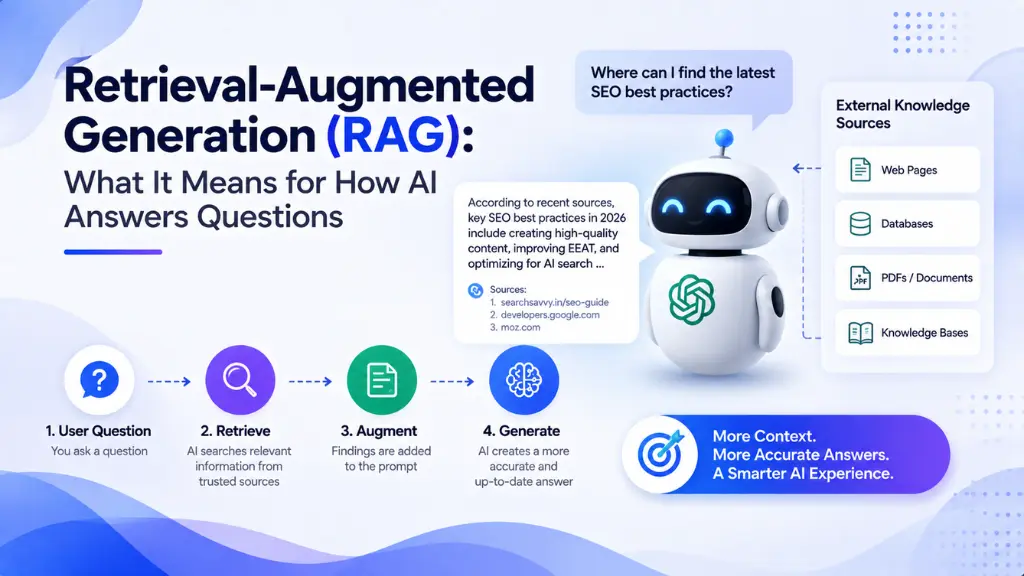
The concept was formalized by researchers at Meta AI (then Facebook AI Research) in a 2020 paper that combined a retrieval system with a generative model, and it has since become foundational infrastructure across the AI industry. In practical terms, a RAG pipeline typically does three things:
- Retrieve – search a knowledge base, document set, or the live web for content relevant to the user’s question
- Augment – insert the most relevant snippets into the model’s context alongside the original question
- Generate – produce an answer grounded in that retrieved material, often with citations back to the source
That’s really it. No fine-tuning of the entire model, no retraining on new data every time something changes. Just a smarter way of feeding the model what it needs, exactly when it needs it.
Why Not Just Train the Model on Everything?#
This is a fair question, and it’s one of the most common People Also Ask-style queries around this topic. Retraining a large model is enormously expensive, slow, and quickly outdated – the moment you finish training, the world has already moved on. RAG sidesteps that entirely. Instead of baking knowledge into the model’s weights, you keep the knowledge in a separate, easily updatable store and let the model pull from it on demand. Update the source documents, and the AI’s answers update instantly – no retraining required.
How Does RAG Actually Work? A Simple Walkthrough#
Here’s what happens, step by step, when a RAG-powered system handles a question:
Step 1: The query is understood. The system analyzes what you’re actually asking, sometimes breaking a complex question into smaller sub-questions – a process often called query fan-out.
Step 2: Relevant content is retrieved. Rather than searching by exact keyword match, most modern RAG systems use vector embeddings – mathematical representations of meaning – to find passages that are semantically related to the query, even if they don’t share the same words.
Step 3: The retrieved content is added to the model’s context. This is the “augmented” part. The model now has both your question and a handful of relevant, often recent, text passages in front of it.
Step 4: The model generates a grounded answer. Instead of writing purely from memory, the model composes a response using the retrieved material as its evidence base.
Step 5: Sources are cited. Many RAG systems – including Google’s AI Overviews, Perplexity, and Microsoft Copilot – attach links back to the original content, which is also how they justify (and fact-check) what they just told you.
Google has described this exact pattern for its own AI Overviews: its systems fetch relevant content from the search index for a given query, a model then generates a summary that combines points from multiple sources, and the process finishes with grounding and citations linking back to the original pages. That grounding step matters because relying only on a model’s internal training risks hallucinations – pulling in real, current content from the web keeps the generated answer anchored to something a user can actually verify.
Where You Already Encounter RAG#
You don’t need to work in AI to run into RAG constantly. A few everyday examples:
- Google AI Overviews and AI Mode – grounded in live web content pulled from Google’s index
- ChatGPT, Gemini, and Copilot with web browsing enabled – retrieving current pages before answering
- Perplexity – built around retrieval and citation as its core product experience
- Customer support chatbots – retrieving from a company’s help docs instead of guessing
- Internal enterprise tools – letting employees “chat with” a company’s own knowledge base, contracts, or codebase
By 2026, this pattern has moved well past the experimental stage. Industry estimates suggest the vast majority of production AI assistants now rely on some form of retrieval-based workflow rather than a model’s raw training knowledge alone, and analysts tracking the enterprise RAG market point to it becoming a multi-billion-dollar category with strong double-digit annual growth as more companies move from pilot projects into full deployment.
RAG vs. Fine-Tuning: What’s the Difference?#
This is another question people frequently search for, so it’s worth a direct answer. Fine-tuning changes the model itself – you retrain it on a specific dataset so its internal behavior and knowledge shift permanently. RAG leaves the model untouched and instead changes what it’s shown at the moment of answering.
In practice, the two aren’t rivals – they’re often combined. A company might fine-tune a model to adopt a certain tone or reasoning style, while still using RAG to keep its factual answers current. If you only remember one distinction: fine-tuning changes what the model knows; RAG changes what the model can look up.
Why RAG Matters for SEO and AI Search Visibility#
Here’s where this stops being a purely technical topic and starts being directly relevant to anyone who publishes content online – which is exactly why we cover it regularly at Search Savvy.
If AI Overviews, ChatGPT, Perplexity, and Copilot all rely on retrieval to generate their answers, then getting retrieved is the new getting ranked. Your content can no longer just aim to rank #1 in a list of ten blue links; it needs to be the kind of content a retrieval system pulls into its context window and trusts enough to cite.
A few practical implications:
Clear, extractable answers win. RAG systems favor content structured in self-contained “chunks” – a clear question followed by a direct, complete answer – because that’s what’s easiest to retrieve and quote accurately. This is exactly why question-based headings and answer-first paragraphs perform well; it’s not just a stylistic choice, it mirrors how retrieval actually works.
Freshness and accuracy carry real weight. Since retrieval systems are pulling live or recently indexed content, outdated pages are less likely to be selected, even if they still rank reasonably well in classic organic search.
Structured data and clean HTML still matter. A retrieval system needs to isolate the relevant passage cleanly. Clear headings, defined sections, and semantic HTML make that job easier – and technical SEO fundamentals remain the gatekeeper, since a page has to be crawlable and indexed before it can ever be retrieved at all.
Authority and trustworthy sourcing matter more, not less. RAG doesn’t reward the loudest content; it rewards the most credible and verifiable content, because these systems are specifically trying to avoid hallucination.
If you want a deeper, practical checklist for this, we’ve walked through the mechanics in detail in how to get your website cited by ChatGPT and AI chatbots, and our AI Search Optimization (GEO/AEO) services page covers how this shifts a content strategy in practice.
Does RAG Eliminate AI Hallucinations Completely?#
No – and this is worth being honest about, because plenty of content overstates it. RAG dramatically reduces hallucination by grounding answers in retrieved evidence, but it doesn’t eliminate the problem entirely. A model can still misread a retrieved passage, blend information from two sources incorrectly, or retrieve something irrelevant if the search step misfires. As one detailed breakdown of AI Overviews put it plainly, the process is “not perfect” and hallucinations and incorrect responses can still occur even with retrieval in place.
The honest way to think about it: RAG shifts the risk from “the model is making things up entirely” to “the model might misinterpret real information.” That’s a meaningful improvement, but it’s not a guarantee of accuracy, which is part of why many AI tools still encourage users to click through and verify sources themselves.
Where RAG Is Headed in 2026#
RAG has evolved considerably since it was first introduced as a relatively simple retrieve-then-generate pipeline. Several developments are shaping where it’s going next:
- Agentic RAG – instead of retrieving once and answering, an AI system can now decide to retrieve, evaluate what it found, and retrieve again if the evidence looks incomplete, closer to how a human researcher would double-check a claim before finalizing an answer.
- Multimodal retrieval – pulling in relevant images, audio, or video alongside text, rather than restricting retrieval to written content.
- Knowledge-graph-assisted retrieval – using structured relationships between entities (not just raw text similarity) to improve how completely a system understands a topic.
- Real-time data retrieval – connecting RAG systems to live operational data rather than only static documents, which is increasingly important for enterprise use cases like support, analytics, and compliance.
None of this changes the core idea. It’s still retrieve, then generate. What’s changing is how intelligently and iteratively that retrieval happens.
FAQ: Retrieval-Augmented Generation#
What does RAG stand for in AI? RAG stands for Retrieval-Augmented Generation – a method where an AI model retrieves relevant external information before generating a response, rather than relying solely on its training data.
Is RAG the same as a chatbot? No. RAG is a technique or architecture that can power a chatbot, a search engine’s AI summary, or an enterprise knowledge tool – it’s the underlying mechanism, not the product itself.
Does ChatGPT use RAG? Yes, when ChatGPT uses browsing or connects to external documents and tools, it’s applying a retrieval-augmented approach to ground its answers in current, specific information rather than relying only on its training data.
Why is RAG important for SEO in 2026? Because AI Overviews, AI chatbots, and answer engines increasingly generate responses by retrieving and citing web content, content needs to be structured for extraction and trustworthiness, not just traditional keyword ranking.
Can RAG completely stop AI from hallucinating? No. RAG significantly reduces hallucination by grounding answers in real, retrieved content, but errors can still happen if retrieval pulls the wrong information or the model misinterprets it.
How is RAG different from simply fine-tuning a model? Fine-tuning permanently changes a model’s internal knowledge through retraining. RAG leaves the model as-is and instead supplies it with relevant external information at the moment it answers a question.
The Bottom Line#
Retrieval-Augmented Generation isn’t a passing technical trend – it’s already the backbone of how most AI systems answer questions accurately, and it’s reshaping what it means to be “found” online. For everyday users, it means fewer outdated or made-up answers. For anyone creating content, it means the old goal of ranking on a search results page has expanded into a new one: being the source an AI system trusts enough to retrieve and cite in the first place.
If you’re rethinking your content and SEO strategy with this shift in mind, that’s exactly the kind of work we dig into regularly at Search Savvy – from technical fundamentals to the newer disciplines of AEO and GEO that RAG has made essential.