

For most local businesses, Search campaigns are the safer first move, and Performance Max (PMax) earns its place later. Search lets you pay only for people already typing what you sell, with tight control over keywords, locations and schedules. PMax can add reach across Maps, YouTube, Display and Discover, but it needs clean conversion data and enough budget to learn. This guide explains how to choose, what to test, and which mistakes drain small budgets. It reflects how both campaign types work as of October 2026.
Performance Max vs Search campaigns: the short answer
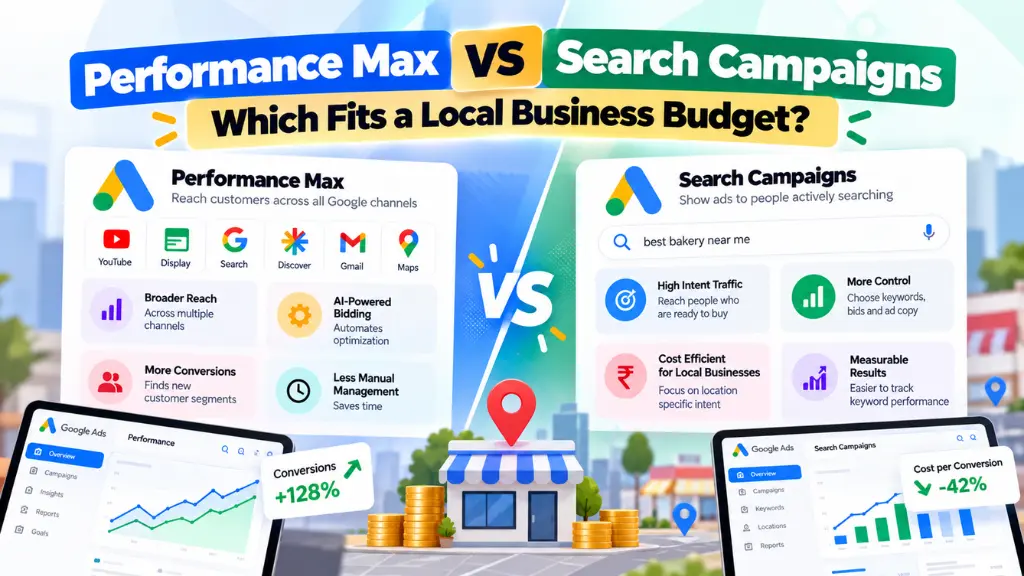
Which is better for a local business, Performance Max or Search? Search campaigns are usually better when your budget is small, your services are clearly defined and you want control over which queries trigger ads. Performance Max is usually better when you already have steady conversions, strong creative, and a goal such as store visits or directions across several locations. Many mature accounts run both.
The reason is simple. Search is a demand-capture tool. PMax is a goal-based automation tool. They solve different problems, and a local budget rarely has room to be wrong about which problem it is solving.
What is a Search campaign?
A Search campaign shows text ads on Google Search results when a query matches your keywords. You choose the keywords and match types, write the responsive search ads, add negative keywords, and decide where and when ads run. Because every click starts with a typed query, intent is easy to read: “emergency electrician near me” tells you far more than a banner impression ever will.
That transparency is the core of Search campaign control. You see the search terms, you exclude the wrong ones, and you can adjust bids by location or schedule when the data supports it.
What is Performance Max?
Google describes Performance Max as a goal-based campaign type that lets you reach all Google Ads inventory, including YouTube, Display, Search, Discover, Gmail and Maps, from one campaign. In its Help Center, Google positions it to “complement your keyword-based Search campaigns”, not replace them.
You supply the raw materials: images, logos, videos, headlines, descriptions, a conversion goal and optional audience signals. Google’s AI assembles ads and decides where to show them.
What are PMax asset groups?
Asset groups are the building blocks of a PMax campaign. Each one bundles creative assets (images, videos, headlines, descriptions), audience signals and optional search themes around a single product or service line. For a local business, that usually means one asset group per core service, such as “boiler repair” and “boiler installation”, rather than one generic group for the whole company. Distinct groups give the system cleaner signals about which message suits which customer.
Performance Max vs Search campaigns at a glance
| Factor | Search campaigns | Performance Max |
| Where ads appear | Google Search results (and Search partners, if enabled) | Search, YouTube, Display, Discover, Gmail, Maps |
| How you target | Keywords, match types, negatives | Conversion goal, asset groups, audience signals, search themes |
| Query visibility | Full search terms report | Search terms insights plus campaign-level negatives |
| Location and schedule bid adjustments | Available | Not compatible, per Google’s feature documentation |
| Creative needs | Text assets | Text, images, logos and ideally video |
| Learning demands | Moderate | Higher, because it spans more channels |
| Typical fit | Defined services, tight budgets, lead generation | Multiple locations, store goals, scale after data exists |
Google’s Performance Max compatibility table is the authority here, and it lists both location-based and ad schedule bid adjustments as unsupported. For a local business that wants to push spend toward its best postcode or opening hours, that matters.
Which one fits a local business budget?
Is Performance Max good for small budgets? It can work, but it is riskier. A small daily budget spread across several channels can leave each channel with too little data to learn from, and weak data produces weak bidding decisions.
Why Search usually wins on small budgets
Think about a hypothetical dentist in a mid-sized city spending a modest daily amount. In a Search campaign, every click comes from someone who typed a dental query. If “free dental implants” shows up in the search terms, one negative keyword fixes it. In PMax, part of that same budget may go to Display or YouTube impressions that are harder to judge quickly.
Automation also needs fuel. Smart Bidding learns from conversions, and Google’s published guidance has long treated roughly 15 conversions in 30 days as a technical minimum for target-based strategies. Many practitioners want considerably more, often citing 30 to 50, before they trust results. A local firm generating a handful of leads a month sits well below that range, which is why starting with Search and Maximize Conversions, then moving to targets later, is a sensible path.
When Performance Max earns its place
PMax becomes more attractive when:
- You have store or location goals. Google says advertisers with store goals and local contacts or directions set up as conversion goals can create PMax campaigns, and former Local campaign users can optimize to offline goals through PMax.
- You run several locations and want Maps and local inventory working alongside Search.
- You already convert reliably and Search is hitting a ceiling on available queries.
- You have good creative, including real photos and a short video, rather than stock images.
How much control do you really get in 2026?
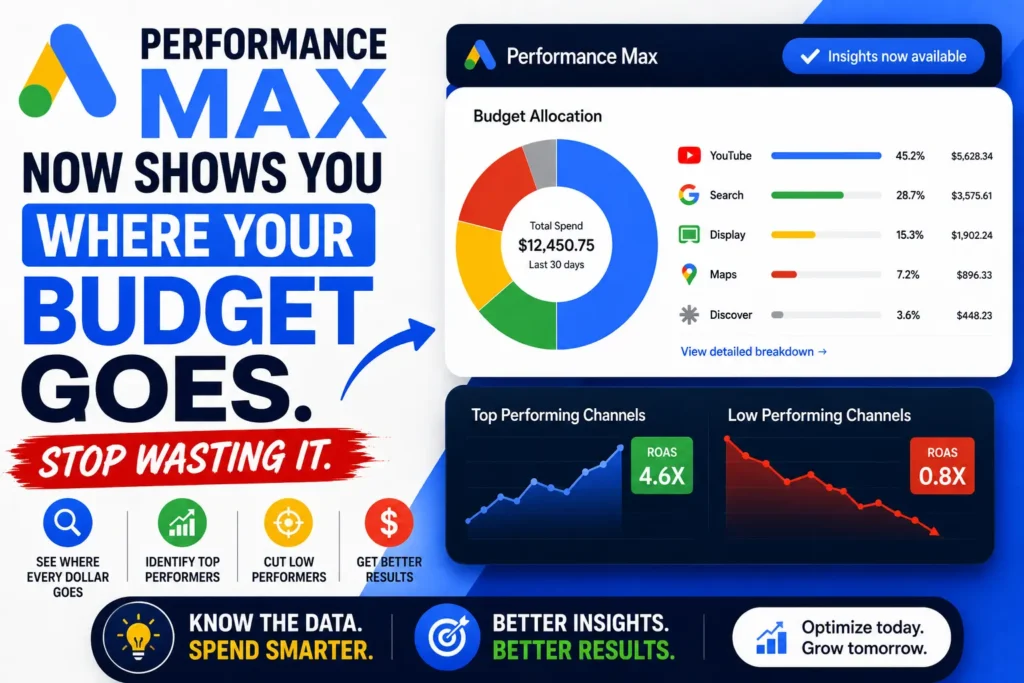
The old complaint that PMax is a black box is now only partly true. Google has added reporting and steering tools, and they matter for tight budgets.
- Channel performance reporting shows how a PMax campaign performs across Google’s channels, with a distribution table covering clicks, conversions and cost, according to Google’s announcement.
- Campaign-level negative keywords are available in PMax, though Google notes they apply to Search and Shopping inventory. They will not stop wasted spend on Display or YouTube.
- Brand exclusions and search themes help steer queries. Search themes are optional signals, not keywords, and industry coverage reports a limit of 50 per asset group.
- Search takes priority on exact matches. Per Google, if a query matches an exact-match keyword in your Search campaign, Search is prioritized over PMax.
Search still wins on granularity. Automated bidding sits behind both campaign types, but in Search you decide the inputs, while in PMax you mostly decide the signals.
Where does AI Max for Search fit?
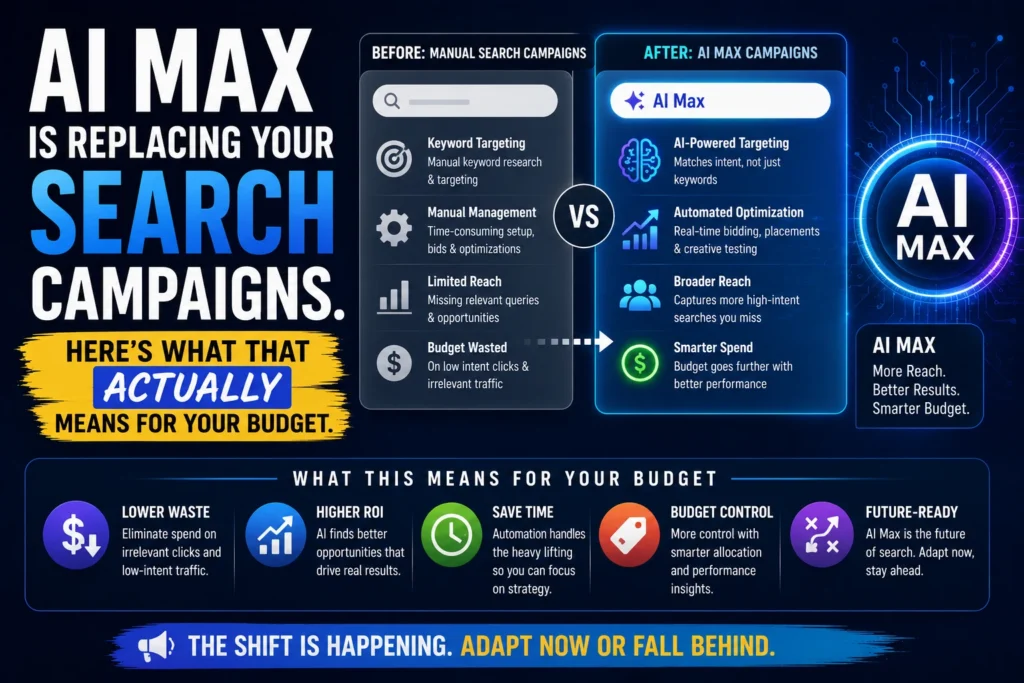
AI Max is an optional feature set inside Search campaigns, covering broader search term matching, text customization and final URL expansion. Google says advertisers activating it typically see 14% more conversions or conversion value at a similar CPA or ROAS, based on internal 2025 data for non-retail advertisers. Treat that as vendor-reported, not independent proof.
For local businesses it offers a middle path: more automation than classic Search, but only on Search text inventory. One caution from Google’s documentation: when final URL expansion is on, pinned assets are not respected if a more relevant URL is chosen. Test it as an experiment, not a blanket switch. The AI Max documentation explains the settings.
A practical rollout plan for a local budget
How do you choose between the two campaign types? Follow this order:
- Fix measurement first. Track calls, form submissions and direction requests as separate conversions, and exclude low-value actions. A website and tracking review, like the one in Search Savvy’s website audit services, is a reasonable place to catch broken tags before spending money on automation.
- Launch a focused Search campaign. Use service-plus-location keywords, add negatives from day one and restrict targeting to the areas you actually serve.
- Let it collect data for several weeks. Avoid constant edits, since changes can restart learning.
- Tighten landing pages. A fast, location-specific page with clear contact options lifts both campaign types. Marking up your business details with a local business schema generator also helps search engines read your address and hours consistently.
- Add PMax as a test. Build separate asset groups per service, apply brand exclusions and account negatives, and set a clear store or lead goal.
- Measure incrementality, not just totals. Compare PMax against your Search baseline, ideally through a Google Ads experiment, to see whether it adds conversions or only relabels the ones Search would have won.
- Review channel and search term reports weekly. Cut waste fast; small budgets cannot absorb a month of drift.
If you manage ads alongside organic work, it helps to treat paid and organic as one local presence. Local SEO services and paid campaigns draw on the same assets: reviews, consistent business data and strong location pages.
Mistakes that drain local budgets
- Launching PMax with no conversion history. The system has nothing to learn from.
- Counting every action as a conversion. Page views or button clicks teach the algorithm the wrong lesson.
- Letting PMax bid on your brand name without brand exclusions, then crediting it for customers who would have found you anyway.
- Using one asset group for every service. Mixed signals produce mixed results.
- Targeting too wide. Check the location setting so you are not paying for people who only show interest in your area.
- Judging results too early. Allow for learning periods and conversion delays before making a call.
- Ignoring phone leads. For many local trades, calls are the real conversion. Make sure they are tracked.
Search Savvy’s PPC and Google Ads glossary is handy if terms like Target CPA, match types or ad rank are unfamiliar when you review reports.
Frequently asked questions
Can I run Performance Max and Search campaigns together?
Yes. Google designs PMax to work alongside Search, and exact-match keywords in Search take priority over PMax. Run both only if you can monitor overlap through search term and channel reports.
How much budget do I need for Performance Max?
Google does not publish a universal minimum. A common rule of thumb is a daily budget that covers several conversions at your target CPA, though that is practitioner advice rather than Google policy. If your budget cannot produce enough conversions within a month, start with Search.
Does Performance Max steal traffic from Search campaigns?
It can overlap. Exact-match Search keywords get priority, but broader queries may land in PMax. Brand exclusions and negative keywords reduce unwanted overlap.
Which is better for lead generation, Search or Performance Max?
Search is usually the stronger starting point for lead generation because intent is visible and controllable. PMax can add leads from other channels once conversion tracking, including offline and call data, is reliable.
Do I still need keywords with Performance Max?
Not in the traditional sense. PMax uses search themes and audience signals as guidance rather than strict keyword targeting, and you can still add negatives to steer Search inventory.
Is Performance Max or Search better for store visits?
Performance Max supports store goals and offline optimization, so it is the more natural fit for store visit objectives. Search can still drive visits through location assets and call extensions, but PMax offers broader local inventory.
The bottom line
Choose Search first if your budget is small, your services are specific and you want to see exactly which queries cost you money. Add Performance Max once conversion data is clean and Search has plateaued, and test it against your Search baseline rather than trusting platform totals. If you want a second opinion on structure, Search Savvy’s Google Ads and PPC services and broader performance marketing services pages describe how paid campaigns can be planned and reported.