

Keyword clustering means grouping related search queries so that each group is answered by one page, and each page supports a wider topic on your site. Done well, it stops you publishing five thin articles for one intent, shows you which topics you have not covered, and gives you a clear order of work. This guide walks through a seven-step method, compares the main clustering approaches, and shows how to turn clusters into a pillar and cluster structure without producing filler. It reflects practice and Google documentation as of October 2026.
What is keyword clustering?
Keyword clustering is the process of grouping keywords that share the same meaning or search intent so they can be targeted by a single page. Instead of one article per keyword, you create one page per cluster, with a primary keyword and supporting variations. The groups are then organised into topic clusters, which feed a content plan.
A simple example: “how to cluster keywords”, “keyword clustering steps” and “group keywords by intent” probably want the same tutorial. “Keyword clustering software” wants a tool comparison. One cluster, two clusters, two different pages.
Why keyword clustering matters for topical authority
Clustering helps in three practical ways.
- It reduces cannibalization. When two of your pages answer the same query, they compete with each other and neither gets a clear signal. Assigning each cluster to one canonical URL removes that overlap.
- It exposes gaps. Once keywords sit in groups, thin areas are obvious. A topic with ten searches covered and only one answered is a planning decision, not a guess.
- It supports depth. A site that covers a subject thoroughly, with pages that link logically, is easier for readers and crawlers to understand.
A note on terminology. Google has not documented a score called “topical authority”. What its Search Quality Evaluator Guidelines do describe is Authoritativeness, meaning the extent to which a website or creator is a go-to source for a topic, as one part of E-E-A-T. The same guidelines state that rater scores do not directly move individual pages up or down; they help measure and improve ranking systems. Treat topical authority as a sensible goal, not a lever you can pull.
Which keyword clustering method should you use?
What are the main keyword clustering methods? There are three: semantic grouping, SERP-based clustering and hybrid clustering. HubSpot’s overview of keyword clustering describes the same three, and most working teams end up with the hybrid approach.
| Method | How it groups keywords | Strength | Weakness | Best for |
| Semantic grouping | Meaning, shared words, language models | Fast; handles thousands of terms | Can merge keywords whose results differ | First pass on large lists |
| SERP-based clustering | Overlap in the ranking URLs for each query | Reflects what Google treats as one intent | Needs live SERP data; overlap shifts over time | Validating priority clusters |
| Intent-based grouping | Informational, commercial, transactional labels | Prevents mixing page types | Labels alone are too coarse | Page type decisions |
| Hybrid | Semantic first, then SERP check, then intent tags | Balances speed and accuracy | Takes more steps | Most content plans |
How to cluster keywords: a seven-step process
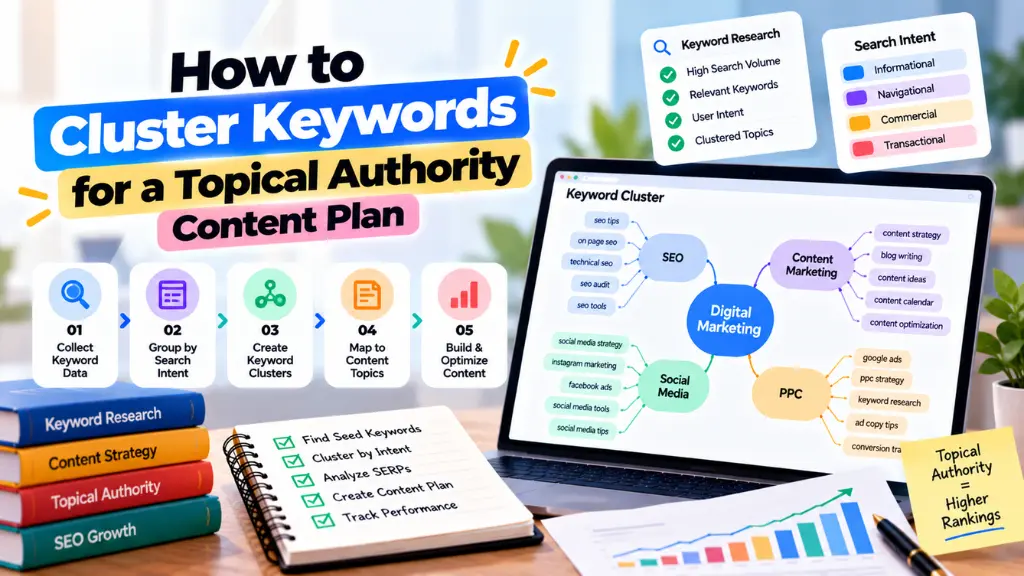
How do you cluster keywords step by step? Collect and clean the list, group it semantically, validate with SERP overlap, tag intent, choose a primary keyword per cluster, map clusters to URLs, then organise them into pillars. The steps below explain each one.
- Build a clean keyword list. Pull seed terms from your products, customer questions, sales calls, Search Console queries and competitor pages, then add related queries and questions. Remove duplicates, brand-irrelevant terms and obvious misspellings. If you need a hand at this stage, Search Savvy’s keyword research services cover list building and prioritisation.
- Do a first-pass semantic grouping. Group by meaning, either manually in a spreadsheet for a few hundred terms or with a clustering tool for larger sets. Expect rough groups, not final answers.
- Validate each group against live SERPs. Search the main keywords in a group and compare the top ten results. If several URLs appear for both queries, they likely share intent. If the results are different page types, split them.
- Tag search intent. Google’s rater guidelines classify queries as Know, Do, Website or Visit-in-person. Know Simple queries seek a short factual answer; Do queries want to accomplish something, such as using a tool; Website queries target a specific site. These labels tell you whether a cluster needs a guide, a tool page, a comparison or a product page.
- Choose a primary keyword per cluster. Pick the term that best describes the intent, usually the one with strong demand and the clearest wording. Keep the others as supporting phrases to use naturally in headings and body copy.
- Map each cluster to one URL. Check whether you already have a page that fits. If so, update it. If not, add the cluster to the content plan. This is also where you decide whether two thin existing pages should merge.
- Group clusters into pillars. Place clusters under broader parent topics. These parents become your pillar pages, and the clusters become supporting pages.
How can you check SERP overlap without a paid tool?
How do you check SERP overlap manually? Search both keywords in a private browser window, note the top ten URLs for each, and count how many appear in both lists. Many practitioners treat roughly four or five shared URLs as strong overlap and zero or one as separate intent, though these thresholds are rules of thumb, not Google guidance. Match your location and language settings to your audience, because results change by region.
For example, searching “keyword clustering” and “keyword grouping” will likely surface several of the same guides, which suggests one page. “Keyword clustering tool” returns tools and software comparisons, which suggests a separate page.
Building the pillar and cluster model
What is the pillar and cluster model? It is a content structure where one broad pillar page covers a topic overview and links to detailed cluster pages on subtopics, which link back to the pillar and to each other where relevant. Clustering tells you what the pillar and cluster pages should be; internal links make the structure visible.
A hypothetical example for an accounting software company:
- Pillar: small business bookkeeping
- Cluster: bookkeeping vs accounting (Know)
- Cluster: how to reconcile bank statements (Do, guide)
- Cluster: bookkeeping software comparison (commercial)
- Cluster: bookkeeping checklist template (Do, download)
The pillar answers the broad question and routes readers deeper. Each cluster page answers one intent fully. If you want help turning a keyword map into a publishing roadmap, Search Savvy’s content strategy and topical authority services page describes that kind of planning.
What is a content silo strategy, and do you need one?
A content silo strategy groups related pages and links them mainly within their own group, so topics stay distinct. In practice, the useful part is the linking discipline, not a rigid URL folder. Google’s guidance on links says crawlable links use an a element with an href, and that anchor text should be “descriptive, reasonably concise” and relevant to both pages. Link from the pillar to every cluster page, link siblings when readers would genuinely want the next page, and avoid stuffing exact keywords into anchors. A tidy hierarchy can also be echoed in navigation, and a breadcrumbs schema generator helps mark up that structure for search engines.
How to prioritise clusters
You will not publish everything at once, so rank clusters using a few plain criteria:
- Business value: does this topic lead to something you sell?
- Demand and difficulty: is there enough search interest, and can you realistically compete?
- Existing assets: can an updated page win faster than a new one?
- Intent fit: can you create something better than what already ranks, such as original data, expert input or a clearer format?
Start with clusters close to your offer where you can add real expertise, then expand outward. An on-page SEO review of your current pages often shows which existing URLs can anchor a cluster before you write anything new.
Mistakes to avoid when clustering keywords
- Clustering by shared words only. “Buy leather boots” and “how to clean leather boots” share words but not intent.
- Over-merging. Forcing everything into one long page can bury answers. If the SERP shows different page types, create separate pages.
- Under-merging. Ten near-identical posts for one intent dilute your own pages.
- Treating clusters as a production target. Google’s quality guidelines describe scaled content abuse as generating many pages mainly to benefit the site owner, with little added value. A cluster list is a plan, not a licence to mass-publish low-effort pages, whether written by people or tools.
- Never revisiting clusters. SERP overlap changes as results shift, so re-check priority clusters periodically.
- Ignoring existing content. Run a content inventory first; a website audit can reveal overlapping URLs that should be merged or redirected.
If any of these terms are new, Search Savvy’s SEO glossary defines the vocabulary used above.
Frequently asked questions
How many keywords should be in one cluster?
There is no fixed number. A cluster contains as many phrases as share the same intent, which might be three or thirty. Judge by search results, not by count.
Is keyword clustering still useful with AI search?
Yes. AI answer engines still draw on pages that answer specific questions clearly, so one focused page per intent, with direct answers and clear headings, remains a sound structure.
How is keyword clustering different from topic clustering?
Keyword clustering groups queries that belong on one page. Topic clustering organises many such pages under broader themes, which is the pillar and cluster model.
Can I cluster keywords in a spreadsheet?
Yes, for small lists. Use columns for keyword, volume, intent and proposed URL, then sort by theme and check SERPs for any uncertain groups. Tools save time once lists reach the thousands.
How often should I update keyword clusters?
Review priority clusters when rankings stall, when you launch a new section or at least periodically, since search results and intent can change.
Does clustering prevent keyword cannibalization?
It reduces it, because each cluster has one target URL. It will not fix cannibalization that already exists, so audit current pages and merge or redirect overlapping ones.
The bottom line
Start with a clean keyword list, group it semantically, confirm each group against live search results, tag the intent, and give every cluster exactly one page. Then arrange those pages under pillars and link them deliberately. Your next step: pick one topic you want to be known for, cluster its keywords this week, and compare the result with your existing URLs. If you would like support building the full map, Search Savvy’s SEO services pages explain how keyword research and content planning fit together.