

Two keywords sit side by side in a spreadsheet: one gets 10,000 searches a month with vague informational intent, the other gets 200 searches a month from people ready to buy. Most beginners target the first one. Most experienced SEOs target the second. Neither search volume nor keyword difficulty is the “right” metric to prioritize on its own – the honest answer is that the two only become useful once you weigh them together, against your site’s actual authority and the keyword’s real intent.
This guide breaks down what each metric actually measures, where they correlate and where they diverge, and a practical framework for deciding which keywords deserve your content budget first.
What Is Search Volume?
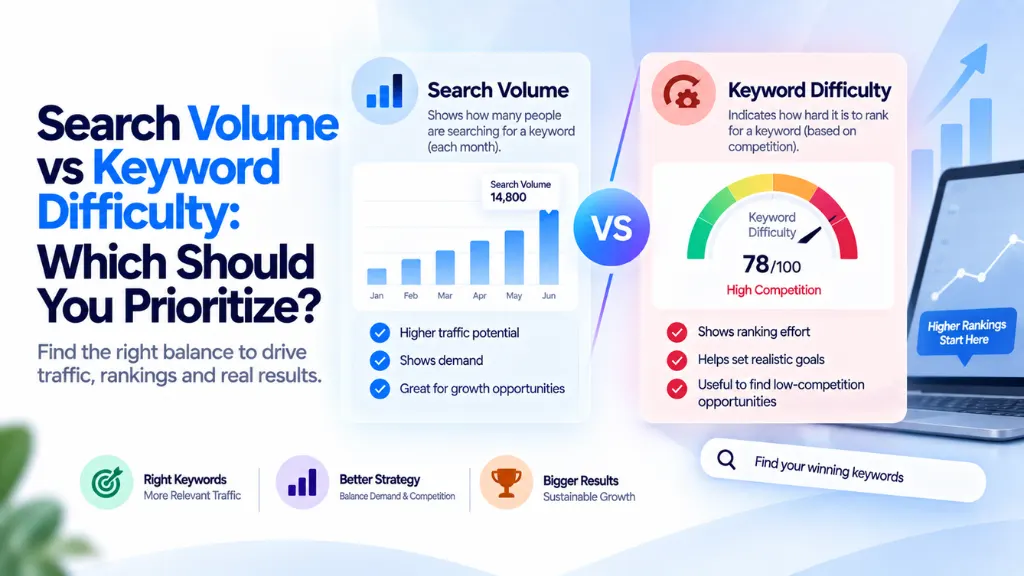
Search volume is the estimated average number of times a keyword is searched per month, typically shown as a range or approximate figure by tools like Google Keyword Planner, Ahrefs, or Semrush. Higher volume signals more potential traffic – but volume alone says nothing about whether that traffic converts, or how hard it will be to actually earn.
Two caveats matter more in 2026 than they used to. First, a keyword with 20,000 monthly searches does not deliver 20,000 monthly visits to any single page – search traffic is always a fraction of volume, since not every search results in a click to an organic result, multiple pages compete for the same clicks, and your position determines what share you actually get. Second, keywords with an AI Overview present tend to produce meaningfully lower click-through than the raw volume number implies, so the same search volume figure can represent very different realistic traffic outcomes depending on what’s showing at the top of that specific results page.
What Is Keyword Difficulty?
Keyword difficulty (KD) is a score, usually from 0 to 100, that estimates how hard it would be to rank a new page in the top 10 results for a given keyword. It’s calculated from factors like the authority and backlink profiles of pages currently ranking, content depth, and overall domain strength – though the exact formula differs by tool.
This last point matters more than it might seem: KD scores are not comparable across tools. Ahrefs, Semrush, and Moz each weight backlinks, authority metrics, and SERP competitiveness differently, and Moz’s methodology in particular tends to produce higher difficulty scores than Ahrefs for the same keyword. Pick one tool and use it consistently for all your comparisons – mixing KD scores from different platforms in the same prioritization exercise will give you numbers that aren’t actually measuring the same thing.
How Search Volume and Keyword Difficulty Relate to Each Other
The two metrics are correlated, but imperfectly. Popular keywords attract more competing content over time, which tends to push difficulty upward – but plenty of high-volume keywords remain moderately achievable, and plenty of low-volume keywords are surprisingly competitive because a handful of large, authoritative sites happen to target them too.
This is exactly why neither metric works as a standalone filter. A keyword with high volume and high difficulty may be a long-term target worth building toward, not a starting point. A keyword with low volume and low difficulty might be an easy win, but not worth the content investment if the search intent behind it has no real connection to a business outcome.
The Prioritization Framework: Weighing Both Metrics Together
Step 1: Establish Your Site’s Difficulty Baseline
Before judging any individual keyword, get a realistic sense of what KD range your site can currently compete for. A newly launched site with minimal backlink history should generally look at a much lower KD ceiling than an established domain with years of earned authority. A practical way to find this baseline: look at keywords you already rank on page one for, and note the typical KD score among them – that’s roughly the range you can expect to compete in for new content today.
Step 2: Set a Minimum Volume Floor, Not a Maximum
Rather than chasing the highest-volume keyword available, set a minimum threshold below which a keyword isn’t worth the content investment – often somewhere around 50 to 100 monthly searches, adjusted for your niche. Below that floor, even a first-place ranking won’t generate meaningful traffic. Above it, volume becomes a secondary sorting factor rather than the primary decision driver.
Step 3: Weight Intent Above Both Metrics
A keyword with 50 monthly searches and clear transactional intent can be more valuable to a business than one with 10,000 searches and vague informational intent, because the smaller keyword is far more likely to convert into a lead, signup, or sale. When two keywords sit at a similar volume and difficulty level, let intent – informational, commercial, or transactional – decide which one gets built first, based on which stage of the funnel your content strategy currently needs most.
Step 4: Check for AI Overview Presence Before Committing
Search a candidate keyword directly and note whether an AI Overview appears. A comprehensive AI answer on a purely informational query can significantly erode the click-through you’d otherwise expect from ranking well – meaning the effective value of that keyword’s search volume is lower than the raw number suggests. A commercial-intent keyword where the AI answer is only partial, and searchers still need to compare options, tends to preserve more of its organic traffic potential. This check doesn’t rule a keyword out, but it should adjust your traffic expectations and, in some cases, tip a close prioritization decision toward the keyword less exposed to AI Overview click erosion.
Step 5: Look for the Overlap Zone
The keywords worth prioritizing first typically sit in the overlap of three conditions: search volume above your minimum floor, difficulty within your site’s realistic range, and intent that connects meaningfully to a business goal. Keywords meeting all three should move to the content calendar before anything scoring well on only one or two of those dimensions.
A Practical Comparison Table
| Scenario | Search Volume | Keyword Difficulty | Recommended Action |
| High volume, high difficulty | High | High | Long-term target – build supporting content and authority first |
| High volume, low difficulty | High | Low | Rare, but a strong immediate priority when found |
| Low volume, low difficulty | Low | Low | Quick win if intent is relevant; low individual impact, but adds up across many terms |
| Low volume, high difficulty | Low | High | Generally skip – poor return relative to effort |
| Moderate volume, moderate difficulty, strong intent | Medium | Medium | Often the best real-world target for most sites |
Don’t Overlook Keywords You Already Rank For
One of the fastest, most overlooked opportunities sits outside the volume-versus-difficulty debate entirely: keywords you already rank for in positions 5 through 20. You already have some authority and indexing established for these; a content refresh, added depth, or a small number of additional backlinks can often move them into the top three faster than starting a brand-new page from a difficulty score of zero. Google Search Console’s Performance report, filtered to page-two average positions, is the fastest way to find this list.
Common Mistakes When Weighing These Two Metrics
- Treating KD scores as comparable across tools. A KD of 30 in one platform and a KD of 30 in another can represent very different real-world ranking difficulty.
- Chasing volume without checking intent. High search volume on a keyword with intent unrelated to a real business outcome produces traffic that doesn’t convert.
- Ignoring your own authority baseline. A KD threshold that’s realistic for an established domain can be far out of reach for a newer site, regardless of how attractive the volume looks.
- Assuming raw search volume equals achievable traffic. AI Overviews, SERP features, and your actual ranking position all reduce the share of that volume you’ll realistically capture.
- Skipping keywords you’re already ranking for. Page-two rankings are often lower-effort wins than net-new content targeting a fresh, unproven keyword.
- Setting a volume floor too high too early. Many small, individually low-volume keywords sharing the same intent can add up to meaningful traffic when covered as a topic cluster, even if no single term looks impressive alone.
Frequently Asked Questions
Should a beginner site prioritize search volume or keyword difficulty? Keyword difficulty, generally. A newer site with limited authority should stay within an achievable KD range first, since even a highly relevant, high-volume keyword produces no traffic at all if the page can’t reasonably rank for it.
What is a good keyword difficulty score to target? There’s no universal number – it depends entirely on your site’s current authority. A newer or smaller site is often better served by keywords scoring roughly 20 to 40, while an established domain with strong backlink history can realistically compete for higher-difficulty terms.
Can a low search volume keyword still be worth targeting? Yes, particularly when it carries strong commercial or transactional intent. A smaller audience genuinely ready to convert is often more valuable than a larger audience just browsing for information.
Why do keyword difficulty scores differ between Ahrefs, Semrush, and Moz? Each tool uses its own formula, weighting factors like backlink profiles, domain authority, and content signals differently. Because the underlying methodology isn’t standardized, KD scores should only be compared within the same tool, not across different platforms.
Do AI Overviews affect how I should weigh search volume? Yes. A keyword’s raw search volume increasingly overstates its realistic traffic potential when an AI Overview appears and fully answers the query, so factoring in AI Overview presence alongside volume and difficulty gives a more accurate picture of what a keyword is actually worth targeting.
Is there a shortcut for finding keywords with both good volume and low difficulty? Not reliably – these combinations are uncommon precisely because volume and difficulty tend to move together. Reviewing keywords you already rank for in positions 5 to 20 is usually a faster path to meaningful traffic gains than searching for a rare high-volume, low-difficulty match.
The Bottom Line
Search volume tells you how many people are searching; keyword difficulty tells you how hard it will be to reach them – neither answers the question of whether a keyword is actually worth your time on its own. Set a realistic difficulty ceiling based on your site’s current authority, a volume floor below which content isn’t worth producing, and let search intent break the tie when two keywords land in similar territory. Search Savvy’s keyword research services build prioritization frameworks around exactly this kind of volume-difficulty-intent balance, and for sites deciding how to phase a larger content roadmap, content strategy and topical authority services helps sequence which keyword tier to tackle first.