
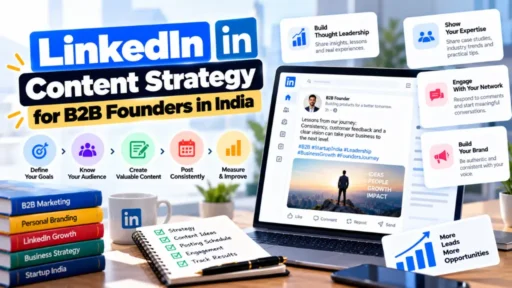
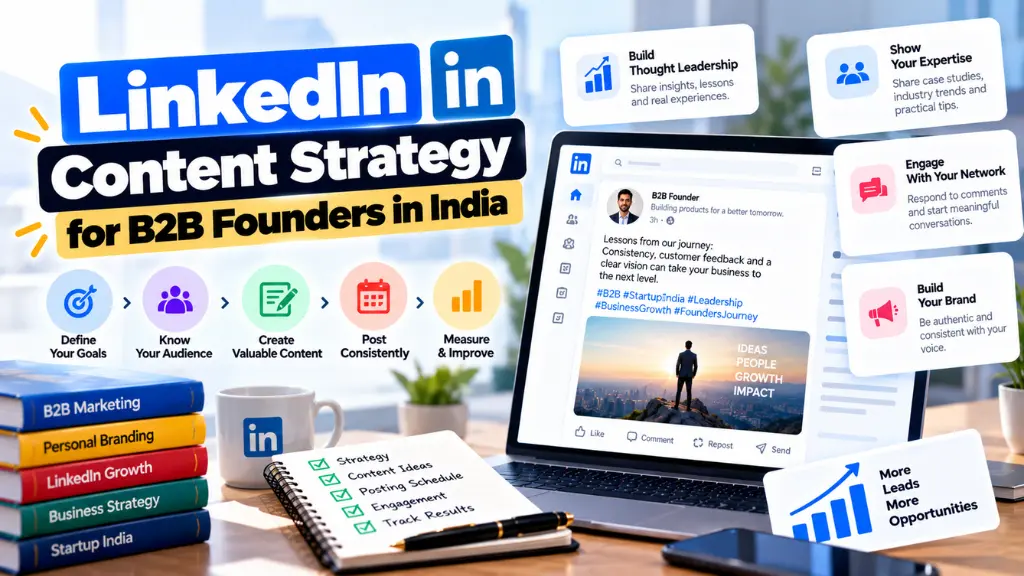

A workable LinkedIn content strategy for B2B founders has four parts: three clear topics tied to buyer problems, a consistent mix of native post formats, a daily habit of commenting and replying, and measurement based on sales conversations rather than likes. This guide shows how to build that system for the Indian market, explains what LinkedIn has said about its 2026 feed, and gives you post structures, a weekly rhythm and the metrics worth tracking.
The case for doing it is strong. India is LinkedIn’s second-largest market, with more than 160 million members according to its India country manager, speaking to PTI in September 2025. And the 2025 Edelman-LinkedIn B2B Thought Leadership Impact Report, drawing on nearly 2,000 professionals, found that more than 40% of B2B deals stall because of misalignment inside buying groups. Founders who publish useful, specific ideas give every person in that group something to circulate.
What is a LinkedIn content strategy for B2B?
A LinkedIn content strategy for B2B is a repeatable plan for what you publish, in which formats, how often and for whom, so that the right buyers recognise your expertise and start conversations. It differs from general social media posting because the audience is a buying group, the sales cycle is long, and the goal is trust and pipeline, not reach for its own sake.
For founders, the plan usually runs through a personal profile, with the company page supporting it.
Why should founders post as themselves?
Should a B2B founder use a personal profile or a company page? Use both, but lead with the personal profile. Buyers evaluating a young company want to see who is behind it, how they think and whether they understand the problem. A founder can show first-hand experience in a way a logo cannot.
This is also where founder personal branding earns its keep in India’s trust-driven B2B sales. Prospects often check a founder’s profile before replying to a message or taking a meeting. A profile that shows clear, consistent thinking answers questions before they are asked.
LinkedIn describes its feed as personalised to each member’s interests and history, so the people who see your posts are those whose behaviour suggests interest in your topics. That favours founders who stay focused.
How does the LinkedIn algorithm work in 2026?
How does the LinkedIn algorithm work now? LinkedIn rebuilt its feed in 2026. According to its March 12, 2026 engineering post, as reported by PPC Land, a unified retrieval system built on large language model embeddings decides which posts are considered, and a separate Generative Recommender ranks them using a member’s interaction history as a sequence.
LinkedIn does not publish ranking weights, so anything beyond that is interpretation. Reasonable takeaways for the LinkedIn algorithm 2026 are:
- Topic consistency helps. A system that reads meaning and history can learn what you are about. Scattered topics make that harder.
- Substance over bait. LinkedIn’s Tim Jurka has said the platform is reducing “repetitive, click-driven posts”, according to a compilation of LinkedIn statements. Engagement-bait and comment pods are a poor bet.
- Native content is safer. Some analyses report that posts pushing readers off-platform get less reach. Treat that as a hypothesis to test, not a rule.
- Be wary of precise “hacks”. Specific percentages for dwell time or reach circulate widely, but most come from third-party samples, not LinkedIn.
How to build your LinkedIn content strategy for B2B, step by step
What are the steps to build a LinkedIn strategy as a founder? Define the buying group, choose three content pillars, turn your profile into a landing page, pick formats, set a weekly rhythm, then connect posts to conversations.
1. Define the buying group, not just the buyer
Edelman and LinkedIn describe “hidden buyers”, people who influence a decision without being the named target. A manufacturing SaaS founder in Pune, for example, may sell to a plant head but also need finance, IT and operations to agree. Write down who sits in that group and what each one worries about. Your posts should answer those worries.
2. Choose three content pillars
Three pillars are enough to be recognisable and still varied. Here is a hypothetical example for an Indian IT services founder:
| Pillar | Purpose | Example topic |
| Buyer problems | Show you understand the pain | Why vendor onboarding drags for six weeks |
| Behind the work | Prove experience | A migration lesson you would do differently |
| Opinions and data | Take a position | When outsourcing a support team backfires |
Search Savvy’s LinkedIn thought leadership services page describes this kind of founder-led positioning if you want outside help defining your angle.
3. Treat your profile as a landing page
Anyone who likes a post will click your name. Your headline should say who you help and with what, not just your job title. Pin one post that explains your approach, and link to a page that answers “what do you do and who is it for?”.
4. Choose the right LinkedIn post format
What is the best LinkedIn post format for B2B? There is no single best format. Match the format to the job.
| Format | Best for | Watch out for |
| Text post | Opinions, short stories, lessons | Long walls of text without line breaks |
| Document carousel | Frameworks, checklists, teardowns | Slides crammed with small type |
| Native video | Explaining a product or idea in your own voice | Weak first seconds, no captions |
| Poll | Quick market research | Vague options that teach you nothing |
| Newsletter | Deeper analysis for subscribers | Publishing without a clear promise |
LinkedIn India’s country manager has said India recorded a 60% rise in immersive video uploads, the highest globally, which suggests video is worth testing. Format mechanics matter too: a free LinkedIn text formatter helps you structure line breaks and emphasis before posting.
5. Set a rhythm you can keep
Consistency beats intensity. A realistic starting week for a busy founder:
- Monday: one text post on a buyer problem
- Wednesday: one carousel or framework
- Friday: one story or opinion
- Daily: 10 to 15 minutes commenting thoughtfully on posts by prospects, partners and peers, and replying to every comment on your own posts
Planning ahead removes the daily “what do I post?” scramble. A shared content calendar and creative production process keeps the pillars balanced.
6. Turn attention into conversations
Posts rarely close deals. They start conversations. Reply to commenters, send short and relevant DMs to people who engage repeatedly, and offer a useful resource without a hard pitch. Avoid automated connection-and-pitch sequences; they undermine the trust you are building.
How do you generate B2B leads from LinkedIn content?
How do you get B2B leads from LinkedIn posts? Publish content that helps buyers solve a problem, make it easy to continue the conversation through comments or DMs, and track which conversations came from which post. Lead generation here is slower and more relational than a form-fill campaign.
Practical tactics for B2B lead generation on LinkedIn:
- End posts with a specific, low-pressure next step, such as “I can share the checklist if useful”.
- Ask new customers and inbound leads how they first heard of you. Self-reported sources catch LinkedIn influence that analytics miss.
- Use paid distribution selectively. Paid social advertising can put a strong organic post in front of a defined account list.
What makes thought leadership content worth reading?
Quality is the gap. In the 2024 Edelman-LinkedIn study, as summarised by CustomerThink, 48% of decision-makers rated the thought leadership they read as good, but only 15% rated it very good or excellent. The 2025 report states that bold, perspective-shifting ideas earn attention. Weak, generic posts do not.
Four structures that tend to work for thought leadership content:
- The lost deal. What you learned when a prospect said no.
- The teardown. A short critique of a common process, with what you would change.
- The decision. A real trade-off you faced, with the numbers you were allowed to share.
- The buyer FAQ. The question every prospect asks, answered honestly, including when you are not the right fit.
Specifics beat slogans. Do not publish client names or figures without permission.
Which metrics matter?
| Metric | What it tells you | How to track it |
| Profile views and follower quality | Whether the right people are noticing you | LinkedIn analytics, plus a manual look at who follows |
| Meaningful comments | Depth of interest | Count comments from target accounts |
| Inbound DMs and meeting requests | Early pipeline | Simple log in a spreadsheet |
| Self-reported attribution | Influence on deals | A field in your CRM or intake form |
| Pipeline touched by LinkedIn | Commercial impact | CRM tagging by source |
Likes are the weakest measure. A post with modest reach that triggers two conversations with ideal buyers beats a viral post with none. Reporting that links activity to pipeline, as in Search Savvy’s analytics and performance reporting service, keeps the team honest.
Mistakes B2B founders make on LinkedIn
- Posting without a theme. Random topics confuse both people and the feed.
- Copying Western templates. Context, buying cycles and decision-makers differ in India. Use local examples.
- Pitching in every post. Teach first; sell when someone asks.
- Ignoring comments. Conversation is where trust forms.
- Using AI drafts unedited. Generic writing sounds like everyone else. Add your own experience.
- Never reviewing results. A periodic social media strategy audit shows what to keep, cut or change.
Frequently asked questions
How often should a B2B founder post on LinkedIn?
Two to three quality posts a week is a sustainable starting point. Consistency over months matters more than daily posting.
Does LinkedIn penalise posts with links?
LinkedIn has not published a rule, although some analyses report weaker reach for link posts. Test link-in-comment and link-in-post versions and compare your own results.
Should I post in English or Hindi?
Post in the language your buyers use in business. For most B2B audiences in India that is English, but test regional or Hindi content if your buyers prefer it.
How long until LinkedIn content generates leads?
It varies by sales cycle and audience. Expect months of steady publishing before patterns appear, and track conversations early rather than waiting for closed deals.
Can employees help amplify founder posts?
Yes, if comments are genuine. Encourage colleagues to add real perspective. Coordinated generic comments can look like engagement bait.
Is LinkedIn Premium or Sales Navigator necessary?
No. Content works without them. They can help with research and prospecting once your content has created familiarity.
The bottom line
Start small: pick three pillars, post two or three times a week, spend ten minutes a day in comments, and log every conversation your content creates. Review after twelve weeks and keep what produced real buyer dialogue. If you want help turning this into a plan, Search Savvy’s social media services pages cover thought leadership, calendars and reporting.