

Here is a shift most brands are still underestimating in 2026: Instagram is no longer just a place people scroll. It is a search engine people use to find products, local businesses, tutorials, and inspiration – and it has over two billion monthly active users running searches through it every day.
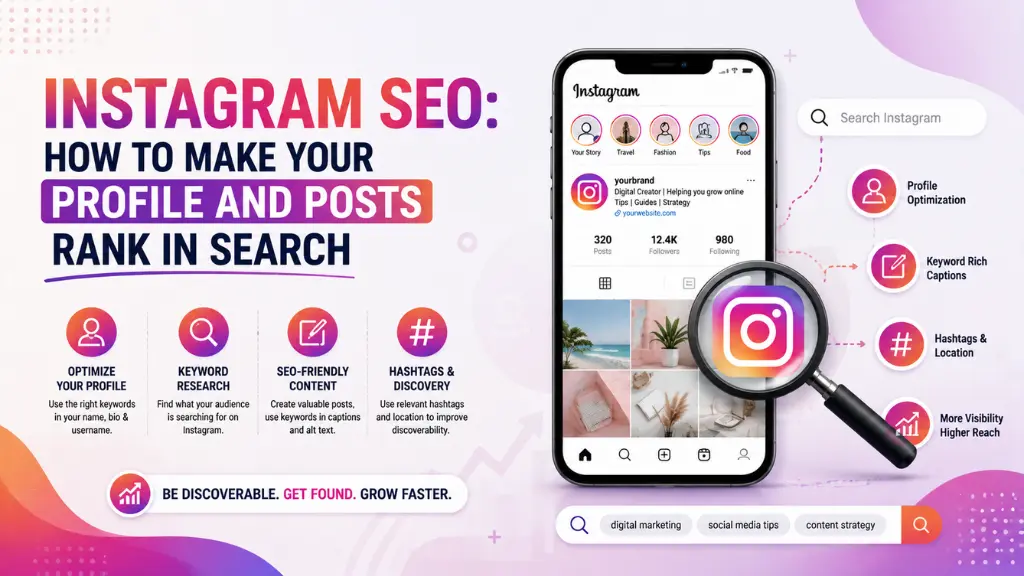
Instagram SEO is the practice of optimising your profile, posts, Reels, and captions so that the right audience finds your content through in-app search, the Explore page, and increasingly through Google, which now indexes public Instagram professional accounts directly.
Instagram SEO used to mean hashtags and nothing else. That era is over. Instagram’s algorithm has evolved into a multi-surface AI system that reads keywords across your bio, captions, text overlays, and alt text, evaluates engagement quality signals like saves and shares, and matches all of it against individual user intent. A profile with the right optimisation now reaches people who have never heard of the brand before – not just existing followers.
Instagram SEO also now connects directly to Google visibility. Public professional accounts and their posts can surface in standard Google search results, meaning every element you optimise for in-app search simultaneously improves your traditional SEO footprint.
At Search Savvy, we build Instagram SEO into every social strategy we run for clients, because platform search and Google search now overlap enough that ignoring either one costs real reach. This guide covers every optimisation layer in one place.
What Is Instagram SEO and How Does It Work?
Instagram SEO is the process of optimising your Instagram account and content so it surfaces in search results both inside the Instagram app and on Google, making your profile discoverable to users searching for specific topics, services, or keywords.
Instagram SEO works through Instagram’s AI-driven algorithm, which reads text signals – your username, name field, bio, captions, hashtags, and alt text – to understand what your content covers and who it is relevant to, then matches it against what individual users are actively searching for and engaging with.
People Also Ask: Is Instagram a search engine in 2026? Short Answer: Yes, effectively. Instagram functions as a discovery engine where users actively search for products, local businesses, tutorials, and inspiration using specific keywords. It uses AI to match search queries with the most relevant accounts and posts based on keyword signals, engagement quality, and user behaviour patterns.
Why Is Instagram SEO Important in 2026?
Instagram SEO matters more in 2026 for two reasons that have converged simultaneously. First, Instagram’s internal search has become sophisticated enough that keyword optimisation, not just hashtag volume, determines whether a post surfaces for a given query. Second, Google now indexes public Instagram professional accounts, turning every profile and post into a potential Google result.
Instagram SEO also directly affects reach beyond your existing followers. Instagram’s algorithm now favours an “interest graph” over a “social graph,” meaning it recommends content from accounts users do not follow, based on search intent and engagement patterns. A well-optimised account reaches entirely new audiences through search and suggested content without spending anything on paid promotion.
- Instagram has over 2 billion monthly active users, making its search function one of the largest in-app discovery surfaces in the world
- Google now indexes public Instagram content, extending in-app optimisation into traditional search results
- Saves and DM shares are the strongest engagement signals for ranking in 2026, having overtaken likes as quality indicators
- Initial Instagram SEO results typically appear within three to four weeks of consistent optimisation
People Also Ask: Does Google index Instagram posts? Short Answer: Yes. Google indexes public Instagram professional accounts and their posts, meaning a well-optimised Instagram profile and its captions can appear in standard Google search results for relevant queries – particularly for branded, local, and niche topic searches.
How Do You Optimise Your Instagram Profile for SEO?
Instagram SEO begins at the profile level, not the post level, because Instagram evaluates your account as a whole to understand what topic area you cover before ranking any individual piece of content within it.
How Does the Name Field Affect Instagram SEO?
Instagram SEO treats the name field – the bolded text at the top of your profile, separate from your @username – as one of the highest-weight keyword signals on the platform. If someone searches for “digital marketing tips India,” an account with that phrase or a close variant in the name field has a significantly higher chance of appearing in results than one using only a brand name.
The username also carries search weight, but it functions differently – it is the handle people use to tag and find you directly. Your best move is to keep the username as close to your brand name as possible, and use the name field to include your primary keyword alongside it.
How Do You Optimise an Instagram Bio for Search?
Instagram SEO extends into the bio, which Instagram scans to match account descriptions with user queries. A bio optimised for search states clearly what you do, includes one or two specific industry keywords, mentions your target audience or location where relevant, and ends with a clear call to action pointing to your link.
Clarity outperforms creativity in the bio for search purposes. “SEO & Digital Marketing Consultant | Helping Indian brands rank on Google” outperforms “Turning ideas into impact ✨” every time from an Instagram SEO standpoint, because Instagram can actually categorise the first version and cannot categorise the second.
People Also Ask: What should an SEO-optimised Instagram bio include? Short Answer: An SEO-optimised Instagram bio should clearly state what you do using specific industry keywords, identify your target audience or location, and include a call to action linking to your website or a lead capture page. Avoid vague taglines and creative language that does not communicate your actual niche.
How Do You Optimise Instagram Posts and Captions for SEO?
Instagram SEO at the post level is primarily driven by caption text. Instagram’s algorithm analyses every caption to determine what a post is about, match it to relevant searches, and decide who should see it in search results, the Explore page, and suggested content feeds.
Instagram SEO in captions works best when the primary keyword appears naturally in the first one to two sentences, since this is the text that appears in previews and gets the most algorithm weight. Writing “5 Instagram SEO mistakes that kill your reach” as an opening line is more effective than burying the keyword three paragraphs down.
Each post caption should follow a consistent intent-based structure:
- Open with the keyword naturally in the first sentence or two
- Deliver genuine value – a tip, a data point, a clear how-to answer
- Use long-tail phrases that match what your audience actually searches (e.g. “Instagram SEO for small businesses India” rather than just “Instagram”)
- Close with an engagement prompt – a question, a poll CTA, or a save reminder
- Keep captions between 150 and 300 words for most post formats, or longer for educational carousel posts
How Do Hashtags Fit Into Instagram SEO in 2026?
Instagram SEO now relies less on hashtags than it did in previous years, with caption keywords and engagement quality carrying significantly more ranking weight. However, hashtags still serve as useful categorisation signals when used correctly.
Instagram SEO best practice for hashtags in 2026 is to use 8 to 15 tightly relevant tags per post rather than the maximum 30, mixing niche-specific tags with a small number of medium-volume ones. Generic tags like #explorepage, #follow4follow, or completely unrelated popular hashtags actively hurt performance by attracting bot engagement and sending mixed categorisation signals to the algorithm.
People Also Ask: How many hashtags should I use on Instagram in 2026? Short Answer: Use 8 to 15 highly relevant, niche-specific hashtags per post in 2026. Using the maximum 30 hashtags with irrelevant or generic tags can suppress reach and attract bot engagement. Hashtags now work best as supporting categorisation signals alongside strong keyword usage in captions rather than as the primary discovery mechanism.
How Do You Optimise Instagram Reels for SEO?
Instagram SEO for Reels follows slightly different rules because Reels have the highest reach potential of any format on Instagram in 2026 and are weighted heavily in both the Explore tab and search results.
Instagram SEO for Reels depends on three key text inputs: the caption, any on-screen text overlay, and the audio context. Instagram’s AI reads on-screen text just as it reads captions, so including a keyword in a text overlay at the beginning of a Reel reinforces the same signal the caption already sends. Reels between 30 and 90 seconds perform best for search surface rankings, with watch time and completion rate serving as strong quality signals.
How Does Alt Text Improve Instagram SEO?
Instagram SEO benefits from alt text in a way most users never use. Instagram allows you to write custom alt text for every post image before publishing, and this text is read by the algorithm to categorise visual content that it might otherwise only partially interpret through computer vision.
Instagram SEO alt text should describe the image naturally while incorporating one relevant keyword – for example, “Instagram SEO checklist for small Indian businesses” rather than a generic “post image.” This assists Instagram’s AI in classifying the content accurately and extends keyword signals to the one area of the post that most competitors leave completely blank.
What Engagement Signals Matter Most for Instagram SEO in 2026?
Instagram SEO is reinforced by engagement quality, and in 2026 the hierarchy of what counts has shifted. Saves and DM shares now carry the most ranking weight, since they signal to the algorithm that a piece of content is genuinely valuable enough to keep or recommend to someone else.
Instagram SEO engagement signals ranked by current impact:
| Engagement Signal | Ranking Weight in 2026 | Why It Matters |
| Saves | Very high | Signals content is valuable enough to return to |
| DM shares | Very high | Signals content is recommendation-worthy |
| Comments | High | Signals active discussion and community |
| Watch time (Reels) | High | Signals content quality and completion |
| Likes | Medium | Still counted but no longer the primary signal |
| Story replies | Medium | Supports ongoing relationship signals |
Instagram SEO engagement compounds over time. Accounts that build genuinely engaged communities see their content recommended more frequently, which attracts new followers, which generates more engagement, creating a reinforcing cycle that stronger SEO optimisation consistently accelerates.
How Does Instagram SEO Help Indian Brands Specifically?
Instagram SEO gives Indian brands a particularly accessible growth lever because India’s Instagram user base skews heavily mobile and uses in-app search actively for product discovery, local business finding, and niche content browsing.
Instagram SEO for Indian accounts should include location tags on relevant posts, since Instagram surfaces localised results for queries with geographic intent – someone in Mumbai searching “digital marketing agency” will see locally tagged accounts before untagged ones. Adding your city or region to both the bio and relevant post captions reinforces this signal.
According to Search Savvy’s insights from optimising Instagram profiles for Indian D2C and service brands, the single highest-impact change is almost always the same: adding a clear primary keyword to the name field. Accounts that shift from a generic brand name only to “Brand Name | Niche + Location” consistently see measurable search visibility improvements within three to four weeks.
Conclusion: Treat Instagram Like a Search Engine
Instagram SEO is not optional groundwork for brands wanting organic reach in 2026 – it is the foundational work that determines whether a profile gets discovered or stays invisible to the millions of users searching for exactly what it offers.
Search Savvy builds Instagram SEO into every social content strategy we deliver, because platform search and Google search have converged enough that optimising one now supports the other. Start with the name field and bio, move to captions and Reels text, and treat every post as a search asset, not just a piece of content.
FAQ: Instagram SEO – Your Questions Answered
Q1: Does Instagram SEO affect Google search rankings? Indirectly, yes. Google now indexes public Instagram professional accounts, meaning a well-optimised profile, bio, and captions can surface in Google search results for relevant queries. This extends the reach of in-app Instagram SEO work into traditional search visibility.
Q2: How long does Instagram SEO take to show results? Most accounts see initial improvements in discoverability within three to four weeks of consistently applying Instagram SEO optimisations. Full momentum, including steady organic reach growth and search ranking stability, typically builds over two to three months of consistent effort.
Q3: Are hashtags or captions more important for Instagram SEO? Both matter, but caption keywords carry more ranking weight in 2026 than hashtags alone. Hashtags still help with categorisation, but Instagram now relies primarily on the natural keyword usage in captions, bios, and alt text to understand and rank content.
Q4: Can a small Instagram account rank in search results? Yes. Instagram search ranking is based on relevance, clarity, and engagement quality, not follower count alone. A small account with a clear niche, keyword-optimised profile, and strong save and share rates can rank above larger accounts that lack topical focus.
Q5: What is the most important part of an Instagram profile for SEO? The name field carries the most SEO weight on your profile, since Instagram indexes it heavily for search queries. Including your primary keyword alongside your brand name in this field is consistently the highest-impact single change for improving in-app search discoverability.
Q6: Should I use location tags for Instagram SEO? Yes, if you serve a specific city, region, or operate a physical location. Instagram factors in location signals for queries with geographic intent, surfacing locally tagged accounts and posts ahead of untagged ones in location-relevant searches.
Not sure whether your Instagram profile is optimised to rank – or losing search visibility to competitors who are doing this correctly? Visit Search Savvy for a social SEO audit that covers both in-app Instagram search and the Google visibility your profile is generating right now.