How to Build an Email List from Scratch (Even with Zero Traffic)

Here is the channel most brands build last, even though the data consistently shows it should be built first: email.
In this article10 sections
Building an email list from scratch feels daunting precisely because it involves a number-you-can’t-fake: you either have subscribers or you don’t, and the gap between zero and your first thousand feels enormous. But every brand with a large, engaged email list started from exactly the same place – zero contacts, zero traffic, and a decision to treat email as infrastructure rather than an afterthought.
Building an email list from scratch matters more in 2026 than it did even two years ago, for a simple reason: every other channel a brand depends on is rented. Instagram can change its algorithm overnight and cut your reach by 80%. SEO rankings can shift after a core update. Paid ads stop the moment the budget runs out. An email list is the one channel you own outright – subscribers who chose to hear from you, reachable directly without any platform deciding whether your message gets shown.
Building an email list from scratch also generates the highest ROI of any marketing channel available. Email marketing consistently delivers around $42 for every $1 spent, a ratio no social media platform or paid ad channel reliably matches, even in 2026 when every platform is competing for that same marketing budget.
At Search Savvy, email list building is the owned-channel foundation we recommend every brand prioritise before scaling any other distribution, because a list is the asset that makes every other marketing effort compound rather than reset.
What Is an Email List and Why Does Building One from Scratch Matter?#
Building an email list from scratch means organically collecting the email addresses of people who have explicitly chosen to hear from your brand, through a sign-up form, a lead magnet, or an opt-in offer – without buying contacts, importing old spreadsheets, or scraping data from any source.
Building an email list from scratch creates what no social media following can: a direct, lasting relationship with your audience that no algorithm, platform policy change, or account ban can interrupt. When someone gives you their email address, they are making a higher-commitment signal than a follow or a like – they are letting you into their inbox.
People Also Ask: Why is an email list better than a social media following? Short Answer: An email list is an owned asset – you can reach every subscriber directly, regardless of algorithm changes. A social media following is a rented audience; platforms control who sees your posts. Email also converts at 3 to 5 times the rate of social media for most offers, making it the higher-ROI channel for nearly every business type.
How Do You Build an Email List from Scratch with No Traffic?#
Building an email list from scratch without existing traffic sounds like a chicken-and-egg problem, but it is not – because the traffic needed to grow a list does not have to come from your own website. It can come from social media, communities, partnerships, YouTube, Quora, Reddit, and live events, all of which are accessible with zero existing audience.
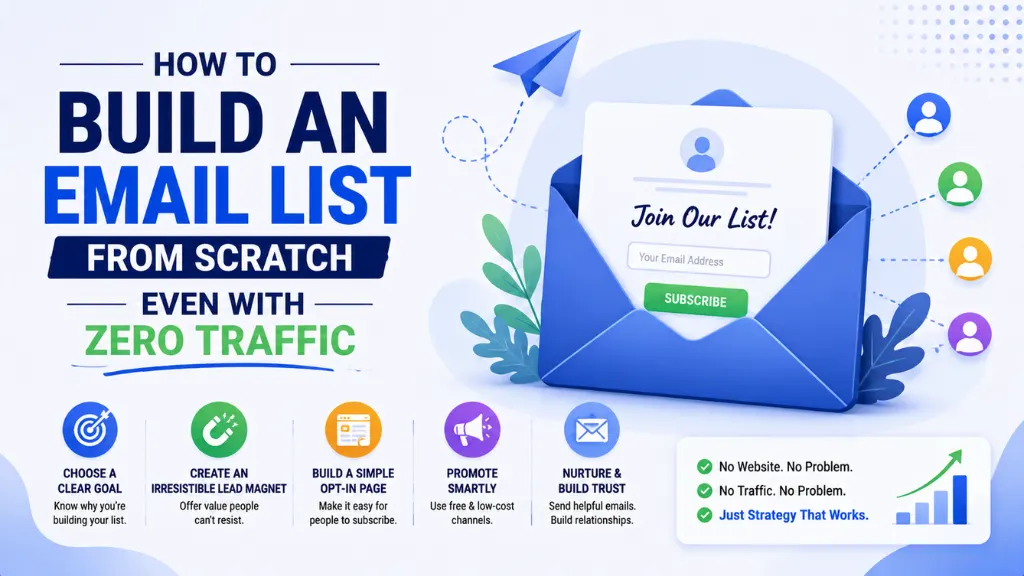
Building an email list from scratch with no traffic requires exactly four things: a compelling lead magnet, a functional landing page, an email marketing tool to collect and store subscribers, and at least one traffic source you can activate immediately. Every element after these four is optional until the system is working.
Step 1: Create One Compelling Lead Magnet#
Building an email list from scratch starts with a lead magnet – a free resource offered in exchange for an email address – and the quality and specificity of that lead magnet determines everything about your early conversion rate.
Building an email list from scratch with a vague lead magnet is one of the most common mistakes. “A free guide to marketing” converts poorly. “The 10-point Instagram SEO checklist I used to get 500 profile visits in 30 days” converts well, because it is specific, tangible, and promises a clear outcome.
The best-performing lead magnet formats in 2026 are:
- Checklists and templates – immediately usable, take under ten minutes to consume
- Short email courses – deliver value over three to five days and keep you in the inbox consistently
- Calculators or diagnostic tools – interactive formats that personalise the output
- Swipe files and script libraries – save readers time on tasks they repeat regularly
- Free mini-workshops or webinars – one focused session on one specific problem
People Also Ask: What makes a lead magnet convert well in 2026? Short Answer: The best lead magnets in 2026 are highly specific, consumable in under ten minutes, and promise one clear, tangible outcome. Broad “ultimate guides” convert far worse than narrow, immediately applicable resources. The more specific the promised result, the higher the opt-in rate.
Step 2: Build a Simple Landing Page#
Building an email list from scratch requires a single, focused page where subscribers opt in – and that page needs only three elements to convert: a headline that clearly states the outcome the reader will get, a short bullet list of what is inside, and an opt-in form.
Building an email list from scratch does not require a full website. Tools like Carrd, Kit (formerly ConvertKit), and MailerLite all let you build a functional opt-in landing page in under an hour, with no coding required and no paid subscription needed at the earliest stage.
A headline formula that consistently converts: “[Specific outcome] in [timeframe] without [common pain point].” Concrete and honest beats clever and vague on a landing page every time.
HubSpot’s research found that companies see a 55% increase in leads when moving from 10 to 15 landing pages – each one tailored to a specific topic or traffic source – making topic-specific landing pages one of the highest-leverage list-building improvements available as your strategy matures.
Step 3: Choose an Email Marketing Tool#
Building an email list from scratch requires an email service provider (ESP) to collect addresses, store subscribers, send a welcome email automatically, and eventually send regular content.
Building an email list from scratch in 2026 is best started with one of these platforms based on current free-tier generosity:
| Tool | Free Plan (2026) | Best For |
| Kit (ConvertKit) | Up to 10,000 subscribers, unlimited emails | Creators, bloggers, solopreneurs |
| MailerLite | 500 subscribers, limited templates | Small businesses, lean teams |
| Brevo (formerly Sendinblue) | 300 emails/day, unlimited contacts | Small businesses with limited volume |
| Systeme.io | Unlimited emails + basic automation | Early-stage funnels on zero budget |
| Mailchimp | 250 contacts, 500 sends/month, no automation | Very early testing only |
Note that Mailchimp’s free tier dropped sharply in early 2026 to 250 contacts with no automation, making it functional only as a test before outgrowing it almost immediately. Kit’s free plan remains the most capable for genuine list-building without paying upfront.
People Also Ask: What is the best free email marketing tool in 2026? Short Answer: Kit (formerly ConvertKit) offers the most capable free plan in 2026, supporting up to 10,000 subscribers with unlimited emails. Systeme.io is the strongest option if you need free automation and funnel features included from day one. Mailchimp’s free tier has become too limited to recommend for serious list building.
Step 4: Drive Traffic to Your Opt-In from Day One#
Building an email list from scratch requires traffic, but that traffic does not have to come from your own website – especially at the start when you have none.
Building an email list from scratch with no existing audience works through borrowed audiences: social platforms, community forums, and content channels where your target subscribers are already present.
The highest-ROI zero-traffic list-building sources in 2026:
- YouTube – the strongest free traffic engine for list building; pin your landing page link in every video description and your channel bio
- LinkedIn – post content in your niche consistently, mention your lead magnet naturally, and add the landing page link to your featured section
- Reddit and Quora – answer specific questions in your niche with genuinely helpful responses, and reference your lead magnet where contextually relevant
- Instagram Reels – create short-form educational content in your niche, direct to the link in bio
- Substack and newsletter swaps – cross-promote with complementary newsletter creators who share your audience
- WhatsApp and Telegram groups – relevant communities in your niche where sharing a useful free resource is genuinely welcomed
Building an email list from scratch through the YouTube and blog combination is specifically worth noting as a long-term compounding engine. It is slower in the first month, but by month three or four it generates subscribers continuously without ongoing manual effort.
How Do You Keep a Growing Email List Healthy?#
Building an email list from scratch is only half the work – the quality of the list over time depends on how well it is maintained. A bloated, unengaged list hurts deliverability and inflates platform costs without delivering business results.
Building an email list from scratch with quality in mind means using double opt-in (where subscribers confirm their address via a follow-up email) from the start, since it produces cleaner lists with higher engagement and significantly fewer spam complaints.
Healthy email list benchmarks for 2026:
- Monthly list growth rate – 3 to 5% is a benchmark for healthy programmes with active signup sources
- Average popup conversion rate – 2.1% across 1.24 billion displays; above 3% is good, above 5% is excellent
- Landing page conversion rate – 5 to 15% for dedicated, focused opt-in pages
- Re-engagement audit frequency – every 3 to 6 months, running a re-engagement sequence before removing non-responders
Building an email list from scratch also requires making unsubscribing easy. Counterintuitively, a clearly visible unsubscribe link reduces spam complaints, keeps your engaged-to-total ratio high, and improves deliverability for the subscribers who want to stay.
How Should Indian Brands Build an Email List from Scratch?#
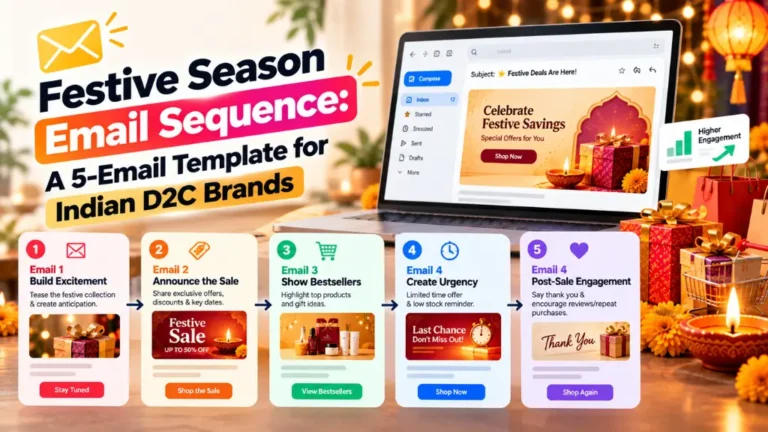
Building an email list from scratch in the Indian market benefits from a few specific adaptations. Lead magnets built around India-specific context – a GST compliance checklist for freelancers, a digital marketing toolkit for Indian SMBs, or an Instagram SEO guide with India-relevant examples – convert dramatically better than generic, internationally-templated resources.
Building an email list from scratch in India should also account for WhatsApp’s unique role as an entry point. Many Indian businesses build WhatsApp broadcast lists before a traditional email list and use those to introduce subscribers to a more structured email newsletter – a sequenced approach that leverages existing platform habits before migrating to owned infrastructure.
According to Search Savvy’s insights from helping Indian content brands and D2C businesses set up their first email lists, the highest-converting first lead magnet for an Indian audience is almost always a specific, actionable checklist or template relevant to the brand’s niche – not a long-form guide or PDF report, which requires too much investment of time to motivate immediate sign-up.
Conclusion: Start Before You Think You Are Ready#
Building an email list from scratch is the one marketing investment that compounds more reliably than almost any other. Every subscriber who joins when your audience is still small is a subscriber you do not have to earn again when you are ready to launch something.
Search Savvy recommends treating your email list as a core business asset from day one – not a future project to set up once traffic is flowing, but the infrastructure that makes all future traffic more valuable when it arrives.
FAQ: Building an Email List from Scratch – Your Questions Answered#
Q1: How long does it take to build an email list from scratch? With a solid lead magnet, a focused landing page, and consistent promotion on at least one traffic channel, most brands reach their first 100 subscribers within four to eight weeks. The first 1,000 typically takes three to six months of consistent effort, with growth accelerating significantly once an evergreen traffic source like YouTube or SEO begins compounding.
Q2: Can I buy an email list to get started faster? No. Purchased lists have consistently terrible engagement rates, damage your sender domain reputation, and can get your account suspended by your email service provider. Every legitimate platform prohibits their use. Building a list organically is slower initially but produces an audience that actually opens, clicks, and buys.
Q3: How often should I email my list once it starts growing? Once per week is the standard starting frequency that balances consistency with sustainability. Consistency matters far more than frequency – one genuinely useful email per week outperforms daily emails that quickly exhaust ideas and burn out the sender. Increase frequency only when you have a clear, content-driven reason to do so.
Q4: Do I need a website to build an email list from scratch? No. A simple landing page tool like Carrd or Kit’s built-in landing page builder is sufficient for the earliest stages. You need a page where people can sign up, a tool to collect and store their addresses, and a traffic source. A full website becomes useful later but is not required to get your first few hundred subscribers.
Q5: What should I send in my first email to new subscribers? Your first email – the welcome email sent automatically when someone subscribes – should deliver the promised lead magnet immediately, introduce yourself briefly and personally, tell subscribers what they can expect from your future emails, and ask one simple question to encourage the first reply. Welcome emails have the highest open rates of any email you will ever send, so make them count.
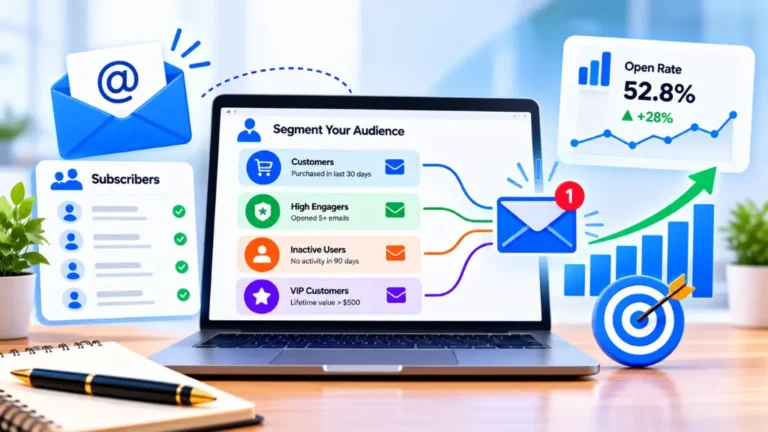
Q6: How do I keep subscribers engaged over time? Send consistently, deliver genuine value in every email, and make the content feel personal rather than broadcast. Segment your list as it grows so different subscribers receive content relevant to their specific interests. Run a re-engagement sequence every three to six months to identify inactive subscribers, and clean the list afterwards to protect deliverability for those who want to stay.
Not sure where to start building your first email list – or looking to grow an existing one that has stalled? Visit Search Savvy for a content and lead magnet strategy session that gets your list-building system live and growing.