
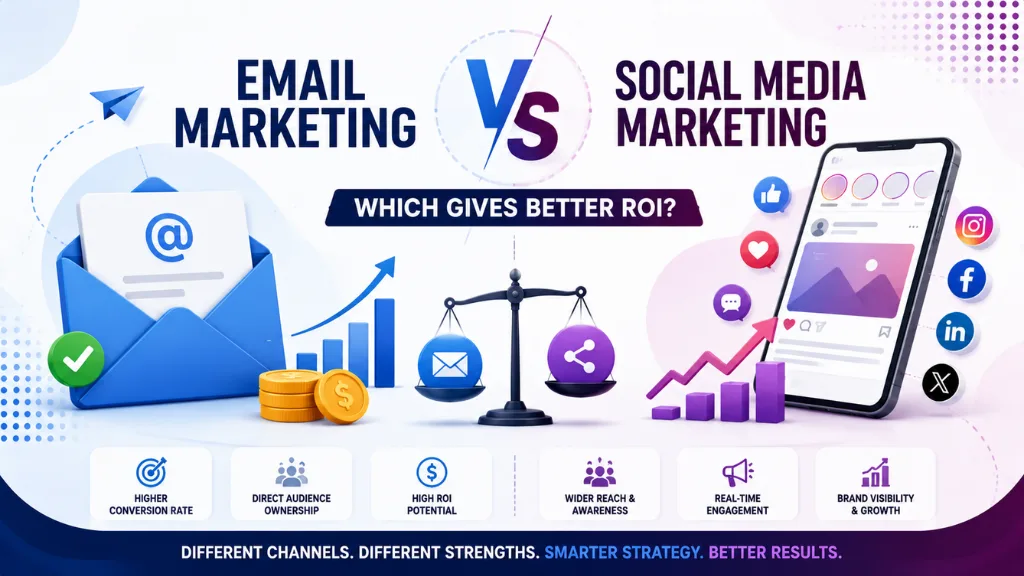

Here is the marketing budget question most businesses answer based on habit rather than data: should the next rupee go into email or social media?
Email Marketing vs Social Media Marketing is not a new debate, but the 2026 numbers have made the answer clearer than at any point before. The gap in ROI between the two channels is not narrow – and understanding why it exists explains not just where the returns come from, but how the two channels should work together rather than competing for the same budget.
Email Marketing vs Social Media Marketing is a comparison that matters because most brands treat them as equivalent alternatives when they are actually built for different stages of the customer journey. Choosing one and ignoring the other almost always leaves significant return on the table.
Email Marketing vs Social Media Marketing also needs to be understood in the context of what each channel actually controls. Social media reach is owned by platforms. Email reach is owned by you. That single distinction drives most of the ROI difference between them – and shapes every strategic decision that follows.
At Search Savvy, we help brands make this exact decision with real data rather than platform preference, because the answer is not the same for every business type, budget, or growth stage. Here is what the 2026 numbers actually say.
What Is the ROI Difference Between Email Marketing vs Social Media Marketing?
Email Marketing vs Social Media Marketing produces a return gap that is, by 2026, genuinely not close. Email marketing delivers between $36 and $42 for every $1 spent, according to Litmus and HubSpot’s 2026 State of Marketing Report. In retail and e-commerce, that figure rises to $45 per $1, and in some well-optimised US e-commerce programmes, it reaches $72 per dollar.
Social media marketing, by comparison, returns roughly $2.80 for every $1 spent on social advertising, according to the same industry benchmarks. Organic social media ROI is even harder to isolate accurately and generally tracks lower.
Put side by side:
| Metric | Email Marketing | Social Media Marketing |
| Average ROI per $1 spent | $36–$42 (up to $45 in e-commerce) | $2.80 (paid social average) |
| Conversion rate | 4.24–8% across campaign types | 0.59–3% (paid higher than organic) |
| Organic reach | 85–95% of subscribers receive the email | 2–10% of followers see organic posts |
| Audience ownership | Fully owned – you control the list | Rented – platform controls the reach |
| Customer acquisition effectiveness | 40x more effective than social (McKinsey) | Strong for discovery, weak for conversion |
| Average email open rate (2026) | 26.6% (up 6% year over year) | N/A – post impressions ≠ opens |
Email Marketing vs Social Media Marketing, when measured purely by ROI and conversion, is not a balanced comparison. Email wins by a factor of ten to fifteen across nearly every metric that connects to revenue.
People Also Ask: Why does email marketing have a higher ROI than social media? Short Answer: Email reaches an opted-in audience that has explicitly chosen to hear from your brand, making them significantly more likely to act. Social media reach is filtered through platform algorithms that show organic brand posts to only 2 to 10% of followers. The combination of audience quality and delivery reliability makes email the consistently higher-converting channel for revenue-focused goals.
How Does Email Marketing Work as a Revenue Channel?
Email Marketing vs Social Media Marketing diverges fundamentally in how each channel reaches its audience. When you send an email, 85 to 95% of your subscribers receive it in their inbox, regardless of algorithm changes, platform policies, or daily engagement patterns. You press send; they get it.
Email Marketing vs Social Media Marketing is also separated by the quality of the audience relationship. An email subscriber has given you their address explicitly – a higher-commitment action than a social media follow, which takes a single tap and carries no real intent signal. That self-selection means email lists are inherently more qualified than social audiences of equivalent size.
Email automation compounds the advantage further. Automated emails account for only 2% of total email volume but generate 37% of all email revenue, according to Omnisend’s 2026 data. One in three automated email clicks results in a purchase, compared to one in 18 for standard campaign emails – driven by triggered sequences like abandoned cart recovery, welcome series, and post-purchase flows that send the right message at exactly the right moment.
People Also Ask: What is a good email open rate in 2026? Short Answer: The average email open rate reached 26.6% in 2026, up 6% year over year. Automated emails perform significantly higher, reaching an average 40.55% open rate. Rates vary by industry, list quality, and subject line optimisation, but a rate above 25% is considered solid for most categories in 2026.
How Does Social Media Marketing Work as a Discovery Channel?
Email Marketing vs Social Media Marketing splits clearly when the goal shifts from conversion to discovery. Social media is where people find brands they have never heard of – through Reels, TikTok videos, LinkedIn posts, and Explore pages that serve content to users who were not looking for it specifically.
Email Marketing vs Social Media Marketing cannot replicate this in email’s favour. Email only reaches people already on your list. It cannot expand your audience independently. Social media, by contrast, can introduce your brand to thousands of new people in hours through a single viral post, a well-placed Reel, or a strong organic LinkedIn piece that gets shared beyond your existing followers.
Social media also generates an organic FOMO and real-time community dynamic that email simply does not replicate. Platform features like Stories, live sessions, polls, and comments create a two-way dialogue visible to other users, building public social proof in a way that email – a private, one-to-one channel – cannot.
People Also Ask: Can social media marketing replace email marketing? Short Answer: No. Social media and email serve genuinely different purposes. Social media drives discovery and brand awareness among audiences who do not yet know you. Email converts and retains the audience you have already earned. Replacing one with the other removes a critical stage from the customer journey rather than simplifying it.
Why Is Understanding Email Marketing vs Social Media Marketing Important in 2026?
Email Marketing vs Social Media Marketing matters more as a question in 2026 because organic social reach has continued declining, making the “free” value proposition of social media increasingly misleading for brands relying on it as a primary conversion channel.
Facebook now shows brand posts to roughly 5% of followers on average. An account with 10,000 followers reaches approximately 500 people per organic post. Instagram Reels offer better distribution to non-followers, but that reach is brand-new audiences, not your existing community.
Email Marketing vs Social Media Marketing is also affected by audience ownership. Your email list is yours – no algorithm, no policy shift, and no platform account ban can eliminate your reach overnight. Your social following exists at the platform’s discretion. In 2026, with platform policies becoming less predictable and paid reach costs rising, the owned-channel advantage of email has become more strategically valuable.
- 4 out of 5 marketers say they would prefer to give up social media entirely rather than give up email marketing
- Email is 40 times more effective than social media for customer acquisition, according to McKinsey
- Email drives conversion rates of 4.24%, while social media sits at 0.59% – a 7x performance advantage
- 89% of marketers use email as their primary lead generation channel
- 57% of Gen Z consumers say they prefer to be contacted by brands via email – a signal that email’s relevance extends well beyond older demographics
When Should You Choose Email Marketing vs Social Media Marketing?
Email Marketing vs Social Media Marketing is not always an either-or decision, but knowing which to prioritise first depends on your specific goal at a specific stage of business growth.
When Email Marketing Wins
Email Marketing vs Social Media Marketing favours email clearly when the goal is:
- Driving direct sales or conversions – email’s 4 to 8% conversion rate versus social’s 0.59 to 3% makes this the higher-ROI choice for revenue-focused campaigns
- Retaining and upselling existing customers – email’s direct, personal channel is far better suited to nurture repeat buyers than broadcasting into a social feed
- Launching a product to a warm audience – subscribers already trust you; a launch email sequence converts significantly better than a social announcement
- Automating revenue – abandoned cart, welcome series, and post-purchase sequences run continuously and generate disproportionate revenue from minimal ongoing effort
When Social Media Marketing Wins
Email Marketing vs Social Media Marketing favours social clearly when the goal is:
- Building brand awareness with cold audiences – social is the only channel that can introduce your brand to people who have never heard of you
- Growing your email list – social media’s reach is the best low-cost mechanism for driving new subscribers into your email funnel
- Building community and social proof – public comments, shares, and engagement are visible to other potential buyers in a way email never is
- Influencer-amplified reach – influencer marketing on social delivers up to 11x higher ROI than traditional advertising for awareness-stage campaigns
What Is the Smartest Way to Use Both Channels Together?
Email Marketing vs Social Media Marketing produces the strongest results when treated as complementary stages of the same funnel rather than competing budget lines.
The model that consistently outperforms single-channel strategies is: social media builds the top of the funnel by generating discovery and awareness, then converts that attention into email subscribers through a compelling lead magnet offer. Email then takes over, nurturing subscribers through personalised sequences that social media cannot replicate at the individual level.
According to Search Savvy’s insights from building integrated marketing strategies for Indian brands, the businesses generating the best combined ROI are those treating social media as an email list acquisition channel – every social post, Reel, and story has a secondary purpose of capturing attention and redirecting it toward an opt-in – while reserving email for conversion, retention, and loyalty sequences.
A practical integration framework:
- Use Instagram Reels and LinkedIn content to reach new audiences and drive profile link-in-bio clicks to a lead magnet landing page
- Convert social visitors into email subscribers through a specific, niche-relevant free resource
- Use email welcome sequences to build trust and deliver value immediately after sign-up
- Segment the list by interest, then send targeted campaigns that convert warm subscribers into buyers
- Re-activate unengaged subscribers with periodic campaigns before cleaning the list quarterly
People Also Ask: How do I use social media to grow my email list? Short Answer: Share your lead magnet directly in social media captions, Stories, and Reels with a clear call to action pointing to a dedicated opt-in landing page. Use a platform-specific link-in-bio tool on Instagram, and add a featured section link on LinkedIn. A specific, useful free resource converts far better than a generic “subscribe to our newsletter” ask.
How Should Indian Brands Approach Email Marketing vs Social Media Marketing?
Email Marketing vs Social Media Marketing for Indian brands carries some market-specific nuances worth accounting for. India’s social media landscape is heavily dominated by Instagram Reels, YouTube Shorts, and WhatsApp, making social media an exceptionally strong discovery channel – particularly for regional audiences in tier-2 and tier-3 cities where organic content still reaches meaningfully without paid spend.
Email Marketing vs Social Media Marketing also benefits from the fact that India’s e-commerce and D2C sector is maturing rapidly, with more Indian consumers comfortable receiving and acting on branded email communications than even two or three years ago. The combination of high social media discovery potential and growing email conversion effectiveness makes India particularly well-suited to the funnel integration model.
At Search Savvy, we recommend Indian brands build social media first for reach – since India’s audience is highly active on Instagram, YouTube, and WhatsApp – then systematically convert that reach into an email list through relevant, India-specific lead magnets that anchor a long-term owned-channel asset.
Conclusion: Different Jobs, Different Channels – Both Essential
Email Marketing vs Social Media Marketing is ultimately the wrong frame for a budget decision. The question is not which channel wins; it is which channel you should use for each stage of your customer journey.
Email wins on conversion, ROI, and audience ownership. Social media wins on discovery, reach, and community. The brands generating the strongest total returns in 2026 are the ones using each channel for the job it was built for – social to grow, email to convert – rather than trying to make one channel do both.
Search Savvy builds integrated email and social strategies that treat both channels as a connected system, because the ROI of each improves when they support rather than compete with each other.
FAQ: Email Marketing vs Social Media Marketing – Your Questions Answered
Q1: Which has a higher ROI in 2026 – email or social media marketing? Email marketing generates $36 to $42 for every $1 spent, compared to approximately $2.80 for paid social advertising. Email’s ROI lead over social media has not narrowed – if anything, it has widened as organic social reach has declined and paid social costs have risen.
Q2: Is organic social media reach good enough to drive sales in 2026? For most brands, no. Organic Facebook posts typically reach 2 to 5% of followers. Instagram Reels offer better organic reach to non-followers, but that is brand-new audience discovery rather than a reliable conversion channel. Social media works best as a top-of-funnel awareness tool, with email handling conversion and retention.
Q3: Can email marketing work for B2B businesses in India? Yes. Email is the third most influential information source for B2B audiences after colleague recommendations and industry thought leaders. For Indian B2B brands, a personalised, segmented email strategy combined with LinkedIn content for awareness consistently outperforms social-only approaches for lead generation and conversion.
Q4: How do social media and email marketing work together most effectively? The highest-performing integration model uses social media to drive awareness and lead magnet downloads, converting social visitors into email subscribers. Email then handles the nurturing, conversion, and retention sequences that social media’s public-broadcast format cannot replicate at the individual level.
Q5: Should a new business prioritise email or social media first? Social media first – because email requires an existing audience to send to, while social media can generate discovery and brand awareness from day one. However, every social media effort should have a secondary goal of capturing email subscribers, since the email list is the owned asset that generates the highest return once it grows.
Q6: Is email marketing relevant for younger Indian consumers in 2026? Yes. Industry data shows that 57% of Gen Z consumers prefer to be contacted by brands via email, challenging the assumption that email is only effective for older demographics. For Indian D2C brands targeting younger buyers, a well-designed email sequence following a social media-driven sign-up can significantly outperform social retargeting for conversion.
Not sure whether your current marketing mix is allocated correctly between email and social – or losing revenue by relying on one channel to do both jobs? Visit Search Savvy for an integrated marketing audit that maps the right channel to every stage of your customer journey.