

Here is the blog posting frequency advice that contradicts everything most “blogging tips” articles recommend: a B2B blog published zero posts for four consecutive months and gained 29% more total traffic during that period than the month before the publishing pause.
The experiment was real. The inblog team tracked 12 months of publishing data against traffic outcomes. After publishing 62 posts between April and October 2025, they stopped entirely for November through February. Daily visits grew from 92 to 119. Total monthly visits climbed from 2,854 to 3,328. Organic traffic plateaued slightly – but total traffic grew because the existing posts were still climbing in rankings, still earning backlinks, and still compounding the authority built during the earlier publishing burst.
Blog to rank on Google is not primarily a frequency game – it is a compounding game. Posts do not peak on publish day. For most content, the traffic ceiling arrives three to six months after publication as rankings gradually stabilise at their earned position. Publishing frequency affects how quickly a site builds enough topical coverage to establish authority. After that foundation is built, quality and content updates matter more than adding new volume.
Blog to rank on Google in 2026 also requires accounting for what posting frequency cannot do: it cannot force rankings for pages that fail search intent, it cannot substitute for quality on thin or repetitive posts, and it cannot replace the internal linking that distributes authority across everything already published.
At Search Savvy, frequency recommendations always come after defining niche coverage requirements, production capacity, and the quality baseline the team can sustain – because a publishing schedule that is too ambitious consistently produces more low-quality pages rather than more rankings.
Does Posting Frequency Directly Affect Google Rankings?
Blog to rank on Google is not a simple relationship between publishing volume and position. Frequency influences three SEO-relevant outcomes that eventually affect rankings – but the mechanism is indirect rather than direct.
Crawl freshness signals: Googlebot crawls sites more frequently when it expects to find new content. Consistent publishing teaches Googlebot to return more regularly, which means new posts get indexed faster. This is a crawl efficiency benefit, not a ranking boost.
Topical coverage acceleration: Publishing across every meaningful subtopic in a niche faster builds the topical authority that Google evaluates. More frequent publishing means comprehensive coverage arrives sooner – but only if the posts are genuinely covering new angles rather than overlapping with existing content.
Authority compounding speed: More posts, each earning some links and engagement, builds domain authority faster. This is real – but only when those posts are earning links through quality, not because they were published frequently.
People Also Ask: Does posting more blog posts help you rank faster on Google? Short Answer: Partially. Higher posting frequency builds topical coverage faster and signals crawl freshness, both of which support ranking. But frequency without quality produces more low-performing pages, which can dilute a site’s overall quality signals. HubSpot’s benchmark data confirms that blogs with 11+ monthly posts generate 3.5x more traffic than those posting 0 to 1 times per month – but this correlation reflects topical coverage and quality, not volume alone.
What Does the 2026 Data Say About Ideal Blog Posting Frequency?
Blog to rank on Google has a range of data-backed recommendations across different site sizes, stages, and competitive contexts. No single number applies universally – but the 2026 data points to consistent patterns.
The HubSpot traffic multiplier data:
| Monthly Posts | Traffic Multiple vs. 0–1 Posts/Month |
| 0–1 posts/month | Baseline |
| 2–5 posts/month | 2x more traffic |
| 6–10 posts/month | 2.5x more traffic |
| 11+ posts/month | 3.5x more traffic |
The inblog 12-month experiment findings:
- Publishing 16 posts in May 2025 (their highest single month) drove a 33% daily visit increase – but the real payoff came three to four months later as those posts matured in rankings
- Publishing zero posts for four months while organic traffic plateaued demonstrates that SEO’s compound effect means past content keeps working, but new coverage stops accumulating
- Publishing 38 posts in March to April 2026 drove a 49% surge in daily visits, with several posts reaching page one within three weeks
The 2026 consensus frequency ranges by site type:
| Site Type | Recommended Posting Frequency |
| New blog (under 12 months) | 6–8 posts/month to establish topical authority |
| Growing blog (1–3 years) | 4–6 posts/month to continue authority building |
| Established blog (3+ years) | 2–4 posts/month with regular content refreshes |
| Highly competitive niche | 4–8 posts/month to keep pace with active competitors |
| Low-competition or niche blog | 2–4 posts/month; quality outweighs volume |
| Service business / local | 2–4 posts/month targeting high-intent queries |
What Is the Minimum Posting Frequency to Rank on Google?
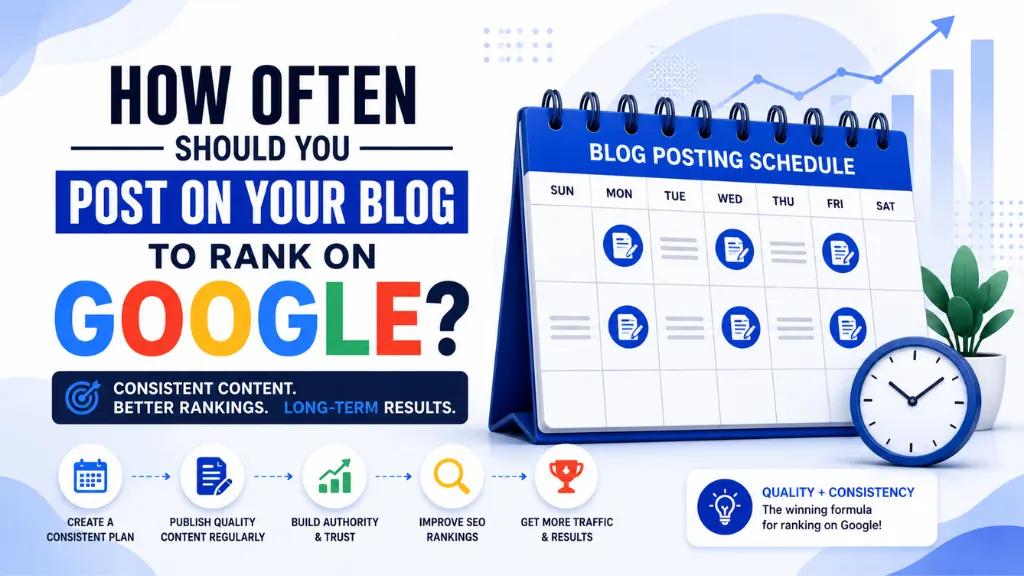
Blog to rank on Google has a practical minimum that consistently emerges from multiple 2026 sources: two to four posts per month. This is the floor below which crawl freshness signals drop, topical authority builds too slowly, and new content volume stalls the compounding effect.
Blog to rank on Google below two posts per month is not impossible – a single exceptionally well-structured, comprehensive piece can rank and drive meaningful traffic independently. But one post per month does not build a content library that creates the topical authority Google rewards. It creates isolated articles that each need to earn their own ranking position without the supporting cluster structure that makes the whole site stronger than any individual piece.
Blog to rank on Google should treat two posts per month as a floor, not a target. The floor is where rankings become possible for individual pieces. The target – where compounding authority generates traffic from dozens of pages simultaneously – typically requires four to eight posts per month during the growth phase, tapering to two to four once the topical foundation is established.
People Also Ask: What is the minimum number of blog posts needed to rank on Google? Short Answer: There is no minimum number of posts that guarantees rankings – ranking depends on quality, relevance, and authority, not quantity. However, at the domain level, consistent publishing of at least two to four posts per month is the minimum at which crawl freshness signals and topical authority start accumulating. Sites publishing once per month or less rarely build the interconnected content library that sustains strong organic visibility.
Does Publishing Quality or Quantity Matter More for Blog SEO?
Blog to rank on Google in 2026 settles this debate conclusively in favour of quality – but with an important caveat about the role quantity still plays.
Quality is what determines whether an individual post ranks. A well-structured, comprehensive article on a topic where the top competing pages are weak can reach page one with no regard for how many other posts are on the site.
Quantity is what determines whether a domain develops the topical authority that makes every new post rank faster and every existing post rank higher. An isolated excellent post on an otherwise thin site reaches its ranking ceiling slower than the same post on a site with 50 closely related, internally linked pieces covering the same topic cluster.
The 2026 conclusion: quality is the prerequisite, quantity is the accelerant. Publish at quality. Publish as frequently as quality can be sustained. Never sacrifice quality to hit a volume target.
What that looks like in practice:
- A solo blogger capable of publishing one exceptional post per week should publish one exceptional post per week – not two mediocre ones
- A content team capable of publishing four strong posts per week should publish four – not two to save capacity on posts that never get promoted or updated
People Also Ask: Is it better to publish one high-quality blog post per week or five average ones? Short Answer: One high-quality post per week consistently outperforms five average ones for long-term ranking performance. In 2026, Google’s Helpful Content systems are specifically calibrated to identify and deprioritise thin, generic content – meaning five average posts produces five underperforming pages and potentially signals a quality concern at the domain level, while one comprehensive post builds genuine authority.
Should You Prioritise New Content or Updating Old Posts?
Blog to rank on Google in 2026 involves a strategic allocation question that many bloggers ignore until their older posts start losing rankings: new content versus content refreshes.
Blog to rank on Google through content refreshes is often the faster win. Pages that currently rank on page two or three with high impressions in Search Console represent existing Google trust waiting to be activated – a substantive content update that adds current data, expands coverage of new subtopics, and improves the heading structure can move these pages to page one faster than a brand-new post targeting the same topic.
The 2026 optimal allocation for established blogs is:
- 70% of content time: new posts targeting uncovered topics and keyword gaps
- 30% of content time: refreshing top-10 most-trafficked or highest- impression existing posts with current data, additional depth, and improved structure
New blogs under 12 months old should invert this ratio – prioritising new content almost exclusively until a sufficient library of 50 to 100 well- structured posts exists, after which content refreshes become a primary ongoing activity.
How Should You Set Your Blog Posting Frequency?
Blog to rank on Google at a sustainable pace requires choosing a frequency based on your specific constraints rather than a universal benchmark.
The three-factor framework for setting your posting cadence:
1. Topical coverage requirements: How many meaningful subtopics in your niche need to be covered to be considered genuinely authoritative? A narrow niche might require 30 to 50 posts to achieve comprehensive coverage. A broad niche might require 200 or more. Knowing this number tells you how long it will take to reach authority at your chosen frequency.
2. Production capacity and quality threshold: What is the maximum number of posts per month you can produce without your quality bar dropping? Honest assessment of this figure is more important than ambition. A sustainable 2-posts-per-month cadence at high quality outperforms a 6-posts-per-month cadence that burns out the team in month four.
3. Operational bandwidth for promotion and measurement: Publishing is only one step. Social distribution, email promotion, internal linking updates on existing posts, and monthly performance tracking all require time. Frequency should account for this operational overhead rather than assuming publishing is the whole job.
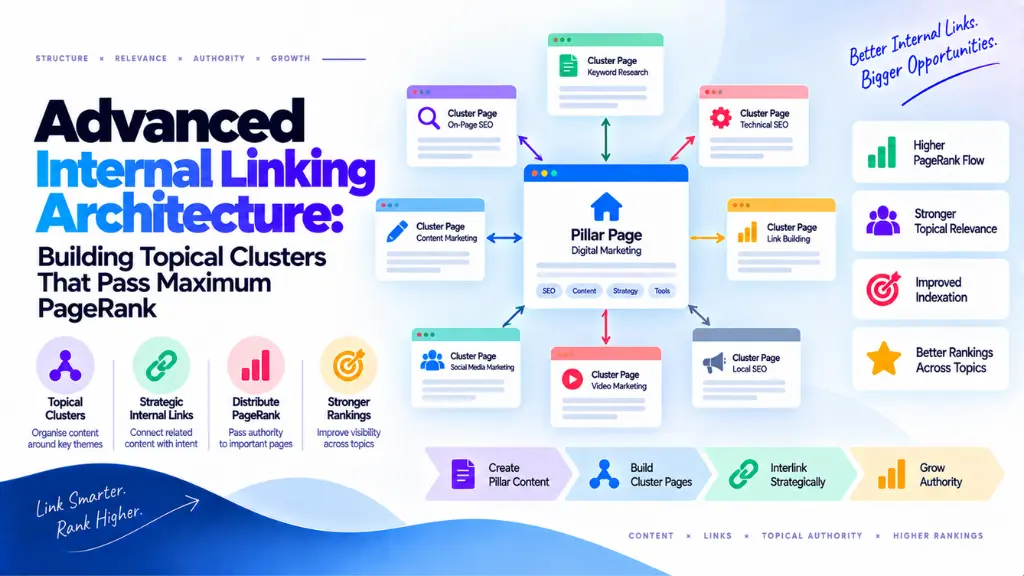
How Do Internal Links Multiply the Value of Every Post You Publish?
Blog to rank on Google at a lower frequency is made significantly more effective through systematic internal linking. The Search Scale AI 2026 analysis found that strong internal linking can make a lower publishing cadence perform like a higher one – by distributing the authority earned by any one post across the full content cluster it belongs to.
Every new post should link to at least two or three existing posts on related topics. Every existing post should be updated with a link to any new post that is closely related. This bidirectional linking ensures that authority earned by your most-linked or highest-traffic pages flows outward to newer and less-established content – accelerating rankings for the entire library, not just individual pieces.
How Should Indian Bloggers Approach Posting Frequency?
Blog to rank on Google in the Indian market benefits from the same compounding logic as global blogging – but Indian language and niche content often faces less competition, which changes the optimal frequency calculation.
For Indian bloggers in regional languages – Hindi, Tamil, Marathi, Bengali – topical coverage gaps are far larger and competition far lower than in English- language equivalents. A consistent two to four posts per month in a clearly defined regional niche can build dominant authority faster than a higher-frequency strategy in a competitive English-language niche.
According to Search Savvy’s insights from working with Indian content creators and bloggers across multiple niches in 2025 and 2026, the most common frequency mistake is starting too high and burning out before the compound effect arrives. Bloggers who begin at one to two well-researched posts per week and sustain that cadence for 12 months consistently outperform those who start at five posts per week, decline to two by month three, and stop entirely by month six.
Conclusion: Frequency Is Sustainable Quality, Not Maximum Volume
Blog to rank on Google is built from consistent quality publication rather than maximum volume. The inblog experiment that opened this guide is the most instructive data point: 62 carefully crafted posts, published over seven months, kept compounding traffic for four months after publishing stopped entirely.
Search Savvy recommends starting at a frequency you can maintain at your current quality bar for 12 to 18 months without compromising either – because the compound effect that makes blogging one of the highest-ROI marketing channels only materialises for bloggers who stay consistent long enough to reach it.
FAQ: Blog Posting Frequency for SEO – Your Questions Answered
Q1: How many blog posts per month do I need to rank on Google? Two to four high-quality posts per month is the minimum at which most blogs begin building meaningful topical authority and crawl freshness signals. For new blogs under 12 months old, six to eight per month accelerates authority building faster. For established blogs with comprehensive topical coverage, two to four per month plus regular content refreshes is sufficient to maintain and grow rankings.
Q2: Will posting every day help my blog rank faster? Only if every daily post is genuinely high quality and targets a meaningful, unaddressed keyword. Daily publishing typically leads to thin, repetitive content that creates more low-performing pages rather than more rankings. In 2026, consistent quality at a sustainable cadence outperforms high-volume, lower-quality publishing every time the data is examined.
Q3: What happens to my rankings if I stop blogging for a few months? As the inblog 12-month experiment demonstrated, previously published posts continue gaining authority and traffic for months after publishing stops – because SEO compounds over time. Total traffic may still grow during a publishing pause due to existing posts maturing. Organic traffic tends to plateau and eventually decline after two to four months without new content, since topical coverage stops expanding and competitor content continues to accumulate.
Q4: Is it better to blog more often or update old posts? Both are necessary, ideally in a 70-30 ratio for established blogs – 70% of content effort on new posts, 30% on refreshing top-performing existing content. Content refreshes often produce faster ranking improvements than new posts, because the page already has some Google trust. New posts expand topical coverage. Both are required for sustained growth.
Q5: Does blogging frequency affect how Google crawls my site? Yes. Consistent publishing teaches Googlebot to crawl a site more frequently, which means new posts get indexed faster. Sites publishing at irregular intervals or very low frequency are crawled less often, meaning new content may take weeks to appear in the index rather than days. Minimum viable frequency for maintaining regular crawl attention is two to four posts per month.
Q6: Should an Indian blog in a regional language post at the same frequency as an English blog? Not necessarily. Regional language content often faces significantly lower competition, meaning comprehensive topical coverage can be achieved with fewer posts before authority begins to compound. A focused two-posts-per-week publishing cadence in a Hindi or Tamil niche with a clear topical focus can build dominant authority faster than the same frequency in a competitive English-language niche that requires far more content to cover the same topical surface area.
Not sure what publishing frequency is right for your specific blog, niche, and team capacity – or struggling to balance new content with updates to older posts that have stopped ranking? Visit Search Savvy for a content strategy session that determines the right cadence for your specific authority-building stage and goals.