


Here is the most common content planning mistake in 2026: treating word count as a goal rather than a result. A content team decides they need 2,000 words, then fills space until they hit the number. The post ranks poorly. The post gets padded with filler. Nobody wins.
How long a blog post should be for SEO in 2026 has a clear, data-backed answer – but it is not the same answer for every piece of content. Traditional SEO ranking, AI Overview citation, and backlink attraction each follow different optimal word count patterns. Getting all three right requires understanding what drives each outcome separately.
How long a blog post be for SEO in 2026 is also a question that Google itself has answered, through its representatives rather than its algorithm. John Mueller stated it explicitly: “There’s no ideal length for blog posts.” Gary Illyes has confirmed: “Word count is not a ranking factor.” These are not arguments for producing thin content – they are clarifications that the variable causing ranking benefits is comprehensiveness, not length. Longer content often ranks better because it usually covers a topic more thoroughly. But the coverage is the cause, and the length is the byproduct.
At Search Savvy, word count is the last thing we decide when planning a blog post – not the first. We determine the target keyword, identify the search intent, analyse what the top five competing pages cover, and write enough to do that better. This guide explains exactly how to do that for every content type you publish.
Does Word Count Affect SEO Rankings in 2026?
How long a blog post be for SEO in 2026 is shaped by one important distinction: word count does not directly cause rankings, but the comprehensiveness that tends to produce longer content does. These are not the same thing.
Google confirmed it does not have a ranking factor that counts words. What it evaluates is whether a page fully satisfies the search intent behind a query – which often requires more depth than a short piece can deliver, but occasionally requires no more than a focused 500-word answer.
The data confirms this correlation in both directions:
- Average first-page Google result: 1,447 words (Backlinko 2026 analysis)
- Average top-performing content: approximately 1,152 words (Semrush data)
- Content over 3,000 words earns 77.2% more backlinks than shorter posts
- Content above 10,000 words can hurt rankings when it fails to maintain relevance and search intent across the full length
People Also Ask: Is word count a direct Google ranking factor in 2026? Short Answer: No. Google has explicitly confirmed through multiple representatives that word count is not a standalone ranking factor. The correlation between longer content and higher rankings exists because comprehensive content tends to be longer – but the comprehensiveness causes the ranking benefit, not the word count itself. A focused 1,200-word post that fully satisfies search intent consistently outperforms a padded 3,500-word post on the same topic.
What Is the Ideal Blog Post Length for Traditional SEO in 2026?
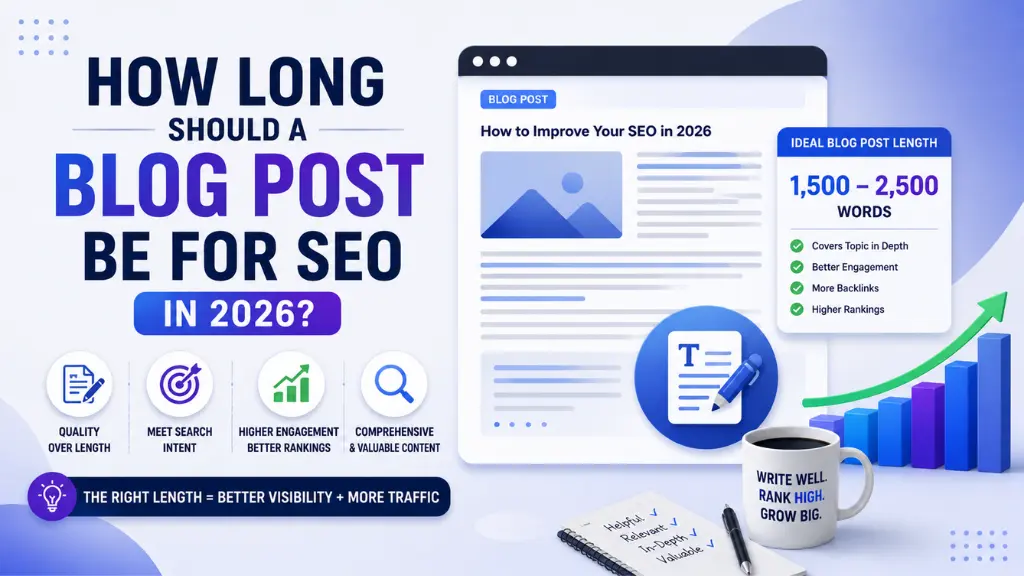
How long a blog post be for SEO in 2026 for traditional Google rankings falls into a consistent range across multiple independent studies: 1,500 to 2,500 words for most competitive informational content. This range provides enough depth to cover a topic comprehensively, enough headings to signal clear structure, and enough semantic coverage to match the full range of related queries – without the padding risk that bloats longer pieces.
How long a blog post be for SEO in 2026 should be calibrated against your specific target keyword, not a universal template. The most reliable method:
- Search your target keyword in Google
- Open the top five to ten ranking results
- Note the approximate word count for each
- Calculate the average
- Target within ±20% of that average while adding genuine additional value
If ten competitors average 1,730 words on your target topic, aim for 1,400 to 2,076 words – but only if every word in that range is contributing something the competing pages do not already cover.
The word count ranges that consistently produce competitive results by intent:
| Content Type | 2026 Target Word Count | Notes |
| Competitive informational posts | 1,500–2,500 words | Most common blog content |
| Pillar pages / ultimate guides | 2,500–5,000 words | Topical authority builders |
| Simple FAQ or definition posts | 500–1,000 words | Narrow intent, quick answers |
| News and timely updates | 400–800 words | Speed and freshness over depth |
| Product pages | 500–1,500 words | Conversion-focused; no padding |
| Local landing pages | 600–1,200 words | Local context + CTA |
| Comparison or vs. posts | 1,500–2,500 words | Decision stage; needs depth |
What Is the Ideal Blog Post Length for AI Overview Citations in 2026?
How long a blog post be for SEO in 2026 is a two-part question – and the answer for AI Overview citations is genuinely different from the answer for traditional ranking positions.
Ahrefs conducted the most comprehensive analysis yet, examining 560,346 AI Overviews and 174,048 cited pages. Their findings turned a widely-held assumption upside down:
- The average word count of content cited in AI Overviews is just 1,282 words – shorter than most top-ranking blog posts
- 53.4% of all AI Overview citations go to pages under 1,000 words
- The Spearman correlation between word count and AI Overview citation rate is 0.04 – functionally zero
How long a blog post be for SEO in 2026 for AI citations is therefore better understood as: short enough to contain a clear, extractable, direct answer to a specific question, structured so the AI can identify exactly which paragraph responds to exactly which query.
The characteristics that earn AI Overview citations are not about length at all:
- A clear, direct 40 to 60-word answer within the first two sentences of a section, before elaborating further
- Question-based H2 and H3 headings that mirror the exact phrasing of queries
- FAQ sections with concise, self-contained answers
- Schema markup (FAQPage and HowTo) that signals structured content
- Genuine expertise and verifiable information that AI systems can cite with confidence
People Also Ask: Does writing longer blog posts help you rank in Google AI Overviews? Short Answer: No. Ahrefs’ analysis of 174,048 pages cited in AI Overviews found that over 53% of cited pages are under 1,000 words, and the correlation between word count and citation rate is 0.04 – statistically meaningless. AI Overviews select content based on answer clarity, structural directness, and genuine expertise – not the total word count of the page.
What Length Is Best for Earning Backlinks?
How long a blog post be for SEO in 2026 has a third answer when the goal is backlink acquisition rather than rankings or AI citations. Long-form content significantly outperforms short-form for earning editorial links – but only when the length is justified by genuinely original or comprehensive content.
- Posts over 3,000 words earn 77.2% more backlinks than shorter posts
- Posts over 3,000 words receive 3.5x more backlinks than posts under 1,000 words
- Original research, unique data, and proprietary case studies earn links from long and short posts alike
How long a blog post be for SEO in 2026 for backlink purposes therefore depends on content type: original research that summarises data in 1,200 words can earn as many links as a 4,000-word guide, because publishers link to the source of unique information rather than the longest version of a topic.
The practical implication: plan content specifically designed to attract links – original surveys, benchmark reports, comprehensive guides with unique data – at 2,500 words and above. For general informational blog posts, the 1,500 to 2,500 word range earns strong link volume relative to production time invested.
What Are the Biggest Word Count Mistakes to Avoid?
How long a blog post be for SEO in 2026 is as much about what to remove as what to add. Five specific patterns consistently hurt performance despite increasing word count:
1. Padding to hit a target Adding sentences that restate earlier points, generic transition paragraphs, or “of course it’s important to note” filler directly hurts user engagement without adding SEO value. Poor engagement signals – users who leave quickly or return to search immediately – feed negatively into Google’s ranking systems.
2. Excessive context before the answer Long introductions before the post addresses what the searcher came for create early exits. Get to the first useful point within the opening two paragraphs.
3. Over-explaining prerequisites for an expert audience A 500-word definition of “what is WordPress” at the top of a WooCommerce guide targeting experienced developers serves no reader and adds no SEO value.
4. Repeating the same example multiple times Two examples suffice for most concepts. A third is fine. A fifth covering the same point is padding regardless of how differently it is phrased.
5. Forcing a longer piece on a simple query A question like “what is robots.txt” can be fully answered in 600 well-structured words. A forced 2,500-word post on the same question will include information that does not belong at the top of that search results page.
People Also Ask: Can a blog post be too long for SEO? Short Answer: Yes, but the risk is not a direct length penalty – it is a quality problem. Excessively long content that includes padding, repetition, and off-topic sections produces poor user engagement, which indirectly hurts rankings over time. Content above 10,000 words particularly risks this issue unless every section adds genuine information that shorter coverage would miss. The practical test: if a section can be removed without the reader missing anything, it should be.
How Does the 2026 Search Landscape Change the Length Equation?
How long a blog post be for SEO in 2026 is more contextual than ever because AI Overviews now appear above organic results for over 55% of search queries. This has a specific implication for word count strategy:
Content should be structured at two levels simultaneously. The page-level goal is comprehensive coverage of a topic, which typically requires 1,500 to 2,500 words for competitive informational content. The section-level goal is a clear, direct, extractable answer within each H2 section, which AI systems need to be short – 40 to 60 words – regardless of the page’s total length.
How long a blog post be for SEO in 2026 therefore calls for a “long body, short answers” architecture: a comprehensively structured long-form piece where each individual section opens with a direct, concise answer before elaborating into depth. This structure serves traditional ranking requirements and AI citation requirements simultaneously.
How Should Indian Bloggers Think About Blog Post Length?
How long a blog post be for SEO in 2026 in Indian market contexts should account for the fact that many high-value Indian search queries – in personal finance, health, digital marketing, and regional language content – face significantly lower competition than their global English equivalents.
Lower-competition queries in Indian markets are often fully served by 1,000 to 1,500 words rather than requiring 2,500-word comprehensive guides to rank. This is particularly true for Hindi and regional language queries, where the top-ranking content is frequently shorter than English equivalents because fewer competitors are producing any content at all.
According to Search Savvy’s insights from managing SEO for Indian bloggers and content brands, the most reliable word count framework for Indian content is: audit the top three to five results for the specific Indian-market version of the target keyword, calculate their average word count, and target that benchmark with meaningfully better structure and more specific India-relevant examples – rather than applying global word count benchmarks that may reflect far more competitive English-language SERP environments.
Conclusion: The Right Length Is the One That Fully Answers the Query
How long a blog post be for SEO in 2026 is always a function of what the searcher needs to leave fully satisfied – no more, no less. For most competitive informational content, that means 1,500 to 2,500 words. For AI citation optimisation, it means clear, short answer blocks regardless of total length. For backlink generation, it means comprehensive, original content that gives other publishers something worth citing.
Search Savvy determines content length after keyword research, intent analysis, and competitor benchmarking – not before – because the right length for any given piece of content cannot be known until you understand exactly what that piece needs to achieve and who is currently competing for the same position.
FAQ: Blog Post Length for SEO in 2026 – Your Questions Answered
Q1: What is the ideal word count for a blog post to rank on Google in 2026? For most competitive informational blog posts, 1,500 to 2,500 words is the most consistently well-performing range in 2026. Backlinko’s analysis puts the average first-page result at 1,447 words; Semrush data shows top-performing content averaging around 1,152 words. The most accurate target is the average of your top five to ten competitors for the specific keyword, ±20%.
Q2: Does Google have a minimum word count for blog posts? No. Google has confirmed no minimum word count for ranking. There are high- ranking pages with under 500 words for queries where a concise, direct answer satisfies search intent completely. Yoast recommends a practical floor of 300 words for regular posts and 900 words for cornerstone content – not because of a Google requirement, but as a quality threshold to prevent thin content.
Q3: What word count gets content cited in Google AI Overviews? Shorter than most bloggers expect. Ahrefs’ analysis of 174,048 cited pages found the average word count is 1,282 words, with 53.4% of all citations going to pages under 1,000 words. The correlation between word count and AI citation rate is 0.04 – essentially zero. Clear, direct answers structured with question- based headings and concise 40 to 60-word answer blocks earn AI citations regardless of total page length.
Q4: Does longer content always rank better in 2026? No. Content above 10,000 words can hurt rankings when it fails to maintain topical relevance and search intent satisfaction. A well-structured, expertly written 1,200-word post consistently outranks a padded 3,500-word post on the same topic. The length-ranking correlation exists because comprehensive content tends to be longer – not because length itself causes ranking improvements.
Q5: How long should pillar pages and cornerstone content be? Pillar pages and ultimate guides that anchor a topical cluster typically perform best at 2,500 to 5,000 words for most topic areas, and can extend further for genuinely complex subjects where comprehensive coverage legitimately requires more space. The test for pillar page length: does removing any section leave an important reader question unanswered? If yes, keep it. If no, cut it.
Q6: What is the most important thing to optimise for beyond word count? Search intent satisfaction and content quality. Google’s systems evaluate whether a page fully addresses what the searcher needed when they typed the query – which sometimes requires 500 words and sometimes 5,000. In 2026, unique data, first-hand experience, and original insight that competitors cannot replicate are the signals most consistently associated with ranking gains through both Google’s March and May 2026 core updates.
Planning content but unsure how long each piece actually needs to be – or producing posts at a fixed word count without checking whether that matches what your target keyword actually requires? Visit Search Savvy for a content strategy session that calibrates your word count targets against real competitor benchmarks and current AI citation data.