Festive Season Email Sequence: A 5-Email Template for Indian D2C Brands

One well-timed email sequence can outperform a dozen one-off blasts during Diwali. Flipkart has announced Big Billion Days from 9 October, Diwali’s main day is 8 November 2026, and most inboxes are read on a phone: industry data compiled by Litmus puts mobile at roughly 41 to 55% or more of all email opens, depending on the month and methodology. A festive email marketing sequence that isn’t planned around that reality, and around your own cart data, leaves recoverable revenue on the table.
In this article19 sections
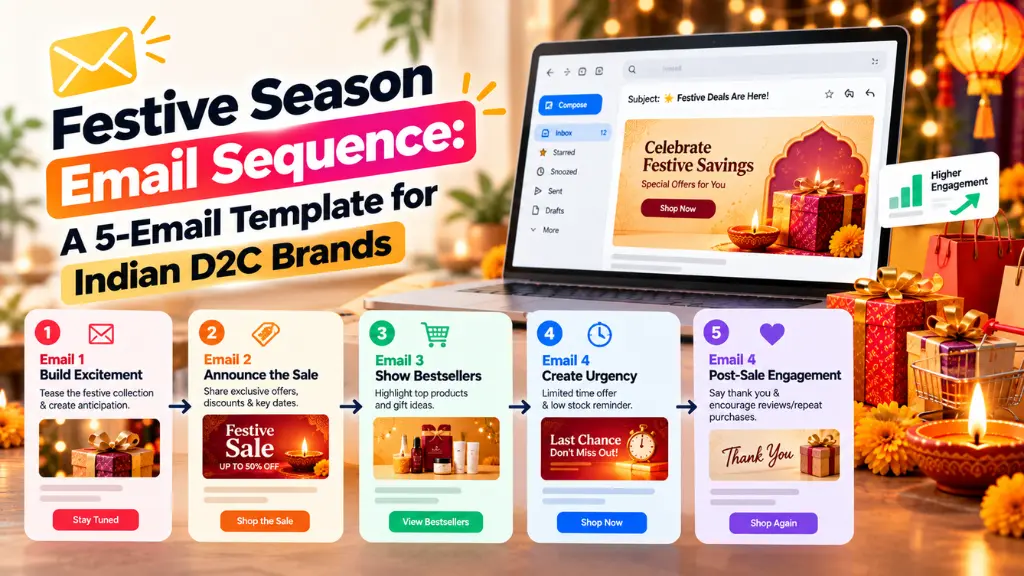
This guide gives Indian D2C brands a 5-email festive sequence template: teaser, launch, cart abandonment, last-day urgency and thank-you, with subject line patterns, timing logic and compliance notes for each. The short version: send the teaser and launch emails before your competitors’ sale opens, automate cart recovery so it doesn’t depend on a person clicking send, and never fake urgency you can’t back up.
What Is a Festive Email Sequence?#
A festive email sequence is a set of automated, time-ordered emails built around one seasonal sale, moving a subscriber from awareness to purchase and then to a post-purchase relationship. Unlike a single newsletter, each email in the sequence has one job and triggers off a date or a subscriber action.
An email automation flow does the sequencing for you: once it is built, it runs on its own triggers (a date, a cart abandonment, a purchase) rather than needing someone to send each email by hand during the busiest week of the quarter. This guide works as a festive email sequence template you can copy into your own calendar; Search Savvy’s social media marketing glossary defines terms like segment, flow and CTR if your team needs a shared vocabulary.
The 5-Email Festive Sequence Template#
| # | Trigger | Timing (2026) | Goal | |
| 1 | Pre-sale teaser | Date-based | 1 to 2 weeks before sale start | Build anticipation, segment interest |
| 2 | Sale launch | Date-based | Sale opening day (from 8 to 9 Oct) | Convert warm interest |
| 3 | Cart abandonment | Behaviour-based | Hours after cart abandonment, throughout the sale | Recover lost carts |
| 4 | Last-day urgency | Date-based | 24 hours before the offer or Diwali ends | Convert fence-sitters |
| 5 | Thank-you and next steps | Purchase-based | Immediately to a few days after purchase | Retain, review, cross-sell |
Dates vary by source and region, so confirm your own sale window before scheduling. Two of these emails (1, 2, 4) are date-triggered and can be scheduled in advance; two (3, 5) are behaviour-triggered and need to be built once as an automation, not sent manually.
Email 1: The Pre-Sale Teaser Email#
A pre-sale teaser email tells subscribers a sale is coming without revealing every offer, so it builds anticipation and lets you segment who is interested before the sale opens.
- Send 1 to 2 weeks before your sale starts. Google’s India team has found that 82% of surveyed festive shoppers plan purchases in advance, so early is safer than late.
- Give one clear next step, such as “set a reminder” or “browse the gift guide,” rather than a hard sell.
- Segment by click. Whoever clicks becomes your warmest audience for Email 2.
Example subject lines: “Something big is coming for Diwali,” “Your Diwali wishlist starts here,” “Mark your calendar: our festive sale begins soon.”
Email 2: The Sale Launch Email#
The launch email announces the offer the moment it goes live, ideally same-day or same-hour as your sale start.
- Lead with the offer and the end date in the subject line and the first line of the email.
- Segment sends so teaser-email clickers get the launch email first, and give non-openers a follow-up with a different subject line 24 to 48 hours later.
- Match the landing page. The email’s promise and the page it links to should say the same thing, in the same words.
Example subject lines: “It’s here: Diwali sale starts now,” “Up to [X]% off, today only through [date],” “The wait is over: festive sale live.”
Email 3: The Cart Abandonment Email#
A cart abandonment email reminds a shopper about items left in their cart, sent automatically after a set delay, and is one of the highest-converting automated emails a store can run.
Timing evidence, mostly from US and global platforms, points to a short first delay:
- Klaviyo’s own best-practice guidance for cart abandonment flows recommends sending within 48 hours, with many stores using a short first delay after abandonment.
- Independent analyses commonly land on a three-email flow: an early reminder around 2 to 4 hours after abandonment with no discount, a follow-up around 24 hours with a modest incentive, and a final message around 48 hours with product recommendations or a reminder of stock.
A widely cited practitioner analysis argues that a fourth email adds less than 1% additional recovery while increasing list fatigue, though this is one platform-specific analysis, not an industry standard, so test it against your own data. During festive weeks specifically, segment by cart value: a high-value cart can justify a stronger incentive than a low-value one.
A simple 3-part cart recovery flow for the festive window:
- 2 to 4 hours: a plain reminder, no discount, showing the cart contents.
- ~24 hours: address a likely objection (delivery time, returns policy, or a small incentive such as free shipping).
- ~48 hours: a final nudge, ideally with a stock or offer-ending note if genuinely true.
Email 4: The Last-Day Urgency Email#
The urgency email creates a final reason to act before the sale or a specific festive date, such as Dhanteras or Diwali, closes.
- Send it once, roughly 24 hours before the true deadline, and be specific: “Offer ends tonight at midnight,” not a vague “hurry.”
- State the real reason for urgency, such as a delivery cut-off for Diwali gifting, not an invented scarcity claim.
- Repeat the CTA at least twice in the email, since mobile readers scan quickly.
Example subject lines: “Last chance: sale ends tonight,” “Order today for Diwali delivery,” “A few hours left.”
Email 5: The Thank-You and Retention Email#
Sent after purchase, this email confirms the order, sets delivery expectations and opens the next relationship step: a review request, a referral offer, or an early look at what comes after Diwali.
- Confirm order details and expected delivery, especially important during a high-volume festive week.
- Ask for a review a few days after delivery, not immediately at checkout.
- Introduce what’s next, such as a loyalty programme or a post-Diwali offer, without overselling in the same email as the receipt.
Festive Subject Lines That Work (and What to Avoid)#
Festive subject lines should be specific, honest and short enough to survive a small mobile screen. Litmus’s email client data shows mobile accounts for a large and growing share of opens, so subject lines get truncated quickly on phones; keep the offer and any deadline near the front.
| Do | Avoid |
| “Diwali sale: up to 40% off, ends 11 Nov” | “AMAZING DIWALI DEALS!!!” |
| “Your cart is waiting (free shipping inside)” | Vague “Don’t miss out” with no specifics |
| “Order by [date] for Diwali delivery” | A countdown claim that isn’t true |
| One relevant emoji, if it fits your brand voice | Emoji stacked in every subject line |
Test two subject lines per email against a small segment first when your list size allows it, and let the winner go to the rest of the list.
Compliance Notes for Indian D2C Email Marketing#
D2C email marketing in India sits inside a changing legal landscape, so this is general awareness, not legal advice.
India’s Digital Personal Data Protection Act, 2023 and its Rules, notified in November 2025, set out a consent-based framework for personal data, including marketing contact details, with most obligations phased in by 13 May 2027. The Rules require that withdrawing consent be as easy as giving it, which maps onto a clear, working unsubscribe link. Building around consent and easy opt-out is the safer default regardless of the exact enforcement date.
- Only send marketing emails to people who opted in.
- Keep the unsubscribe link visible and working in every email, including cart abandonment and urgency emails.
- Avoid confirm-shaming decline links, which the Central Consumer Protection Authority’s dark patterns guidelines have flagged as a manipulative design practice in the e-commerce context.
- Keep records of consent, since this is one of the practical habits regulators expect regardless of exact enforcement dates.
How Do You Build and Automate This Sequence?#
Most email platforms used by Indian D2C brands (Mailchimp, Klaviyo, Zoho Campaigns, WATI for WhatsApp alongside email) support both date-triggered campaigns and behaviour-triggered flows. Build the cart abandonment and thank-you flows once, well before 8 October, and test them by placing a real order and abandoning a real cart yourself. Schedule the teaser, launch and urgency emails to your full festive calendar so nothing depends on someone remembering to hit send during the busiest week.
For teams coordinating email alongside social and paid content, Search Savvy’s content calendar and creative production services can help align messaging across channels, and analytics and performance reporting supports tracking open, click and recovery rates once the sequence is live.
Common Mistakes to Avoid#
- Sending the teaser and launch emails on the same day. Give the teaser time to build interest.
- Manually sending cart recovery emails. Automate it; the delay defeats the purpose.
- Using fake countdowns or fake stock claims. These are flagged manipulative practices, not just bad style.
- Ignoring mobile rendering. Test every email on a phone before it sends.
- Skipping the thank-you email. It’s the cheapest email in the sequence and sets up next season’s list.
Frequently Asked Questions#
How Many Emails Should a Festive Sequence Have?#
Five works well for most D2C brands: teaser, launch, cart abandonment, last-day urgency and thank-you. Cart abandonment itself is often a mini-sequence of two to three emails, so the total email count during the festive window is usually higher than five.
When Should I Send the First Cart Abandonment Email?#
Commonly 2 to 4 hours after the cart is abandoned, based on Klaviyo’s and independent platforms’ guidance, without a discount in that first message. Save an incentive for the follow-up around 24 hours later if the cart is still unrecovered.
Should I Use a Countdown Timer in Festive Emails?#
Only if it is genuinely tied to a real offer end time. A timer or urgency claim that doesn’t reflect reality is a flagged manipulative design practice under India’s dark patterns guidelines, separate from any email-specific law.
How Do I Write a Good Festive Subject Line?#
Be specific about the offer and, where relevant, the deadline, and keep it short enough to survive mobile truncation. Avoid all-caps, stacked emoji and vague urgency; test two versions against a small segment first if your list size allows it.
Is Email Still Effective When WhatsApp and Instagram Get More Attention?#
Yes, particularly for cart recovery and post-purchase communication, where a full record and a working unsubscribe link matter. Treat email, WhatsApp and social as complementary channels in the same festive calendar rather than choosing one over the others.
Do I Need Consent Before Sending Festive Marketing Emails in India?#
Yes, as a matter of good practice and increasingly as a matter of law. India’s DPDP framework is built on consent, with phased enforcement through 2027, so building your list on opt-in and keeping unsubscribe links working protects you regardless of the exact compliance timeline.
The Bottom Line#
A festive email sequence works when each email has one job, the automated flows are built and tested before the sale starts, and every claim of urgency is true. This week, map your own five-email calendar against the 2026 festive dates, build the cart abandonment flow if you don’t already have one, and test every email on a phone. If you’d like help planning the wider festive push, Search Savvy’s performance marketing services are a practical place to start.