
How to Build a 90-Day SEO Plan for a New Small Business Website

A former Google Search spokesperson, Maile Ohye, said it plainly: “In most cases, the SEO will need four months to a year to help your business first implement improvements and then see the potential benefit.” Ninety days is not enough time to fully rank a new small business site, and no honest plan will promise that. It is enough time to build the foundation properly, publish the content that starts compounding, and generate the early signals (indexing, impressions, first rankings for easier terms) that tell you the plan is working.
In this article21 sections
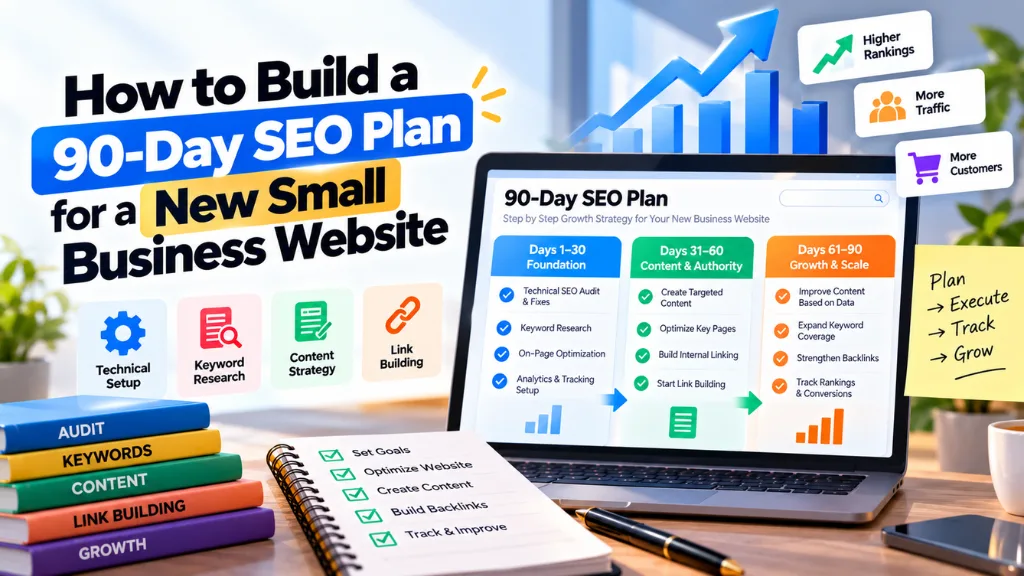
This 90-day SEO plan breaks the work into three clear phases: technical foundation in weeks 1 to 4, keyword-led content in weeks 5 to 8, and promotion and measurement in weeks 9 to 12. The short version: fix what blocks Google first, publish focused content around real search intent second, then earn attention and links for what you’ve built. Skipping the order wastes the content you publish.
What Should a 90-Day SEO Plan Include?#
A 90-day SEO plan for a new small business site should include a technical setup and audit phase, a keyword research and content-publishing phase, and a promotion and measurement phase, in that order. Each phase builds on the one before it, so content published before technical issues are fixed, or promoted before it exists, wastes effort.
| Phase | Weeks | Focus | Primary output |
| 1: Foundation | 1 to 4 | Setup, technical SEO audit, keyword research | Verified tracking, clean crawlability, a prioritized keyword list |
| 2: Content | 5 to 8 | On-page SEO, cornerstone content, local SEO | 6 to 10 published, optimized pages |
| 3: Growth | 9 to 12 | Promotion, link building, measurement | Initial backlinks, baseline reporting, a revised 90-day plan |
Phase 1 (Weeks 1 to 4): Technical Foundation and Keyword Research#
Week 1: Setup and Verification#
Before anything else, confirm Google can find, crawl and measure your site.
- Verify Google Search Console for your domain.
- Install Google Analytics 4 and confirm it fires on real pageviews.
- Check that your site is HTTPS, since Google has used HTTPS as a ranking signal for years.
- Confirm your homepage is not accidentally set to noindex, which Google’s own SEO Starter Guide flags as a common launch mistake.
Week 2: Technical SEO Audit Checklist#
Run through this technical SEO audit checklist before writing a single new page:
- Robots.txt. Test it in Search Console’s settings and confirm it isn’t blocking CSS, JavaScript or important pages by accident, since Google needs those resources to render your pages properly.
- XML sitemap. Submit a clean sitemap that includes only the URLs you want indexed, and declare it in your robots.txt file.
- Crawl and indexing. Use URL Inspection on your homepage and top service pages to confirm Google can access and index them.
- Site speed. Run your homepage through PageSpeed Insights and note your Core Web Vitals baseline; you’ll compare against this later.
- Broken links and redirects. Fix any 404s from old URLs or dev-site links that made it into production, and remove redirect chains.
- Duplicate content. Check for duplicate title tags or near-identical pages, especially if your CMS auto-generates category or tag archives with little unique content.
If your site is complex or you’re unsure how to interpret the results, a technical SEO audit service can shortcut this phase.
Weeks 3 to 4: The Keyword Research Phase#
The keyword research phase turns “we sell X” into a prioritized list of pages worth building. For a new small business site, prioritize buyer-intent and local terms over broad, competitive ones you have no realistic chance of ranking for in year one.
- List your core services or products, then expand each into the specific questions and comparisons a buyer would search.
- Check search intent for each term. A page built for “how to fix X” will not satisfy someone searching “buy X near me,” even if the keyword looks similar.
- Map each priority keyword to one page. Avoid creating two pages that compete for the same intent.
- Include local modifiers if you serve a specific city or region, since local searches often convert faster for small businesses than broad national terms.
Search Savvy’s keyword research services can support this stage if you want an outside pass on prioritization, and the SEO glossary is useful if your team needs shared definitions of intent, cornerstone content or long-tail terms.
Phase 2 (Weeks 5 to 8): Build the Content and On-Page SEO#
Weeks 5 to 6: Cornerstone Pages#
Build the small number of pages that represent what your business actually does: core service or category pages, an about page with genuine detail, and a location or contact page if relevant. These are your cornerstone pages, the ones you’ll link to most often internally.
For each page:
- Write a unique title tag and meta description.
- Use one clear H1 that matches the page’s primary keyword and intent.
- Write for the person reading it first, then check the page covers the terms your keyword research surfaced.
- Add internal links from and to related pages.
Weeks 7 to 8: Supporting Content and Local SEO#
Publish 4 to 6 supporting articles or FAQ-style pages that answer the specific questions your keyword research found, and link each one back to a relevant cornerstone page.
If you serve customers in a specific area, complete local SEO basics in parallel:
- Fully complete your Google Business Profile, including category, services, hours and photos.
- Keep your business name, address and phone number identical across your website, GBP and any directories.
- Add local business schema so search engines and AI systems have a consistent, structured version of your details; Search Savvy’s free local business schema generator can help.
By the end of week 8, you should have roughly 6 to 10 published, optimized pages, not dozens of thin ones. Ahrefs’ analysis of newly published pages found that only 1.74% reach the top 10 for any keyword within a year, and that figure comes from a much larger, more competitive dataset than a typical small business niche. It’s a reminder to aim for a few genuinely useful pages rather than many shallow ones chasing volume.
Phase 3 (Weeks 9 to 12): Promotion, Link Building and Measurement#
The Link Building Timeline for a New Site#
A link building timeline for a brand-new domain should start modestly and prioritize relevance over volume. Google’s own guidance is that links remain a meaningful part of how it evaluates a page’s standing, and industry research consistently finds a correlation between referring domains and rankings, even as content relevance has grown in relative weight. For weeks 9 to 12:
- Claim relevant, free directory and citation listings for your industry and city.
- Reach out for a small number of genuinely relevant links, such as a supplier, local business association or industry directory that would plausibly link to you regardless of SEO.
- Avoid link schemes. Google’s spam policies explicitly prohibit buying or exchanging links to manipulate rankings, and a small new site has more to lose than gain from that risk.
- Track what you build, so you can see which outreach approaches actually convert into links over the following quarters.
Do not expect a flood of links in the first 90 days. This phase is about starting the habit and picking the lowest-risk, most relevant opportunities, not hitting a link count.
Promote What You’ve Built#
Share your cornerstone and supporting pages through the channels you already have: social profiles, email if you have a list, and any existing customer relationships who might genuinely find the content useful. Social media services can help extend this reach if organic social isn’t your team’s core skill.
Set Up Measurement and Plan the Next 90 Days#
By week 12, build a simple baseline report:
- Indexed pages (Search Console coverage report)
- Impressions and clicks by page and query
- Rankings for your priority keyword list, even if most are outside the top 10 so far
- Core Web Vitals status compared with your week 2 baseline
Google has said publicly, through Maile Ohye, that most businesses need four months to a year to see the potential benefit of SEO changes, and John Mueller has separately noted that simple changes get reprocessed quickly while larger, strategic changes take longer to fully show up in rankings. So treat week 12 as a checkpoint for foundation and early signals, not a deadline for page-one rankings. Use what you learn to plan the next quarter: which pages are gaining impressions but not clicks (a title or snippet problem), which keywords need a stronger page, and where to invest further content or outreach effort.
Common Mistakes to Avoid#
- Publishing content before fixing technical issues. Good content on an unindexable page never gets discovered.
- Chasing dozens of keywords with dozens of thin pages. A handful of solid cornerstone pages outperforms scattered thin ones.
- Buying links or joining link exchanges. This risks a manual action for very little benefit on a new site.
- Expecting page-one rankings by day 90. Google’s own guidance sets a 4-month-to-a-year window for most businesses.
- Skipping measurement. Without a baseline, you can’t tell what the next 90 days actually changed.
Frequently Asked Questions#
How Long Until a New Website Ranks on Google?#
Google’s own guidance, from former spokesperson Maile Ohye, is that most businesses need four months to a year to first implement SEO improvements and then see the benefit. Low-competition, local or long-tail terms can appear sooner; competitive national terms usually take longer.
What Should I Do First in a New SEO Plan?#
Start with setup and a technical SEO audit: verify Search Console, check robots.txt and your sitemap, confirm pages are indexable, and establish a Core Web Vitals baseline. Publishing content before fixing crawlability issues wastes the content.
How Many Pages Should I Publish in the First 90 Days?#
Roughly 6 to 10 well-researched, properly optimized pages is a reasonable target for a small business: your core service or category pages plus a handful of supporting content pieces. Quality and intent match matter far more than page count.
Do I Need Link Building in the First 90 Days?#
A light, relevance-first start is reasonable: directory citations, one or two genuine outreach wins, and no link buying. Google’s spam policies prohibit manipulative link schemes, and a new site benefits more from a clean, gradual link profile than a fast, risky one.
Should I Focus on Local SEO or National Keywords First?#
For most new small businesses, local and long-tail terms convert faster and face less competition than broad national keywords. Build out Google Business Profile, local citations and location-relevant content in Phase 2 alongside your main service pages.
What Happens After the First 90 Days?#
Use your week-12 baseline report to plan the next quarter: expand pages gaining impressions but few clicks, target keywords your current pages don’t yet cover, and continue link building at a steady, relevant pace. SEO compounds over multiple 90-day cycles rather than finishing after one.
The Bottom Line#
A 90-day SEO plan for a new small business site works when it respects the order: fix the technical foundation, publish focused content around real intent, then promote and measure. This week, verify Search Console, run your homepage through PageSpeed Insights, and start the keyword list for your first cornerstone pages. If you’d like a second opinion on the plan or help executing any phase, Search Savvy’s SEO services are a practical place to start.