
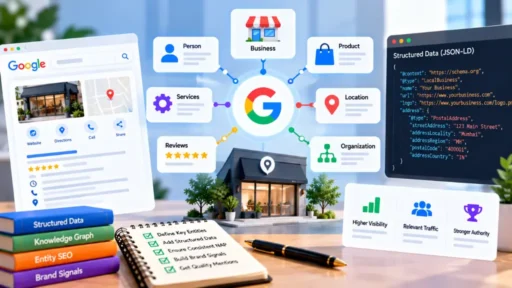
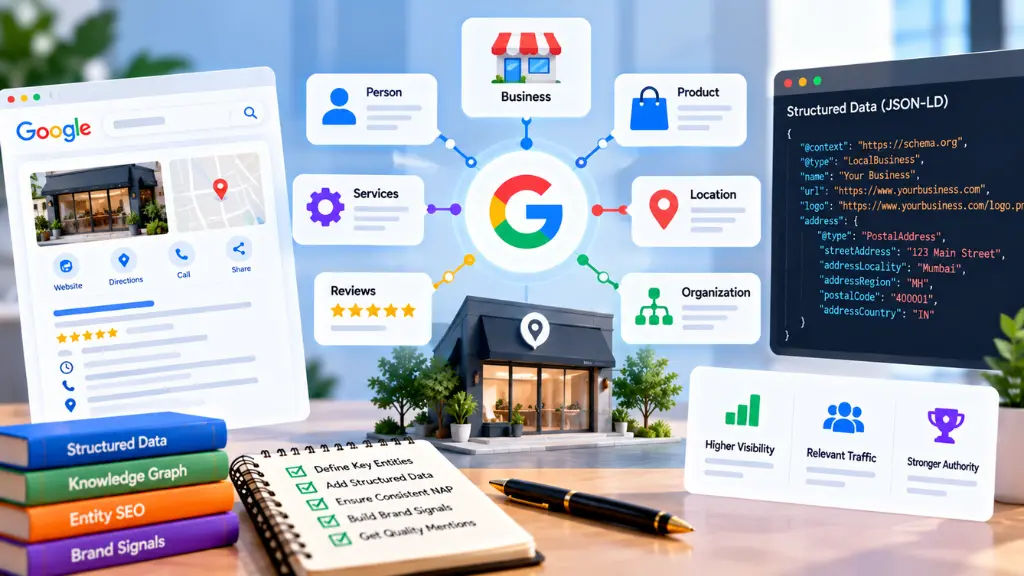

Entity SEO is the practice of making your brand, people, products, and topics clearly identifiable to search engines as distinct “things,” not just strings of keywords. Google stores what it knows about those things in its Knowledge Graph. When it recognizes your business as an entity, it can connect your website, profiles, reviews, and mentions into one consistent picture.
This guide explains how entity SEO works, how Google recognizes entities, and the practical steps that strengthen your brand entity. One caution up front: no tactic guarantees a Knowledge Graph entry or a knowledge panel. What you can control is the clarity and consistency of the signals you publish.
What Is Entity SEO?
Short answer: Entity SEO is optimizing for the real-world things your content describes, such as a company, person, product, or place, so search engines can identify them, understand how they relate to each other, and trust information about them.
An entity is a distinct, identifiable thing. “Nike” the brand, “Mumbai” the city, and “schema markup” the concept can each be entities. Google announced its Knowledge Graph in 2012 with the idea of understanding “things, not strings,” and that shift is why exact-match keywords matter less than clear meaning today.
Entity SEO sits alongside semantic SEO. Semantic SEO focuses on meaning, context, and topical coverage across your content. Entity SEO focuses on identity and relationships: who you are, what you offer, and how you connect to other known entities.
Entity SEO vs Keyword SEO: What Changes?
| Factor | Keyword-focused SEO | Entity-focused SEO |
| Unit of optimization | Search phrases | Things and their relationships |
| Main question | “Which words should this page contain?” | “Is it clear what this page is about and who is behind it?” |
| Key signals | Titles, headings, anchor text | Consistent names, structured data, corroboration, topical coverage |
| Common failure | Keyword stuffing | Ambiguous or inconsistent brand identity |
| Typical benefit | Rankings for phrases | Better understanding, disambiguation, richer search features |
You still need keyword research. Entity SEO changes how you use it: queries become signals of the topics and questions your entity should answer well.
How Does Google Recognize an Entity?
Short answer: Google builds entity understanding by combining many sources: your website, structured data, public databases, Business Profile information, and consistent mentions elsewhere. It looks for agreement across sources, not a single signal.
According to Google’s Organization structured data documentation, adding Organization markup to your home page can help Google understand your organization’s administrative details and disambiguate it in search results. Some properties work behind the scenes, while others can affect visual elements such as the logo shown in results and your knowledge panel.
Commonly cited sources that feed entity understanding include:
- Your own site, especially a clear About page and consistent naming.
- Structured data, such as Organization, LocalBusiness, and Person markup.
- Public knowledge bases, such as Wikipedia and Wikidata, where an entry exists.
- Google Business Profile for local businesses.
- Independent coverage and citations from reputable third parties.
Nobody outside Google knows the exact weighting. Treat any claim of a “formula” skeptically, and focus on making each source accurate and consistent.
What Is the Knowledge Graph, and What Is a Knowledge Panel?
Short answer: The Knowledge Graph is Google’s database of entities and the facts connecting them. A knowledge panel is the information box that can appear in search results for an entity Google recognizes. You cannot apply for a panel directly, and structured data alone does not trigger one.
Panels are generated automatically from Knowledge Graph data. If one appears for your brand, you can usually claim it through Google’s verification process and suggest changes. If none appears, that does not mean your SEO is failing. Many legitimate small businesses do not have one, because panels depend on notability and corroboration across the web.
How Do You Optimize Your Brand Entity? A Step-by-Step Approach
Brand entity optimization means making your identity unambiguous. Work through these steps in order.
Step 1: Define your entity home
Pick one canonical page, usually your About page or home page, that states who you are, what you do, where you operate, and how to contact you. Make it the page other profiles and markup point back to.
Step 2: Standardize your name and details
Use the same legal or trading name, description, address, phone number, and logo everywhere: your site, Business Profile, social profiles, directories, and press mentions. Variations such as “Acme Ltd,” “ACME,” and “Acme Digital” force Google to guess whether they are the same thing.
Step 3: Add Organization (or LocalBusiness) structured data
Use JSON-LD on your home or About page. Google’s documentation lists no required Organization properties but recommends supplying the relevant ones. A simple example for a fictional company:
<script type=”application/ld+json”>
{
“@context”: “https://schema.org”,
“@type”: “Organization”,
“@id”: “https://www.example.com/#organization”,
“name”: “Example Agency”,
“url”: “https://www.example.com/”,
“logo”: “https://www.example.com/images/logo.png”,
“description”: “A digital marketing agency serving small businesses.”,
“sameAs”: [
“https://www.linkedin.com/company/example-agency”,
“https://www.facebook.com/exampleagency”,
“https://www.youtube.com/@exampleagency”
]
}
</script>
The sameAs property lists other official profiles of the same entity. Only include profiles you control and that genuinely represent the business. Search Savvy’s organization schema generator can build this markup, and the schema markup validator can check it for syntax errors.
Step 4: Create entities for the people behind the content
Authors and founders are entities too. Give each author a profile page with a short bio, credentials, and links to their professional profiles, then mark it up with Person schema. A person schema generator can help. This supports the Experience, Expertise, Authoritativeness, and Trust signals Google’s quality guidance describes, because readers and systems can see who stands behind the content.
Step 5: Claim and complete your profiles
Verify your Google Business Profile, complete your LinkedIn company page, and fill in the profiles that matter in your industry. Keep descriptions consistent with your entity home page.
Step 6: Earn corroboration
Independent mentions matter because they confirm your identity. Pursue legitimate coverage: industry directories, partner pages, local organizations, interviews, and original research. If your organization meets Wikipedia’s notability standards, a properly sourced article may follow, but never create or buy one yourself. Wikidata entries should also be accurate and sourced, and you should disclose any conflict of interest.
Step 7: Build topical depth around your entity
An entity is understood partly by what it covers. Publish connected content that answers the full range of questions in your field and link those pages together logically. Search Savvy’s content strategy and topical authority services follow this approach: map a topic, then build clusters that show depth rather than isolated posts.
How Do You Show Entity Relationships?
Short answer: Show relationships through clear writing, consistent internal links, and structured data that connects entities, such as an organization to its founder, its services, and the places it serves.
Entity relationships describe how things connect: a company employs people, offers services, operates in locations, and is mentioned alongside related brands and topics. You can express them in three ways:
- Content. State relationships plainly. “Our founder, [Name], leads the SEO team” is clearer than implied connections.
- Internal links. Link from service pages to the About page, and from author pages to their articles, using descriptive anchor text.
- Structured data. Use the @id property to reference the same entity across pages. For example, an article’s publisher can point to your Organization @id, and an author can point to a Person @id.
Keep markup truthful and visible. Structured data should describe what is actually on the page and reflect reality.
How Can You Check Whether Google Recognizes Your Entity?
Try these checks:
- Search your brand name and note whether results show consistent information, a knowledge panel, or confusion with similarly named entities.
- Use the Knowledge Graph Search API, which lets you look up entities in the Knowledge Graph directly. Not every entry shown there appears in a visible panel.
- Review branded queries in Search Console to see how people reach you and whether the queries match your intended identity.
- Test AI answer engines by asking who your company is and what it does. Inaccurate answers often point to inconsistent or missing source information.
Document your findings and recheck quarterly. Changes can take weeks or months to be reflected.
How Does Entity SEO Help in AI Search?
AI answer engines rely on retrieved sources and learned associations to describe businesses. Clear, consistent, well-corroborated information makes it easier for them to describe you accurately. That said, no verified research shows a guaranteed causal link between a specific entity tactic and AI citations, so treat this as a sensible foundation, not a guaranteed outcome. Search Savvy’s AI search optimization services and its AEO, GEO, and AI search glossary cover how entity clarity fits into answer-engine visibility.
Common Entity SEO Mistakes
- Inconsistent naming. Different business names or addresses across profiles.
- Marking up what is not on the page. Schema that contradicts visible content can be treated as spam.
- Pointing sameAs at profiles you do not control or that describe different entities.
- Buying or faking authority. Paid Wikipedia articles, fake reviews, and purchased followers carry risk and do not build genuine recognition.
- Expecting a knowledge panel on demand. Panels are automated and depend on notability.
- Ignoring disambiguation. If another entity shares your name, add distinguishing context, such as location, industry, and founder.
- Treating schema as the whole strategy. Markup clarifies; it does not replace real-world credibility.
Frequently Asked Questions
What is entity SEO in simple terms?
It means helping search engines understand exactly who or what your content is about. Instead of only matching words, Google connects your brand to a defined entity and its relationships.
Is entity SEO different from semantic SEO?
They overlap. Semantic SEO emphasizes meaning and topic coverage within content. Entity SEO emphasizes identity, relationships, and corroboration across sources. Strong programs use both.
Can I get a Google knowledge panel with schema markup?
Schema can help Google understand your entity, but it cannot force a panel. Panels depend on Google recognizing your entity in its Knowledge Graph, which relies on multiple sources and notability.
Do I need a Wikipedia page for entity SEO?
No. A sourced Wikipedia or Wikidata entry can support recognition when you genuinely qualify, but many businesses build solid entity signals without one. Never create or pay for an entry that does not meet the guidelines.
What is the sameAs property used for?
It lists URLs of other official pages that represent the same entity, such as social profiles. It helps connect your identity across the web, but only for profiles you actually own.
How long does it take to see results from entity SEO?
Expect weeks to months. Search systems need time to recrawl, reconcile sources, and update. Track branded search and the accuracy of search features quarterly.
The Practical Takeaway
Start with one clear entity home page, consistent details across every profile, and valid Organization markup that points to your official accounts. Add author and founder profiles, build real third-party corroboration, and publish connected content that proves topical depth. These steps improve clarity for both people and search systems, whether or not a knowledge panel follows.
If you want help auditing how your brand appears across search and AI answers, Search Savvy can review your entity signals and structured data as part of a broader search strategy.