AI Coding Tools Write 68% of Developer Code. Here’s What That Means for Your Website Budget

Something has quietly happened to the web development industry that most business owners have not factored into their website budgets yet.
In this article13 sections
The developer you hired last year to build your website was, statistically, using AI tools for a significant portion of the code they wrote. Not because they were cutting corners – but because AI web development tools have become the professional standard in 2026. 84% of developers now use AI tools in their daily workflow. GitHub Copilot alone generates an average of 46% of code written by its users, with Java developers reaching 61%. In highly AI-native development environments – teams using agentic coding tools like Claude Code and Cursor – the proportion of AI-generated code reaches significantly higher thresholds. The Pragmatic Engineer Survey from February 2026, covering 15,000 developers, found 73% of engineering teams use AI coding tools daily, up from 41% in 2025.
That shift changes three things that directly affect your website budget: how long websites take to build, how much they cost, and what you should be paying for.
At Search Savvy, we work at the intersection of web strategy, SEO, and digital performance – and the AI web development shift is one of the most significant variables currently affecting how clients budget for digital projects. This article explains exactly what is happening, what the data means for you as a business owner, and how to make smarter decisions about your website investment in 2026.
What Are AI Web Development Tools – and What Has Changed in 2026?#
AI web development tools are software platforms that assist, augment, or autonomously generate code during the development process. They range from inline autocomplete tools integrated into code editors to fully agentic systems that can independently plan, write, test, and refactor entire codebases.
The market for these tools reached $7.37 billion in 2025, with rapid acceleration into 2026. The leading platforms – and how the market has shifted – tell the full story:
| Tool | 2026 Status | Key Statistic |
| GitHub Copilot | Market leader by awareness (76%) and total users (20M+) | Generates 46% of active users’ code; 90% of Fortune 100 adopted |
| Claude Code | Fastest-growing AI coding agent; 18% work adoption globally, 24% in US/Canada | 80.8% on SWE-bench Verified benchmark in Q1 2026; 91% CSAT score |
| Cursor | $2B ARR by February 2026; 18% work adoption globally | Co-leader with Claude Code in specialised AI IDE category |
| ChatGPT | Most widely used AI tool overall by developers | 82% of AI-using developers use it for coding contexts |
| Google Gemini | Growing adoption at 47% of developers | Strong for multi-modal and search-integrated development |
The pace of adoption is accelerating in ways that compound. Claude Code’s awareness among developers jumped from 31% in April–June 2025 to 57% in January 2026 – a nine-month arc described as faster than any comparable tool adoption cycle in the available dataset. The JetBrains Developer Ecosystem Survey 2026, conducted across 10,000+ developers, now shows GitHub Copilot at 29%, Cursor at 18%, and Claude Code at 18% work adoption – three tools nearly tied where one tool was dominant just 18 months ago.
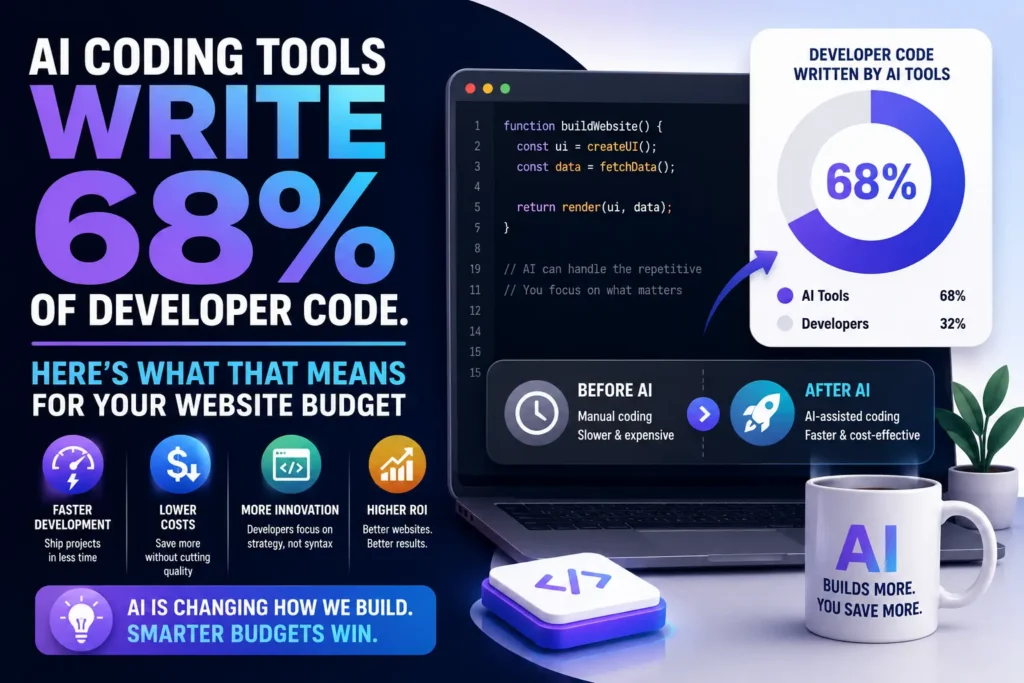
People Also Ask: What percentage of code do AI tools write in 2026? Short Answer: In 2026, AI tools generate an average of 41% of all code written by developers who use them, according to Index.dev research. GitHub Copilot generates an average of 46% of code for active users, with Java developers reaching 61%. In AI-native development teams using agentic tools daily, the proportion is significantly higher – with some environments reaching 68% or above. 84% of developers now use AI coding tools regularly, and 51% of professional developers use them every day.
How Do AI Web Development Tools Work – and Why Does Agentic AI Matter?#
AI web development tools in 2026 operate across a spectrum from assistive to autonomous – and understanding where each tool sits on that spectrum changes how you evaluate the impact on development costs and timelines.
Inline autocomplete tools (GitHub Copilot in IDE mode) suggest the next line or block of code as a developer types, similar to a highly sophisticated autocomplete. The developer accepts, rejects, or edits the suggestion. These tools save 30–60% of time on coding, testing, and documentation – with developers completing tasks 55% faster according to GitHub’s research across 4,800 developers.
Chat-based coding assistants (Claude in Claude.ai, ChatGPT) answer questions, explain code, debug issues, and generate functions or components on request. They operate in a conversational interface rather than embedded in the editor.
Agentic coding tools (Claude Code, Cursor) represent the most significant shift in 2026. These tools can plan and execute complex, multi-file tasks with minimal human intervention. Claude Code powered by Opus 4.6 achieved 80.8% on the SWE-bench Verified benchmark in Q1 2026 – the highest score posted by any individual developer tool. It successfully resolved issues requiring changes across 5+ files at a 23% higher rate than competitors. Claude Code reached 95% first-try correctness on standard development tasks.
The practical difference: where a Copilot user writes code with AI assistance, a Claude Code user instructs an AI to write, test, and verify a feature – then reviews the result. Pull request time decreased from 9.6 days to 2.4 days among Copilot users. DX data measured daily AI users merging 2.3 pull requests per week versus 1.4 for non-users – a 60% throughput advantage.
This is the shift that directly affects website development timelines and pricing.
People Also Ask: What is the difference between AI coding assistants and agentic AI development tools? Short Answer: AI coding assistants (like GitHub Copilot in autocomplete mode) suggest code as developers write, saving time on line-by-line tasks. Agentic AI development tools (like Claude Code and Cursor) can independently plan, write, test, and verify multi-file features with minimal human direction. Agentic tools represent a more fundamental productivity shift – Claude Code achieved 80.8% on SWE-bench Verified benchmark in Q1 2026, the highest score of any individual developer tool, and completed complex multi-file tasks at 23% higher rates than competing tools.
What Does This Mean for Your Website Development Budget in 2026?#
AI web development tools have created a disconnect between market pricing and development economics that many business owners are not yet aware of – and it affects how you should evaluate agency quotes and freelancer rates.
If the same developer who quoted ₹2,00,000 for your website 18 months ago is now using AI tools that complete tasks 55% faster, the logical question is: has their pricing adjusted accordingly? The answer varies enormously by vendor.
Here is the honest breakdown of what the AI development shift means for each type of website project:
Simple Marketing Websites (5–15 Pages)#
AI web development tools have dramatically reduced the legitimate cost of building a standard marketing website. A brochure site that took 40+ hours of developer time 24 months ago – HTML, CSS, responsive design, CMS integration – can now be completed in 15–20 hours with AI-assisted tooling, or built entirely through AI website builder platforms at a fraction of the cost.
AI website builders are often significantly cheaper upfront than custom website development. AI builders provide professional-quality results at predictable, mid-tier pricing that is comparable to most do-it-yourself website builders. For simple sites, a custom domain website with AI builder assistance starts at a few thousand rupees per year in running costs – dramatically lower than agency rates for equivalent output.
For simple websites and quick launches, AI builders are now a legitimate option for businesses with limited budgets where SEO complexity and custom functionality are not primary requirements.
Mid-Market Business Websites (E-Commerce, Lead Generation, Service Businesses)#
AI web development tools reduce build time significantly for mid-market projects – but the strategic and integration work that determines whether the website actually performs for your business is not something AI tools automate effectively.
74% of users judge a company’s credibility by its website design. That perception affects conversion, retention, and deal velocity. AI website builders that replicate templated structures from the same training data produce aesthetically similar websites that blur your brand into the digital wallpaper – one of the biggest problems with AI-generated websites is lack of uniqueness. As more businesses use the same AI systems, websites risk looking increasingly similar.
A developer using Claude Code or Cursor to build your e-commerce site should be completing it faster – which should be reflected in either a lower quote or a higher specification for the same budget. The strategic layer – UX decisions, conversion architecture, SEO structure, performance optimisation – still requires human expertise. The implementation of those decisions is now significantly faster.
For this tier, AI web development tools should mean: the same quality in less time, or higher quality in the same time. If your agency is charging identical rates with no improvement in either timeline or scope, the efficiency gains from their AI tooling are being absorbed entirely as margin.
Enterprise and Custom Application Development#
AI web development tools deliver productivity gains at the enterprise level while introducing new oversight requirements. 90% of Fortune 100 companies have deployed GitHub Copilot. The DORA 2025 report found 90% of software teams use AI at work daily at the enterprise level.
However, 48% of AI-generated code contains security vulnerabilities – a statistic that makes AI code review and security auditing a non-negotiable additional budget line for any project handling customer data, payment processing, or sensitive information. Independent research by METR in 2025 found experienced developers were 19% slower with AI tools despite perceiving themselves as faster – a finding that points to the hidden cost of reviewing and correcting AI output on complex, security-sensitive projects.
Code churn – code revised within two weeks of being written – rose from 3.1% in 2020 to 5.7% in 2024, correlating with increased AI adoption. For enterprise builds, the speed gain from AI tools needs to be balanced against the quality control investment that prevents technical debt accumulation.
People Also Ask: Are AI web development tools making websites cheaper to build in 2026? Short Answer: For simple websites, yes – significantly. AI website builders provide professional-quality results at predictable pricing comparable to DIY tools, making basic digital presence dramatically more affordable. For mid-market and enterprise projects, AI tools reduce development time by 30–55%, which should reduce costs or increase project scope for the same budget. However, the strategic layer – UX, conversion architecture, SEO structure, performance optimisation – still requires human expertise and is not meaningfully affected by AI coding productivity gains.
What Are the Risks of AI Web Development Tools That Affect Your Investment?#
AI web development tools create three specific risks that budget-conscious business owners need to account for – particularly if they are evaluating agency proposals or freelancer quotes without understanding the AI-assisted development landscape.
Security Vulnerabilities in AI-Generated Code#
48% of AI-generated code contains security vulnerabilities, which can create major risks in production systems. This does not mean AI-generated code is unsafe – it means AI-generated code requires the same rigorous security review as human-written code, and that this review represents a legitimate budget item.
When evaluating any website build proposal involving AI tools, ask explicitly: what is the code review and security testing process for AI-generated components? A developer using Claude Code or Copilot who is not conducting structured security reviews is creating technical debt that can become expensive liability.
Template Saturation and Brand Invisibility#
AI web development tools trained on the existing web corpus produce outputs that reflect patterns already present in that corpus. This is efficient for standard components but problematic for brand differentiation.
AI builders automate many traditionally time-consuming processes, but automation often sacrifices strategic depth and customisation flexibility. A website built entirely through AI generation may be technically functional and visually acceptable – but indistinguishable from thousands of similar businesses using the same tools. In competitive markets, where website credibility directly affects conversion and deal velocity, template saturation is a conversion problem, not just an aesthetic one.
Technical Debt Through Speed-Prioritised Development#
AI web development tools make it faster to write code – but not necessarily to write good code. Code churn rising from 3.1% to 5.7% since widespread AI adoption signals that faster initial development is being partially offset by more frequent revisions. Maintenance and ongoing updates cost $0–$2,000 per year for simple sites and scale significantly for complex builds – and poorly structured AI-generated code increases maintenance costs over the site’s lifetime.
How Should You Evaluate a Website Quote in the Age of AI Web Development Tools?#
AI web development tools have changed what questions you should be asking when receiving any website development proposal. According to Search Savvy’s insights from advising clients on digital investment decisions, most businesses are not yet asking the right questions in 2026.
The questions your brief and proposal process should now include:
What AI tools does your development process use? This is not a trick question – it is a productivity and quality question. A developer using Claude Code and completing builds 55% faster should either be charging less or delivering more. If neither is true, ask for clarification.
What is your code review process for AI-generated components? Specifically: how are security vulnerabilities in AI-generated code identified and addressed before launch? What testing framework is applied? This is particularly important for e-commerce sites, membership platforms, or any site handling user data.
How does your design process prevent template saturation? Where does the unique creative direction of this project come from – human design decisions, or AI-generated suggestions? Custom UX, original design systems, and brand-specific interface decisions are where human expertise still commands a genuine premium.
What does the performance optimisation process include? AI tools reduce build time but do not automatically produce optimised output. Core Web Vitals performance – LCP, INP, and CLS – require specific optimisation decisions that are not a default output of AI code generation. Ensure this is explicitly included in any proposal.
At Search Savvy, we recommend treating website development in 2026 as a two-layer investment: the build layer (where AI tools have legitimately reduced costs and should be reflected in pricing) and the strategy layer (where human expertise in SEO architecture, UX conversion design, and performance optimisation remains the primary value driver).
People Also Ask: Should I choose an AI website builder or custom development in 2026? Short Answer: AI website builders win on speed and price for simple sites with standard requirements. Custom development wins on revenue impact, scalability, integration depth, and control for businesses where the website is a primary conversion and acquisition tool. A cheaper launch does not always create stronger long-term growth. Custom sites raise conversion, support complex flows, and avoid rebuilds as needs grow. For businesses in competitive markets where organic search and conversion rate are primary growth levers, the strategic investment in custom development typically delivers higher ROI than AI builder savings.
Which AI Web Development Tools Are Most Widely Used in 2026?#
AI web development tools vary significantly in capability, pricing, and appropriate use case. Here is the current landscape:
GitHub Copilot – Market leader with 20 million users and $10/month entry pricing. 46% average code generation rate. Best for teams already embedded in the GitHub ecosystem. 90% of Fortune 100 companies have deployed it.
Claude Code – Fastest-growing agentic coding tool in 2026. 80.8% on SWE-bench Verified, highest individual developer tool score in Q1 2026. 75% adoption rate at small companies. Highest satisfaction score (91% CSAT) of any AI coding tool surveyed in JetBrains’ January 2026 survey. Best for complex, multi-file tasks and agentic workflows.
Cursor – $2 billion ARR by February 2026. AI-native IDE with strong multi-model support. 18% work adoption globally. Best for teams wanting a full AI-native development environment rather than a plugin.
Vercel v0 and Lovable – AI web application builders that generate working front-end code from text prompts. Best for rapid prototyping and MVP builds rather than production-quality, performance-optimised websites.
According to Search Savvy’s insights from monitoring client development projects, the teams delivering the best combination of speed and quality are using agentic tools (Claude Code or Cursor) for complex feature development while maintaining human oversight for architecture decisions, security review, and performance optimisation. The tool is not the strategy. The strategy determines the outcome.
People Also Ask: What is the best AI tool for building a website in 2026? Short Answer: For small business websites with limited budgets and simple requirements, AI website builders (Wix AI, Squarespace AI, Lovable) provide the fastest and most affordable path. For businesses where SEO, conversion rate, and custom functionality are primary requirements, professional development using agentic AI tools (Claude Code, Cursor) delivers the best combination of speed and quality. GitHub Copilot at $10/month remains the most widely adopted tool globally, generating 46% of code for active users across 20 million developers.
FAQ: AI Web Development Tools and Your Website Budget#
Q1: If AI tools write code faster, why aren’t development costs falling proportionally? The productivity gains from AI web development tools are real – 55% faster task completion, 30–60% time savings on coding and testing – but they are distributed unevenly across a development project. The code-writing portion of a website build is typically 40–60% of total project hours. The remaining time covers discovery, UX design, client communication, testing, deployment, and revision cycles – none of which are significantly accelerated by AI coding tools. Additionally, many agencies are absorbing AI efficiency gains as improved margin rather than passing them to clients. In a competitive market, this creates an opportunity to negotiate scope improvements for the same budget rather than a proportional price reduction.
Q2: Is it safe to use AI-generated code for a website that handles customer data or payments? Only with appropriate security review. 48% of AI-generated code contains security vulnerabilities that can create major risks in production systems. Any website processing payment information, storing user accounts, or handling personally identifiable information requires systematic security testing regardless of how the code was written – but AI-generated code has a documented higher vulnerability rate that makes this review more critical, not less. Ensure any agency or developer building a data-handling website has an explicit security review process for AI-generated components, and budget for security testing as a non-negotiable line item.
Q3: How much should a professionally built website cost in India in 2026? With AI web development tools reducing build time by 30–55%, professional website development costs have decreased for straightforward builds. A simple 10–15 page marketing website in India: ₹30,000–₹75,000 (down from ₹50,000–₹1,20,000 two years ago for equivalent quality). A mid-market e-commerce or lead generation website: ₹80,000–₹3,00,000 depending on functionality and integration complexity. Custom web application development: ₹2,00,000–₹15,00,000+, with complexity and security requirements being the primary cost drivers. Maintenance and updates: ₹10,000–₹50,000 per year depending on the platform and update frequency required.
Q4: What should I prioritise when briefing an agency or freelancer in 2026? Prioritise three things that AI tools do not automate: SEO architecture (how your site structure, URL hierarchy, and internal linking support rankings), conversion design (how your UX guides visitors toward the outcome your business needs), and performance optimisation (how your site achieves Core Web Vitals scores that support rankings and user experience). These strategic layers are where human expertise determines business outcomes. The code implementation of those strategies is faster and cheaper with AI tools – but the strategic decisions themselves require experienced human judgment.
Q5: Can I use AI website builders for SEO without custom development? For basic, local, or low-competition SEO, yes. AI builders now include built-in SEO basics – mobile responsiveness, SSL, sitemap generation, and metadata fields. However, advanced SEO requirements – custom schema markup implementation, sophisticated internal linking architecture, URL structure control, robots.txt editing, Core Web Vitals optimisation – are where most AI builders hit structural limitations. For businesses where organic search is a primary customer acquisition channel, these limitations typically justify the investment in a platform (WordPress, Webflow, or custom development) that provides full technical SEO control.
Q6: How do I know if my current developer or agency is using AI tools responsibly? Ask directly and specifically. A developer using AI web development tools responsibly will be transparent about which tools they use, able to explain their code review process for AI-generated components, and able to articulate how they validate security and performance before delivery. Red flags: dramatically lower quotes with no explanation, unwillingness to discuss their development process, or inability to explain specific code decisions. The use of AI tools is not itself a red flag – 84% of developers use them. The absence of human oversight over AI-generated output is.
Budgeting for a website rebuild or new digital project in 2026? Visit Search Savvy for an honest, data-backed briefing on what AI web development tools mean for your specific project – and what to ask any agency before signing.